Why Morgan Stanley sees tokenized securities as a ‘natural path’ from H2 2026

ambcryptoОпубліковано о 2026-03-25Востаннє оновлено о 2026-03-25

Анотація

Morgan Stanley plans to support tokenized securities trading in its Trajectory Cross dark pool starting H2 2026, viewing it as a natural evolution from its existing infrastructure for traditional equities, ETFs, and ADRs. The move is part of a broader institutional push into tokenization, with major exchanges like NYSE and Nasdaq also developing similar capabilities. Tokenized assets have demonstrated significant growth, surging 245% year-over-year, highlighting rapid adoption. As one of the largest wealth managers overseeing $8.2 trillion in assets, Morgan Stanley has been expanding its crypto offerings, including allowing advisors to recommend spot BTC and ETH ETFs to all clients. The bank has also applied for its own spot Bitcoin ETF, further cementing its commitment to digital assets.

The institutional race for tokenized securities is heating up. Traditional stock exchanges such as the New York Stock Exchange (NYSE) and Nasdaq are partnering with tech firms to build systems for tokenized securities.

Investment banks are also gearing up for the same. According to Morgan Stanley’s head of crypto, Amy Oldenburg, the global wealth management and investment bank will roll out support for tokenized securities in H2 2026.

On the sidelines of Blockworks’ Digital Asset Summit, Oldenburg said,

One of the things we’re planning for the second half of 2026 is turning our Trajectory Cross, our dark pool, to support tokenized securities later this year.

She added,

It already supports traditional equities, ETFs, and ADRs. So, it’s a natural path forward to open our infrastructure to support tokenized equities going forward.

Unpacking Morgan Stanley’s crypto and tokenization bet

Morgan Stanley is among the big four wirehouses, alongside Merrill Lynch (Bank of America), UBS, and Wells Fargo, that allow their wealthy clients to invest in crypto. Together, these firms oversee about $15–17 trillion in client assets, with Morgan Stanley leading at $8.2 trillion.

As a result, they were viewed as the key drivers of the ‘second-wave’ of Bitcoin ETF adoption. Interestingly, this roadmap is already playing out.

In late 2025, Morgan Stanley became the first wirehouse to allow advisors to actively pitch spot BTC and ETH ETFs to all wealth management clients, including those handling retirement accounts. This was an expansion of its earlier restricted crypto ETF access, which was limited to wealthy individuals in August 2024.

Still, spot crypto access was included in Morgan Stanley’s E·TRADE platform for trading stocks, bonds, ETFs, and more. Through its asset management unit, the wirehouse has applied for an in-house spot BTC ETF, and market watchers believe it could flip the demand from BlackRock’s IBIT. Now, it’s betting on the next hottest market narrative: tokenization.

As mentioned earlier, both Nasdaq and NYSE are setting the ground for tokenized securities trading. For tradFi players, tokenization improves operational efficiency and enables an expanded global market that trades 24/7.

The segment has already exploded to $1 billion in total value, with 45% growth in monthly transfer volume to $2.5 billion, underscoring the massive adoption in the sub-sector. In fact, in March, AI and tokenized assets were the top-performing sectors and most of the segments that saw significant adoption.
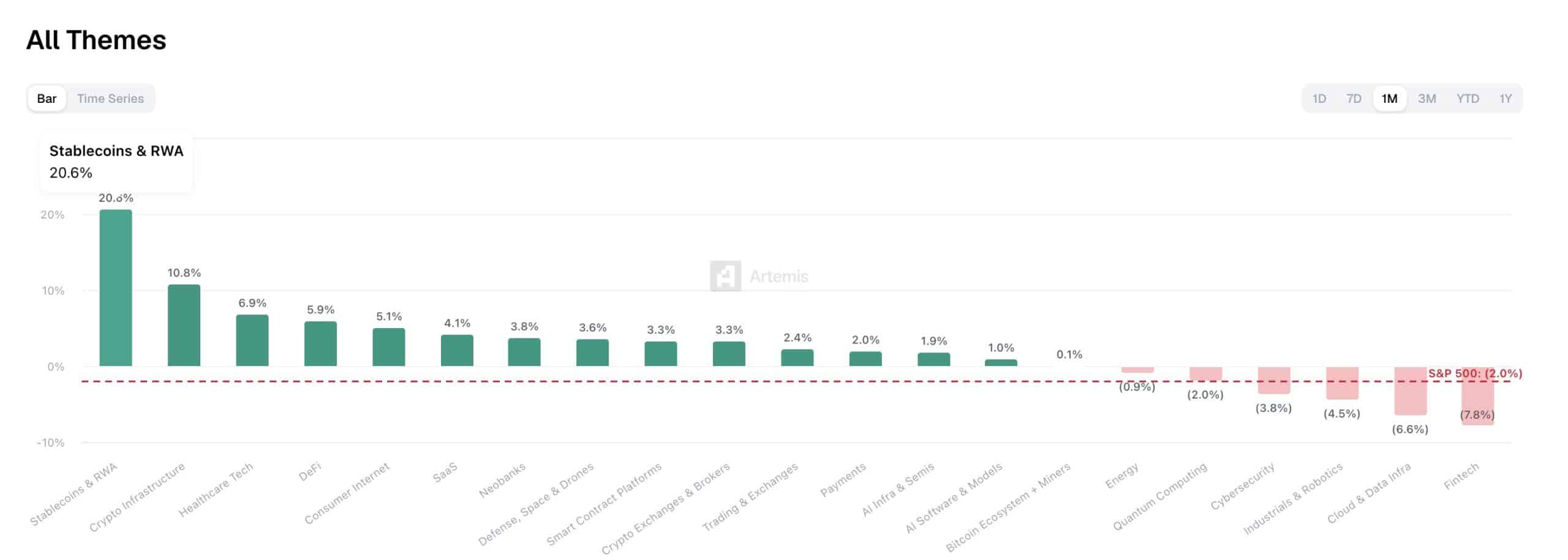
Source: Artemis

Highlighting the growing traction, Grayscale noted,

Growth in tokenization activity has remained robust. Tokenized assets reached new highs, up 245% year over year. Stablecoins grew 35%.


Final Summary

  • Morgan Stanley is now betting on tokenized securities, with likely trading support expected later this year.
  • Tokenized assets have seen one of the highest growth rates in the crypto market, with adoption rising 245% YoY.


Пов'язані питання

QWhen does Morgan Stanley plan to roll out support for tokenized securities, and through which platform?

AMorgan Stanley plans to roll out support for tokenized securities in the second half of 2026 through its Trajectory Cross dark pool.

QWhat traditional assets does Morgan Stanley's Trajectory Cross currently support?

AIt currently supports traditional equities, ETFs, and ADRs.

QWhy is Morgan Stanley's move into tokenized securities considered a 'natural path'?

AIt is considered a 'natural path' because the bank is opening its existing infrastructure, which already handles traditional securities, to support tokenized equities.

QWhat was the year-over-year growth rate for tokenized assets as highlighted by Grayscale?

ATokenized assets grew by 245% year over year.

QWhich other major traditional stock exchanges are also building systems for tokenized securities?

AThe New York Stock Exchange (NYSE) and Nasdaq are also partnering with tech firms to build systems for tokenized securities.

Пов'язані матеріали

Uncovering the Truth About Agent Commerce, Payments, and Infrastructure

Decoding Agent Commerce, Payments, and Infrastructure: The Reality Over the past year, I've been building infrastructure for the Agent economy, engaging with major players like Stripe, Visa, Coinbase, Google, and dozens of startups. A clear conclusion emerges: true, large-scale demand does not yet exist. Startups face structural challenges. Data points illustrate this gap. Stripe's Agent commerce platform has over 1,000 merchants but only single-digit transacting agents. Visa's Agent payment token requires 9-month KYC and a $250M revenue threshold, accessible only to giants like Amazon. On-chain analysis reveals actual daily Agent transaction volume is around $17k, half of which are test transactions. The article analyzes four potential markets: **1. Agent-to-Merchant (A2M):** Current AI shopping UX is often inferior to traditional e-commerce for visual, comparison-heavy purchases (clothing, electronics). Chat interfaces are a step back. Real merchant interest is defensive "Agent Engine Optimization," fearing future obsolescence, not current demand. Potential exists in high-frequency, low-decision purchases (e.g., food delivery) or simplifying terrible UX (complex checkouts, non-native shoppers), but these require massive consumer distribution channels dominated by giants like DoorDash and Amazon. **2. Agent-to-API (A2A):** Developers already have subscriptions and billing for core APIs (compute, data). The argument for micro-payments via crypto for sub-dollar API calls is addressed by pre-paid balances today. The deeper issue is supplier resistance; major SaaS firms rely on enterprise contracts, not fractional cent pricing. Opportunity lies in the long tail of niche services, but this is a smaller market catering to developers, a historically low-paying group. **3. Agent-to-Agent (A2A):** This remains a theoretical long-term vision with near-zero current transaction volume. It involves unique challenges: discovery, trust, negotiation, dispute resolution. When it materializes, it will require a fundamentally new settlement infrastructure for high-speed, variable-value, multi-party transactions. It's a real long-term bet, but not the current market. **4. Agent-to-Finance (A2F):** This is the only category with existing, paying demand. Integrating AI into financial workflows (trading, portfolio management) is a natural evolution and enables new capabilities like autonomous rebalancing. However, competition favors incumbents with regulatory licenses, compliance infrastructure, and existing client relationships. **The Real Issue:** Why is infrastructure still being built? Incumbents can afford long-term bets, and payment companies see every problem as a nail for their payment hammer. However, payment is just one piece. The core challenge is *coordination*—orchestrating work between Agents and humans, verifying outcomes, and settling results. Payment is part of settlement, which is part of coordination. Companies that solve the coordination problem will subsume payments, not the other way around. Startups lack the infinite runway of giants and must find today's real market, which, after a year of exploration, lies outside these four categories—in an area with real, growing, and underserved activity.

marsbit5 год тому

Uncovering the Truth About Agent Commerce, Payments, and Infrastructure

marsbit5 год тому

Торгівля

Спот
Ф'ючерси

Популярні статті

Як купити STO

Ласкаво просимо до HTX.com! Ми зробили покупку StakeStone (STO) простою та зручною. Дотримуйтесь нашої покрокової інструкції, щоб розпочати свою криптовалютну подорож.Крок 1: Створіть обліковий запис на HTXВикористовуйте свою електронну пошту або номер телефону, щоб зареєструвати обліковий запис на HTX безплатно. Пройдіть безпроблемну реєстрацію й отримайте доступ до всіх функцій.ЗареєструватисьКрок 2: Перейдіть до розділу Купити крипту і виберіть спосіб оплатиКредитна/дебетова картка: використовуйте вашу картку Visa або Mastercard, щоб миттєво купити StakeStone (STO).Баланс: використовуйте кошти з балансу вашого рахунку HTX для безперешкодної торгівлі.Треті особи: ми додали популярні способи оплати, такі як Google Pay та Apple Pay, щоб підвищити зручність.P2P: Торгуйте безпосередньо з іншими користувачами на HTX.Позабіржова торгівля (OTC): ми пропонуємо індивідуальні послуги та конкурентні обмінні курси для трейдерів.Крок 3: Зберігайте свої StakeStone (STO)Після придбання StakeStone (STO) збережіть його у своєму обліковому записі на HTX. Крім того, ви можете відправити його в інше місце за допомогою блокчейн-переказу або використовувати його для торгівлі іншими криптовалютами.Крок 4: Торгівля StakeStone (STO)Легко торгуйте StakeStone (STO) на спотовому ринку HTX. Просто увійдіть до свого облікового запису, виберіть торгову пару, укладайте угоди та спостерігайте за ними в режимі реального часу. Ми пропонуємо зручний досвід як для початківців, так і для досвідчених трейдерів.

290 переглядів усьогоОпубліковано 2025.04.03Оновлено 2026.06.02

Як купити STO

Обговорення

Ласкаво просимо до спільноти HTX. Тут ви можете бути в курсі останніх подій розвитку платформи та отримати доступ до професійної ринкової інформації. Нижче представлені думки користувачів щодо ціни STO (STO).

活动图片