Why LAB crypto’s 34% crash has traders watching THIS support

ambcryptoОпубліковано о 2026-07-02Востаннє оновлено о 2026-07-02

Анотація

LAB crypto experienced a sharp 34% crash to $9.00, driven by the unwinding of excessive leverage and concerns over upcoming token unlocks and concentrated ownership. Despite a 121% surge in daily trading volume to $58.71 million, market activity was dominated by position closures, with Open Interest falling 23% to $130.39 million, indicating a broad reduction in speculative exposure without significant new buying. The price is now testing a crucial support level at $7.65, with the MACD indicating strong bearish momentum. A breakdown below this support could target the next major level near $4.00. Persistent negative funding rates confirm that short sellers remain in control of the derivatives market, sustaining the bearish pressure. The token's near-term outlook hinges on whether buyers can successfully defend the $7.65 support zone.

LAB recorded one of its sharpest daily declines after excessive leverage unwound and tokenomics concerns weighed heavily on sentiment. At the time of writing, the token traded at $9.00, down 34% over the past 24 hours, while its market capitalization declined to $3.88 billion.

Despite the sell-off, trading activity accelerated as daily volume climbed 121% to approximately $58.71 million, showing that market participation increased during the decline. Reports highlighting upcoming token unlocks and concerns over concentrated token ownership added further pressure, prompting participants to reassess LAB’s valuation.

As a result, leveraged positions closed rapidly, while heightened uncertainty encouraged additional selling across both spot and derivatives markets.

Leverage rapidly disappeared from LAB’s market

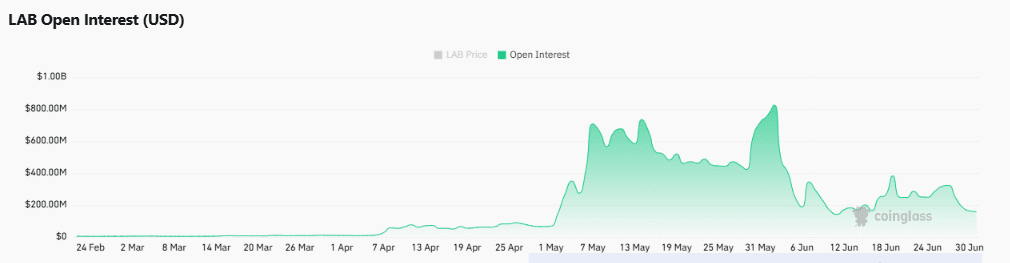
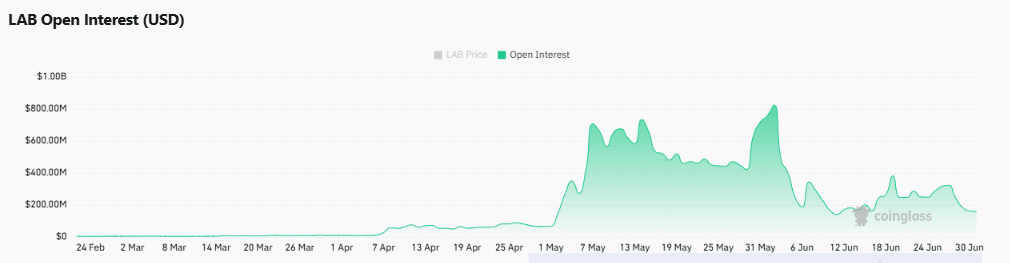
During the decline, derivatives activity reflected a broad reduction in speculative exposure rather than fresh risk-taking.

At press time, Open Interest (OI) fell 23.01% to $130.39 million, indicating that traders closed positions instead of adding new leverage during the decline. The contraction suggests that long positions absorbed most of the selling pressure as the market reacted to deteriorating sentiment.

Trading volume remained elevated despite the decline in OI, reinforcing the view that position unwinding dominated market activity. However, the absence of rising OI alongside heavy volume showed that new buyers had not stepped in aggressively.

Instead, capital exited leveraged positions while participants reduced exposure amid growing uncertainty surrounding LAB’s near-term outlook.
Source: CoinGlass

Can LAB defend its final support zone?

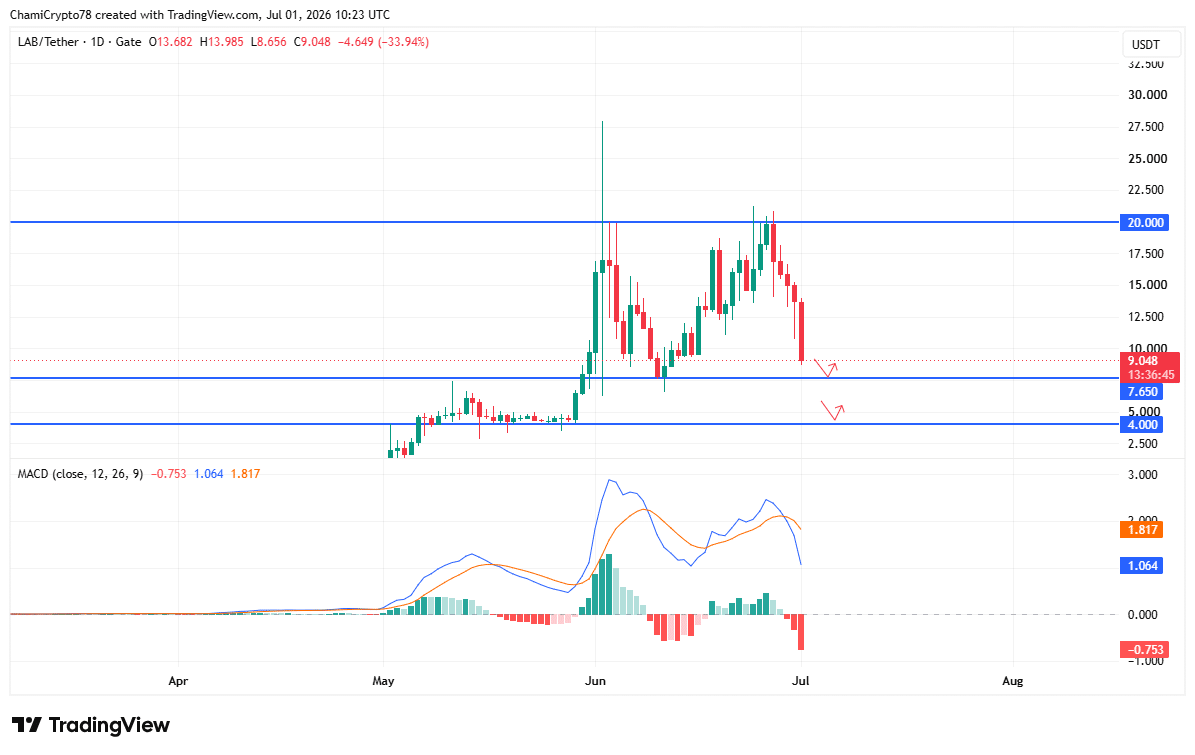
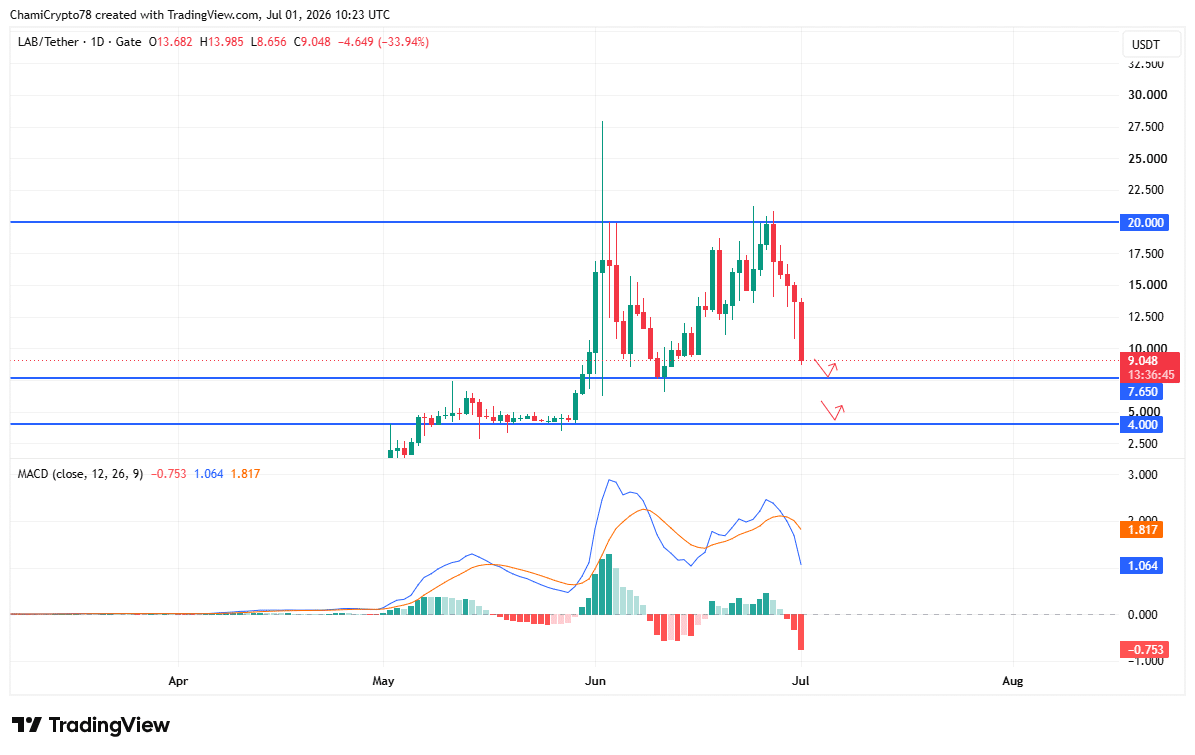
LAB approached the $7.65 support after a sharp rejection from the $20 resistance area, leaving sellers firmly in control of the broader trend.

Price closed near $9.04, placing the token only a short distance above this key demand level. At the time of writing, the MACD remained bearish as the MACD line stayed below the signal line.

The histogram continued expanding deeper into negative territory, confirming that downside pressure had strengthened throughout the latest decline. A decisive loss of $7.65 would expose the next major support near $4.00, where buyers previously emerged.

However, if buyers defend the current zone successfully, LAB could attempt a relief rebound toward $7.65 before challenging higher resistance levels, although confirmation would still require improving technical strength.
Source: TradingView

Why are short sellers still in control?

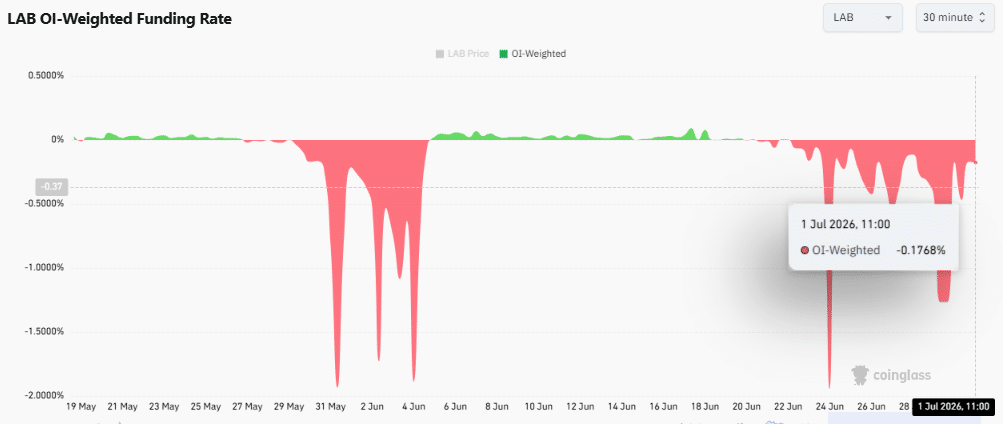
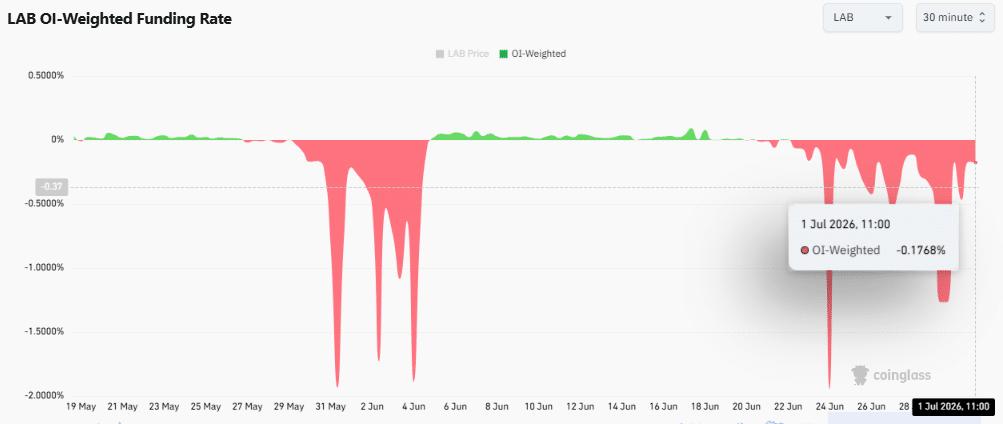
Funding data continued supporting the bearish derivatives outlook as the OI-Weighted Funding Rate remained below zero throughout the recent decline. The latest reading stood at approximately -0.1768%, showing that short sellers continued paying to maintain their positions.

Persistent negative funding reflected sustained bearish conviction despite the sharp correction. Unlike temporary funding dips, this trend extended across several sessions and aligned with the decline in OI, reinforcing the broader risk-off environment.

Although funding had not reached the extreme levels seen earlier in June, it still indicated that bearish positioning dominated the derivatives market. Until funding recovers toward positive territory, sellers would likely retain the upper hand.
Source: CoinGlass

If buyers defend the $7.65 support, the token could stabilize and attempt a recovery.

However, a confirmed breakdown below that level would likely shift attention toward the $4.00 support as bearish pressure remained dominant.


Final Summary

  • LAB trading volume surged while leverage rapidly exited, highlighting aggressive risk reduction across derivatives.
  • Bearish funding and weakening technical structure kept sellers firmly in control near critical support.


Трендові криптовалюти

Пов'язані питання

QWhat were the main reasons for LAB crypto's 34% price crash mentioned in the article?

AThe main reasons were the unwinding of excessive leverage and concerns over tokenomics, specifically upcoming token unlocks and concentrated token ownership, which weighed heavily on sentiment.

QAccording to the article, what key support level is LAB approaching after its decline?

ALAB is approaching the $7.65 support level after a sharp rejection from the $20 resistance area.

QWhat does the decline in Open Interest (OI) for LAB derivatives indicate about trader behavior?

AThe 23.01% decline in Open Interest indicates that traders were closing existing leveraged positions rather than adding new leverage, showing a broad reduction in speculative exposure and risk-taking during the decline.

QWhat does the persistently negative OI-Weighted Funding Rate suggest about market sentiment?

AThe persistently negative OI-Weighted Funding Rate suggests sustained bearish conviction, with short sellers paying to maintain their positions. It indicates that sellers retain the upper hand and bearish positioning dominates the derivatives market.

QWhat are the potential price targets mentioned if LAB loses the $7.65 support level?

AIf LAB decisively loses the $7.65 support level, it would expose the next major support near $4.00.

Пов'язані матеріали

Robinhood Chain Mainnet Goes Live: Can Stocks Finally Be Moved Into Wallets?

Robinhood has officially launched its public mainnet, Robinhood Chain, along with stock-like tokens, the USDG yield product, and a DeFi lending portal. This marks a significant shift where a major online broker is integrating its user interface, regulatory compliance, self-custody wallet, and on-chain protocols into a single, streamlined experience. The goal is to simplify access to stock exposure, stablecoin yields, collateralized lending, and AMM trading for mainstream users. Eligible non-U.S. users can hold these "Stock Tokens"—structured as tokenized debt securities—in the Robinhood Wallet for 24/7 exposure to assets like U.S. stocks or ETFs. U.S. users can access an estimated ~7% APY on dollar-backed USDG through the Robinhood Earn program via self-custody wallets, with lending infrastructure powered by Morpho protocol. Built as a Layer 2 on Arbitrum, Robinhood Chain leverages existing DeFi protocols like Uniswap. The core strategy is not to reinvent DeFi but to channel Robinhood's large traditional finance user base (27.4 million funded customers as of Q1 2026) into on-chain finance, lowering the technical barriers. However, key limitations exist. The stock tokens are not direct equity ownership and are unavailable in the U.S. and some jurisdictions due to regulatory constraints. The ~7% yield is variable and carries inherent DeFi risks, not guaranteed principal protection. Furthermore, while AMMs enable trading, price discovery for major stocks will likely remain anchored in traditional markets like NASDAQ for the foreseeable future. Ultimately, Robinhood Chain is an early experiment in "on-chain brokerage." Its success will depend on real-world metrics like trading volume, sustained user migration to self-custody, stable yield performance, and regulatory feedback, rather than its launch narrative.

marsbit9 хв тому

Robinhood Chain Mainnet Goes Live: Can Stocks Finally Be Moved Into Wallets?

marsbit9 хв тому

Circle CEO Responds to OUSD Challenge: Stablecoin Market Is 'Winner-Takes-All', Consortium Model Doomed to Fail

Circle CEO Jeremy Allaire addresses market concerns following the announcement of the Open USD (OUSD) stablecoin project backed by 140 global companies. Allaire argues the stablecoin market exhibits "winner-takes-all" dynamics due to powerful network effects. He cites USDC's near-decade lead in three key areas: 1) **Application Integration & Protocol Development**: Thousands of integrated services and protocols (like CCTP) create utility and lock-in for developers and users. 2) **Liquidity Network Effects**: A deeply embedded, globally distributed liquidity infrastructure across primary and secondary markets, built over years. 3) **Regulatory Integration**: Extensive licensing and compliance groundwork ensuring USDC's acceptance in major markets like Europe and Japan. Allaire challenges OUSD's proposed advantages. He contends that promises of free redemption, while appealing, face market realities where such models can become exit routes for other stablecoins. He also questions the feasibility of fully distributing all revenue to an alliance, stating it would "starve" the critical infrastructure investments needed for scale and utility. Furthermore, he expresses skepticism about large alliance governance models, noting they often lead to slow decision-making and misaligned incentives. While welcoming OUSD to the ecosystem, Allaire reaffirms confidence in USDC's dominant position, backed by its long-term infrastructure investments and strong partnerships, including its ongoing collaboration with Coinbase.

marsbit11 хв тому

Circle CEO Responds to OUSD Challenge: Stablecoin Market Is 'Winner-Takes-All', Consortium Model Doomed to Fail

marsbit11 хв тому

Circle CEO Responds to OUSD Challenge: Alliance Model Doomed to Fail, It's a 'Winner-Takes-All' Game

Circle CEO Jeremy Allaire addresses the challenge posed by the new Open USD (OUSD) stablecoin project, backed by 140 global companies. He argues that the stablecoin market exhibits "winner-take-all" characteristics, where USDC's near-decade-long lead in application integrations, global liquidity, and regulatory compliance secures its dominant position. Allaire outlines three key network effects underpinning USDC's strength: 1) Extensive integration as an internet protocol layer, 2) Deep, globally distributed liquidity networks, and 3) Deep integration with global policy and regulatory frameworks. He cites data showing USDC facilitated 80% of on-chain USD stablecoin transaction volume in Q1 2026. He directly counters OUSD's proposed advantages: 1) "Free minting and redemption" may not be sustainable against market realities, which USDC addresses via contractual mechanisms. 2) "Sharing all revenue" risks starving the infrastructure of necessary investment for growth and reliability. 3) A "consortium model" often leads to slow innovation and poor coordination compared to focused, independent operators like Circle. Allaire reaffirms Circle's strong partnership with Coinbase and notes that Circle continues to collaborate with many OUSD founding members. He concludes by welcoming OUSD to the ecosystem while expressing confidence in USDC's entrenched network advantages and continued expansion.

Odaily星球日报14 хв тому

Circle CEO Responds to OUSD Challenge: Alliance Model Doomed to Fail, It's a 'Winner-Takes-All' Game

Odaily星球日报14 хв тому

dYdX Changes Tack and Starts Anew, This Time Partnering with Robinhood: Will It Succeed?

On July 1st, dYdX Labs, in partnership with Robinhood Crypto, launched the Beta version of Arcus, a new decentralized exchange (DEX). Deployed on the newly launched Robinhood Chain (an L2 built on Arbitrum), Arcus supports spot trading for 95 tokenized stocks and plans to introduce cross-asset perpetual contracts. This marks a separate, new product line for the dYdX team, distinct from the existing dYdX Chain. Arcus's core features promise 24/7 trading, self-custody, and institutional-grade liquidity. Initial offerings include zero-fee web-based spot trading and a perpetual contracts testnet. Future plans involve using tokenized stocks as collateral and providing access to Pre-IPO investments. The platform is not available to users in the US, Canada, the UK, and other restricted jurisdictions. This move follows dYdX's v4 upgrade, which, while achieving full decentralization, faced criticism over performance and tokenomics, leading to a loss of market share. Arcus represents a strategic pivot, leveraging Robinhood's vast user base to target the RWA (Real World Assets) sector and global 24/7 trading. The dYdX Foundation clarified that Arcus is a parallel product incubated by dYdX Labs, and the original dYdX Chain continues to operate independently. While no official token plans have been announced, market participants speculate about potential new tokens or airdrops from the Arcus project.

Foresight News21 хв тому

dYdX Changes Tack and Starts Anew, This Time Partnering with Robinhood: Will It Succeed?

Foresight News21 хв тому

Торгівля

Спот

Популярні статті

Як купити ONE

Ласкаво просимо до HTX.com! Ми зробили покупку Harmony (ONE) простою та зручною. Дотримуйтесь нашої покрокової інструкції, щоб розпочати свою криптовалютну подорож.Крок 1: Створіть обліковий запис на HTXВикористовуйте свою електронну пошту або номер телефону, щоб зареєструвати обліковий запис на HTX безплатно. Пройдіть безпроблемну реєстрацію й отримайте доступ до всіх функцій.ЗареєструватисьКрок 2: Перейдіть до розділу Купити крипту і виберіть спосіб оплатиКредитна/дебетова картка: використовуйте вашу картку Visa або Mastercard, щоб миттєво купити Harmony (ONE).Баланс: використовуйте кошти з балансу вашого рахунку HTX для безперешкодної торгівлі.Треті особи: ми додали популярні способи оплати, такі як Google Pay та Apple Pay, щоб підвищити зручність.P2P: Торгуйте безпосередньо з іншими користувачами на HTX.Позабіржова торгівля (OTC): ми пропонуємо індивідуальні послуги та конкурентні обмінні курси для трейдерів.Крок 3: Зберігайте свої Harmony (ONE)Після придбання Harmony (ONE) збережіть його у своєму обліковому записі на HTX. Крім того, ви можете відправити його в інше місце за допомогою блокчейн-переказу або використовувати його для торгівлі іншими криптовалютами.Крок 4: Торгівля Harmony (ONE)Легко торгуйте Harmony (ONE) на спотовому ринку HTX. Просто увійдіть до свого облікового запису, виберіть торгову пару, укладайте угоди та спостерігайте за ними в режимі реального часу. Ми пропонуємо зручний досвід як для початківців, так і для досвідчених трейдерів.

372 переглядів усьогоОпубліковано 2024.12.12Оновлено 2026.06.02

Як купити ONE

Обговорення

Ласкаво просимо до спільноти HTX. Тут ви можете бути в курсі останніх подій розвитку платформи та отримати доступ до професійної ринкової інформації. Нижче представлені думки користувачів щодо ціни ONE (ONE).

活动图片