Why is HYPE Still Surging? Has It Topped Out?

marsbitОпубліковано о 2026-05-20Востаннє оновлено о 2026-05-20

Анотація

The article analyzes the reasons behind the continued surge of the HYPE token, despite the current market conditions. The primary drivers identified are: 1. **ETF Inflows and a New Buyback Mechanism:** The launch of two ETFs (THYP by 21Shares and BHYP by Bitwise) has opened a channel for traditional capital. Crucially, Bitwise announced it will allocate 10% of BHYP's management fee income to acquire and stake HYPE, creating a potential source of recurring buy pressure linked to the ETF's growth. 2. **USDC Integration and New Revenue Stream:** The return of USDC to Hyperliquid, facilitated by Coinbase and Circle, is significant. It establishes a protocol revenue-sharing model from USDC reserve yields. Community estimates suggest this could generate substantial daily income (approx. $440k), which could be used for HYPE buybacks, decoupling token demand from just trading fees and linking it to the platform's stablecoin deposits. 3. **Expansion into New Markets:** Hyperliquid is broadening beyond being just a Perp DEX. Its HIP-4 feature launches it into the prediction market space, already showing high volume. This requires HYPE staking for market creation, directly increasing token utility and staking demand. Furthermore, the platform's Real-World Asset (RWA) trading has seen Open Interest hit a new high of $2.6B, indicating growth in trading traditional assets like stocks and commodities. 4. **Regulatory Tailwinds for RWA:** Potential SEC exemptions for tokenized stock tr...

Author | Asher(@Asher_ 0210)

In the current crypto market, if there's still an altcoin that can excite the market, it's probably HYPE.

Market data shows that the exchange rates of HYPE against BTC and BNB continue to hit new all-time highs, with HYPE/BTC currently at 0.0006249 and HYPE/BNB at 0.075. This indicates that HYPE's strength is not merely following the market rebound but is consistently outperforming major crypto assets like BTC and BNB.
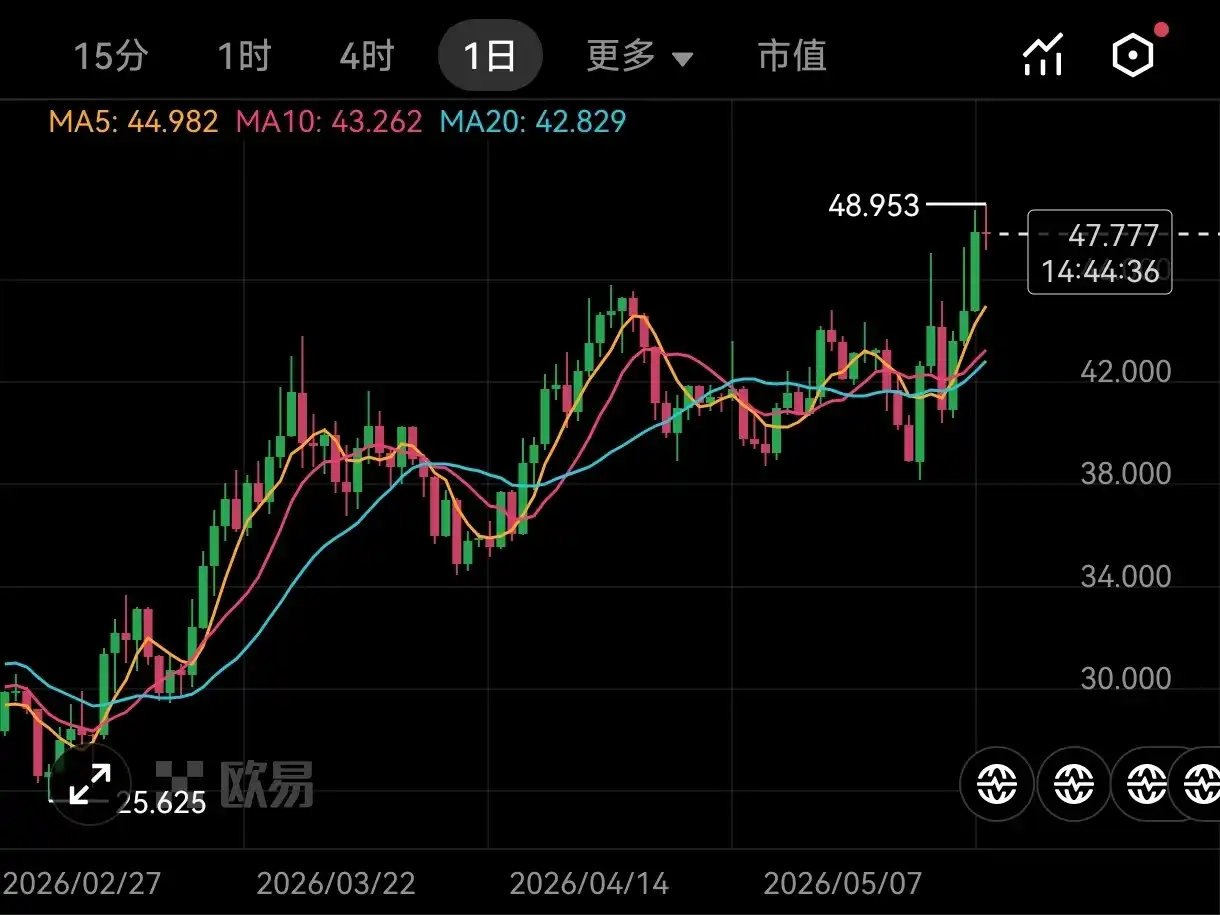
Previously, the outside world's understanding of Hyperliquid was largely confined to a high-performance Perp DEX. However, it's now evident that capital is not just buying the token of a decentralized trading platform; it's betting that Hyperliquid can integrate more asset types, more liquidity, and more trading scenarios into the same on-chain trading system.

HYPE's price performance also reflects the market's ongoing re-evaluation of Hyperliquid's value.

This article from Odaily Planet Daily will dissect its rising logic from several key changes.

From THYP to BHYP: Compliant Buying for HYPE is Opening Up

The first external catalyst for HYPE's recent surge is the opening of ETF channels.

Currently, two asset management firms have begun launching ETF products centered around Hyperliquid. On May 12th, 21Shares listed the Hyperliquid ETF under the ticker THYP; on May 15th, Bitwise listed the Hyperliquid ETF under the ticker BHYP. Data shows that as of May 18th EST, the total historical net inflows for 21Shares Hyperliquid ETF THYP reached $12.901 million; Bitwise Hyperliquid ETF BHYP reached $2.0446 million.

More crucially, Bitwise didn't stop at merely issuing an ETF. Yesterday, Bitwise announced it would allocate 10% of the management fee revenue from its BHYP Hyperliquid ETF to hold HYPE on its corporate balance sheet, with the related HYPE holdings also being staked.

This transforms the ETF narrative from a simple product listing to a potential source of continuous buying pressure. The larger the ETF size and the higher the management fee revenue, the greater the amount Bitwise could theoretically use to accumulate more HYPE. In the short term, this capital might not immediately sway prices; but in the long run, it links ETF growth, asset manager revenue, and HYPE holdings together.

In other words, ETFs are not just a one-time hype for HYPE but a new capital channel. HYPE is beginning to transition from a crypto-native asset to an on-chain trading platform token that traditional capital can also price.

USDC Returns to Hyperliquid, Adding Potential Daily Buy Pressure Exceeding $400k for HYPE

The second reason for HYPE's recent rise is that with USDC's return to Hyperliquid, the market has started to recalculate the protocol's future stable income and whether this income can continue to flow towards HYPE buybacks.

According to Hyperliquid's official announcement, Coinbase will act as the fund deployer, Circle will be responsible for CCTP and native cross-chain infrastructure deployment, and both parties have committed to staking HYPE to activate AQAv2. This means that the return of USDC is not just a simple stablecoin integration but a new mechanism established by Coinbase, Circle, and Hyperliquid around native USDC, cross-chain liquidity, and reserve yield distribution.

The key point is that Coinbase will subsequently share the majority of the USDC reserve yield with the Hyperliquid protocol. Although the specific revenue-sharing ratio has not been officially disclosed, if referencing the previous USDH yield distribution mechanism, Hyperliquid could potentially receive about 90% of the reserve yield. Therefore, the market also interprets AQAv2 as Hyperliquid establishing a protocol revenue-sharing mechanism for USDC reserve yields.

According to community estimates, based on a scale of $4.7 billion and an annualized yield of 3.8%, the USDC reserve yield corresponds to approximately $160 million in annualized revenue, translating to roughly $440,000 in potential daily HYPE buyback pressure. Once the AQAv2 interface is perfected and officially operational, Hyperliquid would no longer rely solely on trading fees to buy back HYPE but could gain an additional source of relatively stable cash flow.

This is where USDC's return truly impacts HYPE's pricing. Previously, the strength of HYPE buybacks depended mainly on trading volume: the more active the trading, the higher the protocol revenue and repurchase capability. However, with the addition of USDC reserve yields, the source of HYPE buying pressure is no longer solely dependent on trading fees but also begins to depend on how much stablecoin capital Hyperliquid can accumulate. In other words, trading fee buybacks represent platform trading activity, while USDC reserve yield buybacks represent the platform's capital accumulation capability. The market's re-pricing of HYPE might be precisely due to observing that HYPE's buyback story is no longer solely reliant on trading hype.

Hyperliquid Integrates HIP-4, Also Entering the Prediction Market Business

Beyond RWA, Hyperliquid is also reaching into one of the hottest crypto sectors this year – prediction markets.

On May 2nd, Hyperliquid launched HIP-4 Outcome Markets on its mainnet, initially introducing BTC intraday binary outcome contracts. Simply put, users can trade whether the BTC price will be above a specified price at a certain point in time. The contract price fluctuates between 0.001 and 0.999, corresponding to the market's pricing of the event's probability; it settles to 1 if the event occurs and 0 if it does not.

Predictefy data shows that on the first day of HIP-4's launch, the trading volume for BTC price-related event contracts reached $6.15 million, meaning Hyperliquid's volume in this niche market alone already far exceeded that of Kalshi, Polymarket, and other similar markets on prediction platforms.

For HYPE, the significance of HIP-4 is not just adding another product feature but connecting prediction markets to HYPE's staking, fee, and buyback mechanisms. According to the design, in the future, for permissionless deployment of prediction events, market creators will need to stake 1 million HYPE tokens, which is higher than the 500,000 HYPE required for deploying perpetual markets under HIP-3. Each staking slot can support rolling and periodic markets and can be reused after settlement; staked assets may also be slashed if issues like oracle manipulation, abnormal market states, or prolonged downtime occur.

Therefore, what HIP-4 brings to HYPE is not just a simple prediction market concept boost but a more direct value capture path. More permissionless deployment of prediction events means more demand for HYPE staking, more trading volume means more fee revenue, and this portion of fees will ultimately feed back into Hyperliquid's original buyback logic.

RWA Open Interest Hits New Highs, Hyperliquid's Ceiling is More Than Just a Perp DEX

Beyond ETF and USDC yield inflows, RWA is further expanding Hyperliquid's trading boundaries.

Data shows that the open interest for RWA trading on the Hyperliquid platform has risen to $2.6 billion, setting a new all-time high and doubling from two months ago. This data indicates that Hyperliquid is no longer just catering to crypto asset trading demand for BTC, ETH, SOL, etc.; real-world assets are also beginning to scale within its on-chain trading system.

This is crucial for HYPE's pricing. If Hyperliquid were merely a Perp DEX, its valuation anchor would primarily be the crypto cycle, trading volume, and fee revenue. But RWA opens up another dimension: stocks, commodities, precious metals, Pre-IPO assets, and more could all become subjects of 24/7 on-chain trading.

The significance of RWA for Hyperliquid isn't about adding a few more trading pairs; it's about pulling the platform out of the internal competition within the crypto market. Perp DEXes compete over who captures more crypto trading volume, but RWA competition is about who can migrate off-chain asset trading demand onto the chain. If Hyperliquid can continue to grow this part of the market, HYPE's pricing will no longer solely follow the crypto trading cycle but begin to tie into the larger demand for real asset trading.

US SEC Plans Tokenized Stock Exemption, Adding More Imagination to RWA Narrative

Potential regulatory easing by the US SEC regarding tokenized stocks is also raising Hyperliquid's long-term ceiling. According to reports, the US SEC is preparing to introduce an innovation exemption for tokenized stock trading, allowing tokens tied to publicly traded company stocks to trade on crypto platforms. In certain circumstances, related platforms might not need to fully register as broker-dealers or exchanges, and tokenized stocks issued by third parties might not even require consent from the listed companies.

For Hyperliquid, the significance of this is not starting tokenized stocks from scratch but adding regulatory imagination to the RWA direction it is already advancing. On the Hyperliquid platform, trading of real assets like stocks and Pre-IPO assets is already scaling, and RWA open interest has also reached new highs. If US regulation indeed opens a testing window for tokenized stocks, this type of on-chain trading demand could be further amplified.

For Hyperliquid, clearer regulatory boundaries could mean less resistance to bringing real asset trading on-chain; and those more likely to capture incremental growth are often not individual asset issuers but platforms capable of handling order books, liquidity, and settlement. If tokenized stocks transition from gray-area experiments to compliant growth, Hyperliquid's already operational RWA business would not just be an early attempt but could become the main battlefield in the next round of on-chain trading competition.

Fundamentals Still Strengthening, But Short-term Enters a Bull-Bear Battle Zone

The logic behind HYPE's rise is becoming clearer. ETFs open compliant capital inlets, USDC's return brings potential buyback increments, and RWA, prediction markets, and tokenized stocks continue to widen Hyperliquid's trading boundaries. These changes all point in the same direction – Hyperliquid is no longer just a Perp DEX but is expanding into a larger on-chain trading system.

However, a valid long-term logic doesn't mean short-term prices will keep rising unilaterally. According to on-chain data, HYPE is currently witnessing a massive standoff between large long and short whales, with the TOP1 and TOP2 whale positions acting as direct counterparties, with a total size exceeding $60 million. The longs are looking at Hyperliquid's subsequent growth space, while the shorts are betting on pullback pressure after rapid short-term gains. As whale position sizes expand, HYPE's short-term price may no longer be dictated solely by fundamentals but will also be influenced by leverage liquidations, funding rates, and market sentiment.

Therefore, HYPE's short-term price action is not easy to predict and depends more on which side between bulls and bears is forced to exit first. But over a longer timeframe, HYPE's fundamentals are still worthy of market optimism. Hyperliquid continues to expand tradable assets, capital inlets, and revenue sources, and HYPE plays a more central role as a value carrier within the buyback, staking, and fee capture mechanisms.

Related Content

First-Day Volume Crushes Polymarket, Hyperliquid Enters Prediction Market with BTC Binary Options

Behind USDH's Acquisition by Coinbase: Hyperliquid's Choice of Interests

Пов'язані питання

QWhat are the two new ETFs that have listed HYPE, and how could they potentially create ongoing buying pressure for the token?

AThe two new ETFs are 21Shares' THYP and Bitwise's BHYP. Specifically, Bitwise has announced that 10% of the management fee income from its BHYP ETF will be used to purchase and stake HYPE on its corporate balance sheet. This creates a scenario where the larger the ETF grows, the more fee income Bitwise generates, and the more ongoing buying pressure for HYPE.

QHow does the return of USDC to Hyperliquid create a new source of potential buy pressure for HYPE, separate from trading fees?

AThe return of USDC, facilitated by Coinbase and Circle through the AQAv2 mechanism, allows Hyperliquid to share in the reserve yield generated from USDC deposits. Community estimates suggest this could generate daily protocol revenue of around $440,000 (based on $4.7B in assets at 3.8% APY). A significant portion of this new revenue stream is expected to be used for HYPE buybacks, providing a source of buy pressure tied to stablecoin deposits rather than just trading activity.

QWhat is HIP-4 on Hyperliquid, and how does it create direct value capture for the HYPE token?

AHIP-4 Outcome Markets is Hyperliquid's new binary options (prediction market) product. It creates direct value capture for HYPE by requiring event creators to stake 1 million HYPE tokens to deploy a market (compared to 500,000 HYPE for perpetual markets). This increases staking demand. Furthermore, the trading fees generated from this new product feed into the protocol's overall revenue, which is used for HYPE buybacks.

QWhy is the growth of RWA (Real World Assets) trading on Hyperliquid significant for HYPE's valuation narrative?

AThe growth of RWA trading (with Open Interest hitting a new high of $2.6B) shifts Hyperliquid's narrative from being just a crypto-native Perp DEX to a broader chain-based trading system. It expands the potential market HYPE is tied to beyond the cyclical crypto trading demand and into the much larger market for trading traditional assets like stocks and commodities. This significantly raises the platform's long-term addressable market and potential revenue, which benefits HYPE's value capture.

QWhat recent US regulatory development could further boost the RWA narrative for Hyperliquid?

AReports suggest the U.S. SEC is preparing an innovative exemption for tokenized stock trading, potentially allowing tokenized versions of publicly traded company stocks to be traded on crypto platforms without full broker-dealer registration. This regulatory clarity could dramatically increase the demand for trading tokenized real-world assets, a market segment where Hyperliquid, with its existing RWA infrastructure and growing OI, is well-positioned to capture significant volume.

Пов'язані матеріали

USDC Begins Nested Issuance, Coinbase Launches Custom Stablecoin Branding Service

Coinbase has launched its "Custom Stablecoins" platform, enabling businesses to offer branded stablecoins. The first client is Flipcash, a social payments app, which has introduced USDF. USDF is a Solana-based stablecoin, pegged 1:1 to USDC, and is designed to serve as a stable pricing and settlement unit for Flipcash's user-created community currencies. This move shifts the focus of stablecoins from being standalone assets or investment products to becoming embedded payment and settlement components within broader applications. For businesses like Flipcash, the core need is not to become a stablecoin issuer, but to integrate stable, reliable digital cash functionality—handling pricing, payments, and settlements—without managing the complex underlying infrastructure of issuance, reserves, on-chain contracts, fiat on-ramps, and compliance. Coinbase's platform provides this infrastructure as a service, positioning the exchange as a stablecoin infrastructure provider. While USDC remains the foundational reserve asset, the branded token (e.g., USDF) offers applications a tailored, user-facing financial tool. This development highlights a potential path for stablecoins to become ubiquitous backend utilities in social, gaming, and e-commerce applications, though it also brings significant regulatory and operational complexities associated with handling real user funds.

链捕手16 хв тому

USDC Begins Nested Issuance, Coinbase Launches Custom Stablecoin Branding Service

链捕手16 хв тому

Detained for 37 Days: The First Wave of People Who Got Rich from 'AI Gateways' Are Starting to Go to Jail

A prominent AI proxy service operator was reportedly detained for 37 days and is now on bail pending trial, highlighting the legal risks in China's booming but unregulated AI intermediary market. These services act as "AI scalpers," providing domestic users with access to restricted overseas models (like OpenAI, Claude) by bundling APIs, handling payments, and bypassing network blocks, all for a fee. Their controversial profitability stems from practices like bulk-registering accounts to resell free credits, exploiting refund policies, overcharging for tokens, substituting cheaper models, and illegally selling user conversation data. Major figures, including cryptocurrency entrepreneurs, are now entering this space. Legally, these operations face severe risks. Their core model often involves unauthorized API access and operating without required telecom licenses, potentially constituting illegal business operations. They fail to meet data security obligations for the vast amounts of user data they process, risking charges for failing to fulfill network security duties. Crucially, the unauthorized collection and sale of user data, which can include personal and commercial secrets, easily meets the threshold for the crime of infringing on personal information. The case underscores a critical juncture for the AI industry. While proxies lower access barriers, they expose user data to unsecured middlemen and undermine the business models of AI developers, forcing them to divert resources to security and distorting market value perceptions. The article argues that the industry's sustainable future depends on building trust, protecting data, and fostering compliant competition, moving away from its current "wild growth" phase.

marsbit42 хв тому

Detained for 37 Days: The First Wave of People Who Got Rich from 'AI Gateways' Are Starting to Go to Jail

marsbit42 хв тому

Putting Markets On-Chain: Canton Network Quietly Becomes the New Backbone of Institutional Finance

**Title: Letting the Market Itself Go On-Chain: Canton Network Quietly Becomes the New Backbone for Institutional Finance** **Summary:** The Canton Network, a blockchain platform designed for institutional finance, is gaining significant traction. A key sign of its maturity was Visa's recent entry as a super-validator, a proposal approved in just three days—highlighting prior, extensive collaboration between traditional finance and crypto. Unlike public chains like Ethereum that prioritize transparency and asset onboarding, Canton focuses on enabling confidential, compliant business operations for regulated institutions. Its core design features built-in **data visibility control**, meaning transaction details are only shared between direct counterparties. This privacy is fundamental, allowing competing institutions (like banks Goldman Sachs, JPMorgan, and BNP Paribas, all validators) to interact on the same network without exposing sensitive positions or strategies. Developed by Wall Street veterans at Digital Asset, Canton has taken a slow, deliberate approach to onboard real financial activity. It now handles over **$9 trillion monthly** in transaction volume, primarily from real-world institutional use cases like **tokenized repo agreements**, Treasury settlements, and collateral mobility. Major live applications include **JPM Coin** for institutional payments and **DTCC's tokenized U.S. Treasuries** project. Canton's native token, **CC**, is framed as a "network utility asset" with zero pre-mine or VC allocations. Its value is intended to be driven by the volume of real financial activity on the network. Looking ahead, Canton aims to become the invisible foundational layer for global finance—enabling atomic settlement (where payment and asset delivery occur simultaneously), 24/7 capital flows, and the native issuance and settlement of various asset classes, from corporate bonds to potentially equities. The main challenges are no longer technical but involve navigating fragmented global regulations and integrating with legacy financial systems.

marsbit1 год тому

Putting Markets On-Chain: Canton Network Quietly Becomes the New Backbone of Institutional Finance

marsbit1 год тому

It's Bankless That Needs Ethereum, Not Ethereum That Needs Bankless

Titled "Bankless Needs Ethereum, Not the Other Way Around," this article analyzes the significant recent news involving Bankless, a prominent crypto media outlet. Bankless co-founder David Hoffman announced the sale of all his ETH holdings, while the company also reportedly underwent major layoffs, with its founders parting ways. The news, likened to a high-profile defection, initially sent shockwaves through the Ethereum community, given Bankless's historical role as a key evangelist and "semi-official" narrative builder for Ethereum. For years, through its podcasts and writings, Bankless championed core Ethereum ideas like "ultrasound money" and the blockchain's role as a new financial settlement layer, acting as a crucial community hub and belief system during its growth phase. However, the article argues this development is not necessarily negative for Ethereum. It suggests Bankless's "first mission"—serving as Ethereum's passionate, inward-facing "propaganda department"—has largely been completed. As Ethereum matures and moves towards mainstream, institutional adoption, the narrative baton has shifted. Today, the value propositions of ETH are increasingly communicated to traditional finance by asset managers like BlackRock and VanEck, public companies adding ETH to their treasuries, and established financial figures. This represents a natural evolution towards a more decentralized, professional, and institutionally-focused narrative network. Therefore, while Bankless's retreat marks the end of an era, it signifies Ethereum's growing resilience and its reduced reliance on any single entity for belief, as its story is now carried forward by a broader and more mature ecosystem of advocates.

链捕手1 год тому

It's Bankless That Needs Ethereum, Not Ethereum That Needs Bankless

链捕手1 год тому

Торгівля

Спот
Ф'ючерси

Популярні статті

Як купити HYPE

Ласкаво просимо до HTX.com! Ми зробили покупку Hyperliquid (HYPE) простою та зручною. Дотримуйтесь нашої покрокової інструкції, щоб розпочати свою криптовалютну подорож.Крок 1: Створіть обліковий запис на HTXВикористовуйте свою електронну пошту або номер телефону, щоб зареєструвати обліковий запис на HTX безплатно. Пройдіть безпроблемну реєстрацію й отримайте доступ до всіх функцій.ЗареєструватисьКрок 2: Перейдіть до розділу Купити крипту і виберіть спосіб оплатиКредитна/дебетова картка: використовуйте вашу картку Visa або Mastercard, щоб миттєво купити Hyperliquid (HYPE).Баланс: використовуйте кошти з балансу вашого рахунку HTX для безперешкодної торгівлі.Треті особи: ми додали популярні способи оплати, такі як Google Pay та Apple Pay, щоб підвищити зручність.P2P: Торгуйте безпосередньо з іншими користувачами на HTX.Позабіржова торгівля (OTC): ми пропонуємо індивідуальні послуги та конкурентні обмінні курси для трейдерів.Крок 3: Зберігайте свої Hyperliquid (HYPE)Після придбання Hyperliquid (HYPE) збережіть його у своєму обліковому записі на HTX. Крім того, ви можете відправити його в інше місце за допомогою блокчейн-переказу або використовувати його для торгівлі іншими криптовалютами.Крок 4: Торгівля Hyperliquid (HYPE)Легко торгуйте Hyperliquid (HYPE) на спотовому ринку HTX. Просто увійдіть до свого облікового запису, виберіть торгову пару, укладайте угоди та спостерігайте за ними в режимі реального часу. Ми пропонуємо зручний досвід як для початківців, так і для досвідчених трейдерів.

241 переглядів усьогоОпубліковано 2024.12.11Оновлено 2026.04.28

Як купити HYPE

Обговорення

Ласкаво просимо до спільноти HTX. Тут ви можете бути в курсі останніх подій розвитку платформи та отримати доступ до професійної ринкової інформації. Нижче представлені думки користувачів щодо ціни HYPE (HYPE).

活动图片