Why is Ethereum Urgently Needing ZK-ification?

marsbitОпубліковано о 2026-01-13Востаннє оновлено о 2026-01-13

Анотація

The article discusses the urgent need for Ethereum to adopt zero-knowledge (ZK) technology as a core narrative for its future development. While Ethereum previously focused on ICOs, DeFi, and being a global financial settlement layer, it now lacks a compelling new narrative. ZK technology is highlighted as a critical solution, with Ethereum being the blockchain most invested in its development. ZK-EVM has reached the Alpha stage, a milestone celebrated by Vitalik Buterin. The primary motivation for ZK integration is to maintain Ethereum’s decentralization while improving scalability. Currently, increasing the Gas limit boosts TPS but raises node operation costs, potentially centralizing the network. ZK proofs allow nodes to verify transactions efficiently without expensive hardware upgrades, similar to automated exam grading versus manual checking. ZK itself doesn’t directly increase TPS but enables future Gas limit hikes with minimal node cost increases. The recent Fusaka upgrade, including PeerDAS, advances this goal. A ZK-powered Ethereum could achieve over 1000 TPS, strengthening its narrative. The article also addresses the role of third-party ZK teams (e.g., Polygon, Scroll, ZKsync, Taiko), which remain crucial for innovation and testing different ZK-EVM types (Type 1 to 4). ZK-VMs, like Brevis, are noted for higher performance and diversity, as they aren’t constrained by EVM compatibility. While ZK L1 may attract some L2 users, it also benefits L2s by reducing costs...

One of the most frequently asked questions recently is, how to view Ethereum's narrative?

Admittedly, Ethereum focused on ICOs and the world computer in 2017, and on DeFi and the financial settlement layer in 2021. However, for the 2025 cycle, there seems to be few new narratives that can match the height of the old ones.

Perhaps ETF and Staking ETF count as half, but this is not within the control of Ethereum developers. If there is another half, it can only be ZK.

Ethereum is undoubtedly the public chain that has bet the most on ZK in the entire Crypto world.

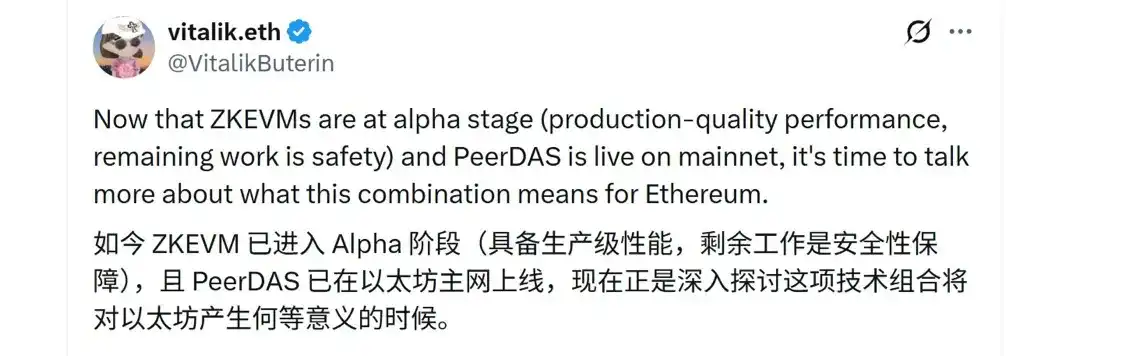
A few days ago, Vitalik was quite excited. He officially announced on Twitter that ZKEVM has now entered the Alpha stage.
Why is Ethereum so persistent about ZK?

Actually, Ethereum's TPS is not low anymore, with the theoretical peak already increased to over 200 TPS. The main reason is that Ethereum has repeatedly raised the Gas limit.
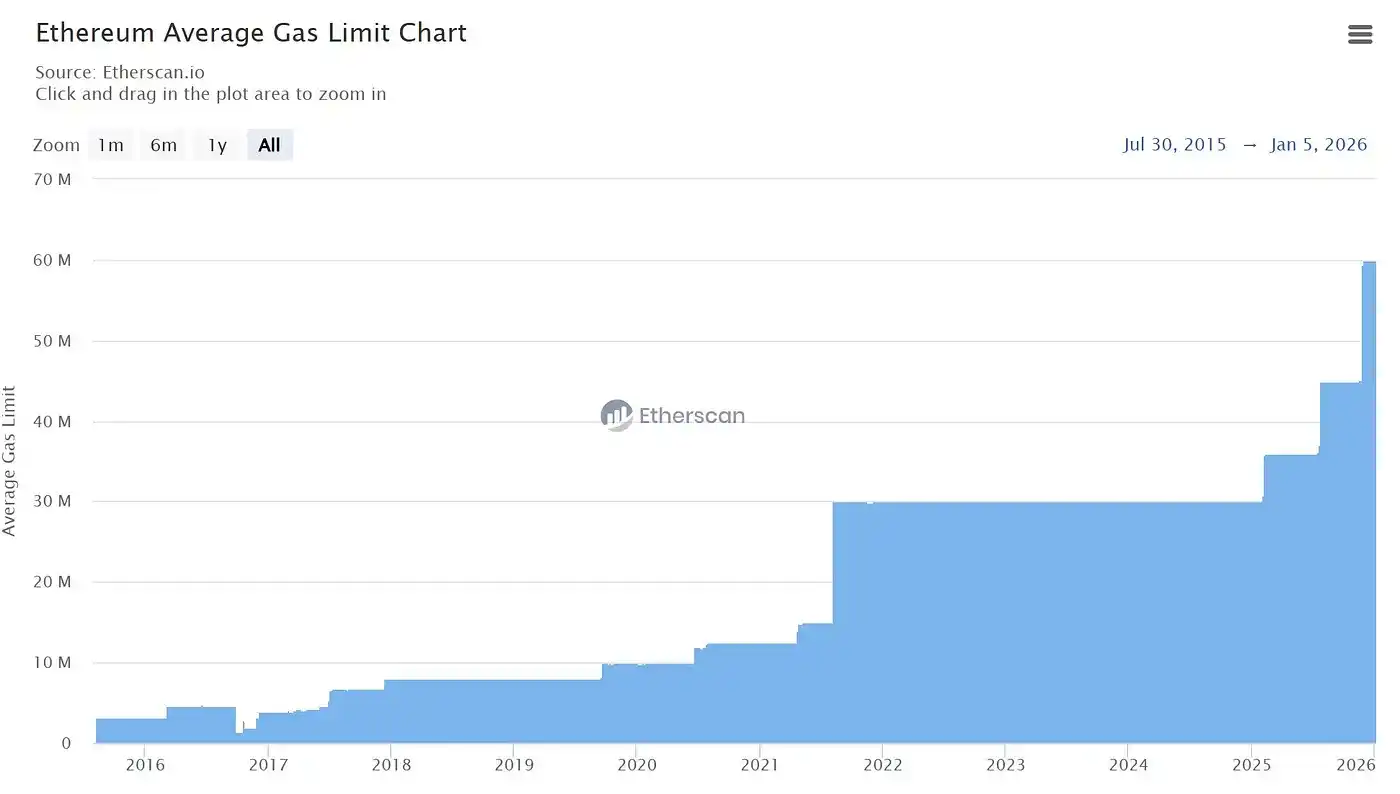
However, raising the Gas limit comes at a cost and cannot be done indefinitely. Its cost is that nodes need more expensive servers to run.

But Ethereum also wants to maintain its proud high degree of decentralization, so it cannot push node server performance too high (refer to Solana, where a single server is about 5–10 times more expensive than an ETH server).

Therefore, the mainnet must be ZK-ified. Note, this is not about creating a few ZK L2s; this is a full ZK-ification of the L1 mainnet.

So what are the benefits after ZK-ification?

Those ETH nodes can simply verify these ZK proofs, without needing to tediously verify transactions one by one as in the past.
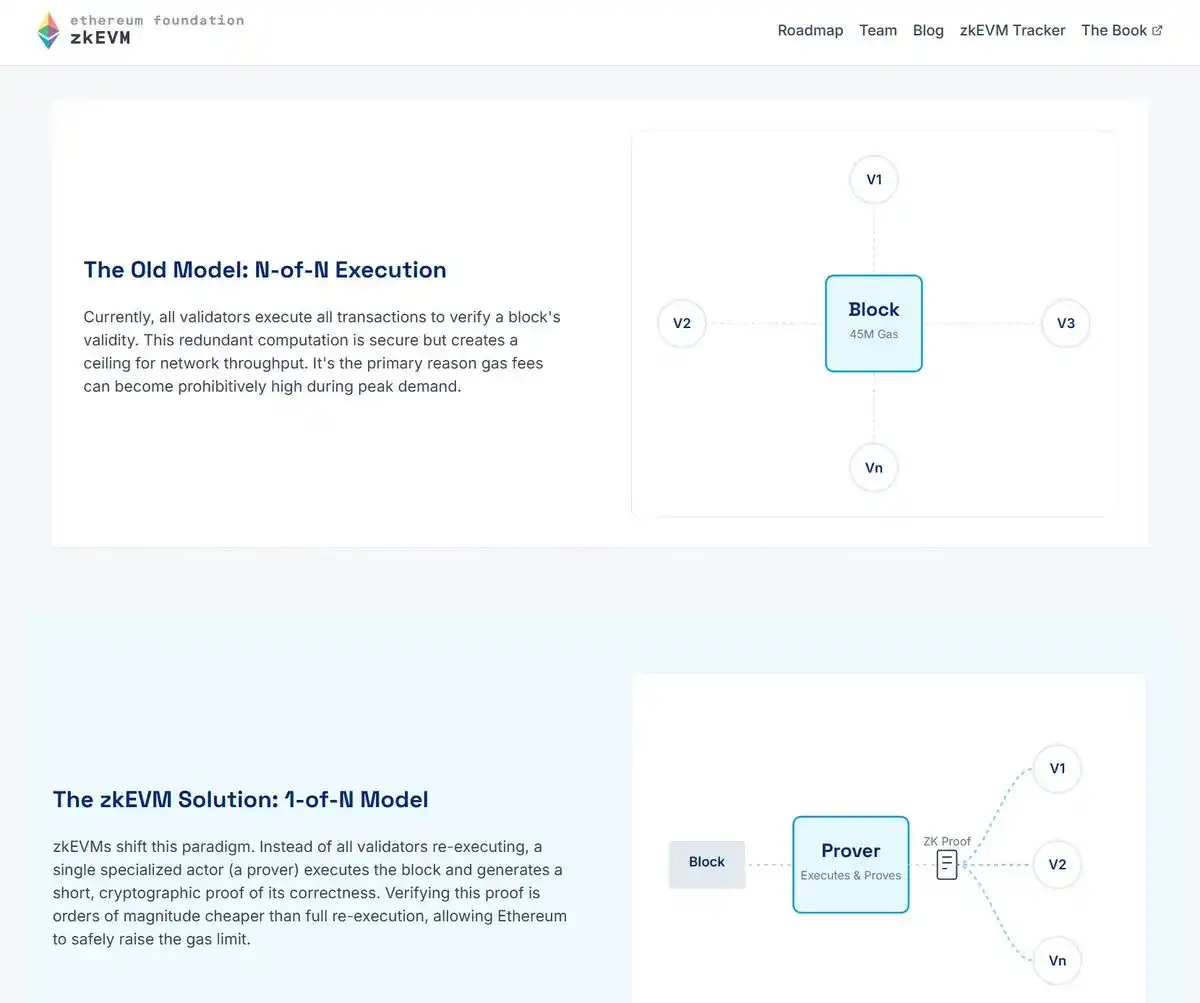
For example, if you are a grading teacher (node), the transactions are the students' exam papers.

In the past, manually grading papers was slow. But since the invention of the answer sheet (ZK-ification)神器, the machine calculates the total score in a second, so as a teacher, aren't you much more relaxed?

You are relaxed; in the past, one person could only grade 50 papers, but now they can grade 1000. The person is the same, but efficiency skyrockets.

Therefore, Ethereum must first ZK-ify the mainnet, and then it can significantly raise the Gas limit again.

ZK-ification itself does not directly increase TPS; it is a prerequisite. Improving performance still relies on raising the Gas limit, but after ZK-ification, nodes do not need to increase server costs much, making the代价很小.

After the recent Fusaka upgrade (especially the PeerDAS upgrade) performed well, Ethereum has taken another step closer to mainnet ZK-ification, which is why Vitalik is so excited.

Imagine a mainnet with TPS breaking thousands; for Ethereum, that indeed counts as a decent narrative.

Someone raised a question:

If Ethereum itself builds a ZK-EVM for the mainnet, are other ZK teams still meaningful?

First, the conclusion is, they are still meaningful.

Why?

First, ZK engineering is one of the most difficult developments in the entire network, sitting at the same table as FHE. It requires a large number of cryptography talents.

It is believed that the ETH Foundation has some reserves in this area, but as an open-source community, Ethereum adheres to the philosophy that many hands make light work. It needs a large number of third-party ZK teams for trial, error, and innovation. In return, Ethereum will give substantial support.

Second, there are four types of ZK-EVM, from type 1 to type 4. Several groups, including Polygon, Scroll, ZKsync, and Taiko, are like each认领任务,分别实现其中一个类型.

Additionally, there is ZK-VM, such as Brevis.

In fact, ZK-VM's position is even more stable compared to ZK-EVM.

The reason is that among the four major ZK-EVM types, it is highly likely that one with the best cost-performance ratio will eventually be chosen to become part of the designated solution for Ethereum's mainnet ZK-EVM, which may affect the other three.

However, for ZK-VM, it is not EVM-compatible by nature, so it will definitely be part of Ethereum's diversity.

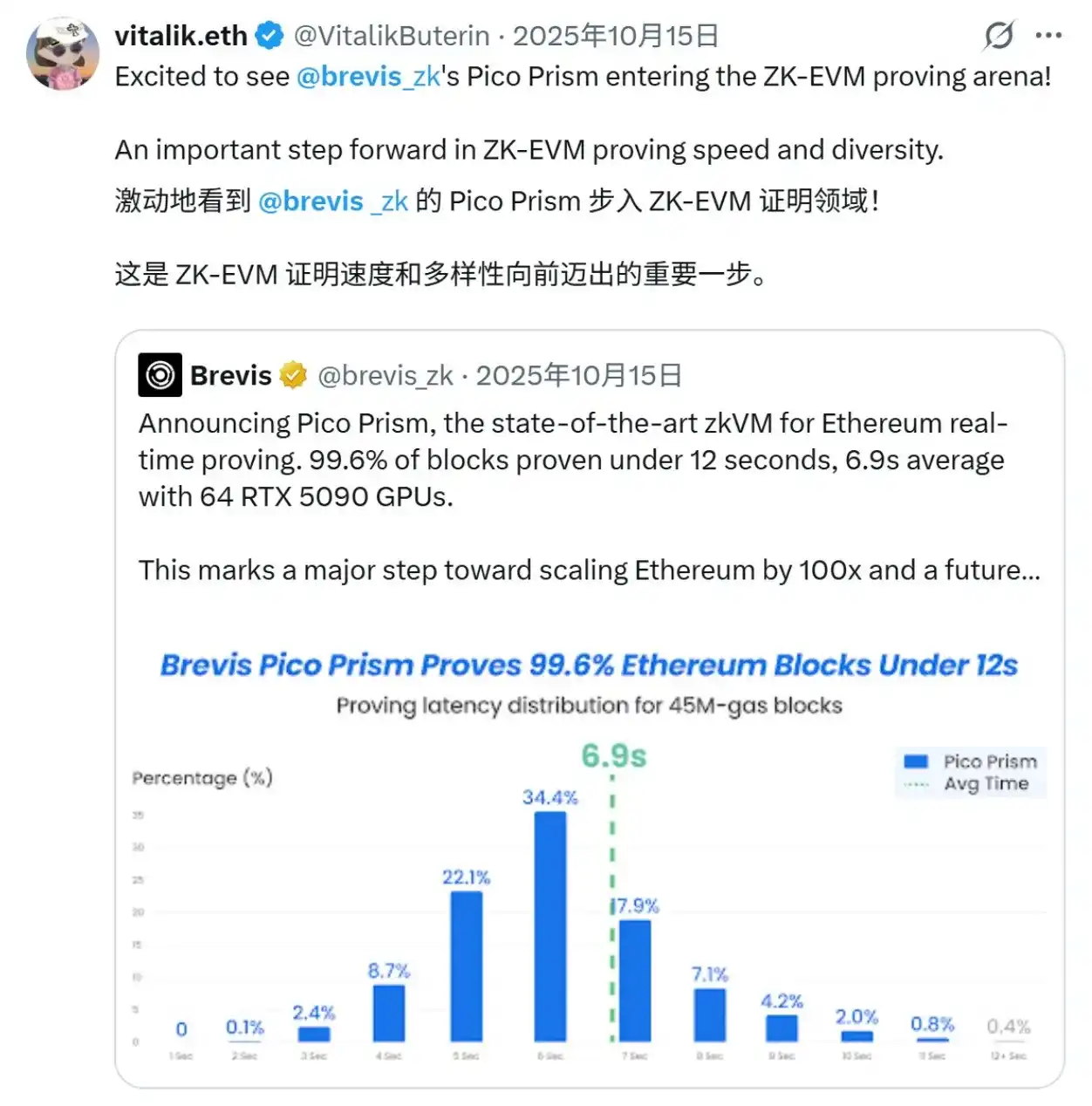
Moreover, since VM is not constrained by EVM limitations, its performance can run very high. Ethereum's ZK-EVM poses no threat to it; instead, the Ethereum official will continue to encourage it.

For example, Vitalik previously specifically mentioned the performance of Brevis's ZK-VM and expressed期待它们进入 ZK-EVM 领域.
What about L2?There might be some impact, but it's still not significant.

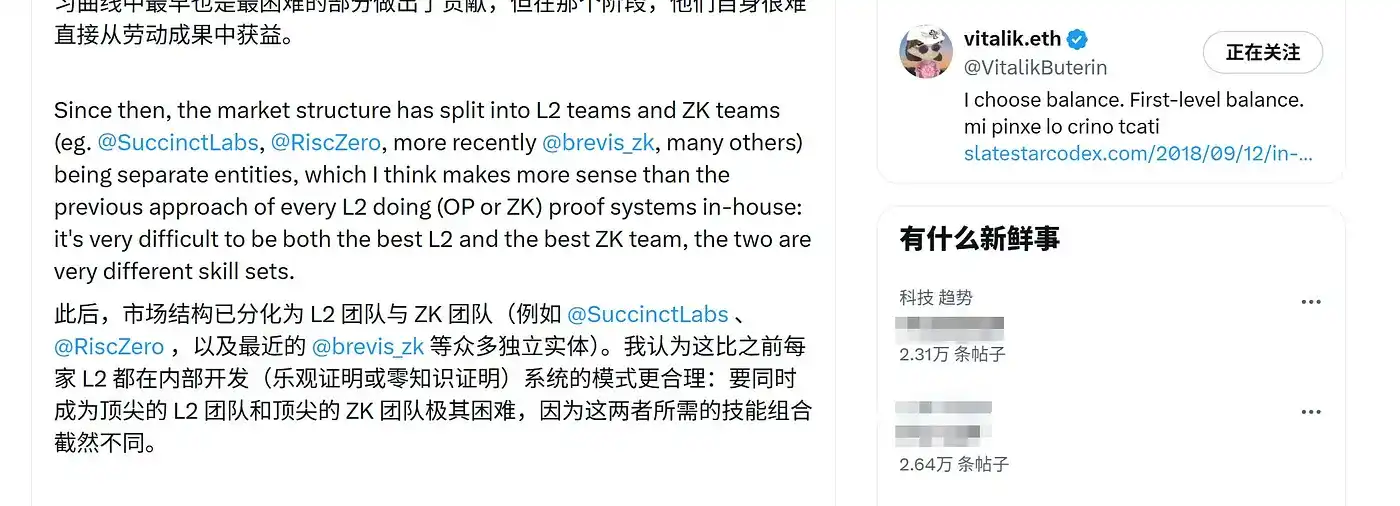
Vitalik once said when discussing Polygon that ZK and L2 should be separated比较好.

The ZK-ified L1 will certainly attract back some users from ZK L2s. After all, if L1 is cheap enough, the number of users on L2 may decrease.

But think about it the other way: if L1 is the foundation and L2 is the skyscraper, the foundation must be as solid as possible. So, if the L1 mainnet is ZK-ified, L2 fees will also decrease, which is beneficial.

Moreover, in that tweet, Vitalik also specifically mentioned Brevis, which works on ZK-VM. The reason is that much of Brevis's ZK work is not limited to L2, meaning "ZK research and L2 research are separated."

For example, they have a ZK computing power market, helping with ZK-ified reward distribution for Uniswap's hooks, which is application-driven.
In summary, Ethereum has been online for 10 years now, and the slogan of ZK-ification has been proposed for five or six years. After continuous cultivation, ZK-ification has finally entered the Alpha stage. This is thanks to the continuous investment from Ethereum and numerous third-party ZK teams including Brevis and Polygon.

Трендові криптовалюти

Пов'язані питання

QWhy does Ethereum urgently need to become ZK-based according to the article?

AEthereum needs to become ZK-based to significantly increase its TPS by raising the Gas limit without forcing node operators to use prohibitively expensive servers, thereby preserving its high degree of decentralization while scaling.

QWhat is the role of ZK technology in improving Ethereum's node efficiency?

AZK technology allows nodes to simply verify cryptographic proofs of transaction batches instead of manually verifying each transaction individually, dramatically increasing the number of transactions a node can process without a proportional increase in computational cost.

QHow does the article differentiate between ZK-EVM and ZK-VM, and which one is considered more stable?

AThe article states that ZK-VM is considered more stable because it is not EVM-compatible and exists as part of Ethereum's diversity. It is not threatened by Ethereum's own ZK-EVM development and is performance-optimized without EVM constraints.

QWhat impact might a ZK-based Ethereum L1 have on existing ZK L2s?

AA cheaper and more scalable ZK-based L1 might attract some users back from L2s. However, it also benefits L2s by providing a more robust foundational layer (L1), which can lead to lower fees on L2s as well.

QWhat is the significance of the 'Alpha stage' announcement for ZKEVM mentioned in the article?

AThe announcement that ZKEVM has entered its Alpha stage signifies a major milestone after years of development, indicating that the core technology for Ethereum's full ZK integration is becoming operational and bringing the vision of a high-TPS, decentralized mainnet closer to reality.

Пов'язані матеріали

WeChat AI Card Hands-On Guide: Has the AI Shopping Era Arrived?

**"WeChat AI Card" Practical Test Guide: Has the Era of AI Shopping Arrived?** WeChat has officially launched the "AI Exclusive Card," a feature integrated into its Workbuddy AI assistant. This card is designed to handle payments for AI-initiated purchases. Our hands-on test reveals it's not yet a tool for fully autonomous AI shopping, but rather a controlled payment layer for AI agents. The AI Card functions as an isolated sub-wallet within WeChat Pay. Users must bind the card and transfer funds into it from their main wallet. Crucially, every transaction requires explicit user confirmation via smartphone scan; AI cannot spend autonomously. Currently accessible through the Workbuddy agent, the card targets specific digital consumption scenarios: purchasing paid content (reports, data), calling paid APIs/tools, and subscribing to services. Its design prioritizes security and control by separating funds and mandating approval for each payment. We tested a real-world scenario: ordering bubble tea via Workbuddy using a "Meituan Life Assistant" skill. The process encountered multiple hurdles: high "skill" usage costs (exceeding daily free credits), and most importantly, while a payment was successfully initiated, the AI purchased an incorrect product (a mismatched group-buy coupon instead of the desired drink). This highlights the current limitation: the **AI Card only solves the payment step**. The broader challenge lies in the **AI agent's execution chain**—accurately understanding intent, navigating third-party platforms, selecting the right product, and ensuring proper fulfillment. The payment succeeded, but the purchase failed to meet the user's need. In conclusion, the WeChat AI Exclusive Card is a cautious, early-step experiment in AI commerce. It provides a secure, user-controlled payment method for agent interactions but is not yet capable of reliable, end-to-end complex purchases. For now, it's best used for low-value, low-risk digital services with careful user verification at each step. The vision of AI handling complete shopping tasks remains a work in progress.

marsbit2 год тому

WeChat AI Card Hands-On Guide: Has the AI Shopping Era Arrived?

marsbit2 год тому

Deconstructing Notion's Growth: From a Note-taking Tool to 100 Million Users—How Notion Built a Triple Growth Flywheel Through Product, Templates, and Community

Notion's growth from a niche note-taking tool to a platform with 100 million users is powered by three interconnected flywheels: Product-Led Growth (PLG), a Template Economy, and Community-Driven Growth. First, Notion's PLG strategy relies on a highly flexible, "plastic" product that users can adapt to countless personal and team workflows. Its freemium model lowers the barrier to entry, while features like page sharing and collaboration drive organic, usage-based viral growth as users naturally invite others. Second, the Template Economy solves the "blank page" problem. Templates, created by both Notion and its community, transform abstract product capabilities into concrete, copyable solutions for specific scenarios (e.g., project management, content calendars). This dramatically lowers activation costs for new users and fuels SEO-driven discovery. Third, a vibrant Community acts as a distributed growth engine. Users and official Ambassadors create tutorials, share use cases, and host local events. This community not only educates users but also fosters a sense of identity around pursuing "better ways of working," strengthening loyalty and enabling global, low-cost expansion. Together, these flywheels create a self-reinforcing ecosystem: a great product attracts users who create templates and community content, which in turn attracts more users and deepens engagement. This system allowed Notion to scale from individuals to teams and enterprises through a bottom-up adoption path. Looking ahead, AI integration promises to accelerate these flywheels further by making templates smarter and the platform a potential AI-native work operating system. Ultimately, Notion's defensible advantage is not just its features, but this deeply entrenched network of user assets, creators, and community trust.

marsbit2 год тому

Deconstructing Notion's Growth: From a Note-taking Tool to 100 Million Users—How Notion Built a Triple Growth Flywheel Through Product, Templates, and Community

marsbit2 год тому

$10 Billion, Qualcomm to Acquire Chip Legend Jim Keller's Company

Global mobile chip giant Qualcomm is in advanced talks to acquire AI chip startup Tenstorrent in a deal valued between $8-10 billion, according to media reports. This potential acquisition would be one of the largest in the AI chip sector in recent years. Tenstorrent, led by legendary chip architect Jim Keller, has gained prominence for its RISC-V architecture and AI accelerator designs. The move highlights Qualcomm's strategic push to diversify beyond its core smartphone chip business. As the smartphone market matures, Qualcomm is aggressively targeting growth in automotive, data center, and cloud AI. Acquiring Tenstorrent would allow Qualcomm to rapidly enter the high-end AI computing market, bypassing lengthy in-house development cycles. Tenstorrent's cost-effective system architecture, which avoids expensive HBM memory and relies on standard Ethernet for clustering, offers a potential alternative to Nvidia's costly solutions. Furthermore, Tenstorrent's high-performance RISC-V CPU technology and its focus on the automotive and edge computing segments align with Qualcomm's strategic goals, including its "Snapdragon Digital Chassis" platform. Despite the strategic rationale, the high valuation has sparked some investor caution. The successful integration of Tenstorrent's open-source culture and independent team into Qualcomm's organization, along with the commercialization of its technology, remains a key challenge.

marsbit2 год тому

$10 Billion, Qualcomm to Acquire Chip Legend Jim Keller's Company

marsbit2 год тому

CARDS' Brutal Truth of $535M FDV: Only $43M Net Revenue, Profit Margin Halved

The article deconstructs Collector Crypt (CC), a blockchain-based platform for trading tokenized collectible cards, revealing a significant disparity between its high volume and actual business fundamentals. Key findings include: * CC's cumulative revenue of $635M is misleading; 90.6% is instantly returned to users via card buybacks, leaving only $43M in net revenue (6.7% retention). * Trading activity is minimal, with real secondary market trading below $5M. eBay sales as a percentage of volume have declined for six consecutive quarters. * The platform's user base is highly concentrated, with a few dozen high-frequency wallets driving most of the volume, resembling a "casino" with ~420 daily active players. * As volume shifts to higher-priced card packs, the net profit margin has halved from 11.2% to 5.8%. * Token value capture (via burns and buybacks) totals only $1.4M, just 3.4% of net revenue. Meanwhile, operational wallets have off-ramped $45.7M in USDC. * With a Fully Diluted Valuation (FDV) of ~$535M, the token trades at 7.3x net revenue. The float is only 20.5%, with 72% of the supply allocated to insiders and locked until November 2027. The analysis concludes that while CC has found product-market fit as a high-speed gacha machine, it shows little evidence of evolving into a sustainable collector's marketplace, with minimal value accruing to its CARDS token.

marsbit2 год тому

CARDS' Brutal Truth of $535M FDV: Only $43M Net Revenue, Profit Margin Halved

marsbit2 год тому

Торгівля

Спот
Ф'ючерси

Популярні статті

Як купити ZK

Ласкаво просимо до HTX.com! Ми зробили покупку ZKsync (ZK) простою та зручною. Дотримуйтесь нашої покрокової інструкції, щоб розпочати свою криптовалютну подорож.Крок 1: Створіть обліковий запис на HTXВикористовуйте свою електронну пошту або номер телефону, щоб зареєструвати обліковий запис на HTX безплатно. Пройдіть безпроблемну реєстрацію й отримайте доступ до всіх функцій.ЗареєструватисьКрок 2: Перейдіть до розділу Купити крипту і виберіть спосіб оплатиКредитна/дебетова картка: використовуйте вашу картку Visa або Mastercard, щоб миттєво купити ZKsync (ZK).Баланс: використовуйте кошти з балансу вашого рахунку HTX для безперешкодної торгівлі.Треті особи: ми додали популярні способи оплати, такі як Google Pay та Apple Pay, щоб підвищити зручність.P2P: Торгуйте безпосередньо з іншими користувачами на HTX.Позабіржова торгівля (OTC): ми пропонуємо індивідуальні послуги та конкурентні обмінні курси для трейдерів.Крок 3: Зберігайте свої ZKsync (ZK)Після придбання ZKsync (ZK) збережіть його у своєму обліковому записі на HTX. Крім того, ви можете відправити його в інше місце за допомогою блокчейн-переказу або використовувати його для торгівлі іншими криптовалютами.Крок 4: Торгівля ZKsync (ZK)Легко торгуйте ZKsync (ZK) на спотовому ринку HTX. Просто увійдіть до свого облікового запису, виберіть торгову пару, укладайте угоди та спостерігайте за ними в режимі реального часу. Ми пропонуємо зручний досвід як для початківців, так і для досвідчених трейдерів.

210 переглядів усьогоОпубліковано 2024.12.13Оновлено 2026.06.02

Як купити ZK

Обговорення

Ласкаво просимо до спільноти HTX. Тут ви можете бути в курсі останніх подій розвитку платформи та отримати доступ до професійної ринкової інформації. Нижче представлені думки користувачів щодо ціни ZK (ZK).

活动图片