Why $HYPER Keeps Climbing: Investing in Infrastructure

bitcoinistОпубліковано о 2026-02-09Востаннє оновлено о 2026-02-09

Анотація

The current market cycle shows capital shifting from speculative assets to critical infrastructure, particularly Bitcoin Layer 2 solutions. Bitcoin Hyper ($HYPER) is emerging as a key player by integrating Solana Virtual Machine (SVM) with Bitcoin’s security, aiming to solve scalability issues and enable high-speed, low-cost transactions. This architecture supports complex dApps while using Bitcoin as a secure settlement layer. With over $31M raised and significant whale accumulation during its presale, $HYPER reflects strong institutional interest. The project offers high APY staking to encourage long-term holding, positioning itself as infrastructure that enhances Bitcoin’s utility rather than competing with it.

The current market cycle is defined by a distinct rotation: capital is moving from speculative assets into critical infrastructure. While meme coins dominate social media volume, on-chain data reveals that ‘smart money’ is increasingly positioning itself in the rails that will carry the next generation of decentralized finance (DeFi).

Bitcoin remains the undisputed king of crypto, but let’s be honest, its utility has historically been capped by technical limitations. The network is secure, yes, but slow. While the Lightning Network attempted to solve payments, the broader issue of programmability remains. Institutions are watching this gap. Unlocking even 1% of Bitcoin’s dormant capital for decentralized applications represents a trillion-dollar opportunity.

The future isn’t about whether Bitcoin will recover and how high it climbs again. It’s about turning it from a place where Bitcoin isn’t just a store of value, but the settlement layer for a bustling ecosystem of high-speed applications. This structural shift is directing liquidity toward Layer 2 solutions that promise to modernize the network without compromising security.

Bitcoin Hyper ($HYPER) is capitalizing on this demand, effectively merging the speed of Solana with the security of Bitcoin. This makes it one of the best crypto to buy.

Solving The Scalability Trilemma With SVM Integration

The main driver here is the ‘Scalability Trilemma,’ the challenge of achieving speed, security, and decentralization all at once. Most Bitcoin layers sacrifice performance for security. The result? Sluggish user experiences that fail to retain retail users. Bitcoin Hyper addresses this by integrating the Solana Virtual Machine (SVM) directly into a Bitcoin Layer 2 framework.
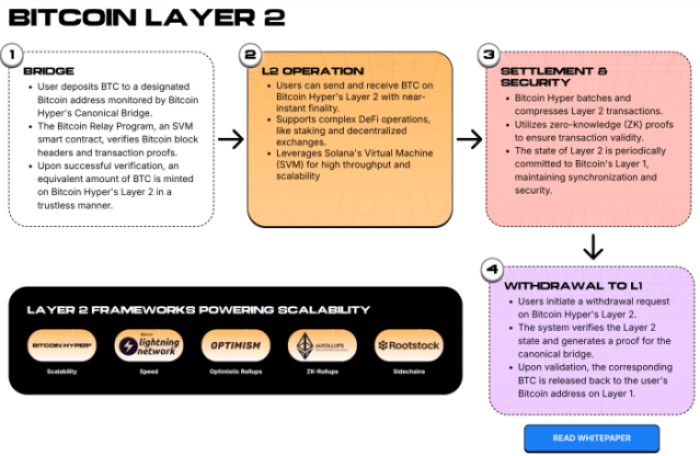
That matters because the SVM is currently the gold standard for high-throughput execution. By using this architecture, Bitcoin Hyper delivers sub-second finality and negligible transaction fees, a stark contrast to the costly execution found on traditional Ethereum-based L2s or the mainnet itself. It’s not just a technical upgrade; it’s a user experience revolution.

It lets developers build complex dApps, such as high-frequency trading platforms and interactive gaming, using Bitcoin’s robust liquidity as the settlement layer.

From a development perspective, this modular approach, using Bitcoin L1 for settlement and a real-time SVM L2 for execution, lowers the barrier to entry. Developers can use Rust to build applications that feel as fast as Solana but settle on the world’s most secure blockchain. Plus, the decentralized Canonical Bridge reduces friction, allowing for seamless $BTC transfers. Want a full project play-by-play? Check out our ‘What is Bitcoin Hyper ($HYPER)?‘ guide.

For investors, the value proposition is clear: infrastructure that eliminates bottlenecks captures value.

EXPLORE THE $HYPER ECOSYSTEM

Smart Money Flows Favor Early-Stage Infrastructure

Technical architecture provides the thesis, but on-chain flows provide the timing. Traders often look for divergences between price action and capital accumulation. In the case of Bitcoin Hyper ($HYPER), the funding data indicates significant demand for this infrastructure-focused approach.

$HYPER has already raised over $31M. That figure underscores strong conviction from early backers. With tokens currently priced at $0.0136753, the entry point reflects an early valuation relative to established Layer 2 competitors like Stacks. The sheer volume suggests the market is validating the ‘SVM on Bitcoin’ thesis before the mainnet is fully saturated.

Crucially, high-net-worth individuals are already taking positions. Smart money is moving. Etherscan data shows that during the presale, whales have bought up over $1M, with the largest purchase totalling $500K. Whale accumulation during a presale phase is a notable signal; it implies that sophisticated actors are locking in supply, anticipating a supply shock post-TGE.

Plus, the protocol’s decision to offer high APY staking immediately after the Token Generation Event (TGE), with a short 7-day vesting period for presale stakers, incentivizes long-term holding over short-term flipping.

$HYPER isn’t competing with $BTC; it’s lifting it up to what it can be, maximizing its potential.

BUY YOUR $HYPER FROM THE OFFICIAL PRESALE PAGE

The content provided in this article is for informational purposes only and does not constitute financial advice. Cryptocurrency markets are volatile, and presale investments carry inherent risks. Always perform your own due diligence before investing.


Пов'язані питання

QWhat is the main reason capital is moving from speculative assets to infrastructure according to the article?

AThe main reason is that 'smart money' is increasingly positioning itself in the infrastructure that will carry the next generation of decentralized finance (DeFi), seeing a trillion-dollar opportunity in unlocking Bitcoin's dormant capital.

QHow does Bitcoin Hyper ($HYPER) aim to solve the Scalability Trilemma?

ABitcoin Hyper addresses the Scalability Trilemma by integrating the Solana Virtual Machine (SVM) into a Bitcoin Layer 2 framework, achieving high speed, security, and decentralization simultaneously.

QWhat key advantage does the Solana Virtual Machine (SVM) provide to the Bitcoin Hyper network?

AThe SVM provides the advantage of high-throughput execution, enabling Bitcoin Hyper to deliver sub-second finality and negligible transaction fees.

QWhat on-chain data is provided as evidence of significant demand for the $HYPER token?

AThe article cites that $HYPER has raised over $31M, with Etherscan data showing whales bought over $1M during the presale, including a single purchase of $500K.

QWhat is the value proposition of $HYPER for investors, as stated in the article?

AThe value proposition for investors is that infrastructure which eliminates bottlenecks in the blockchain ecosystem captures value, and $HYPER provides this by modernizing Bitcoin's network without compromising security.

Пов'язані матеріали

Bitcoin's 'Rally Ends,' Officially Entering the Later Stage of a Bear Market?

Bitcoin prices declined 13% this week, reversing the recent rebound and signaling a likely transition into the later stages of a bear market. Key on-chain metrics deteriorated, with the short-term holder cost basis falling below the Realized Price—a pattern last seen in early 2022, characteristic of bear market maturity. The rally to ~$82k proved to be a bear market bounce, as evidenced by the 90-day realized profit/loss ratio failing to sustain above the bullish threshold of 2. Daily realized losses surged to $1.35B, including significant selling from long-term holders who accumulated near cycle tops, indicating ongoing supply redistribution. Price was rejected almost precisely at the aggregate US spot ETF cost basis of ~$83k, turning that level into resistance and leaving the average ETF investor underwater again. Spot market selling pressure intensified, with the 7-day volume delta turning significantly negative to its weakest level since February. While a major long liquidation event cleared over $400M in leverage, spot demand has not yet stepped in to absorb the resulting supply. Options markets continue pricing in higher future volatility (elevated volatility risk premium) and maintain a skew toward put options, reflecting persistent demand for downside protection, though not yet panic. Overall, market structure remains fragile. Sustained recovery likely requires a reclaim of the ETF cost basis, a shift back to positive spot demand, and a slowdown in realized loss-taking. Until then, the market risks further downside or extended consolidation within the broader bear trend.

Foresight News51 хв тому

Bitcoin's 'Rally Ends,' Officially Entering the Later Stage of a Bear Market?

Foresight News51 хв тому

How Risky is the "Death Spiral" of MSTR and STRC?

Summary: This article explores the perceived "death spiral" risk between MicroStrategy (MSTR), its Bitcoin holdings, and its perpetual preferred stock (STRC), drawing comparisons to the LUNA-UST collapse. While both systems feature price anchors, high yields for holders, and potential feedback loops, their core mechanisms differ fundamentally. The MSTR-STRC structure relies on continuous financing to sustain its high dividend payouts, primarily through stock ATM offerings. A negative feedback cycle could occur: falling MSTR stock price makes raising equity capital harder, increasing pressure to sell Bitcoin, which undermines STRC confidence and further depresses MSTR. However, unlike LUNA-UST's automated, direct linkage, the MSTR-STRC loop is weaker and has brakes: STRC dividends can be deferred or rates lowered, and STRC holders have a $100/share liquidation preference in bankruptcy, providing a price floor. The company's sustainability hinges on its ability to continue financing. Its current ~$900 million USD reserves cover only about 6.3 months of its ~$1.71 billion annual interest/dividend burden. The next six months are critical, aligning with both the potential bottom in Bitcoin's four-year cycle and the depletion timeline of its reserves. While a LUNA-style catastrophic collapse is deemed highly unlikely due to structural differences, the key question is whether MicroStrategy can navigate this period through healthy deleveraging to restart its capital engine.

Foresight News1 год тому

How Risky is the "Death Spiral" of MSTR and STRC?

Foresight News1 год тому

Торгівля

Спот
Ф'ючерси
活动图片




