Why Does Hyperliquid Earn Less Than Coinbase?

marsbitОпубліковано о 2025-12-18Востаннє оновлено о 2025-12-18

Анотація

Hyperliquid, a decentralized exchange, processes near-Nasdaq-level perpetual trading volumes but captures significantly lower fees compared to centralized platforms like Coinbase and Robinhood. While Hyperliquid cleared $205.6 billion in notional volume over 30 days, it generated only $80.3 million in fees—an effective take rate of ~3.9 bps. In contrast, Coinbase and Robinhood achieve take rates of ~35.5 bps and ~33.5 bps, respectively, by operating as retail brokers that monetize multiple layers: distribution, balances, subscriptions, and order flow. This gap stems from a structural difference: Hyperliquid positions itself as a low-fee *market layer* (like Nasdaq), providing high-throughput execution and清算 infrastructure, while brokers like Coinbase control user relationships and extract value through higher-margin activities. Hyperliquid’s model includes permissionless distributor frontends (Builder Codes) and product deployment (HIP-3), which drive ecosystem growth but also create long-term fee compression risks by outsourcing high-value distribution. To defend its economics, Hyperliquid is taking steps to retain distribution control, integrate HIP-3 markets natively, and introduce balance-driven revenue streams like USDH (a native stablecoin with 50% reserve收益 sharing) and portfolio margin (10% interest fee on borrows). These moves aim to shift its model from pure exchange-level execution toward a hybrid approach that captures broker-like profit pools—without sacrificin...

Editor's Note: As Hyperliquid's trading volume approaches that of traditional exchanges, what truly warrants attention is no longer just "how large the volume is," but rather which layer of the market structure it chooses to occupy. This article uses the division of labor between "brokers vs. exchanges" in traditional finance as a reference to analyze why Hyperliquid actively adopts a low-fee market layer positioning, and how Builder Codes and HIP-3 amplify the ecosystem while simultaneously creating long-term pressure on the platform's take rate.

Hyperliquid's path reflects a core issue facing the entire crypto trading infrastructure: after scaling up, how should profits ultimately be distributed?

The original text follows:

Hyperliquid is processing perpetual contract trading volumes nearing Nasdaq levels, but its profit structure similarly exhibits "Nasdaq-level" characteristics.
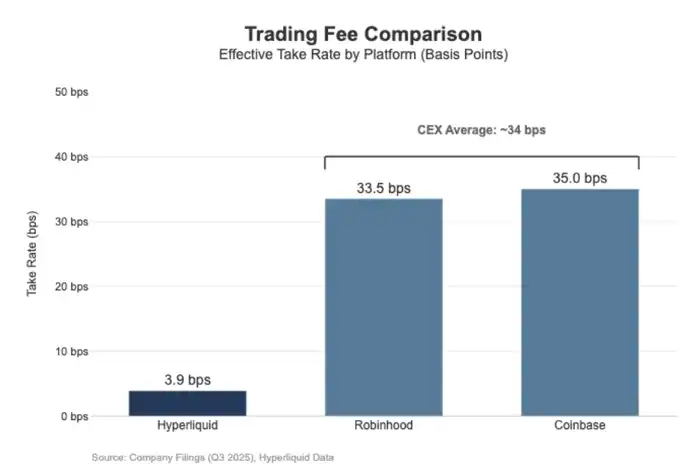
Over the past 30 days, Hyperliquid cleared $205.6 billion in perpetual contract notional trading volume (approximately $617 billion annualized quarterly) but generated only $80.3 million in fee revenue, translating to a fee rate of approximately 3.9 basis points (bps).

This means Hyperliquid's monetization approach is closer to a wholesale execution venue rather than a retail-facing, high-fee trading platform.

For comparison, Coinbase recorded $295 billion in trading volume in Q3 2025 but realized $1.046 billion in trading revenue, implying a take rate of approximately 35.5 basis points.


Robinhood's monetization logic for its crypto business is similar: its $80 billion in crypto asset notional trading volume brought in $268 million in trading revenue, an implied fee rate of about 33.5 bps; meanwhile, Robinhood's stock notional volume in Q3 2025 was as high as $647 billion.

Overall, Hyperliquid has joined the ranks of top-tier trading infrastructure in terms of volume, but in terms of fee structure and business model, it resembles a low-take-rate execution layer for professional traders rather than a retail-oriented platform.
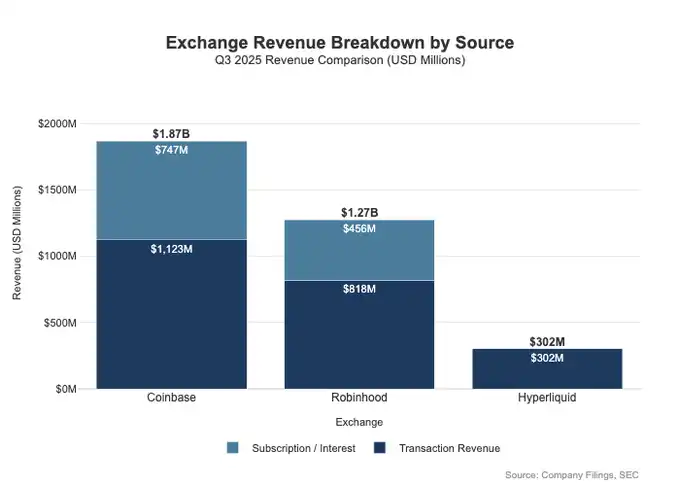
The gap is evident not only in the fee level but also in the breadth of monetization dimensions. Retail platforms often profit simultaneously across multiple revenue "interfaces." In Q3 2025, Robinhood achieved a total of $730 million in transaction-related revenue, plus $456 million in net interest income, and $88 million in other revenue (primarily from Gold subscription services).

In contrast, Hyperliquid currently relies much more heavily on trading fees, and these fees are structurally compressed into the single-digit basis point range at the protocol level. This means Hyperliquid's revenue model is more concentrated, more singular, and closer to the low-fee, high-turnover infrastructure role, rather than a retail platform that monetizes deeply through multiple product lines.
This can be explained by a fundamental positioning difference: Coinbase and Robinhood are brokerage/distribution businesses, monetizing through multiple layers leveraging their balance sheets and subscription systems; whereas Hyperliquid is closer to the exchange layer. In traditional financial market structures, the profit pool is naturally split between these two layers.

Broker-Dealer vs. Exchange Model

In traditional finance (TradFi), the core divide is the separation between the distribution layer and the market layer.
Retail platforms like Robinhood and Coinbase reside in the distribution layer, capturing high-margin monetization surfaces; whereas exchanges like Nasdaq reside in the market layer, whose pricing power is structurally constrained, and execution services are pushed by competition towards an almost commoditized economic model.

Broker/Dealer = Distribution Power + Customer Balance Sheet

Brokers control the customer relationship. Most users do not connect directly to Nasdaq but access the market through a broker. Brokers handle account opening, custody, margin and risk management, customer support, tax documents, etc., and then route orders to specific trading venues.
It is this "relationship ownership" that allows brokers to monetize in multiple ways beyond just trading:

Funds and Asset Balances: Cash sweep spreads, margin lending, securities lending

Product Bundling: Subscription services, feature packages, debit cards / advisory products

Routing Economics: Brokers control order flow and can embed payment or revenue-sharing mechanisms in the routing chain

This is why brokers often earn more than trading venues: the profit pool is truly concentrated at the "distribution + balances" location.

Exchange = Matching + Rules + Infrastructure, Take Rate Limited

Exchanges operate the trading venue itself: the matching engine, market rules, deterministic execution, and infrastructure connectivity. Their main monetization methods include:

Trading fees (continuously pressured lower in highly liquid products)

Rebates / Liquidity incentives (often returning most of the nominal fee to market makers to compete for liquidity)

Market data, network connectivity, and co-location services

Listing fees and index licensing

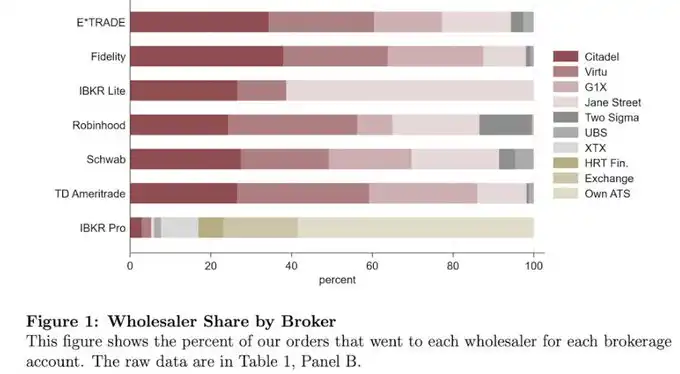
Robinhood's order routing mechanism clearly illustrates this structure: the user relationship is held by the broker (Robinhood Securities), and orders are then routed to third-party market centers, with economic benefits distributed along the routing chain.


The truly high-margin layer is at the distribution end, which controls customer acquisition, user relationships, and all monetization surfaces around execution (like payment for order flow, margin, securities lending, and subscription services).
Nasdaq itself resides in the thin-margin layer. The product it provides is essentially a highly commoditized execution capability and queue access, and its pricing power is strictly limited by mechanism.

The reasons are: To compete for liquidity, trading venues often need to return a large portion of the nominal fee in the form of maker rebates; regulatory caps on access fees limit the chargeable fee space;同时, order routing is highly elastic, capital and orders can quickly switch between different trading venues, making it difficult for any single venue to raise prices.

This is reflected very直观ly in Nasdaq's disclosed financial data: the net revenue it actually captures in cash equity trading is typically on the order of a few mils per share. This is a direct写照 of the structurally compressed profit space at the market layer exchange.
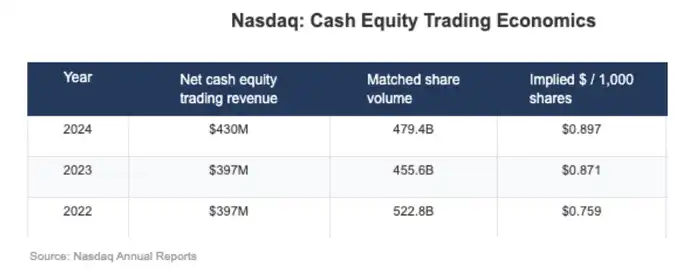
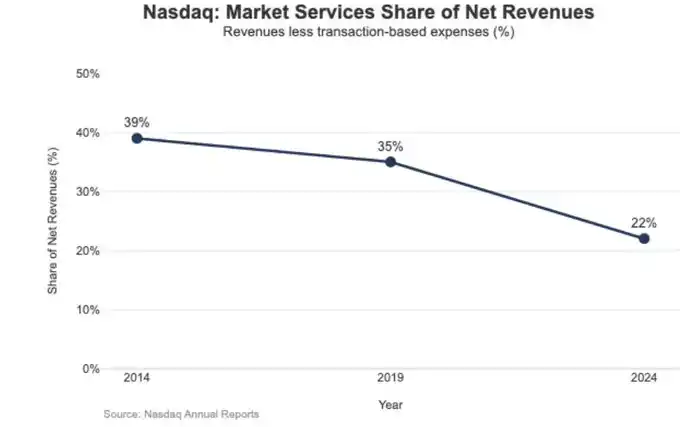
The strategic consequences of this low profitability are also clearly reflected in the changes in Nasdaq's revenue structure.

In 2024, Nasdaq's Market Services revenue was $1.020 billion, accounting for 22% of total revenue of $4.649 billion; this proportion was as high as 39.4% in 2014 and was still 35% in 2019.

This持续下滑 trend is高度一致 with Nasdaq's主动 shift from execution-based业务 highly dependent on market volatility and limited profits towards more recurring, predictable software and data businesses. In other words, it is the structurally low profit space at the exchange level that has pushed Nasdaq to gradually migrate its growth focus from "matching and execution" to "technology, data, and servitized products."
Hyperliquid as the "Market Layer"

Hyperliquid's effective take rate of approximately 4 basis points (bps) is高度一致 with its有意选择的 market layer positioning. It is building an on-chain "Nasdaq-style" trading infrastructure:

A high-throughput matching, margin, and clearing system centered on HyperCore, employing maker/taker pricing and market maker rebate mechanisms, aiming to maximize execution quality and shared liquidity, rather than multi-layer monetization面向 retail users.

In other words, Hyperliquid's design focus is not on subscriptions, balances, or distribution-based revenue, but on providing commoditized yet extremely efficient execution and settlement capabilities—this is a typical characteristic of the market layer and the inevitable result of its low-fee structure.
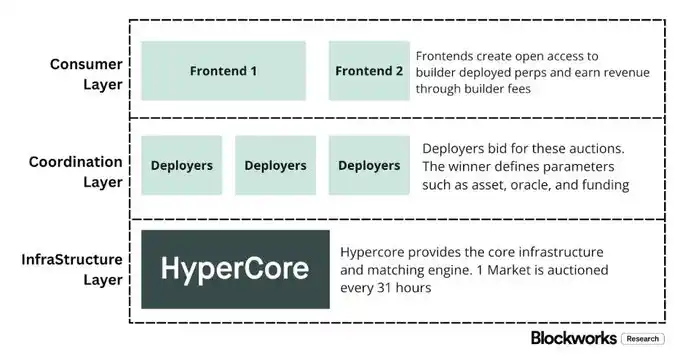
This is reflected in two types of structural splits that most crypto trading platforms have not yet truly implemented but are very typical in traditional finance (TradFi):

First, permissionless broker/distribution layer (Builder Codes).

Builder Codes allow third-party trading frontends to be built on top of the core trading venue and to charge their own economic fees. Among these, Builder fees have clear caps: up to 0.1% (10 bps) for perpetuals and up to 1% for spot, and fees can be set at the individual order level.
This mechanism thus creates a competitive market at the distribution layer, rather than having a single official application monopolize the user entry point and monetization rights.

Second, permissionless listing/product layer (HIP-3).

In traditional finance, exchanges typically control listing approvals and product creation. HIP-3 externalizes this function: developers can deploy perpetual contracts that inherit HyperCore's matching engine and API capabilities, while the definition and operation of specific markets are the responsibility of the deployer.

In terms of economic structure, HIP-3 clarifies the revenue-sharing relationship between the trading venue and the product layer: deployers of spot and HIP-3 perpetual contracts can retain up to 50% of the trading fees generated by the assets they deploy.

Builder Codes have already shown effectiveness on the distribution end: as of mid-December, approximately one-third of users trade not through the native interface but through third-party frontends.
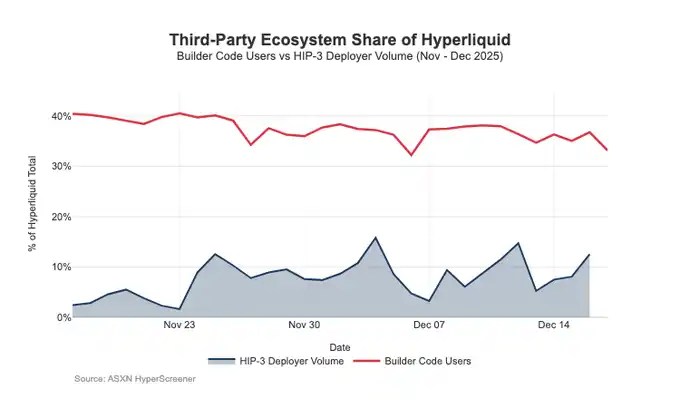
The problem is that this structure, which favors distribution expansion, itself creates持续 pressure on the trading venue layer's take rate:

1. Pricing is compressed.
Multiple frontends simultaneously selling access to the same underlying liquidity will naturally compete towards the lowest total trading cost; and Builder fees can be flexibly adjusted at the order level, further pushing prices downward.

2. Loss of monetization surfaces.
The frontend controls account opening, product bundling, subscription services, and the complete trading workflow, thereby capturing the high-margin space of the broker layer; while Hyperliquid can only retain the thinner exchange layer take rate.

3. Strategic routing risk.
Once frontends evolve into true cross-venue routers, Hyperliquid could be forced into wholesale execution competition, having to defend order flow through fee reductions or increased rebates.

Overall, Hyperliquid is consciously choosing a low-profit-margin market layer positioning (via HIP-3 and Builder Codes), while allowing a high-profit-margin broker layer to grow on top of it.


If Builder frontends continue to expand, they will increasingly determine user-facing pricing structures, control user retention and monetization interfaces, and gain bargaining power at the routing level, structurally creating long-term pressure on Hyperliquid's take rate.

Defending Distribution Rights and Introducing Non-Exchange Profit Pools

The most direct risk is commoditization.

If third-party frontends can consistently undercut the native interface on price long-term, or even ultimately achieve cross-venue routing, Hyperliquid would be pushed towards a wholesale execution economic model.

Recent design adjustments show that Hyperliquid is trying to avoid this outcome while exploring new revenue sources.

Distribution Defense: Maintaining the Native Frontend's Economic Competitiveness

A previously proposed staking discount scheme, which allowed Builders to receive up to a 40% fee discount by staking HYPE, effectively provided third-party frontends with a path to be structurally cheaper than Hyperliquid's native interface. The withdrawal of this proposal equates to canceling direct subsidies for external distribution "price undercutting."

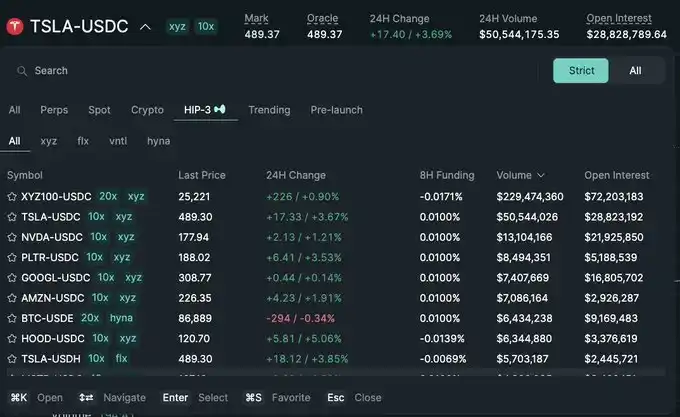
At the same time, HIP-3 markets were initially positioned to be distributed primarily through Builders and not displayed on the main frontend;但现在, these markets have begun to be displayed on Hyperliquid's native frontend, subject to strict listing standards.

This signal is very clear: Hyperliquid remains permissionless at the Builder layer but will not do so at the cost of sacrificing its core distribution rights.
USDH: Shifting from Trading Monetization to "Float" Monetization

The launch of USDH aims to recapture stablecoin reserve earnings that would otherwise be captured outside the ecosystem. Its公开 structure is a 50/50 split of reserve收益: 50% to Hyperliquid, 50% for USDH ecosystem growth.


Simultaneously, the trading fee discounts offered for USDH-related markets further reinforce this orientation: Hyperliquid is willing to concede on per-transaction economics in exchange for a larger, stickier profit pool tied to balances.


In effect, this introduces an annuity-like revenue stream for the protocol, whose growth depends on the monetary base size, not just nominal trading volume.

Portfolio Margin: Introducing Prime Broker-like Financing Economics

Portfolio margin unifies the margin for spot and perpetual contracts, allowing different exposures to offset each other, and introduces a native borrowing loop.


Hyperliquid will retain 10% of the interest paid by borrowers, making the protocol's economics increasingly dependent on leverage utilization and interest rate levels, not just trading volume. This is closer to a broker/prime revenue model than pure exchange logic.

Hyperliquid's Path Towards a "Brokerage-Style" Economic Model

In terms of throughput, Hyperliquid has already reached first-tier trading venue scale; but in terms of monetization, it still resembles the market layer: extremely high nominal trading volume paired with a single-digit basis point effective take rate. The gap with Coinbase and Robinhood is structural.

Retail platforms reside at the broker layer, controlling user relationships and fund balances, able to monetize multiple profit pools (financing, idle cash, subscriptions); whereas pure trading venues sell execution services, and under liquidity and routing competition, execution naturally tends towards commoditization, with net capture being持续 compressed. Nasdaq is the TradFi reference for this constraint.

Hyperliquid initially leaned明显 towards the trading venue prototype. By splitting the distribution layer (Builder Codes) and the product creation layer (HIP-3), it accelerated ecosystem expansion and market coverage; the cost is that this architecture could also push economics outward: once third-party frontends determine composite prices and can route cross-venue, Hyperliquid risks being squeezed into a thin-margin wholesale execution轨道.

However, recent actions show a conscious pivot: defending distribution rights and expanding revenue sources to "balance-based" profit pools, without abandoning the advantages of unified execution and clearing.

Specifically: the protocol is no longer willing to subsidize external frontends to be structurally cheaper than the native UI; HIP-3 is being displayed more natively; and balance sheet-style revenue sources are being introduced.


USDH pulls reserve earnings back into the ecosystem (50/50 split, with fee discounts for USDH markets); portfolio margin introduces financing economics through a 10% take on borrower interest.

Overall, Hyperliquid is converging towards a hybrid model: an execution rail as the foundation, overlaid with distribution defense and balance-driven profit pools. This reduces the risk of being trapped in a low-bps, wholesale-type trading venue, while moving closer to a brokerage-style revenue structure without sacrificing the advantages of unified execution and clearing.

Looking ahead to 2026, the unresolved question is: Can Hyperliquid move further towards a brokerage-style economy without破坏 its "outsourcing-friendly" model. USDH is the clearest test case: at the current supply level of approximately $100 million, expansion through外包发行 appears relatively slow when the protocol doesn't control distribution.


An obvious alternative path could have been UI-level defaults—for example, automatically converting the roughly $4 billion USDC存量 into the native stablecoin (similar to Binance's auto-conversion for BUSD).


If Hyperliquid wants to truly capture broker-layer profit pools, it might also need brokerage-style behavior: stronger control, tighter native product integration, and clearer boundaries with ecosystem teams regarding distribution and balance competition.


Пов'язані питання

QWhy does Hyperliquid generate less revenue than Coinbase despite having a similar trading volume?

AHyperliquid operates as a low-fee, wholesale execution venue (market layer) with an effective take rate of around 3.9 bps, while Coinbase functions as a retail-focused broker-dealer (distribution layer) with a higher take rate of 35.5 bps, leveraging multiple revenue streams like subscriptions, interest, and order flow payments.

QWhat is the key structural difference between Hyperliquid's and Coinbase's business models?

AHyperliquid is positioned as an exchange-like infrastructure layer focused on high-efficiency execution with compressed fees, whereas Coinbase is a broker-dealer that controls user relationships, balances, and multiple high-margin revenue interfaces such as custody, lending, and subscription services.

QHow do Builder Codes and HIP-3 contribute to Hyperliquid's ecosystem but also pressure its fee structure?

ABuilder Codes enable third-party frontends to compete on分销, driving down overall trading costs, while HIP-3 allows external product deployment with up to 50% fee sharing. Both expand ecosystem but structurally compress Hyperliquid's take rate by fostering competition and outsourcing high-margin分销 activities.

QWhat strategies is Hyperliquid adopting to defend its economic model and capture more value?

AHyperliquid is defending its分销 by retracting subsidies for third-party frontends, natively showcasing HIP-3 markets, and introducing balance-driven revenue pools like USDH (50%收益分成) and portfolio margin (10% interest抽成) to shift toward broker-dealer economics without sacrificing execution efficiency.

QHow does Nasdaq's financial evolution reflect the challenges Hyperliquid might face as a market-layer platform?

ANasdaq's declining reliance on market services revenue (from 39.4% in 2014 to 22% in 2024) due to structurally compressed exchange-layer fees mirrors Hyperliquid's challenge: high volume with low take rates. Both are pushed to diversify into higher-margin, non-transactional revenue streams like data, tech services, or balance-based products.

Пов'язані матеріали

Why Do You Always Lose Money on Polymarket? Because You're Betting on News, While the Pros Read the Rules

Why do you always lose money on Polymarket? Because you bet on news, while the pros study the rules. This article explains how top traders ("che tou") profit by meticulously analyzing market rules, not just predicting events. Polymarket, a prediction market platform, often sees disputes over event outcomes due to ambiguous rule wording. For instance, a market asking "Who will be the leader of Venezuela by the end of 2026?" was misinterpreted by many who bet on Delcy Rodríguez, assuming she held power. However, the rules specified "officially holds" as the formally appointed, sworn-in individual. Since Nicolás Maduro was still recognized as president officially, he won the market—even being in prison. To resolve such disputes, Polymarket uses a decentralized arbitration system via UMA protocol. The process involves: 1. Proposal: Anyone can propose a market outcome by staking 750 USDC, earning 5 USDC if unchallenged. 2. Dispute: A 2-hour window allows challenges with a 750 USDC stake; successful challengers earn 250 USDC. 3. Discussion: A 48-hour period on UMA Discord for evidence and debate. 4. Voting: UMA token holders vote in two 24-hour phases (blind then public). Outcomes require >65% consensus and 5M tokens voted; otherwise, four re-votes occur before Polymarket intervention. 5. Settlement: Results are final and automatic. Unlike traditional courts, Polymarket’s system lacks separation between arbitrators and stakeholders—voters often hold market positions, creating conflicts of interest. This leads to herd mentality in discussions and non-transparent outcomes without explanatory rulings, preventing precedent formation. Thus, success on Polymarket hinges on deep rule interpretation, not just event prediction, exploiting gaps between reality and contractual wording.

marsbit1 год тому

Why Do You Always Lose Money on Polymarket? Because You're Betting on News, While the Pros Read the Rules

marsbit1 год тому

DeepSeek Funding: Liang Wenfeng's 'Realist' Pivot

DeepSeek, a leading Chinese AI company, has initiated its first external funding round, aiming to raise at least $300 million at a valuation of no less than $10 billion. This move marks a significant shift from its founder Liang Wenfeng’s previous idealistic stance of rejecting external capital to maintain independence. Despite strong financial backing from its parent company, quantitative trading firm幻方量化 (Huanfang Quant), which provided an estimated $700 million in revenue in 2025 alone, DeepSeek faces mounting challenges. Key issues include a 15-month gap in major model updates, delays in its flagship V4 release, and the loss of several core researchers to competitors offering significantly higher compensation. The company is also undergoing a strategic pivot by migrating its infrastructure from NVIDIA’s CUDA to Huawei’s Ascend platform, a move aligned with China’s push for technological self-reliance amid U.S. export controls. However, DeepSeek lags behind rivals like智谱AI and MiniMax—both now publicly listed—in areas such as product ecosystem, multimodal capabilities, and commercialization. The funding round, though relatively small in scale, is seen as a way to establish a market-validated valuation anchor, making employee stock options more competitive and facilitating talent retention. It also signals DeepSeek’s transition from a pure research-oriented organization to a commercially-driven player in the global AI ecosystem.

marsbit2 год тому

DeepSeek Funding: Liang Wenfeng's 'Realist' Pivot

marsbit2 год тому

Торгівля

Спот
Ф'ючерси

Популярні статті

Що таке $S$

Розуміння SPERO: Комплексний огляд Вступ до SPERO Оскільки ландшафт інновацій продовжує еволюціонувати, виникнення технологій web3 та криптовалютних проектів відіграє ключову роль у формуванні цифрового майбутнього. Один з проектів, який привернув увагу в цій динамічній сфері, — це SPERO, позначений як SPERO,$$s$. Ця стаття має на меті зібрати та представити детальну інформацію про SPERO, щоб допомогти ентузіастам та інвесторам зрозуміти його основи, цілі та інновації в рамках web3 та крипто-сектору. Що таке SPERO,$$s$? SPERO,$$s$ — це унікальний проект у криптопросторі, який прагне використати принципи децентралізації та технології блокчейн для створення екосистеми, що сприяє залученню, корисності та фінансовій інклюзії. Проект розроблений для полегшення взаємодії між користувачами новими способами, надаючи їм інноваційні фінансові рішення та послуги. У своїй основі SPERO,$$s$ прагне надати можливості індивідам, забезпечуючи інструменти та платформи, які покращують користувацький досвід у криптовалютному просторі. Це включає в себе можливість більш гнучких методів транзакцій, сприяння ініціативам, що підтримуються спільнотою, та створення шляхів для фінансових можливостей через децентралізовані додатки (dApps). Основна концепція SPERO,$$s$ обертається навколо інклюзивності, прагнучи зменшити розриви в традиційній фінансовій системі, використовуючи переваги технології блокчейн. Хто є творцем SPERO,$$s$? Особистість творця SPERO,$$s$ залишається дещо невідомою, оскільки є обмежені публічно доступні ресурси, що надають детальну інформацію про його засновників. Ця відсутність прозорості може бути наслідком зобов'язання проекту до децентралізації — етики, яку багато проектів web3 поділяють, ставлячи колективні внески вище за індивідуальне визнання. Зосереджуючи обговорення навколо спільноти та її колективних цілей, SPERO,$$s$ втілює суть наділення без виділення конкретних осіб. Таким чином, розуміння етики та місії SPERO є більш важливим, ніж ідентифікація єдиного творця. Хто є інвесторами SPERO,$$s$? SPERO,$$s$ підтримується різноманітними інвесторами, починаючи від венчурних капіталістів до ангельських інвесторів, які прагнуть сприяти інноваціям у крипто-секторі. Зосередження цих інвесторів зазвичай узгоджується з місією SPERO — пріоритет надається проектам, які обіцяють технологічний прогрес у суспільстві, фінансову інклюзію та децентралізоване управління. Ці інвесторські фонди зазвичай зацікавлені в проектах, які не лише пропонують інноваційні продукти, але й позитивно впливають на спільноту блокчейн та її екосистеми. Підтримка з боку цих інвесторів підкріплює SPERO,$$s$ як значного конкурента в швидко змінюваній сфері крипто-проектів. Як працює SPERO,$$s$? SPERO,$$s$ використовує багатогранну структуру, яка відрізняє його від традиційних криптовалютних проектів. Ось деякі ключові особливості, які підкреслюють його унікальність та інноваційність: Децентралізоване управління: SPERO,$$s$ інтегрує моделі децентралізованого управління, надаючи користувачам можливість активно брати участь у процесах прийняття рішень щодо майбутнього проекту. Цей підхід сприяє відчуттю власності та відповідальності серед членів спільноти. Корисність токена: SPERO,$$s$ використовує свій власний криптовалютний токен, розроблений для виконання різних функцій в екосистемі. Ці токени дозволяють здійснювати транзакції, отримувати винагороди та полегшувати послуги, що пропонуються на платформі, підвищуючи загальну залученість та корисність. Шарова архітектура: Технічна архітектура SPERO,$$s$ підтримує модульність та масштабованість, що дозволяє безперешкодно інтегрувати додаткові функції та додатки в міру розвитку проекту. Ця адаптивність є надзвичайно важливою для збереження актуальності в постійно змінюваному крипто-ландшафті. Залучення спільноти: Проект підкреслює ініціативи, що підтримуються спільнотою, використовуючи механізми, які стимулюють співпрацю та зворотний зв'язок. Підтримуючи сильну спільноту, SPERO,$$s$ може краще задовольняти потреби користувачів та адаптуватися до ринкових тенденцій. Фокус на інклюзію: Пропонуючи низькі комісії за транзакції та зручні інтерфейси, SPERO,$$s$ прагне залучити різноманітну базу користувачів, включаючи осіб, які раніше не брали участі в крипто-просторі. Це зобов'язання до інклюзії узгоджується з його загальною місією наділення через доступність. Хронологія SPERO,$$s$ Розуміння історії проекту надає важливі уявлення про його розвиток та етапи. Нижче наведено пропоновану хронологію, що відображає значні події в еволюції SPERO,$$s$: Етап концептуалізації та ідеації: Початкові ідеї, що стали основою SPERO,$$s$, були сформовані, тісно пов'язані з принципами децентралізації та фокусом на спільноті в індустрії блокчейн. Запуск білого паперу проекту: Після концептуального етапу був випущений комплексний білий папір, що детально описує бачення, цілі та технологічну інфраструктуру SPERO,$$s$, щоб залучити інтерес та зворотний зв'язок від спільноти. Створення спільноти та ранні залучення: Активні зусилля були спрямовані на створення спільноти ранніх прихильників та потенційних інвесторів, що полегшило обговорення цілей проекту та отримання підтримки. Подія генерації токенів: SPERO,$$s$ провів подію генерації токенів (TGE) для розподілу своїх рідних токенів серед ранніх прихильників та встановлення початкової ліквідності в екосистемі. Запуск початкового dApp: Перший децентралізований додаток (dApp), пов'язаний з SPERO,$$s$, став доступним, дозволяючи користувачам взаємодіяти з основними функціями платформи. Постійний розвиток та партнерства: Безперервні оновлення та вдосконалення пропозицій проекту, включаючи стратегічні партнерства з іншими учасниками блокчейн-простору, сформували SPERO,$$s$ у конкурентоспроможного та еволюціонуючого гравця на крипто-ринку. Висновок SPERO,$$s$ є свідченням потенціалу web3 та криптовалют для революціонізації фінансових систем та наділення індивідів. Завдяки зобов'язанню до децентралізованого управління, залучення спільноти та інноваційно спроектованих функцій, він прокладає шлях до більш інклюзивного фінансового ландшафту. Як і з будь-якими інвестиціями в швидко змінюваному крипто-просторі, потенційним інвесторам та користувачам рекомендується ретельно досліджувати та обдумано взаємодіяти з поточними подіями в SPERO,$$s$. Проект демонструє інноваційний дух крипто-індустрії, запрошуючи до подальшого дослідження його численних можливостей. Хоча подорож SPERO,$$s$ ще триває, його основні принципи можуть справді вплинути на майбутнє того, як ми взаємодіємо з технологією, фінансами та один з одним у взаємопов'язаних цифрових екосистемах.

73 переглядів усьогоОпубліковано 2024.12.17Оновлено 2024.12.17

Що таке $S$

Що таке AGENT S

Агент S: Майбутнє автономної взаємодії в Web3 Вступ У постійно змінюваному ландшафті Web3 та криптовалюти інновації постійно переосмислюють, як люди взаємодіють з цифровими платформами. Один з таких новаторських проектів, Агент S, обіцяє революціонізувати взаємодію людини з комп'ютером через свою відкриту агентну структуру. Прокладаючи шлях для автономних взаємодій, Агент S прагне спростити складні завдання, пропонуючи трансформаційні застосування в штучному інтелекті (ШІ). Це детальне дослідження заглиблюється в складності проекту, його унікальні особливості та наслідки для сфери криптовалюти. Що таке Агент S? Агент S є революційною відкритою агентною структурою, спеціально розробленою для вирішення трьох основних викликів в автоматизації комп'ютерних завдань: Набуття специфічних знань у галузі: Структура інтелектуально навчається з різних зовнішніх джерел знань та внутрішнього досвіду. Цей подвійний підхід дозволяє їй створити багатий репозиторій специфічних знань у галузі, покращуючи її продуктивність у виконанні завдань. Планування на довгих горизонтах завдань: Агент S використовує планування з підкріпленням досвіду, стратегічний підхід, який полегшує ефективний розподіл та виконання складних завдань. Ця функція значно підвищує її здатність ефективно та результативно управляти кількома підзавданнями. Обробка динамічних, неоднорідних інтерфейсів: Проект представляє Інтерфейс Агент-Комп'ютер (ACI), інноваційне рішення, яке покращує взаємодію між агентами та користувачами. Використовуючи багатомодальні великі мовні моделі (MLLMs), Агент S може безперешкодно орієнтуватися та маніпулювати різноманітними графічними інтерфейсами користувача. Завдяки цим новаторським функціям Агент S надає надійну структуру, яка вирішує складнощі, пов'язані з автоматизацією людської взаємодії з машинами, прокладаючи шлях для численних застосувань у ШІ та за його межами. Хто є творцем Агент S? Хоча концепція Агент S є фундаментально новаторською, конкретна інформація про його творця залишається невідомою. Творець наразі невідомий, що підкреслює або початкову стадію проекту, або стратегічний вибір зберегти засновників у таємниці. Незважаючи на анонімність, акцент залишається на можливостях та потенціалі структури. Хто є інвесторами Агент S? Оскільки Агент S є відносно новим у криптографічній екосистемі, детальна інформація про його інвесторів та фінансових спонсорів не задокументована. Відсутність публічно доступних відомостей про інвестиційні фонди або організації, що підтримують проект, викликає питання щодо його фінансової структури та дорожньої карти розвитку. Розуміння підтримки є критично важливим для оцінки стійкості проекту та потенційного впливу на ринок. Як працює Агент S? В основі Агент S лежить передова технологія, яка дозволяє йому ефективно функціонувати в різних умовах. Його операційна модель побудована навколо кількох ключових функцій: Взаємодія з комп'ютером, подібна до людської: Структура пропонує розширене планування ШІ, прагнучи зробити взаємодії з комп'ютерами більш інтуїтивними. Імітуючи людську поведінку при виконанні завдань, вона обіцяє підвищити досвід користувачів. Наративна пам'ять: Використовується для використання високорівневого досвіду, Агент S використовує наративну пам'ять для відстеження історій завдань, тим самим покращуючи свої процеси прийняття рішень. Епізодична пам'ять: Ця функція надає користувачам покрокові інструкції, дозволяючи структурі пропонувати контекстуальну підтримку в міру виконання завдань. Підтримка OpenACI: Завдяки можливості працювати локально, Агент S дозволяє користувачам зберігати контроль над своїми взаємодіями та робочими процесами, узгоджуючи з децентралізованою етикою Web3. Легка інтеграція з зовнішніми API: Його універсальність і сумісність з різними платформами ШІ забезпечують те, що Агент S може безперешкодно вписатися в існуючі технологічні екосистеми, роблячи його привабливим вибором для розробників та організацій. Ці функціональні можливості колективно сприяють унікальному положенню Агент S у крипто-просторі, оскільки він автоматизує складні, багатоступеневі завдання з мінімальним втручанням людини. У міру розвитку проекту його потенційні застосування в Web3 можуть переосмислити, як відбуваються цифрові взаємодії. Хронологія Агент S Розробка та етапи Агент S можуть бути узагальнені в хронології, яка підкреслює його значні події: 27 вересня 2024 року: Концепція Агент S була представлена в комплексній науковій статті під назвою “Відкрита агентна структура, яка використовує комп'ютери як людина”, що демонструє основи проекту. 10 жовтня 2024 року: Наукова стаття була опублікована на arXiv, пропонуючи детальне дослідження структури та її оцінки продуктивності на основі бенчмарку OSWorld. 12 жовтня 2024 року: Було випущено відеопрезентацію, що надає візуальне уявлення про можливості та особливості Агент S, ще більше залучаючи потенційних користувачів та інвесторів. Ці маркери в хронології не лише ілюструють прогрес Агент S, але й вказують на його прихильність до прозорості та залучення громади. Ключові моменти про Агент S У міру розвитку структури Агент S кілька ключових характеристик виділяються, підкреслюючи її новаторський характер та потенціал: Інноваційна структура: Розроблена для забезпечення інтуїтивного використання комп'ютерів, подібного до людської взаємодії, Агент S пропонує новий підхід до автоматизації завдань. Автономна взаємодія: Здатність автономно взаємодіяти з комп'ютерами через GUI означає стрибок до більш інтелектуальних та ефективних обчислювальних рішень. Автоматизація складних завдань: Завдяки своїй надійній методології він може автоматизувати складні, багатоступеневі завдання, роблячи процеси швидшими та менш схильними до помилок. Безперервне вдосконалення: Механізми навчання дозволяють Агенту S покращуватися на основі минулого досвіду, постійно підвищуючи свою продуктивність та ефективність. Універсальність: Його адаптивність до різних операційних середовищ, таких як OSWorld та WindowsAgentArena, забезпечує його здатність служити широкому спектру застосувань. Оскільки Агент S займає своє місце в ландшафті Web3 та криптовалюти, його потенціал покращити можливості взаємодії та автоматизувати процеси означає значний прогрес у технологіях ШІ. Завдяки своїй інноваційній структурі Агент S є прикладом майбутнього цифрових взаємодій, обіцяючи більш безперешкодний та ефективний досвід для користувачів у різних галузях. Висновок Агент S представляє собою сміливий крок вперед у поєднанні ШІ та Web3, з можливістю переосмислити, як ми взаємодіємо з технологією. Хоча проект все ще на ранніх стадіях, можливості для його застосування є величезними та переконливими. Завдяки своїй комплексній структурі, що вирішує критичні виклики, Агент S прагне вивести автономні взаємодії на передній план цифрового досвіду. У міру того, як ми заглиблюємося в сфери криптовалюти та децентралізації, проекти, подібні до Агент S, безсумнівно, відіграватимуть ключову роль у формуванні майбутнього технологій та співпраці людини з комп'ютером.

485 переглядів усьогоОпубліковано 2025.01.14Оновлено 2025.01.14

Що таке AGENT S

Як купити S

Ласкаво просимо до HTX.com! Ми зробили покупку Sonic (S) простою та зручною. Дотримуйтесь нашої покрокової інструкції, щоб розпочати свою криптовалютну подорож.Крок 1: Створіть обліковий запис на HTXВикористовуйте свою електронну пошту або номер телефону, щоб зареєструвати обліковий запис на HTX безплатно. Пройдіть безпроблемну реєстрацію й отримайте доступ до всіх функцій.ЗареєструватисьКрок 2: Перейдіть до розділу Купити крипту і виберіть спосіб оплатиКредитна/дебетова картка: використовуйте вашу картку Visa або Mastercard, щоб миттєво купити Sonic (S).Баланс: використовуйте кошти з балансу вашого рахунку HTX для безперешкодної торгівлі.Треті особи: ми додали популярні способи оплати, такі як Google Pay та Apple Pay, щоб підвищити зручність.P2P: Торгуйте безпосередньо з іншими користувачами на HTX.Позабіржова торгівля (OTC): ми пропонуємо індивідуальні послуги та конкурентні обмінні курси для трейдерів.Крок 3: Зберігайте свої Sonic (S)Після придбання Sonic (S) збережіть його у своєму обліковому записі на HTX. Крім того, ви можете відправити його в інше місце за допомогою блокчейн-переказу або використовувати його для торгівлі іншими криптовалютами.Крок 4: Торгівля Sonic (S)Легко торгуйте Sonic (S) на спотовому ринку HTX. Просто увійдіть до свого облікового запису, виберіть торгову пару, укладайте угоди та спостерігайте за ними в режимі реального часу. Ми пропонуємо зручний досвід як для початківців, так і для досвідчених трейдерів.

1.2k переглядів усьогоОпубліковано 2025.01.15Оновлено 2025.03.21

Як купити S

Обговорення

Ласкаво просимо до спільноти HTX. Тут ви можете бути в курсі останніх подій розвитку платформи та отримати доступ до професійної ринкової інформації. Нижче представлені думки користувачів щодо ціни S (S).

活动图片