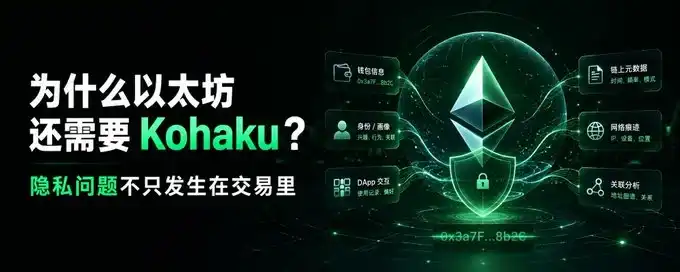
Why Does Ethereum Still Need Kohaku? Privacy Concerns Aren't Just in Transactions

marsbitОпубліковано о 2026-06-09Востаннє оновлено о 2026-06-09

Анотація

The article "Why Ethereum Still Needs Kohaku: Privacy Issues Extend Beyond Transactions" explains the Kohaku initiative as a suite of privacy-first tools designed to improve user privacy on the Ethereum network. It addresses the problem that while Ethereum's transparency enables innovation, it also exposes users' financial activities, asset holdings, and social connections when they reuse a single address. Kohaku aims to bridge the gap between existing privacy protocols (like Railgun, Privacy Pools) and practical user experience by integrating privacy features into wallets, developer tools, and daily interactions. Key focuses include: enabling wallets to manage multiple accounts for different purposes ("many accounts, many you"), facilitating controlled visibility for transactions instead of full transparency, protecting user data during RPC queries and network activity, and providing developers with easier ways to integrate privacy. The article clarifies that Kohaku is not a single product but an ongoing effort to make privacy a default, usable component of the ecosystem, moving beyond complex protocols to practical application. It counters common misconceptions, arguing that privacy is a fundamental user right for normal activities, not just for anonymity, and that it can coexist with compliance through selective disclosure. Ultimately, Kohaku represents an essential step for Ethereum's maturation, ensuring users can participate in the open network while maintaining contro...

Author: Luna

This article is an original contribution from the author. The views expressed are solely those of the author's personal understanding. ETHPanda has edited and organized the content.

Recently, the relevant team within the Ethereum Foundation has become more active in explaining the direction of this privacy-related work around Kohaku to the outside world. The community has shown considerable interest in this name, but some confusion also exists: Is it a wallet, a protocol, or a set of more underlying developer tools? This article will clarify the problems Kohaku aims to solve in a more understandable way.

Kohaku points not to a single feature, but to a theme that is increasingly difficult to avoid in Ethereum's long-term user experience: privacy. It connects privacy protocols, wallet experiences, developer tools, and daily user activities, attempting to bring these capabilities beyond just research papers or tools for a few advanced users.

If summarized in one sentence: What Kohaku wants to achieve is to allow Ethereum users to maintain basic information boundaries while using the open network.

I. First, Understand the Problem: Why Does Ethereum Have Privacy Anxiety?

The power of Ethereum largely comes from its "openness." Transactions, contracts, asset flows, and address interactions can all be verified and audited by anyone. This transparency enables open finance, on-chain governance, and composable applications.

However, the same mechanism also brings side effects: the on-chain behavior of ordinary users is almost by default exposed. An address can reveal which assets a user holds, which protocols they have participated in, when payments or receipts occurred, which addresses they have interacted with, and can even be used to infer certain social relationships or economic status.

In real life, we do not post our bank statements, shopping records, social relationships, and salary income on public bulletin boards. But in the on-chain world, if users consistently reuse the same address, similar information exposure is very likely to occur.

Therefore, Ethereum's privacy issue is not as simple as "whether someone wants to hide bad deeds." It is more like a fundamental user rights issue: As on-chain applications increasingly resemble real-life activities, can users still decide which information should be public and which should only be disclosed in necessary scenarios?

II. What is the Kohaku Initiative?

Kohaku is a set of privacy-first tooling in the Ethereum ecosystem. It revolves around wallets, privacy protocols, developer integrations, and user experience. It is not a standalone consumer App, nor is it just a single protocol.

The Kohaku documentation lists tooling directions for privacy pool protocols such as Railgun, Privacy Pools, Tornado, some of which are still WIP or in alpha stages; the GitHub repository also continued merging related implementations and version updates at the end of May. Therefore, Kohaku is more like a set of evolving privacy infrastructure tools rather than a fully finalized product.

The question it aims to answer is also very concrete: Ethereum already has some privacy protocols and cryptographic capabilities; how can wallets and applications more easily, securely, and naturally integrate them into real-world usage scenarios?

💡 The key word for Kohaku is not "mystery," but "usability": turning privacy capabilities into basic components that wallets and applications can call, users can understand, and the ecosystem can iterate upon.

III. Why is Kohaku Considered "Infrastructure Catch-up"?

Over the past few years, the Ethereum ecosystem has spent a great deal of effort solving issues like scaling, L2, account abstraction, modularity, and data availability. This work has made transactions cheaper, throughput higher, and application deployment more flexible. But for ordinary users, another issue is equally important: Will what I do on-chain be permanently, completely, and without context exposed to everyone?

Privacy technology is not new today. The problem lies in the fact that many privacy solutions have long remained at the protocol layer, research layer, or advanced user layer. Users need to understand complex concepts, wallets require additional adaptation, and developers also lack sufficiently convenient integration methods. As a result, while privacy capabilities exist, they have not become part of the default experience.

Kohaku is precisely about bridging that "from protocol to experience" middle layer. Privacy should not just be a selling point for an independent tool; it can gradually enter more routine areas such as wallet design, account management, RPC access, fund flows, and developer interfaces.

IV. What Specific Problems Might Kohaku Be Addressing?

1. Wallet Layer Privacy: Privacy Must Enter the Entry Point

The wallet is the first entry point for the vast majority of users into Ethereum. If privacy capabilities cannot enter wallets, they will be difficult for ordinary users to truly adopt.

When users connect to a dApp today, they often directly expose a long-term address. This address might be used simultaneously for DeFi, NFTs, social interactions, receiving payments, and voting. Once these activities are linked together, the address is no longer just a technical identifier but becomes a publicly analyzable dossier.

The concept of "many accounts, many you" mentioned in the Kohaku documentation provides an intuitive idea: in reality, a person uses different identities in different scenarios. Correspondingly, in the on-chain experience, wallets could also make it easier for users to create and manage different accounts for different dApps and purposes, and complete funding and usage in more privacy-friendly ways.

2. Transaction Privacy: From "Fully Public" to "Controllable Visibility"

Ethereum transactions are transparent by default; the sender, receiver, amount, and transaction data may all be visible. But not all transactions need to disclose their complete context permanently to the entire network.

This does not mean turning Ethereum into a completely black-box system. A more reasonable direction is "controllable visibility": users can prove, disclose, and audit when necessary, but do not need to expose all information indiscriminately to all observers.

Privacy pool protocols like Railgun and Privacy Pools attempt to provide such capabilities. Kohaku's role, then, is more akin to helping wallets and applications integrate these protocol capabilities into usable experiences.

3. RPC & Network Privacy: Queries Themselves Can Leak Information

When many people discuss on-chain privacy, they only focus on whether transactions are public, overlooking another issue: when wallets query on-chain data, they might also leak what the user is looking at, checking, or which addresses they are concerned about.

Wallets typically need to obtain on-chain information via RPC. If all requests pass through centralized RPC services, users' querying behavior itself could form a profile. Therefore, the Kohaku documentation mentions directions like private RPC, user-defined RPC, light clients, and verifying untrusted RPC results through light clients like Helios.

This type of work may sound less eye-catching than "private transactions," but it is crucial for the real user experience. Because privacy doesn't only happen at the moment a transaction is sent; it also occurs in every step where a wallet loads balances, browses history, connects to applications, and requests data.

4. Developer Usability: Privacy Cannot Stay Only in Papers

For privacy technology to enter mainstream applications, developers must be able to understand and integrate it at low cost. Otherwise, even the strongest cryptographic capabilities can only serve a few teams familiar with the underlying mechanisms.

Through toolkits, documentation, and wallet implementations, Kohaku breaks down these problems into modules more accessible to developers: Which privacy protocols can be integrated? How do wallets handle accounts? How do users complete shield/unshield? How to retain necessary proving capabilities while protecting privacy?

This work requires not just code, but also ecosystem understanding. Wallet teams, protocol teams, application developers, and ordinary users all need to understand more clearly: What problems is Kohaku actually solving, and how will these capabilities enter daily use?

V. Common Misconceptions: Privacy Is Not a Thin Slogan

Misconception 1: Privacy Equals Anonymous Crime Tools

This is the most common and easily misleading misconception. In reality, privacy is a basic need for ordinary people: you would not want all your payment records, asset status, and social relationships to be queried by strangers at any time. On-chain privacy follows the same logic.

Of course, privacy tools need to address risks of abuse and explore mechanisms for proof, disclosure, and risk control. However, the existence of risks should not lead to negating all reasonable privacy needs of users.

Misconception 2: Ethereum Already Has Privacy Protocols, So the Problem Is Solved

There is a big gap between "having tools" and "users being able to use them naturally." Ordinary users will not research complex protocols for every daily interaction, nor will they voluntarily take on the security risks that come with high-threshold operations.

Therefore, the real key is to build privacy capabilities into wallets, default processes, and developer interfaces. Only when users can make safer choices without becoming cryptography experts can privacy be considered to have entered the product layer.

Misconception 3: Kohaku Is a Standalone Product

Kohaku is not a single product but a set of work revolving around privacy protocol toolkits, wallet implementations, best practices, RPC privacy, and developer integrations.

Thus, evaluating Kohaku is not just about whether it has launched a standalone App, but also about whether these tools can be absorbed by more wallets and applications to become part of the default experience.

Misconception 4: Privacy and Compliance Are Inevitably in Conflict

There is indeed tension between privacy and compliance, but it is not necessarily a binary choice. More important future directions may include minimizing information exposure, selective disclosure, verifiable claims, risk isolation, and user authorization.

In other words, good privacy design is not about making all information disappear, but about allowing information to be disclosed only in appropriate scenarios, with appropriate granularity, and to appropriate parties.

VI. What Would Users Experience After These Capabilities Enter Wallets?

If work like Kohaku is adopted by more wallets, ordinary users might first notice not complex cryptographic concepts, but several changes closer to daily use.

  • Wallets might encourage users to manage accounts by scenario more, rather than tying all activities to one long-term address.
  • The barrier to using privacy protocols might decrease, but this depends on wallet integration, protocol maturity, and security audit progress.
  • Wallets might pay more attention to RPC, query, and network layer leakage issues; users would be protected not just in transactions themselves, but also in their querying behavior.
  • Users might have more choices: when to be public, to whom, and to what extent.

These changes will not happen overnight, nor do they mean all wallets will immediately incorporate complex privacy features. But they point in the same direction: the maturation of Ethereum's user experience should not only be reflected in being cheaper and faster, but also in being safer and having more defined boundaries.

VII. What Should Developers Focus On?

For developers, the focus of Kohaku is not to require all applications to immediately shift to being privacy-first, but to make privacy capabilities easier to understand, test, and integrate.

In the past, many applications by default required users to connect with the same address and built all interactions on the premise of address traceability. As privacy tools gradually mature, product teams can rethink: Should they support more granular identities? Should they reduce unnecessary data exposure? Should they make privacy protection a more natural default process, rather than hiding it in advanced settings?

This is especially true for wallet teams. Wallets are not just signing tools; they are also the management layer for user identity, assets, permissions, and information boundaries. The value of Kohaku ultimately depends on whether these complex technologies can be translated into simple, trustworthy, low-friction interactions.

Conclusion: Privacy Is a Piece of the Puzzle for Ethereum's Journey Towards Everyday Use

If Ethereum were merely an open ledger used by a few developers and traders, the privacy pressure brought by transparency might not be so apparent. But if Ethereum is to carry broader activities like payments, identity, social interactions, organizational collaboration, and finance, then privacy is no longer a peripheral issue.

The importance of the Kohaku Initiative lies precisely here: it not only states "Ethereum needs privacy," but also places privacy back into the positions that truly affect user experience—wallets, protocols, and developer tools.

Kohaku is still under construction and iteration, but it addresses a very real problem: In a default-public on-chain world, how can users regain the right to choose?

This might also be a question that Ethereum's next phase of user experience must answer. Truly mature public infrastructure should not only allow everyone to participate but also enable everyone to maintain reasonable boundaries while participating.

Пов'язані питання

QWhat is the primary purpose of the Kohaku Initiative within the Ethereum ecosystem, as described in the article?

AThe primary purpose of the Kohaku Initiative is to bridge the gap between existing privacy protocols/capabilities and real-world user experience. It is a set of privacy-first tooling focused on making privacy features easier to integrate into wallets, more understandable for users, and more accessible for developers, moving them from research papers into default user experiences.

QAccording to the article, what is one of the key misconceptions about privacy on Ethereum that the author addresses?

AA key misconception addressed is that 'privacy equals anonymous crime tools.' The author argues that privacy is a fundamental need for ordinary users, akin to not wanting all payment records, asset status, and social relationships to be publicly queryable. While acknowledging risks of abuse, the article asserts that reasonable user privacy demands should not be dismissed.

QBesides transaction privacy, what other aspect of user activity does Kohaku aim to protect, as mentioned in the section about RPC and network privacy?

AKohaku aims to protect the privacy of user queries and data-fetching behavior. When wallets query blockchain data via RPC services, these requests can reveal what information a user is looking at, which addresses they are checking, or what they are interested in, potentially creating a user profile. Kohaku explores solutions like private RPC and light clients to address this.

QWhat specific user experience change might wallets adopting Kohaku's principles encourage, according to the article?

AWallets might encourage users to manage different accounts for different scenarios or purposes, rather than binding all activities to a single, long-term address. This aligns with the concept of 'many accounts, many you,' helping users maintain better information boundaries across various dApps and use cases.

QHow does the article define the relationship between privacy and compliance, arguing against a common misunderstanding?

AThe article argues that privacy and compliance are not necessarily in conflict. The future direction should focus on minimizing information exposure, enabling selective disclosure, using verifiable claims, isolating risks, and implementing user authorization. Good privacy design allows information to be disclosed only in appropriate scenarios, to appropriate parties, and with appropriate granularity, rather than hiding everything.

Пов'язані матеріали

Wang Chuan: After Investing in Storage Stocks and Seeing a Thirty-Fold Return, How to Remain Unanxious (Part 7) - A Quarter-Century Cycle

Wang Chuan: Reflections on Investment Anxiety and Market Cycles After Observing a 30x Gain in a Storage Stock (Part 7) – A Quarter-Century Cycle This article examines the cyclical nature and inherent risks in technology hardware investments, using the storage and semiconductor sectors as examples. It criticizes the misleading practice of "annualized" Net Dollar Retention (NDR) rates, where short-term growth is extrapolated unrealistically. A key concept explored is "reflexivity" – demand driven by panic, exploration, and liquidity during market booms, which can vanish just as quickly when conditions reverse. This reflexivity exists both in product demand and among speculative stock buyers, creating powerful feedback loops that inflate prices during upturns and exacerbate crashes during downturns. The author highlights a major risk for hardware sectors: unlike assets with defined cycles (e.g., Bitcoin's halving), there's no guarantee of a swift recovery post-crash. Companies like Micron, Intel, and Cisco took roughly a quarter-century to surpass their 2000 highs, enduring drawdowns exceeding 80%. This is attributed to the "bullwhip effect" in supply chains, where demand collapses instantly but过剩产能 persists, and a migration of narrative-driven capital. High-valuation stories吸引 speculative funds during growth phases, but these funds quickly depart for the next hot narrative once growth slows, leaving behind stronger companies with much lower valuations. The piece warns of dangerous mental models formed during bull markets: 1) equating current strong demand with perpetual high growth, and 2) believing that making fast, large profits is easy. Citing巴菲特, the author notes that easy money undermines rationality, likening speculators to Cinderella at a ball with a clock that has no hands. The current phase presents an asymmetric risk-reward scenario: potential for further gains exists, but the downside risk is an 80%+ drawdown and a multi-decade wait for breakeven, which reflexive speculators cannot tolerate. The hypothetical investor "老王" (Lao Wang), who achieved a 30x return, is used to illustrate potential pitfalls. Leverage could lead to a wipeout during a sharp correction. Even without leverage, ingrained beliefs in easy money would likely lead him to double down after losses, expecting a quick rebound. Instead, he might face a protracted decline, depleting his resources through frantic trading as the high-growth narrative fades. The conclusion references Schopenhauer, comparing those who have seen multiple market cycles to an audience seeing the same magic trick repeatedly—once the illusion is understood, its power is gone.

marsbit20 хв тому

Wang Chuan: After Investing in Storage Stocks and Seeing a Thirty-Fold Return, How to Remain Unanxious (Part 7) - A Quarter-Century Cycle

marsbit20 хв тому

US Stocks Too Expensive? This Top CIO Scoured the Globe and Found 5 Stocks More Attractive Than NVIDIA

Summary: Main Street Research CIO James Demmert maintains his bullish 8,100 target for the S&P 500 but argues that greater opportunities now lie overseas. He identifies five international stocks with superior valuations poised to benefit from the AI revolution, suggesting international markets will outperform the US for years. Key Recommendations: 1. **ASML (Netherlands):** A foundational chip manufacturing technology provider, offering crucial AI exposure and geographic diversification. Demmert's top long-term pick. 2. **HSBC (UK/Asia):** A global bank with a 9x P/E ratio, better growth prospects than US peers like JPMorgan, and strong Asian presence. 3. **Siemens Energy (Germany):** A direct play on global power grid expansion driven by AI, crypto, and EV electricity demand. 4. **BHP Group (Australia):** A "hidden AI play" and "second derivative" of the trend due to massive copper demand for data centers. Trades at a 16x P/E. 5. **AstraZeneca (UK):** An undervalued healthcare stock with a strong pipeline (18x P/E, >20% growth), expected to benefit from AI's impact on medicine. Core Thesis: International outperformance is driven by both attractive valuations and a major policy shift. While the US tightens fiscal policy, Europe and Japan are launching unprecedented stimulus, reigniting growth. Demmert recommends allocating 45% of a portfolio internationally, citing excessive US investor conservatism as a key mistake.

marsbit25 хв тому

US Stocks Too Expensive? This Top CIO Scoured the Globe and Found 5 Stocks More Attractive Than NVIDIA

marsbit25 хв тому

a16z Partner: Three Paths for Crypto Projects to Find PMF

Author: Jason Rosenthal. Compiler: Shenchao TechFlow. Finding Product-Market Fit (PMF) is the most critical variable for a company's survival. In the crypto space, misaligned growth hacking and airdrops often mask the absence of true PMF. However, leading teams are now finding PMF faster. Here are three proven paths for crypto projects to achieve PMF: 1. **Co-build with Anchor Clients:** Partner with the most sophisticated potential clients in your field and develop the product based on their specific needs. Their adoption serves as the strongest validation, more valuable than media coverage or TVL metrics. This approach is shaping current product roadmaps, as seen in collaborations between crypto startups and traditional finance. 2. **Position Ahead of an Exponential Curve:** Identify and position yourself ahead of a major emerging trend before the market fully realizes it. The most evident current curve is the rise of AI Agents as autonomous economic actors. Projects like AgentCash by Merit Systems, which enables AI Agents to pay for API access with crypto, are building foundational payment rails for the impending Agent economy. 3. **Be Your Own First and Best Customer:** The most enduring infrastructure companies don't wait for external validation. They first build and prove their technology by using it to power their own applications at scale before offering it to others. Matter Labs exemplifies this by anchoring its ZKsync technology in a concrete application, Cari Network, which enables U.S. regional banks to conduct real-time, on-chain interbank transfers of tokenized deposits. The underlying logic is consistent: the fastest path to PMF involves choosing the right battlefield and executing with conviction—by co-building with clients whose validation compounds, positioning ahead of the curve before consensus forms, or becoming your own best case study.

marsbit26 хв тому

a16z Partner: Three Paths for Crypto Projects to Find PMF

marsbit26 хв тому

Wang Chuan: How to Avoid Anxiety When the Neighbor, Lao Wang, Made Thirty Times His Investment in Storage Stocks (7) - A Quarter-Century Cycle

Wang Chuan: Reflections on a Quarter-Century Cycle – How to Stay Calm After a 30x Gain on Storage Stocks (Part 7) This article continues the discussion on investment pitfalls. It highlights the deceptive use of metrics like the "Annualized Net Dollar Retention Rate" by some companies to inflate growth projections. The core analysis focuses on the "reflexivity" present in both product demand and financial markets during boom periods. In a bubble, speculative and fear-driven demand in the real economy interacts with speculative, leveraged buying in financial markets, creating a powerful upward feedback loop. This dynamic reverses sharply when faced with physical or liquidity constraints, leading to a cascading downturn. The hardware and semiconductor sectors face unique risks. Unlike assets with defined cycles, there's no guarantee of a swift recovery post-crash. Historical examples like Micron, Intel, and Cisco show it can take decades to surpass previous peaks after severe drawdowns (80-95%). This is due to the "bullwhip effect" in supply chains—demand vanishes quickly while过剩产能 persists—and the migration of speculative capital and growth narratives to new sectors once momentum slows. Companies may have stronger fundamentals years later, but the speculative "soul" of extreme valuations is long gone. The author warns of psychological traps for new investors: mistaking temporary, intense demand for permanent growth, and believing that making quick, large profits is easy. Citing Buffett, the piece cautions that easy money erodes rationality. The current phase presents an asymmetric risk-reward scenario: potential for further gains versus the risk of an 80%+ drawdown and a multi-decade recovery wait—an outcome reflexive speculators cannot endure. The hypothetical "Lao Wang" who made 30x may be wiped out by leverage or, driven by the "get-rich-quick" mindset, may repeatedly try to recover losses until exhausted, failing to recognize that the high-growth narrative has ended. The piece concludes with Schopenhauer's analogy: those who've seen multiple cycles are like an audience watching the same magic trick repeatedly—the illusion no longer works.

链捕手34 хв тому

Wang Chuan: How to Avoid Anxiety When the Neighbor, Lao Wang, Made Thirty Times His Investment in Storage Stocks (7) - A Quarter-Century Cycle

链捕手34 хв тому

Торгівля

Спот
Ф'ючерси

Популярні статті

Що таке ETH 2.0

ETH 2.0: Нова ера для Ethereum Вступ ETH 2.0, широко відомий як Ethereum 2.0, є величезним оновленням для блокчейну Ethereum. Ця трансформація не є лише косметичною зміною; вона має на меті фундаментально покращити масштабованість, безпеку та сталий розвиток мережі. З переходом від енергомісткого механізму консенсусу Proof of Work (PoW) до більш ефективного Proof of Stake (PoS), ETH 2.0 обіцяє трансформаційний підхід до екосистеми блокчейнів. Що таке ETH 2.0? ETH 2.0 — це збірка особливих, взаємопов’язаних оновлень, спрямованих на оптимізацію можливостей та продуктивності Ethereum. Це перетворення розроблене для вирішення критичних викликів, з якими стикалося існуюче механізм Ethereum, зокрема щодо швидкості транзакцій та заторів у мережі. Мета ETH 2.0 Основні цілі ETH 2.0 зосереджені на покращенні трьох ключових аспектів: Масштабованість: Мета — значно підвищити кількість транзакцій, які мережа може обробити за секунду; ETH 2.0 прагне вийти за межі поточного обмеження приблизно в 15 транзакцій на секунду, потенційно досягнувши тисяч. Безпека: Підвищені заходи безпеки є невід’ємною частиною ETH 2.0, зокрема через покращену стійкість до кібератак і збереження децентралізованої етики Ethereum. Сталий розвиток: Новий механізм PoS розроблений не тільки для підвищення ефективності, але й для різкого зменшення споживання енергії, що узгоджує операційну структуру Ethereum з екологічними міркуваннями. Хто є творцем ETH 2.0? Створення ETH 2.0 можна віднести до Ethereum Foundation. Ця неприбуткова організація, яка відіграє важливу роль у підтримці розвитку Ethereum, очолюється відомим співавтором Віталіком Бутеріним. Його бачення більш масштабованого та стійкого Ethereum стало рушійною силою цього оновлення, залучаючи внески зі всього світу від розробників і ентузіастів, які прагнуть покращити протокол. Хто є інвесторами ETH 2.0? Хоча подробиці про інвесторів ETH 2.0 не були оприлюднені, відомо, що Ethereum Foundation отримує підтримку від різних організацій та осіб у сфері блокчейну та технологій. Ці партнери включають венчурні капітальні компанії, технологічні компанії та філантропічні організації, які мають спільний інтерес у підтримці розвитку децентралізованих технологій та інфраструктури блокчейну. Як працює ETH 2.0? ETH 2.0 відзначається введенням низки ключових функцій, які відрізняють його від попередника. Proof of Stake (PoS) Перехід до механізму консенсусу PoS є одним із знакових змін ETH 2.0. На відміну від PoW, який покладається на енергомісткий видобуток для перевірки транзакцій, PoS дозволяє користувачам підтверджувати транзакції та створювати нові блоки відповідно до кількості ETH, яку вони ставлять у мережі. Це призводить до підвищення енергоефективності, зменшуючи споживання приблизно на 99,95%, завдяки чому Ethereum 2.0 стає значно більш екологічною альтернативою. Шардові ланцюги Шардові ланцюги є ще одним ключовим нововведенням ETH 2.0. Ці менші ланцюги працюють паралельно з основним ланцюгом Ethereum, що дозволяє обробляти кілька транзакцій одночасно. Це підходи покращує загальну ємність мережі, усуваючи проблеми масштабованості, які переслідували Ethereum. Beacon Chain У центрі ETH 2.0 знаходиться Beacon Chain, яка координує мережу і управляє протоколом PoS. Вона виконує роль організатора: контролює валідаторів, забезпечує з’єднання шард з мережею і моніторить загальний стан екосистеми блокчейнів. Хронологія ETH 2.0 Шлях ETH 2.0 характеризується кількома ключовими етапами, які відображають еволюцію цього значного оновлення: Грудень 2020: Запуск Beacon Chain ознаменував введення PoS, проклавши шлях до міграції на ETH 2.0. Вересень 2022: Завершення "Злиття" є знаковим моментом, коли мережа Ethereum успішно перейшла з PoW на PoS, відкриваючи нову еру для Ethereum. 2023: Очікуване розгортання шардових ланцюгів має на меті подальше покращення масштабованості мережі Ethereum, закріплюючи ETH 2.0 як надійну платформу для децентралізованих додатків і послуг. Ключові особливості та переваги Покращена масштабованість Однією з найзначніших переваг ETH 2.0 є його покращена масштабованість. Поєднання PoS та шардових ланцюгів дозволяє мережі розширити свою ємність, що дозволяє їй обробляти набагато більший обсяг транзакцій в порівнянні з класичною системою. Енергоефективність Запровадження PoS є величезним кроком до енергоефективності в технології блокчейн. Значно зменшуючи споживання енергії, ETH 2.0 не тільки знижує операційні витрати, але також ближче узгоджується з глобальними цілями сталого розвитку. Підвищена безпека Оновлені механізми ETH 2.0 сприяють підвищенню безпеки по всій мережі. Впровадження PoS, поряд з інноваційними контрольними заходами, встановленими через шардові ланцюги та Beacon Chain, забезпечує вищий рівень захисту від потенційних загроз. Зниження витрат для користувачів З покращенням масштабованості вплив на витрати на транзакції також стане очевидним. Збільшена ємність і зменшені затори, як очікується, призведуть до зниження зборів для користувачів, що зробить Ethereum більш доступним для повсякденних транзакцій. Висновок ETH 2.0 є значною еволюцією в екосистемі блокчейну Ethereum. Оскільки він вирішує важливі питання, такі як масштабованість, споживання енергії, ефективність транзакцій і загальна безпека, важливість цього оновлення не можна недооцінювати. Перехід до Proof of Stake, введення шардових ланцюгів і фундаментальна робота Beacon Chain свідчать про майбутнє, в якому Ethereum може задовольнити зростаючі вимоги децентралізованого ринку. В індустрії, що рухається вперед завдяки інноваціям та прогресу, ETH 2.0 є підтвердженням можливостей технології блокчейн у прокладенні шляху до більш сталого та ефективного цифрового економіки.

168 переглядів усьогоОпубліковано 2024.04.04Оновлено 2024.12.03

Що таке ETH 2.0

Що таке ETH 3.0

ETH3.0 та $eth 3.0: Глибоке дослідження майбутнього Ethereum Вступ У швидко змінюваному світі криптовалют та технології блокчейн, ETH3.0, часто позначуваний як $eth 3.0, став темою значного інтересу та спекуляцій. Цей термін охоплює два основні концепти, які потребують уточнення: Ethereum 3.0: Це потенційне майбутнє оновлення, яке має на меті покращення можливостей існуючого блокчейну Ethereum, зокрема, фокусуючись на поліпшенні масштабованості та продуктивності. ETH3.0 Мем Токен: Цей окремий криптовалютний проект прагне використовувати блокчейн Ethereum для створення екосистеми, орієнтованої на меми, сприяючи залученню до криптовалютної громади. Розуміння цих аспектів ETH3.0 є важливим не лише для криптоентузіастів, але й для тих, хто спостерігає за широкими технологічними тенденціями у цифровому просторі. Що таке ETH3.0? Ethereum 3.0 Ethereum 3.0 пропонується як оновлення вже існуючої мережі Ethereum, яка стала основою багатьох децентралізованих додатків (dApps) та смарт-контрактів з моменту свого виникнення. Передбачувані удосконалення зосереджені в основному на масштабованості — інтегруючи передові технології, такі як шардінг та нульові знання (zk-докази). Ці технологічні нововведення націлені на забезпечення безпрецедентної кількості транзакцій на секунду (TPS), потенційно досягаючи мільйонів, тим самим вирішуючи одну з найзначніших обмежень, з якими стикається сучасна технологія блокчейн. Покращення є не лише технічним, а й стратегічним; воно спрямоване на підготовку мережі Ethereum до широкого прийняття та корисності в майбутньому, позначеному збільшеним попитом на децентралізовані рішення. ETH3.0 Мем Токен На відміну від Ethereum 3.0, ETH3.0 Мем Токен пропонує легшу та грайливішу домену, поєднуючи культуру інтернет-мемів із динамікою криптовалют. Цей проект дозволяє користувачам купувати, продавати та обмінювати меми на блокчейні Ethereum, надаючи платформу, яка сприяє залученню громади через креативність та спільні інтереси. ETH3.0 Мем Токен має на меті продемонструвати, як технологія блокчейн може перетинатися з цифровою культурою, створюючи випадки використання, які є водночас розважальними та фінансово життєздатними. Хто є творцем ETH3.0? Ethereum 3.0 Ініціатива щодо Ethereum 3.0 переважно підтримується консорціумом розробників та дослідників у межах громади Ethereum, зокрема, до складу якого входить Джастін Дрейк. Відомий своїми думками та внеском у розвиток Ethereum, Дрейк є помітною особистістю в обговореннях щодо переходу Ethereum на новий рівень консенсусу, який називається «Beam Chain». Цей колабораційний підхід до розробки свідчить про те, що Ethereum 3.0 не є продуктом єдиного творця, а скоріше втіленням колективної винахідливості, спрямованої на просування технології блокчейн. ETH3.0 Мем Токен Деталі про творця ETH3.0 Мем Токена наразі не відстежуються. Природа мем-токенів часто призводить до більш децентралізованої та громартової структури, що може пояснити відсутність специфічної атрибуції. Це узгоджується з етикою ширшої крипто-спільноти, де інновації часто виникають з колективних, а не індивідуальних зусиль. Хто є інвесторами ETH3.0? Ethereum 3.0 Підтримка Ethereum 3.0 переважно надходить від Фонду Ethereum поряд з ентузіастичною спільнотою розробників та інвесторів. Це базове співробітництво надає значний градус легітимності та підвищує ймовірність успішної реалізації, оскільки воно використовує довіру та авторитет, накопичені за роки роботи мережі. У швидко змінюваному кліматі криптовалют підтримка громади займає важливу роль у розвитку та прийнятті, позиціонуючи Ethereum 3.0 як серйозного конкурента для майбутніх блокчейн-інновацій. ETH3.0 Мем Токен Хоча наразі доступні джерела не надають явної інформації щодо інвестиційних фондів або організацій, що підтримують ETH3.0 Мем Токен, це свідчить про типову модель фінансування для мем-токенів, яка часто спирається на підтримку знизу та залучення громади. Інвестори в такі проекти зазвичай складаються з осіб, які мотивовані потенціалом інновацій, що керуються спільнотою, та духом співпраці, притаманним крипто-спільноті. Як працює ETH3.0? Ethereum 3.0 Відмінні риси Ethereum 3.0 полягають у його запропонованій реалізації технології шардінгу та zk-proof. Шардінг — це метод розподілу блокчейну на менші, керовані частини чи «шарди», які можуть обробляти транзакції одночасно, а не послідовно. Це децентралізоване оброблення допомагає запобігти заторам та забезпечити оперативність мережі навіть під великим навантаженням. Технологія нульових доказів (zk-proof) надає ще один рівень складності, дозволяючи валідацію транзакцій без розкриття підпорядкованих даних. Цей аспект не лише підвищує конфіденційність, а й збільшує загальну ефективність мережі. Також обговорюється включення нульової Ефірної віртуальної машини (zkEVM) в це оновлення, що ще більше підвищить можливості та корисність мережі. ETH3.0 Мем Токен ETH3.0 Мем Токен виділяється завдяки використанню популярності культури мемів. Він створює ринок, на якому користувачі можуть брати участь у торгівлі мемами не лише для розваги, але й для потенційного економічного вигоди. Інтегруючи функції, такі як стейкінг, забезпечення ліквідності та механізми управління, проект сприяє створенню середовища, яке заохочує взаємодію та участь громади. Пропонуючи унікальне поєднання розваг та економічних можливостей, ETH3.0 Мем Токен прагне залучити різну аудиторію, яка охоплює від криптоентузіастів до casual-консумерів мемів. Хронологія ETH3.0 Ethereum 3.0 11 листопада 2024: Джастін Дрейк натякає на майбутнє оновлення ETH 3.0, яке зосереджене на поліпшеннях масштабованості. Це оголошення означає початок формальних обговорень щодо майбутньої архітектури Ethereum. 12 листопада 2024: Очікується, що запропоновану пропозицію для Ethereum 3.0 буде представлено на Devcon у Бангкоку, що готує ґрунт для більш широкого зворотного зв'язку від громади та потенційних наступних кроків у розвитку. ETH3.0 Мем Токен 21 березня 2024: ETH3.0 Мем Токен офіційно потрапляє у список на CoinMarketCap, що означає його дебют у публічному крипто-просторі та підвищує видимість для його меморієнтованої екосистеми. Ключові моменти На завершення, Ethereum 3.0 представляє значну еволюцію в межах мережі Ethereum, зосереджуючись на подоланні обмежень щодо масштабованості та продуктивності через передові технології. Його запропоновані оновлення відображають проактивний підхід до майбутніх вимог і корисності. Натомість ETH3.0 Мем Токен втілює суть культури, керованої громадою, у сфері криптовалют, використовуючи культуру мемів для створення привабливих платформ, які заохочують творчість і участь користувачів. Розуміння окремих цілей і функцій ETH3.0 та $eth 3.0 є надзвичайно важливим для кожного, хто цікавиться поточними подіями в крипто-просторі. З обома ініціативами, які прокладають унікальні шляхи, вони разом підкреслюють динамічну та багатогранну природу інновацій у блокчейн-технологіях.

158 переглядів усьогоОпубліковано 2024.04.04Оновлено 2024.12.03

Що таке ETH 3.0

Як купити ETH

Ласкаво просимо до HTX.com! Ми зробили покупку Ethereum (ETH) простою та зручною. Дотримуйтесь нашої покрокової інструкції, щоб розпочати свою криптовалютну подорож.Крок 1: Створіть обліковий запис на HTXВикористовуйте свою електронну пошту або номер телефону, щоб зареєструвати обліковий запис на HTX безплатно. Пройдіть безпроблемну реєстрацію й отримайте доступ до всіх функцій.ЗареєструватисьКрок 2: Перейдіть до розділу Купити крипту і виберіть спосіб оплатиКредитна/дебетова картка: використовуйте вашу картку Visa або Mastercard, щоб миттєво купити Ethereum (ETH).Баланс: використовуйте кошти з балансу вашого рахунку HTX для безперешкодної торгівлі.Треті особи: ми додали популярні способи оплати, такі як Google Pay та Apple Pay, щоб підвищити зручність.P2P: Торгуйте безпосередньо з іншими користувачами на HTX.Позабіржова торгівля (OTC): ми пропонуємо індивідуальні послуги та конкурентні обмінні курси для трейдерів.Крок 3: Зберігайте свої Ethereum (ETH)Після придбання Ethereum (ETH) збережіть його у своєму обліковому записі на HTX. Крім того, ви можете відправити його в інше місце за допомогою блокчейн-переказу або використовувати його для торгівлі іншими криптовалютами.Крок 4: Торгівля Ethereum (ETH)Легко торгуйте Ethereum (ETH) на спотовому ринку HTX. Просто увійдіть до свого облікового запису, виберіть торгову пару, укладайте угоди та спостерігайте за ними в режимі реального часу. Ми пропонуємо зручний досвід як для початківців, так і для досвідчених трейдерів.

3.1k переглядів усьогоОпубліковано 2024.12.10Оновлено 2026.06.02

Як купити ETH

Обговорення

Ласкаво просимо до спільноти HTX. Тут ви можете бути в курсі останніх подій розвитку платформи та отримати доступ до професійної ринкової інформації. Нижче представлені думки користувачів щодо ціни ETH (ETH).

活动图片