Why Do Memes Only Cut You? An Article That Explains Their True Growth Mechanism

比推Опубліковано о 2026-01-21Востаннє оновлено о 2026-01-21

Анотація

The article "Why Do Meme Coins Only 'Cut' You? Clarifying Their True Growth Mechanism" offers a fresh, analytical perspective on meme coin dynamics, framing their growth not as irrational speculation but as a mathematically explainable phenomenon. The core argument is that a meme coin’s market capitalization isn't just driven by price increases (Z-axis), but is fundamentally supported and "propped up" by two underlying factors: narrative density (X-axis) and the network of传播 nodes (Y-axis). Together, these form the base radius of a "Wealth Cone." A meme with only height (price) but no base (narrative and community) is like a thin needle—easily toppled. A strong, expanding base is necessary to support sustainable, exponential growth. The proposed XYZ three-dimensional growth spiral model explains the interaction: * **X-axis (Narrative Density):** The meme's core idea, cultural resonance, originality, and the richness of community-created content. * **Y-axis (Propagation Network):** The transmission pipelines, from major influencers (e.g., Elon Musk) to KOLs and finally to retail investors. * **Z-axis (Capital Flow):** The monetization of attention, measured by market cap, trading volume, and crucially, liquidity depth. The lifecycle of a successful meme is a reflexive, spiral ascent through stages: **Ignition** (a Y-axis spike from a KOL callout lifts the Z-axis), **Spin** (price growth attracts more discussion, enriching the narrative), and **Ascension** (an expande...

Author: danny

Original Title:

Why Do the Memes You Buy Only Fall? — Deconstructing the Growth Spiral and Volume of Memes Using First Principles


In the eyes of most people, Meme coins are irrational狂欢, a fool's赌场. But from a mathematical perspective, the birth of every ten-thousand-fold myth is not accidental; it is actually a middle school spatial geometry evolution word problem.

This article proposes a颠覆性的 perspective: The market value of Meme coins is not "grown" but "propped up." The value of Memes can be calculated!

We are accustomed to focusing on the fluctuations of the Z-axis (price height), but we overlook that what determines life and death is the base radius constructed by the X (narrative density) and Y (propagation nodes) axes. A Meme with only height and no base is just a very thin "needle" that topples with the wind; only by continuously expanding the consensus radius can it support a stable, geometrically growing wealth cone under the gravity of capital.

Note: This article is a popular science article on "financial physics," not a rigorous econometric paper, and is only intended to provide a new perspective for viewing Memes.

1. The Beginning of the Theory: The Three-Dimensional Coordinate System of Memes

In the current cryptocurrency market, Meme coins are often seen as irrational狂欢. But is that really the case?

If we strip away the noise of emotions, KOL shilling, and community bandwagoning, we will find that the birth and death of every phenomenal Meme follows a strict mathematical logic.

The essence of Meme coins is the tokenization of the attention economy. Their market value is not determined by traditional discounted cash flow (DCF) but is jointly constructed by the breadth of the narrative, community resonance, and the explosive power of funds.

For better discussion, we define these factors as the XYZ three-dimensional growth spiral model.

These three axes are not just independent variables; there is a strong reflexivity between them—that is, a change in one variable reinforces another, forming a positive feedback loop.

Let's explain these parameters:

X-axis: Narrative Density and Cultural Memes

Definition: The "genes" of a Meme. Includes the core梗 (e.g., Doge), origin story (e.g., CZ's pet name), cultural symbols (e.g., Pepe the Frog), and the richness of community二次创作.

Key metrics: Narrative originality, replicability, emotional resonance.

Y-axis: Propagation Potential and Node Network

Definition: The transmission pipeline of information. From top-tier nodes (CZ, Elon Musk) to secondary nodes (Alpha Callers, KOLs), and then to end nodes (ordinary retail investors).

Key metrics: Node weight, propagation coverage, shilling frequency.

Z-axis: Fund Flow and Liquidity Carrier

Definition: The monetization result of attention. Includes on-chain fund inflows, liquidity depth—i.e., the沉淀的价值 or the total amount of sell orders that can be承接.

Key metrics: Market capitalization, trading volume, turnover rate, and liquidity (the most important metric).

2. Diagram of the Growth Curve of XYZ Axis Interaction

If we plot these three axes in three-dimensional space, the growth trajectory of a successful Meme will generally show a spiral upward trend: (as shown in the figure below)
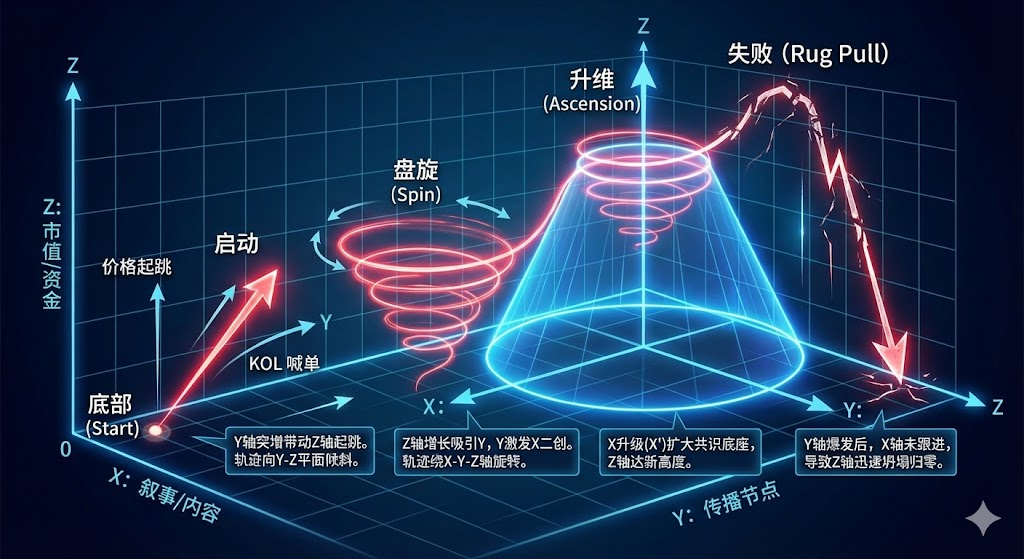
Bottom (Start): X, Y, Z are all close to zero.

Ignition: The Y-axis surges (KOL shilling), driving the Z-axis (price) to jump. The trajectory line tilts toward the Y-Z plane.

Spin: The growth of the Z-axis attracts more Y (more people discussing), and Y stimulates X's二次创作 (enriching content). The trajectory line begins to rotate around the X-Y-Z axes.

Ascension: As X is upgraded (X'), the base area of the cone expands (broader consensus range), and the Z-axis (market capitalization) reaches a new height.

Failed Meme (Rug Pull): Usually表现为 the Y-axis爆发后, the Z-axis briefly rises, but the X-axis fails to follow up with an upgrade (narrative scarcity), causing the Z-axis to quickly collapse to zero. The trajectory line shows an inverted V-shaped fall.

3. Evolution of the Growth Curve: The Spiral Ascension of Four Stages

From the previous section, we know that the lifecycle of a Meme is not linear but a vortex that continuously expands around the Z-axis (fund flow). In this section, we will analyze it based on the four development stages of Memes.

The figure below shows its standard evolution path: (I was also shocked at how cool AI drew it?!)


Original link:https://www.bitpush.news/articles/7604686

Пов'язані питання

QWhat is the core perspective proposed in the article regarding the growth of Meme coins?

AThe article proposes that Meme coin market capitalization is not simply 'rising' but is 'propped up' by a mathematical model involving narrative density (X-axis) and propagation nodes (Y-axis), which together form the base supporting the value (Z-axis).

QHow does the article define the X-axis in its Meme growth model?

AThe X-axis is defined as 'Narrative Density and Cultural Memes,' which includes the core meme, origin story, cultural symbols, and the richness of community-created content.

QAccording to the article, what is the role of the Y-axis in the Meme coin growth spiral?

AThe Y-axis represents 'Propagation Potential and Node Network,' which refers to the information transmission pipelines, from top nodes like influencers to secondary and end nodes like ordinary retail investors.

QWhat does the Z-axis represent in the XYZ model for Meme coins?

AThe Z-axis represents 'Capital Flow and Liquidity Carrier,' which is the monetization result of attention, including on-chain capital inflow, liquidity depth, and the total value that can absorb selling pressure.

QWhat is the key difference between a successful Meme and a failed one (Rug Pull) according to the model?

AA successful Meme undergoes a spiral ascent where narrative (X) and propagation (Y) expand to support the value (Z). A failed Meme (Rug Pull) sees a brief spike in Y and Z, but a lack of narrative development (X) causes the value to collapse back to zero.

Пов'язані матеріали

Gensyn AI: Don't Let AI Repeat the Mistakes of the Internet

In recent months, the rapid growth of the AI industry has attracted significant talent from the crypto sector. A persistent question among researchers intersecting both fields is whether blockchain can become a foundational part of AI infrastructure. While many previous AI and Crypto projects focused on application layers (like AI Agents, on-chain reasoning, data markets, and compute rentals), few achieved viable commercial models. Gensyn differentiates itself by targeting the most critical and expensive layer of AI: model training. Gensyn aims to organize globally distributed GPU resources into an open AI training network. Developers can submit training tasks, nodes provide computational power, and the network verifies results while distributing incentives. The core issue addressed is not decentralization for its own sake, but the increasing centralization of compute power among tech giants. In the era of large models, access to GPUs (like the H100) has become a decisive bottleneck, dictating the pace of AI development. Major AI companies are heavily dependent on large cloud providers for compute resources. Gensyn's approach is significant for several reasons: 1) It operates at the core infrastructure layer (model training), the most resource-intensive and technically demanding part of the AI value chain. 2) It proposes a more open, collaborative model for compute, potentially increasing resource utilization by dynamically pooling idle GPUs, similar to early cloud computing logic. 3) Its technical moat lies in solving complex challenges like verifying training results, ensuring node honesty, and maintaining reliability in a distributed environment—making it more of a deep-tech infrastructure company. 4) It targets a validated, high-growth market with genuine demand, rather than pursuing blockchain integration without purpose. Ultimately, the boundaries between Crypto and AI are blurring. AI requires global resource coordination, incentive mechanisms, and collaborative systems—areas where crypto-native solutions excel. Gensyn represents a step toward making advanced training capabilities more accessible and collaborative, moving beyond a niche controlled by a few giants. If successful, it could evolve into a fundamental piece of AI infrastructure, where the most enduring value in the AI era is often created.

marsbit10 год тому

Gensyn AI: Don't Let AI Repeat the Mistakes of the Internet

marsbit10 год тому

Why is China's AI Developing So Fast? The Answer Lies Inside the Labs

A US researcher's visit to China's top AI labs reveals distinct cultural and organizational factors driving China's rapid AI development. While talent, data, and compute are similar to the West, Chinese labs excel through a pragmatic, execution-focused culture: less emphasis on individual stardom and conceptual debate, and more on teamwork, engineering optimization, and mastering the full tech stack. A key advantage is the integration of young students and researchers who approach model-building with fresh perspectives and low ego, prioritizing collective progress over personal credit. This contrasts with the US culture of self-promotion and "star scientist" narratives. Chinese labs also exhibit a strong "build, don't buy" mentality, preferring to develop core capabilities—like data pipelines and environments—in-house rather than relying on external services. The ecosystem feels more collaborative than tribal, with mutual respect among labs. While government support exists, its scale is unclear, and technical decisions appear driven by labs, not state mandates. Chinese companies across sectors, from platforms to consumer tech, are building their own foundational models to control their tech destiny, reflecting a broader cultural drive for technological sovereignty. Demand for AI is emerging, with spending patterns potentially mirroring cloud infrastructure more than traditional SaaS. Despite challenges like a less mature data industry and GPU shortages, Chinese labs are propelled by vast talent, rapid iteration, and deep integration with the open-source community. The competition is evolving beyond a pure model race into a contest of organizational execution, developer ecosystems, and industrial pragmatism.

marsbit11 год тому

Why is China's AI Developing So Fast? The Answer Lies Inside the Labs

marsbit11 год тому

3 Years, 5 Times: The Rebirth of a Century-Old Glass Factory

Corning, a 175-year-old glass company, is experiencing a dramatic revival as a key player in AI infrastructure, driven by surging demand for high-performance optical fiber in data centers. AI data centers require vastly more fiber than traditional ones—5 to 10 times as much per rack—to handle high-speed data transmission between GPUs. This structural demand shift, coupled with supply constraints from the lengthy expansion cycle for fiber preforms, has created a significant supply-demand gap. Nvidia has invested in Corning, along with Lumentum and Coherent, in a $4.5 billion total commitment to secure the optical supply chain for AI. Corning's competitive edge lies in its expertise in producing ultra-low-loss, high-density, and bend-resistant specialty fiber, which is critical for 800G+ and future 1.6T data rates. Its deep involvement in co-packaged optics (CPO) with partners like Nvidia further solidifies its position. While not the largest fiber manufacturer globally, Corning's revenue from enterprise/data center clients now exceeds 40% of its optical communications sales, and it has secured multi-year supply agreements with major hyperscalers including Meta and Nvidia. Financially, Corning's optical communications revenue has surged, doubling from $1.3 billion in 2023 to over $3 billion in 2025. Its stock price has risen nearly 6-fold since late 2023. Key future catalysts include the rollout of Nvidia's CPO products and the scale of undisclosed customer agreements. However, risks include high current valuations and potential disruption from next-generation technologies like hollow-core fiber. The company's long-term bet on light over electricity, maintained even through the telecom bubble crash, is now being validated by the AI boom.

marsbit12 год тому

3 Years, 5 Times: The Rebirth of a Century-Old Glass Factory

marsbit12 год тому

Торгівля

Спот
Ф'ючерси
活动图片




