Why Do Gold Farming Studios Sustain World of Warcraft but 'Kill' All Web3 Games?

marsbitОпубліковано о 2026-01-30Востаннє оновлено о 2026-01-30

Анотація

The article explores why gold farming studios, which thrived in games like World of Warcraft (WoW), have negatively impacted Web3 games. In WoW, gold farming did not destroy the game because in-game currency was not the ultimate value—prestige, achievements, and top-tier gear were untradeable and bound to player effort. Blizzard also managed the issue by incorporating gold buying into official systems, adding time-based constraints, and emphasizing social and cooperative elements that gold couldn’t bypass. Roblox, another successful game, avoids gold farming issues by focusing on creativity—monetizing through map creation and community engagement rather than repetitive tasks—and maintaining a closed economic system with limited cash-out options. In contrast, Web3 games often fail because they inherently link play and earn, allowing repeatable actions and free asset withdrawal. This design attracts capital and bots rather than genuine players, making it impossible to balance fun, profit, and scalability. The author argues that not everything should be financialized; some values, like memory and experience, are meant to be lived, not traded.

Written by: Lao Bai

A while ago, I tweeted about my son frantically recharging Robux in Roblox to steal other people's items, marveling at how this game is even more powerful than Genshin Impact's gacha system or Pop Mart's blind boxes—a true god of spending, which resonated with many folks. That post also had the highest traffic recently.

The next day, it suddenly occurred to me—why are there seemingly no "gold farming studios" in Roblox, despite it being such a cash-heavy game? Or even if there are, why do they have almost no impact on the game's lifecycle? Coincidentally, @j0hnwang also dug up his previous article on Roblox, mentioning this very point. I had bookmarked it before and went back to read it again.
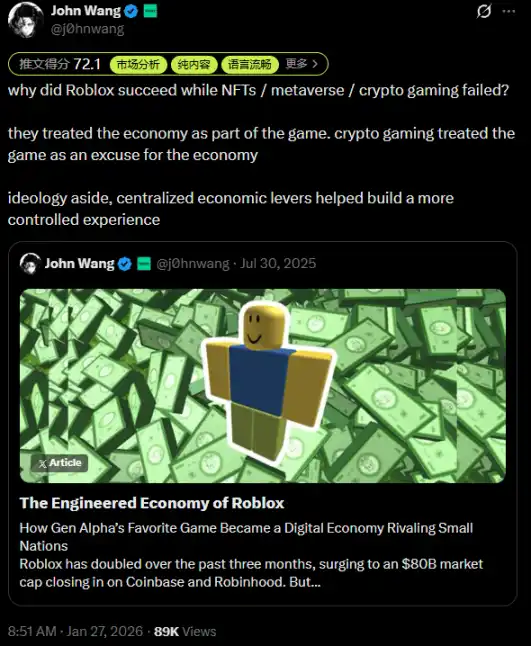
John's view is that Roblox treats the economic system as part of the game, while crypto games treat the game as a facade for the economic system. He believes that centralized economic mechanisms help build a more controllable gaming experience.

This makes sense. The lack of fun in Web3 games has been a common criticism, but the current generation of Web3 games has significantly improved in playability, and their economic mechanisms are also very centrally regulated. Yet, the outcome remains unchanged. There must be other reasons.

Then I thought about World of Warcraft and Kaito. On the day X blocked Kaito's API, I made the following comment.

Once Behavior Can Be Scaled, It Will Be Industrialized

From the "Chinese Farmers" in the Web2 era of World of Warcraft, to the scripts and gold farming studios in Web3's X2Earn, and now the inevitable "AI批量起号,多人矩阵嘴撸" (AI mass account creation, multi-account matrix farming) brought by嘴撸 (a term for farming).

So,嘴撸 wasn't ruined by clever retail players or KOLs; it was ruined by the property of "replicability." This isn't just a problem with the Kaito project; it's essentially the ultimate fate of all incentive systems.

So, what is the secret behind World of Warcraft and Roblox? Why can't studios kill them? Why did players complain about inflation and Chinese Farmers when they first appeared on the US servers, but eventually accept it as a fixed part of the game's ecosystem?

There must be something that Web3 games lack, and it's not just centralized economic mechanisms.

First, Let's Talk About World of Warcraft
1. Gold Is Not the "Endgame Value"

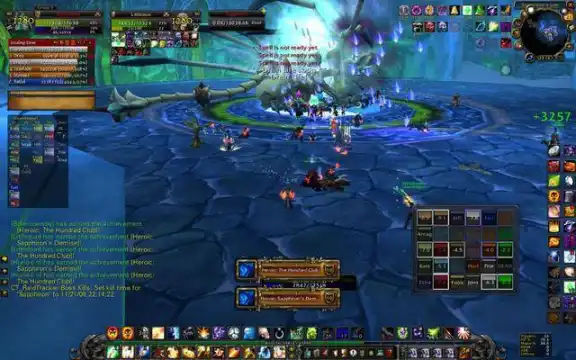
Those who have deeply played WOW should know this: in the game, gold has little to do with your status or identity. Your achievements, rankings, reputation, etc.—none of these can be directly bought with gold. When a top-tier item drops in a dungeon, you either roll for it or bid with DKP (Dragon Kill Points) based on contribution. The player who loots it also binds it immediately, so it can't be sold for cash.

So, gold can at most save you some time, but it can't turn you into a core player. Many domestic web games back then were the complete opposite—big spenders could dominate everything with RMB, similar to the current style of Web3 games.

Essentially, in World of Warcraft, all "meaningful things"—top equipment, achievements, titles, dungeon contribution, etc.—cannot be directly purchased with gold. So, although gold farming can be scaled, leading to the industrialization of the first Chinese Farmers, it始终无法主导游戏的核心体验 (could never dominate the core experience of the game). In other words, this "industrialization" was confined to the "peripheral layer" of the game.

2. The Official Approach: "Absorption, Not Confrontation"

After the emergence of gold farming studios, Blizzard made a series of moves that, in hindsight, were very clever:

  • First, official control—allowing you to buy gold with real money, but the price is regulated by the system, and there's no free financial exit, turning the underground black market into official currency exchange;
  • Second, adding various barriers—such as daily and weekly quests, various cooldown locks... No matter how many accounts or high levels you have, you still have to wait patiently, diluting the advantage of industrialization;
  • Third, adding more "meaningful things" that cannot be bought with gold, like guilds, raids, social reputation... This led to the later emergence of gold runs and GKP (Gold Kill Points), but various dungeon first kills were always achieved by top guilds, never by gold runs. So, gold farming in World of Warcraft always remained a "second-class citizen."

As for Roblox, the Logic Is Slightly Different
1. Encouraging Creativity Over Repetitive Labor

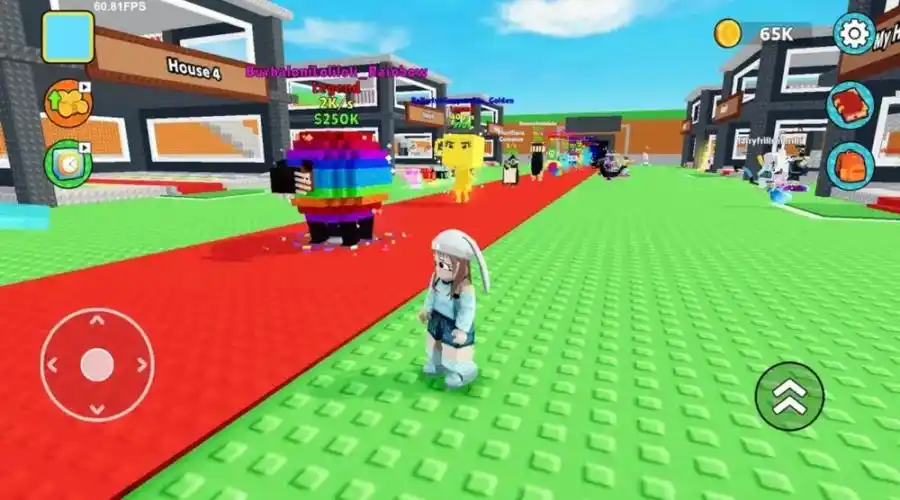
If you read the article I referenced in my previous post about Roblox, you'll know that the most profitable activities in Roblox are not repetitive tasks like farming resources, which offer little profit.

The real money is in creating maps, designing gameplay, and operating communities.

These are difficult for studios to scale and replicate. No matter how many resources you farm, you can't farm a gameplay that appeals to kids (though with AI now, this might also become "mass-producible").

2. Closed-Loop Internal Economic System, Restricted Asset Exchange

This is somewhat similar to John's idea. It's quick to buy Robux with a credit card, but converting Robux back to cash isn't as smooth—there are barriers, delays, and exchange rate losses, so arbitrage and搬砖 (a term for grinding/farming for profit) tactics don't work well here.

Moreover, most of the money in Roblox flows to platform fees, the top creators mentioned above, and in-game consumption, forming a closed-loop economic system with little overflow.

Of course, whether it's World of Warcraft or Roblox, being fun and having a large player base are the most important foundations, which is undeniable.

So, What Is the Real Reason Behind the Collective Demise of Web3 Games?

Thinking back, aside from the fun factor, perhaps the initial design intention of链游 (chain games/Web3 games) destined today's outcome.

Almost all链游 allow for "repeatable behavior" + "freely withdrawable assets."

In an era where Web2 gaming systems are already mature, this inevitably turns the final players of链游 into capital + scripts, not humans.

In other words, as long as Play and Earn are linked, this will always be the result.

Whether it's Play 2 Earn, the later improved Move 2 Earn, or Play & Earn, they are all different in name but not in essence.

This is somewhat like an impossible triangle for games. Among being fun, allowing speculators to make money, and enabling studios to scale, you can achieve at most two.
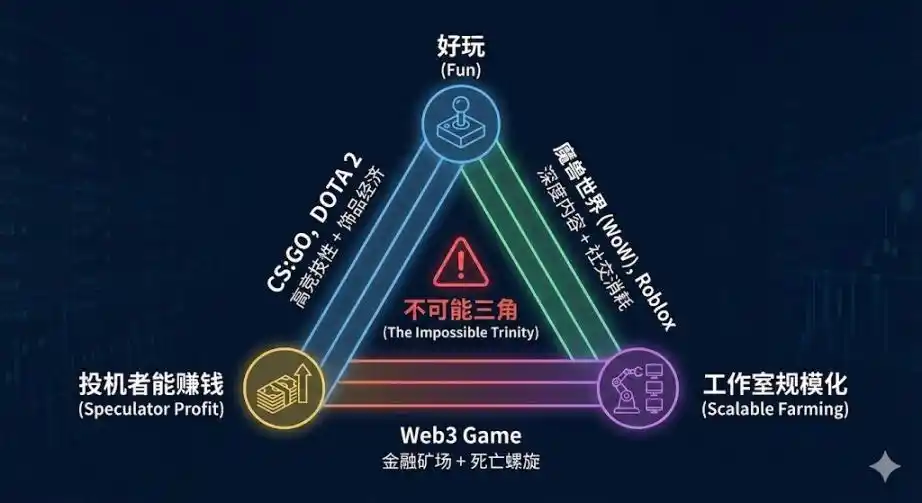
From this perspective, the problem with Web3 games isn't team quality or funding scale; it's that, at the most fundamental genetic level, they cannot be "fun."

Would Putting World of Warcraft on-Chain Work? Would It Be Meaningful?

I remember during the peak of链游 hype, we often fantasized about a scenario: what if World of Warcraft went on-chain?

Not the entire game, but putting WOW's economic system on-chain, including gold, items, mounts, etc., making them freely tradable, freely withdrawable, and financializable.

Now, thinking back, we were very naive. Doing this would注定会被系统毁掉 (destined to be destroyed by the system).

The underlying axioms of World of Warcraft's success:

  • Meaning cannot be traded—The most valuable things, top equipment, achievements, titles... are almost all bound, untradeable, non-transferable. These things signify what you have done, not what you own;
  • Progress does not equal wealth—Your time investment, operational skills, and team collaboration are your foundation. Gold can at most make you more comfortable; it cannot allow you to跨越阶级 (transcend classes);
  • Players are not asset owners but role-players—This equipment was obtained by me through effort / exchanged with DKP, this Boss was a world first kill by our guild, this character is my心血 (labor of love) trained over 10 years... Once this becomes "something I bought, an investment," this character emotionally bound to you downgrades into a skin for an asset account.

If we must talk about going on-chain, the things in World of Warcraft truly worth putting on-chain are these—for example, proof of a Boss's first kill, guild history, timestamps of your achievements, records of witnessing world events... What goes on-chain is not assets and value, but memories and traces.

The greatness of World of Warcraft lies precisely in the fact that its most important things can never be sold.

From this perspective, "链游必须死" (Chain games must die).

And it's not just链游. We once treated blockchain as a hammer, seeing everything as a nail to be struck. Little did we know that too many things in this world根本不需要被「金融化」 (simply do not need to be "financialized"). Their reason for existence is to be experienced, remembered, and told.


Пов'язані питання

QWhy did gold farming studios not destroy World of Warcraft (WoW) like they did with Web3 games?

AIn WoW, gold is not the ultimate value; meaningful elements like top-tier equipment, achievements, and reputation cannot be directly bought with gold. The official response involved absorbing and regulating the economy rather than outright对抗, implementing systems like official currency exchange, time-gated content, and non-tradable prestigious items. This kept gold farming activity on the periphery without dominating the core game experience.

QHow does Roblox prevent gold farming studios from harming its ecosystem?

ARoblox encourages creative activities like map design and community management, which are hard to scale industrially, rather than repetitive resource grinding. Its economy is a closed loop with friction and delays for cashing out Robux, making arbitrage difficult. The platform's focus on creativity and internal consumption, combined with financial barriers to withdrawal, limits the impact of farming.

QWhat is the fundamental reason Web3 games fail according to the article?

AWeb3 games inherently link play and earn, allowing repeatable actions and freely withdrawable assets. This design inevitably attracts capital and bots rather than genuine players, making it impossible for the games to be truly fun. The 'impossible triangle' suggests that a game cannot simultaneously achieve being fun, allowing speculators to profit, and enabling studio scalability—Web3 games prioritize the latter two at the expense of enjoyment.

QWhat would happen if World of Warcraft's economy were fully put on-chain?

AFully on-chaining WoW's economy would destroy it because the game's success relies on non-tradable elements like bound items, achievements, and player identity rooted in effort and memory, not financial ownership. On-chaining would reduce characters to asset accounts, stripping away the emotional attachment and meaning that comes from earned progress and shared experiences.

QWhat does the article suggest is worth putting on-chain from games like WoW?

AThe article suggests that instead of assets and value, meaningful elements like proof of first kills, guild history, achievement timestamps, and records of world events should be put on-chain. These represent memories and traces of player experiences, which align with the emotional and narrative value of the game, rather than promoting financialization.

Пов'язані матеріали

Two Legends Lost in Three Days: Is Google's AI Talent Dam Cracking?

In three days, Google lost two AI legends. On June 18, Noam Shazeer, co-author of the seminal "Attention is All You Need" paper and Gemini co-lead, left for OpenAI. Just 48 hours later, John Jumper, 2024 Nobel laureate and AlphaFold lead, departed DeepMind for Anthropic. This follows Andrej Karpathy joining Anthropic in May. These moves highlight a structural trend: top AI talent is concentrating at mission-driven, pre-IPO firms like OpenAI and Anthropic, while Google becomes a primary source. The exodus stems from a core mission mismatch. Google's ad-centric model often subordinates AI research to product and revenue goals, creating friction for pioneers like Shazeer, who returned in 2024 only to leave again. In contrast, OpenAI and Anthropic offer singular focus on pushing AI boundaries, whether towards AGI or safety-aligned models, which deeply appeals to top researchers like Jumper. Financial incentives amplify the pull. With both OpenAI and Anthropic nearing IPO, employees stand to gain immensely from equity, an upside Google's mature stock cannot match. Furthermore, the 2023 merger of Google Brain and DeepMind, intended to consolidate strength, has instead created cultural tension and slowed the path from research to product, as evidenced by Gemini's pace. This talent redistribution is reshaping the AI landscape. While Google retains vast data and compute resources, its true crisis is the quiet, continuous loss of the people who define the field's future. The real moat in AI is not infrastructure, but the concentration of brilliant minds—a battle Google is currently losing.

marsbit59 хв тому

Two Legends Lost in Three Days: Is Google's AI Talent Dam Cracking?

marsbit59 хв тому

Behind the AI Report Card, Lies a Chinese 'Exam Setter'

Beyond the familiar performance charts like MMLU-Pro and MMMU, which major AI models strive to ace, stands a key "examiner": Chinese-Canadian researcher Wenhu Chen. An assistant professor at the University of Waterloo and founder of TIGERLab, Chen addresses the crucial need for more rigorous AI evaluation. As models like GPT-4 began scoring near-perfect results on older benchmarks like MMLU, it became difficult to distinguish their true capabilities. In response, Chen introduced MMLU-Pro in 2024, featuring harder, more reasoning-focused questions with more answer choices, successfully reintroducing meaningful performance gaps. His work extends to multi-modal evaluation with MMMU and its enhanced version, MMMU-Pro. These benchmarks test a model's ability to understand and reason with complex information from images, charts, and text across diverse academic subjects, exposing the significant challenges even top models face in genuine comprehension. Chen's background in complex QA, table reasoning, and his experience at Google DeepMind on projects like Gemini inform his approach. He understands that effective benchmarks must anticipate how models might "cheat" by memorizing data or avoiding visual analysis. His lab also actively researches video understanding and generation models (e.g., UniVideo, Vamba), ensuring his evaluation work is grounded in practical model-building challenges. Now at Meta's Super Intelligence Lab, Chen continues his focus on multi-modal data and evaluation, representing the deep yet often unseen contributions of Chinese talent in shaping the fundamental tools of the AI industry.

marsbit1 год тому

Behind the AI Report Card, Lies a Chinese 'Exam Setter'

marsbit1 год тому

Alliance Co-founder's Letter to Entrepreneurs: Written at the Moment Cursor Sold for $600 Billion

Alliance Co-founder's Letter to Entrepreneurs: On Cursor's $60 Billion Sale Many aspiring founders see massive exits like Cursor's $60B sale and wonder why they can't achieve the same, often concluding opportunities are exhausted. But great companies aren't built in obvious, crowded spaces. Cursor, like Stripe, Figma, and Shopify before it, started with a non-consensus belief about the future. Before ChatGPT, they believed AI would transform knowledge work. They focused on a genuinely exciting domain, became their own customer, and obsessed over power users. Their journey involved years of "glass-chewing" effort before the market was ready. The pattern is consistent: identify a long-term technological shift, find a missed entry point, and execute for years before the trend becomes obvious. First-generation products (PayPal, Adobe, Amazon) prove a market exists. Second-generation winners (Stripe, Figma, Shopify) rebuild that market around new insights, technology, or changing customer behaviors. Founders must identify their phase in the cycle. Early entrants like Coinbase or Cursor focus on making new technology usable for power users. Later entrants find the "yin" to the established "yang"—the blind spots incumbents miss as they grow distant from individual users. The key is deep market immersion. Use every product in your space. Talk to users. Build an audience. Stop looking for ideas and start *seeing* them everywhere. Then, choose one. The idea must offer a 10x improvement or solve a "hair-on-fire" pain point—something severe enough that users are already crafting workarounds. When building, avoid feature bloat. Ask: why would someone switch? Great startups rarely force new behaviors; they improve familiar workflows with drastically lower friction (e.g., Cursor forked VS Code instead of creating a new editor). Distribution is the underestimated moat. Before product-market fit, achieve distribution-market fit. How do customers discover new tools? Founders like those at Airbnb, Stripe, and Cursor did unscalable, manual work to recruit early users. The final, unteachable ingredient is resilience. Cursor built for years pre-market, faced rejection, and persisted. So did Airbnb, Nvidia, and Rain (which launched post-FTX collapse). The lesson isn't that these founders were smarter, but that they stayed in the game long enough for their insights to compound. Framework: Spot technological cycles. Cultivate unique insight. Obsess over your market. Talk to customers. Find a hair-on-fire problem. Build the simplest wedge. Win your distribution channel. Above all, don't quit when it gets hard. Most people won't do these things consistently. The few who do build the next generation of great companies. Go build.

marsbit1 год тому

Alliance Co-founder's Letter to Entrepreneurs: Written at the Moment Cursor Sold for $600 Billion

marsbit1 год тому

Weekly Editor's Picks (0613-0619)

Weekly Editor's Picks (0613-0619): Market Insights & Analysis This weekly digest curates in-depth analysis often lost in the information flow, focusing on key insights across macro trends, investment, and technology. **Macro & Geopolitics:** With the Strait of Hormuz reopening and military conflict shifting to negotiation, markets are pivoting from "war shock" to "supply restoration." Trades include shorting crude risk premiums, longing airlines/tourism, Asian energy importers, and bond duration, while shorting inflation expectations. LNG, fertilizer, and chemical chains are also being repriced. **Investment & VC:** Ray Dalio advises against betting on concentrated AI giants dominating indices, advocating for diversified portfolios of high-quality, low-correlation assets instead. Analysis covers the 4-year crypto cycle, predicting the core surviving product by 2029 will be asset trading markets. Current BTC metrics suggest a potential bottoming zone, presenting a patient accumulation window. SpaceX's high-profile IPO at a $2.1T valuation faces scrutiny over fundamentals, with key watchpoints being its likely inclusion in the Nasdaq index and Q2 earnings. Concerns are raised about potential "gamma squeeze" and systemic risks if its narrative-driven valuation gets amplified by passive index funds. Robinhood (HOOD) is noted for breaking its high correlation with crypto, bolstered by its stock trading and new underwriting business. **Web3 & AI:** A warning highlights ~$1.8T in off-balance-sheet AI infrastructure commitments (purchase commitments, leases) as a potential systemic risk if AI monetization lags. AI models are being used for World Cup predictions, adding a new layer for betting markets. A cost breakdown of a $20 AI subscription reveals the supply chain from model companies to cloud, GPUs, and power. **Prediction Markets:** The emergence of prediction market "concept stocks" is noted, with Robinhood developing its own platform, Rothera, signaling a shift from market competition to a "channel war" for user access. **CeFi & DeFi:** The SpaceX IPO tested perpetual contract mechanisms for pre-IPO assets, highlighting challenges in handling corporate actions like stock splits on-chain. The de-pegging of STRC (Strategy's preferred share) to ~$89 reflects market concerns over MicroStrategy's capital structure and BTC-backed leverage model. BlackRock's covered-call Bitcoin ETF (BITA) offers yield but caps upside, appealing to yield-seeking institutions. **Ethereum:** An opinion piece argues Ethereum's core strength is its vast developer community and composability, solidifying its role as the default operating system for the financial internet. **Weekly Hot Topics:** Include the US-Iran deal reopening the Strait of Hormuz, Fed's hawkish hold, Anthropic restricting model access, SpaceX acquiring Cursor, and a humorous stock surge for "Liuliumei" due to its "LLM" ticker.

marsbit1 год тому

Weekly Editor's Picks (0613-0619)

marsbit1 год тому

Alliance's Co-Founder's Letter to Entrepreneurs: Written on the Occasion of Cursor's $60 Billion Sale

In this letter to entrepreneurs, Alliance reflects on the success of Cursor's $60 billion sale to Elon Musk, using it as a case study to counter the misconception that opportunities in crowded fields like AI or crypto are exhausted. The piece argues that great companies like Cursor, Stripe, Figma, and Shopify are not built by geniuses with perfect ideas, but by founders who start with a non-consensus belief about the future and build for years before that future becomes obvious to everyone. They identify long-term shifts, find overlooked entry points, and execute relentlessly. The framework for success involves: 1. **Identifying your place in the technology cycle**: Early-stage opportunities focus on making new tech usable for power users (e.g., Coinbase, Cursor). Later-stage opportunities involve finding the "yin" to an existing "yang"—the blind spots of first-generation players (e.g., Stripe vs. PayPal, Figma vs. Adobe). 2. **Cultivating unique insights**: Immerse yourself deeply in the market. Use every product, talk to users, and build an audience. Insights will emerge naturally from deep engagement. 3. **Finding a "hair-on-fire" problem**: Look for a 10x improvement or a severe, urgent pain point. The strongest signal is people already building clumsy workarounds. 4. **Building a focused MVP**: Don't just add features because you can. Ask why users would abandon their current tool for yours. The best startups rarely force new behaviors; they improve familiar workflows with drastically lower friction. 5. **Winning a distribution channel**: Distribution is often the moat. Before product-market fit, achieve channel-market fit. Find where your customers are and build an engine to reach them, even through unscalable, manual efforts initially. 6. **Persistence**: The final, unteachable ingredient is resilience. Success stories like Cursor, Airbnb, and Nvidia involved years of grinding, rejection, and perseverance when the path forward seemed unclear. The conclusion is that there is no secret. Most people fail to consistently execute these steps over the long term. The few who do build the companies that define the next era. The world is yours to create.

链捕手1 год тому

Alliance's Co-Founder's Letter to Entrepreneurs: Written on the Occasion of Cursor's $60 Billion Sale

链捕手1 год тому

Торгівля

Спот
Ф'ючерси
活动图片