Why Do Chinese Memes Lack Staying Power?

Odaily星球日报Опубліковано о 2026-01-13Востаннє оновлено о 2026-01-13

Анотація

Chinese meme coins on BSC experienced a brief surge in early January 2026, led by tokens like “我踏马来了” (I’m F*cking Coming) and “老子” (Laozi), but quickly lost momentum within days. The rally, initially sparked by a tweet from He Yi (Binance co-founder), reflected a recurring pattern within the BSC ecosystem—dubbed “Shandongology”—where meme tokens gain traction through perceived endorsements from CZ or He Yi, even without direct involvement. This culture has led to growing community fatigue and internal division. Many participants expressed resistance to what they see as excessive sycophancy, undermining cohesion and diverting attention from organic meme culture. Unlike the October 2025 wave, which attracted global interest and cross-chain engagement, this surge failed to gain significant traction outside Chinese-speaking communities, limiting liquidity and buyer diversity. Moreover, Chinese meme coins are no longer novel. While they’ve become a recurring category within crypto, their reliance on “Shandongology” and lack of independent cultural identity make them highly susceptible to short-lived hype cycles. Tokens that fail to evolve beyond influencer-driven narratives tend to fade quickly, reinforcing a “pump-and-dump” pattern that shortens each meme cycle.

Original | Odaily Planet Daily (@OdailyChina)

Author | Golem (@web 3_golem)
"The two-day on-chain bull run is over"—this is the prevailing sentiment in the Meme community today.

Following the surge in October last year, Chinese Meme coins once again sparked a frenzy on BSC in January this year, giving rise to many community-favored tokens (related reading:From "Life K-Line" to "Laozi", a rundown of the top 5 hottest BSC "Chinese Memes"). However, according to GMGN data today, popular Chinese Memes have generally seen pullbacks. Within 24 hours, "I'm F*cking Coming" dropped by 30%, "Laozi" fell by 25%, "Life K-Line" declined over 20%, and "Manager Xiao Ni" plunged over 40%.

Every feast eventually ends, and Memes cool down particularly quickly. Last October, the Chinese Meme hype started during the National Day holiday and lasted a full month before fading. But this time, it ended so abruptly. What exactly went wrong?

Rejection of "Shandong-ology" Undermines Community Unity

This round of Chinese Meme hype was cold-started from a tweet by He Yi. On January 1st, He Yi posted on X with the caption "2026, I'm f*cking coming" to celebrate the New Year. A week later, the同名 Meme coin began to gain traction, eventually listing on Binance Alpha and igniting the Chinese Meme community.

However, along with this came widespread discussion in the community about "Crypto Shandong-ology: which way does the fish head face?"—pointing directly to a整套 Meme launch model on BSC revolving around CZ and He Yi. CZ and He Yi don’t need to personally direct or even know about these tokens; from developers to the community to the Binance alpha team, everyone automatically "gets enlightened." The fate of a Meme is decided by a single tweet.

In February 2025, CZ首次 interacted with a worthless on-chain test token TST on BSC, marking the雏形 of this Meme launch model on BSC. After subsequent small-cycle iterations like the dispute over CZ’s dog and the Dubai narrative, the community figured out the "social nuances" necessary for a BSC Meme hype cycle from cold start to peak.

To make money in such an ecosystem, put politely, one must learn from the top and the excellent; put bluntly, one "absolutely cannot stand upright."

"Is it really different this time?" As this Chinese Meme wave peaked again, countless bloggers asked on social media. This wasn’t just mere meme-ing; it genuinely reflected the psychological shadow left by this "Crypto Shandong-ology" since 2025.

When enough shadows accumulate, they form rejection. Some criticized the BSC ecosystem for going to any lengths to "suck up," blindly截取 content from CZ and He Yi’s tweets, even giving birth to tokens like "Mom," "Dad," and "Laozi," making Chinese Memes increasingly tacky.

Previously, Odaily Planet Daily also analyzed the community debate sparked by "I'm F*cking Coming" listing on Binance Alpha, calling it "a serious blow to genuine Chinese Meme culture" (related reading: How to evaluate the listing of "I'm F*cking Coming" on Binance?).

When rejection of "Crypto Shandong-ology" becomes widespread, searching for community Meme coins without the CZ/He Yi angle itself became a community force. Crypto blogger Honest Mai总 (X:@Michael_Liu93)直言, "Everyone is really tired of sucking up." (The blogger holds 1% of "Life K-Line" tokens)
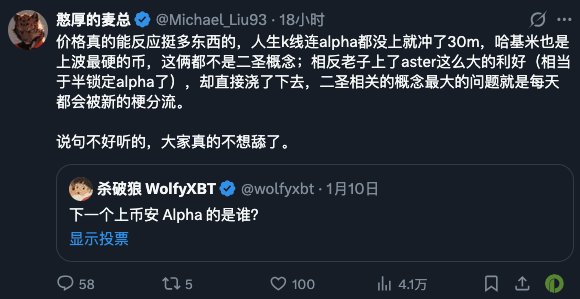
Regardless, such division ultimately harms the unity of the BSC Meme community. Capital cannot form a合力. When a community-consensus leader fails to emerge quickly, Meme sentiment rapidly dissipates.

Lack of External Liquidity

To sustain a small Meme cycle, there must be price increases, and to sustain increases, there must be new buying pressure exceeding selling pressure. A possible reason for the lack of staying power in this Chinese Meme wave is the absence of external liquidity injection. The market cap was primarily driven up by the Chinese community on BSC, without attracting buying from overseas communities or the Solana Meme community.

The Chinese Meme hype last October had an unprecedented reach. Many overseas Meme influencers sought help on X to join Chinese Meme communities; "Dagou WeChat groups" suddenly saw an influx of English-speaking degens. This wave also prompted other chains to court the Chinese Meme community: Base chain lead Jesse invited the community to build on Base, while Solana founder Toly and Solana Foundation president Lily Liu fueled the hype for the Solana Chinese Meme "Suolala."

This influence溢出 from the wealth effect of Chinese Meme coins translated into tangible on-chain buying power, prolonging the duration of the October hype.

But the January Chinese Meme hype lacked this externality, still revolving around CZ and He Yi’s tweets. The only Chinese Meme with some externality, "Life K-Line" (reportedly covered by CCTV on January 3rd), had its spotlight quickly overshadowed after "I'm F*cking Coming" listed on Alpha.

One piece of this lack of external liquidity: using language filters on X to search for posts and views about recent hot Chinese Memes (e.g., I'm F*cking Coming, Laozi, Small Shareholder) in English-speaking regions shows that, aside from exchange listing announcements with high views, discussion of these Memes in English is scarce.
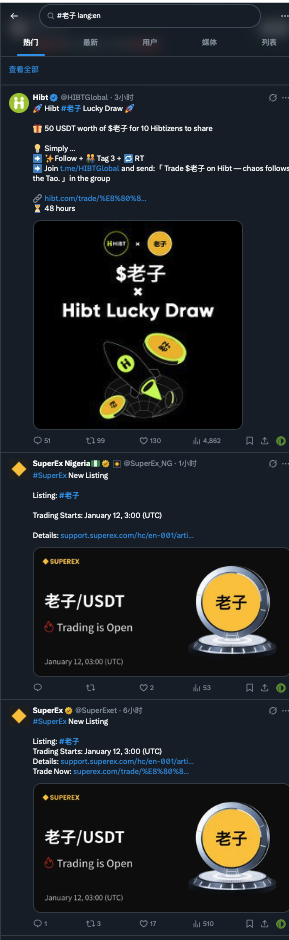
Hot posts about "Laozi" in the X English section are all exchange listing announcements

Chinese Memes Themselves Are No Longer Novel

A乒乓球 dropped from a height always bounces back lower each time.

Chinese Memes themselves are no longer a sufficiently attractive narrative.

Odaily Planet Daily asserted at the end of October last year that although the October Meme hype ended, Chinese Memes themselves would not die out but would become a fixed Meme category, with periodic hype cycles in the future. (Related reading:After Binance Life, Chinese Memes Evolve from Hits to a Sector)

This also means that if a Meme coin merely has a Chinese ticker and some "position-determines-view" logic for rising, it is destined not to last.

Since last October, the only Chinese Meme coins with lasting vitality are Binance Life and Hachimi. Tokens like Customer Service Xiao He, Cultivation, and Nailong have vanished into history. The representative Memes in this wave were all strongly tied to the "Shandong-ology" of CZ and He Yi and failed to develop an independent culture beyond the "Two Saints'" halo. Thus, they are注定 to lack the生命力 to survive beyond small Meme cycles, like any previous similar token (theoretically, Life K-Line doesn't belong here; its popularity was essentially sparked by the CCTV article).

When the Chinese Meme narrative first emerged, a Chinese Meme coin could rise simply due to novelty. Now, Chinese Memes have become an unremarkable, fixed category. As Chinese Memes fully integrate into the BSC Meme cycle assembly line, and as the market becomes increasingly familiar with this playbook, the ecosystem reverts to a "speed run" mode. The entire Meme cycle accelerates: cold start via "imperial decree," baiting continued interaction, listing on Binance Alpha, and finally, dumping...

This round of Chinese Memes is just a microcosm of that.

Пов'язані питання

QWhat are the main reasons mentioned for the lack of staying power of Chinese Meme coins in the recent cycle?

AThe main reasons include community division due to rejection of the 'Shandong School' dynamics (excessive reliance on CZ and He Yi's influence), lack of external liquidity from international or Solana communities, and the diminished novelty of Chinese Meme narratives as a category.

QHow did the 'Shandong School' concept affect the cohesion of the BSC Meme community?

AThe 'Shandong School' concept, which revolves around creating Meme coins based on CZ and He Yi's social media activity, caused community division. Some participants rejected this sycophantic culture, leading to fragmented consensus and reduced collective buying power, which weakened the Meme cycle's sustainability.

QWhy was external liquidity important for previous Chinese Meme booms, and how did it differ in January?

AExternal liquidity, from international or cross-chain communities, provided additional buying pressure that extended the duration of previous booms (e.g., October 2025). In January, the lack of such external engagement, with minimal discussion in English-speaking communities, resulted in quicker exhaustion of the hype.

QWhat role did Binance Alpha play in the recent Chinese Meme cycle?

ABinance Alpha listings, such as for '我踏马来了' (I'm Coming), acted as a catalyst by amplifying visibility and legitimacy. However, it also intensified community debates over the 'Shandong School' and centralized influence, contributing to the cycle's rapid decline.

QHow has the perception of Chinese Meme coins evolved over time?

AInitially, Chinese Meme coins benefited from novelty and freshness, attracting broad interest. Over time, they became a standardized category within BSC's Meme cycles, losing their unique appeal. The market now operates in a 'pump and dump' mode, with accelerated cycles due to familiarity with the playbook.

Пов'язані матеріали

human.tech Launches Clean SDK for Privacy-First Web3 Apps

human.tech has launched the Clean SDK, a toolkit enabling developers to build privacy-first Web3 applications with transparent accountability. Released alongside Aztec's version 5, the SDK provides components for integrating zero-knowledge identity verification, sanctions screening, and private transactions, without developers handling sensitive user data or building compliance infrastructure from scratch. It uses zero-knowledge proofs and programmable verification to allow apps to confirm user legitimacy and sanctions compliance while keeping identities confidential. The first application built on the SDK, Shield, a privacy bridge to Aztec, also launched. It allows users to transfer assets privately while proving a unique human is behind each transfer and that funds have passed sanctions checks, as verified by a May 2026 audit. The SDK offers three core verification techniques: Proof of Innocence (sanctions screening against 23 sources), Proof of Personhood (simpler verification via Human Passport), and Proof of Clean Hands (higher-assurance zero-knowledge government ID checks). This allows apps to authenticate users and transactions without exposing personal data. Designed for Aztec builders, the SDK lets developers add programmable privacy to decentralized apps, eliminating the need to create their own verification and ZK infrastructure. Shield demonstrates its practical use for private bridges, but the SDK aims to enable a wider ecosystem of private, accountable financial apps and services. The launch addresses growing demand for infrastructure that balances privacy and accountability. The SDK avoids traditional identity databases, storing encrypted data off-chain, screening at both entry and exit points, and including a gated disclosure mechanism for legal requests. human.tech's products, including the Clean SDK, focus on using zero-knowledge technology to enable verifiable personhood and privacy in digital systems.

TheNewsCrypto16 хв тому

human.tech Launches Clean SDK for Privacy-First Web3 Apps

TheNewsCrypto16 хв тому

Unlocking $100 Million in Liquidity? Pump.fun's New Policy Tests the 5-Minute Pump Technique

Pump.fun, a popular meme coin launchpad, has introduced a new standard mechanism called BOOST. It aims to address a significant capital efficiency issue: when a newly launched token graduates from its initial bonding curve to a liquidity pool (LP), roughly 20% of its liquidity becomes permanently locked as "dead liquidity," estimated to waste over $100 million annually. Instead of locking these funds permanently, BOOST repurposes them. Upon a token's migration, approximately 20% of the settlement funds (e.g., 17.6 SOL or ~$2516 USDC) are used to buy back the token on the open market over a 5-minute period via a Time-Weighted Average Price (TWAP) mechanism. All purchased tokens are immediately burned. This creates a brief, systematic buy pressure immediately after migration, potentially generating a short-term price surge ("pump") while permanently reducing the token's circulating supply. The goal is to enhance the immediate post-launch trading experience, potentially increasing trader retention and sustainable protocol revenue, which funds ongoing token buybacks. However, concerns exist that this artificial 5-minute boost could lower the barrier for launching low-quality tokens and lead to steeper price crashes once the buy pressure stops, if followed by large sell-offs. The feature automatically applies to tokens migrating after July 21, 2024, but not to previously migrated tokens or those launched via the Mayhem AI Agent lab.

marsbit23 хв тому

Unlocking $100 Million in Liquidity? Pump.fun's New Policy Tests the 5-Minute Pump Technique

marsbit23 хв тому

Podcast Notes | Conversation with GSR Asset Management Head: To Determine if This Crypto Rally is Real, Just Watch the Lending Rates on Aave

Podcast Summary: Dialogue with GSR's Head of Asset Management: To Determine if This Crypto Rally is Real, Just Check Lending Rates on Aave Andy Baehr, Managing Director of Asset Management at GSR, discusses the current crypto market, characterizing it as stuck in a state of "ambivalence" with short-lived, unsustainable rallies. He outlines a simple framework: the market moves between "ambivalence" and "conviction" (sustained upward momentum). Currently, every rally resembles a single-stage rocket booster that quickly fizzles out. Baehr identifies three key signals to watch: 1) DeFi lending rates, 2) the potential passage of the CLARITY Act, and 3) the market forming a consensus on the "Fed hawkish peak." He emphasizes that the most immediate indicator for the sustainability of the recent CPI-triggered rally is the USDC borrowing rate on Aave, currently around 3.75%—close to U.S. Treasury yields. The absence of a credit spread indicates low leverage demand and a lack of market energy. He explains that a healthy, sustained rally requires layered buying pressure. Last year's rally progressed from an ETH short squeeze to crypto-native trader influx and finally to ETF inflows. Currently, this structure is missing. Other potential structural buyers like Digital Asset Treasury (DAT) companies are absent, and ETF flows have proven transient. Baehr notes that while small-cap crypto tokens outperformed large caps in Q2—a potential sign of capitation in major assets—capital is also flowing to more exciting opportunities like AI stocks and tech IPOs, leaving crypto sidelined. Regarding DeFi, he highlights that platforms like Aave provide a clear, real-time signal of leverage demand through their supply/demand-driven interest rates. A significant, sustained rate increase would signal genuine market conviction. He also observes the quiet emergence of fixed-income-like products and vaults in DeFi. On regulation, the probability of the CLARITY Act passing before the August 7th deadline has dropped linearly from 75% to below 40% on Polymarket. Baehr suggests its passage would be treated as a bullish surprise, a potent driver for price movement. However, political hurdles, including ethical clause debates and disclosures about the First Family's crypto profits, remain significant obstacles. Ultimately, the market awaits clarity on the Fed's terminal rate under Chair Warsh. Until the "Fed Solstice"—the point where the market collectively understands the peak of hawkish policy—sustained conviction will be difficult to achieve.

marsbit54 хв тому

Podcast Notes | Conversation with GSR Asset Management Head: To Determine if This Crypto Rally is Real, Just Watch the Lending Rates on Aave

marsbit54 хв тому

Торгівля

Спот
活动图片





