Why Do Chinese Memes Lack Staying Power?

Odaily星球日报Опубліковано о 2026-01-13Востаннє оновлено о 2026-01-13

Анотація

Chinese meme coins on BSC experienced a brief surge in early January 2026, led by tokens like “我踏马来了” (I’m F*cking Coming) and “老子” (Laozi), but quickly lost momentum within days. The rally, initially sparked by a tweet from He Yi (Binance co-founder), reflected a recurring pattern within the BSC ecosystem—dubbed “Shandongology”—where meme tokens gain traction through perceived endorsements from CZ or He Yi, even without direct involvement. This culture has led to growing community fatigue and internal division. Many participants expressed resistance to what they see as excessive sycophancy, undermining cohesion and diverting attention from organic meme culture. Unlike the October 2025 wave, which attracted global interest and cross-chain engagement, this surge failed to gain significant traction outside Chinese-speaking communities, limiting liquidity and buyer diversity. Moreover, Chinese meme coins are no longer novel. While they’ve become a recurring category within crypto, their reliance on “Shandongology” and lack of independent cultural identity make them highly susceptible to short-lived hype cycles. Tokens that fail to evolve beyond influencer-driven narratives tend to fade quickly, reinforcing a “pump-and-dump” pattern that shortens each meme cycle.

Original | Odaily Planet Daily (@OdailyChina)

Author | Golem (@web 3_golem)

"The two-day on-chain bull run is over"—this is the prevailing sentiment in the Meme community today.

Following the surge in October last year, Chinese Meme coins once again sparked a frenzy on BSC in January this year, giving rise to many community-favored tokens (related reading:From "Life K-Line" to "Laozi", a rundown of the top 5 hottest BSC "Chinese Memes"). However, according to GMGN data today, popular Chinese Memes have generally seen pullbacks. Within 24 hours, "I'm F*cking Coming" dropped by 30%, "Laozi" fell by 25%, "Life K-Line" declined over 20%, and "Manager Xiao Ni" plunged over 40%.

Every feast eventually ends, and Memes cool down particularly quickly. Last October, the Chinese Meme hype started during the National Day holiday and lasted a full month before fading. But this time, it ended so abruptly. What exactly went wrong?

Rejection of "Shandong-ology" Undermines Community Unity

This round of Chinese Meme hype was cold-started from a tweet by He Yi. On January 1st, He Yi posted on X with the caption "2026, I'm f*cking coming" to celebrate the New Year. A week later, the同名 Meme coin began to gain traction, eventually listing on Binance Alpha and igniting the Chinese Meme community.

However, along with this came widespread discussion in the community about "Crypto Shandong-ology: which way does the fish head face?"—pointing directly to a整套 Meme launch model on BSC revolving around CZ and He Yi. CZ and He Yi don’t need to personally direct or even know about these tokens; from developers to the community to the Binance alpha team, everyone automatically "gets enlightened." The fate of a Meme is decided by a single tweet.

In February 2025, CZ首次 interacted with a worthless on-chain test token TST on BSC, marking the雏形 of this Meme launch model on BSC. After subsequent small-cycle iterations like the dispute over CZ’s dog and the Dubai narrative, the community figured out the "social nuances" necessary for a BSC Meme hype cycle from cold start to peak.

To make money in such an ecosystem, put politely, one must learn from the top and the excellent; put bluntly, one "absolutely cannot stand upright."

"Is it really different this time?" As this Chinese Meme wave peaked again, countless bloggers asked on social media. This wasn’t just mere meme-ing; it genuinely reflected the psychological shadow left by this "Crypto Shandong-ology" since 2025.

When enough shadows accumulate, they form rejection. Some criticized the BSC ecosystem for going to any lengths to "suck up," blindly截取 content from CZ and He Yi’s tweets, even giving birth to tokens like "Mom," "Dad," and "Laozi," making Chinese Memes increasingly tacky.

Previously, Odaily Planet Daily also analyzed the community debate sparked by "I'm F*cking Coming" listing on Binance Alpha, calling it "a serious blow to genuine Chinese Meme culture" (related reading: How to evaluate the listing of "I'm F*cking Coming" on Binance?).

When rejection of "Crypto Shandong-ology" becomes widespread, searching for community Meme coins without the CZ/He Yi angle itself became a community force. Crypto blogger Honest Mai总 (X:@Michael_Liu93)直言, "Everyone is really tired of sucking up." (The blogger holds 1% of "Life K-Line" tokens)
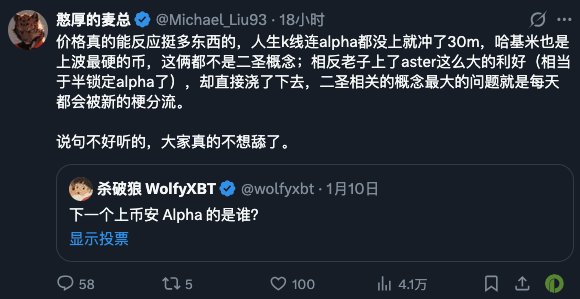
Regardless, such division ultimately harms the unity of the BSC Meme community. Capital cannot form a合力. When a community-consensus leader fails to emerge quickly, Meme sentiment rapidly dissipates.

Lack of External Liquidity

To sustain a small Meme cycle, there must be price increases, and to sustain increases, there must be new buying pressure exceeding selling pressure. A possible reason for the lack of staying power in this Chinese Meme wave is the absence of external liquidity injection. The market cap was primarily driven up by the Chinese community on BSC, without attracting buying from overseas communities or the Solana Meme community.

The Chinese Meme hype last October had an unprecedented reach. Many overseas Meme influencers sought help on X to join Chinese Meme communities; "Dagou WeChat groups" suddenly saw an influx of English-speaking degens. This wave also prompted other chains to court the Chinese Meme community: Base chain lead Jesse invited the community to build on Base, while Solana founder Toly and Solana Foundation president Lily Liu fueled the hype for the Solana Chinese Meme "Suolala."

This influence溢出 from the wealth effect of Chinese Meme coins translated into tangible on-chain buying power, prolonging the duration of the October hype.

But the January Chinese Meme hype lacked this externality, still revolving around CZ and He Yi’s tweets. The only Chinese Meme with some externality, "Life K-Line" (reportedly covered by CCTV on January 3rd), had its spotlight quickly overshadowed after "I'm F*cking Coming" listed on Alpha.

One piece of this lack of external liquidity: using language filters on X to search for posts and views about recent hot Chinese Memes (e.g., I'm F*cking Coming, Laozi, Small Shareholder) in English-speaking regions shows that, aside from exchange listing announcements with high views, discussion of these Memes in English is scarce.
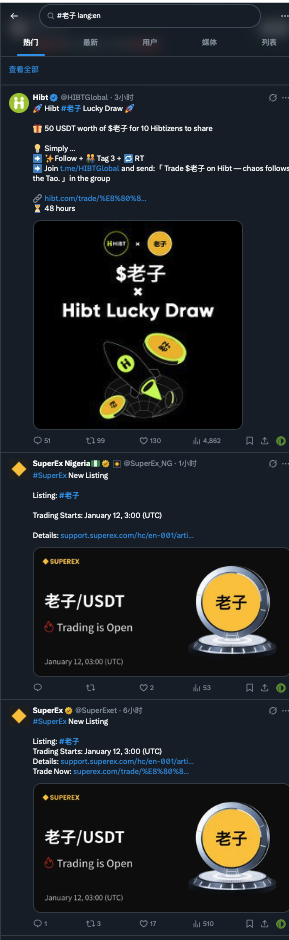
Hot posts about "Laozi" in the X English section are all exchange listing announcements

Chinese Memes Themselves Are No Longer Novel

A乒乓球 dropped from a height always bounces back lower each time.

Chinese Memes themselves are no longer a sufficiently attractive narrative.

Odaily Planet Daily asserted at the end of October last year that although the October Meme hype ended, Chinese Memes themselves would not die out but would become a fixed Meme category, with periodic hype cycles in the future. (Related reading:After Binance Life, Chinese Memes Evolve from Hits to a Sector)

This also means that if a Meme coin merely has a Chinese ticker and some "position-determines-view" logic for rising, it is destined not to last.

Since last October, the only Chinese Meme coins with lasting vitality are Binance Life and Hachimi. Tokens like Customer Service Xiao He, Cultivation, and Nailong have vanished into history. The representative Memes in this wave were all strongly tied to the "Shandong-ology" of CZ and He Yi and failed to develop an independent culture beyond the "Two Saints'" halo. Thus, they are注定 to lack the生命力 to survive beyond small Meme cycles, like any previous similar token (theoretically, Life K-Line doesn't belong here; its popularity was essentially sparked by the CCTV article).

When the Chinese Meme narrative first emerged, a Chinese Meme coin could rise simply due to novelty. Now, Chinese Memes have become an unremarkable, fixed category. As Chinese Memes fully integrate into the BSC Meme cycle assembly line, and as the market becomes increasingly familiar with this playbook, the ecosystem reverts to a "speed run" mode. The entire Meme cycle accelerates: cold start via "imperial decree," baiting continued interaction, listing on Binance Alpha, and finally, dumping...

This round of Chinese Memes is just a microcosm of that.

Пов'язані питання

QWhat are the main reasons mentioned for the lack of staying power of Chinese Meme coins in the recent cycle?

AThe main reasons include community division due to rejection of the 'Shandong School' dynamics (excessive reliance on CZ and He Yi's influence), lack of external liquidity from international or Solana communities, and the diminished novelty of Chinese Meme narratives as a category.

QHow did the 'Shandong School' concept affect the cohesion of the BSC Meme community?

AThe 'Shandong School' concept, which revolves around creating Meme coins based on CZ and He Yi's social media activity, caused community division. Some participants rejected this sycophantic culture, leading to fragmented consensus and reduced collective buying power, which weakened the Meme cycle's sustainability.

QWhy was external liquidity important for previous Chinese Meme booms, and how did it differ in January?

AExternal liquidity, from international or cross-chain communities, provided additional buying pressure that extended the duration of previous booms (e.g., October 2025). In January, the lack of such external engagement, with minimal discussion in English-speaking communities, resulted in quicker exhaustion of the hype.

QWhat role did Binance Alpha play in the recent Chinese Meme cycle?

ABinance Alpha listings, such as for '我踏马来了' (I'm Coming), acted as a catalyst by amplifying visibility and legitimacy. However, it also intensified community debates over the 'Shandong School' and centralized influence, contributing to the cycle's rapid decline.

QHow has the perception of Chinese Meme coins evolved over time?

AInitially, Chinese Meme coins benefited from novelty and freshness, attracting broad interest. Over time, they became a standardized category within BSC's Meme cycles, losing their unique appeal. The market now operates in a 'pump and dump' mode, with accelerated cycles due to familiarity with the playbook.

Пов'язані матеріали

The Shutdown of Claude Mythos Revealed the True Cost of Renting AI to Me

The sudden shutdown of Claude Mythos this week starkly highlights a critical, often overlooked risk for founders: when your core capability relies entirely on someone else's platform, your fate is not in your own hands. The key question becomes: who truly owns the intelligence your product depends on? For years, the debate around open-source models focused on cost. Now, the evidence is clear: fine-tuned open-source models can achieve frontier-level quality for specific, mission-critical tasks at a fraction of the cost. However, the deeper issue is control. Relying on a third-party API is like renting; it works until the landlord changes the rules, raises the rent, or asks you to leave—as Mythos experienced. The lesson is not to stop using frontier models—they are incredible infrastructure. The goal is ownership. Ownership means starting with a powerful open-source model and shaping it around what makes your company unique: your data, workflows, domain expertise, and definition of "good." Over time, the model becomes less generic and more reflective of your business, creating durable value. The optimistic conclusion is that AI's future doesn't hinge on one superior model. There is no single frontier. The frontier includes proprietary models, models fine-tuned on company-specific knowledge, specialized models for narrow problems, and intelligent routers orchestrating model ensembles. The most interesting development is not models getting smarter, but intelligence becoming increasingly customizable. The winning companies will be those that transform intelligence into a unique, owned asset. Looking ahead, the vision is not one model dominating all, but many teams owning the part of the frontier that matters most to them.

marsbit36 хв тому

The Shutdown of Claude Mythos Revealed the True Cost of Renting AI to Me

marsbit36 хв тому

Tiger Research: U.S. Strategic Bitcoin Reserve - Should the Market Be Happy or Disappointed?

Tiger Research analyzes the evolution of U.S. legislative efforts regarding a strategic Bitcoin reserve, concluding the market impact is limited in the short term but potentially positive long-term. The core event was a March 2025 executive order by former President Trump, which designated confiscated Bitcoin as a strategic reserve and promised not to sell existing holdings (approx. 190k BTC). As it contained no mandate to purchase new Bitcoin, the market reacted negatively, with prices dropping 5.7%. Legislative history shows a significant retreat from initial ambitions. The 2024 "BITCOIN Act" proposed mandatory purchases of 1 million BTC over five years. Reintroduced in 2025, it stalled due to high fiscal costs, concerns over dollar hegemony, and opposition from the Treasury Secretary. The current frontrunner, the 2026 "American Retirement and Monetary Advancement (ARMA) Act," is a compromise. It lacks any purchase requirement, instead focusing on consolidating existing government-held Bitcoin and legally prohibiting its sale for at least 20 years. While ARMA has higher passage odds due to bipartisan support and no purchase mandate, its immediate market effect is neutral. It eliminates potential government selling pressure but creates no new demand. The long-term significance is that formally establishing Bitcoin as a national reserve asset in law could later reignite debates on mandatory purchases. Therefore, the path to a government buyer is longer than initially priced by the market, but the directional narrative remains intact.

marsbit39 хв тому

Tiger Research: U.S. Strategic Bitcoin Reserve - Should the Market Be Happy or Disappointed?

marsbit39 хв тому

US Stock Market Trend (June 16): SpaceX Rises 42% in Two Days, New Fed Chairman Takes Office Today

**U.S. Stocks Trend (June 16): SpaceX Soars 42% in Two Days, New Fed Chair Takes Office Today** Markets surged on Monday following former President Trump's social media announcement of a completed U.S.-Iran deal to reopen the Strait of Hormuz, pending a June 19 signing. The news triggered a broad risk-on rally: oil prices crashed, tech stocks soared, bond yields fell, and defensive sectors lagged. **Market Performance:** The Nasdaq jumped 3.07%, led by semiconductor stocks like Micron (+9.2%). The S&P 500 gained 1.65%, and the Dow rose 0.92% to a record high. However, the Russell 2000 small-cap index underperformed (+0.72%). SpaceX continued its hot streak, rising another 5% pre-market after disclosures of large buys by an Australian billionaire and Cathie Wood's ARK. Boeing also rallied on the transportation optimism. Conversely, energy stocks like Chevron fell over 3% on the oil price plunge, with other defensive sectors also selling off. The day's action showed a clear rotation of funds from energy/defensive plays into AI and tech narratives. **Macro & Outlook:** The VIX fear index fell 8.37%. Treasury yields declined, and WTI crude dropped over 5%. Attention now shifts to a packed schedule: the Bank of Japan is widely expected to hike rates to 1.0% on Tuesday. The Fed's June meeting concludes Wednesday, marking new Chair Wash's debut. While rates are expected to hold, his tone on stubborn inflation and the "dot plot" will be crucial for gauging the 2024 rate path. The formal Iran deal signing is set for Friday. **Trend Perspective:** While the peace deal is a genuine positive, Monday's explosive rally may have gotten ahead of itself, pricing in a swift resolution to inflation concerns. The shortened trading week faces a triple test: BoJ tightening, the Fed's policy stance, and deal implementation details. Tech and semiconductors, which led the surge, remain vulnerable to any disappointment from these key events. The real price discovery begins with the central banks' communications this week.

marsbit1 год тому

US Stock Market Trend (June 16): SpaceX Rises 42% in Two Days, New Fed Chairman Takes Office Today

marsbit1 год тому

Торгівля

Спот
Ф'ючерси
活动图片





