Why Do 85% of Token Launches Ultimately Become Expensive 'Funerals'?

marsbitОпубліковано о 2026-02-24Востаннє оновлено о 2026-02-24

Анотація

According to Arrakis Research, 85% of tokens launched in 2025 ended the year with negative returns, highlighting a systemic failure in token design rather than market conditions. Token Generation Events (TGEs) are not celebrations but "open gladiator arenas" where flawed economic models are exploited. Key failures include excessive Fully Diluted Valuations (FDV) over $1 billion, which had a 100% failure rate, and low initial circulation, leading to massive sell pressure upon unlocks. Only 9.4% of tokens that dropped in their first week recovered. The report identifies four critical success factors: 1. **Sybil Resistance:** Filtering out airdrop farmers (e.g., LayerZero’s efforts reduced initial sell-off). 2. **Revenue-Based Airdrops:** Treating airdrops as customer acquisition costs tied to real protocol usage. 3. **Ready Infrastructure:** Staking, governance, and custody must be operational at launch to provide utility and retain holders. 4. **Effective Market Makers:** Choosing transparent market-making services that provide liquidity depth, not artificial demand. The ultimate goal is achieving decentralization in development, governance, value distribution, and participation. Success requires building genuine demand through protocol utility, not marketing hype. Tokens must be designed to withstand inherent sell pressure from airdrop recipients, exchanges, and market makers from day one.

Written by: Eli5DeFi

Compiled by: AididiaoJP, Foresight News

Token launches in 2026 face a brutal reality.

It's not a celebration, nor is it a reward for your hard work building.

It's more like an 'open gladiator arena'—any flaw in your token economic model will be seized upon and publicly exploited by seasoned veterans with better models than yours.

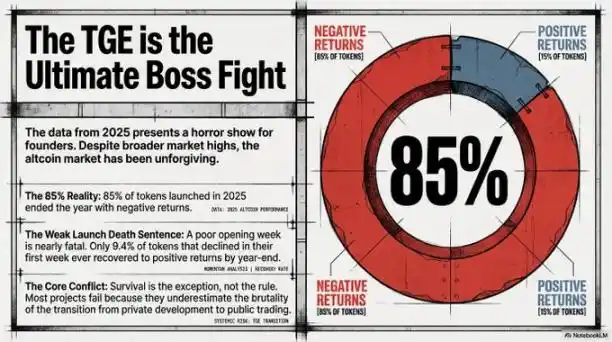
Arrakis Research compiled data from 2025, and the results are unequivocal: 85% of token launch projects ended the year with negative returns.

This can't be blamed on poor market conditions; a bear market doesn't specifically target tokens with poor tokenomics while sparing the well-designed ones.

This number is the market sounding an alarm for founders: most people are heading into a fight but have only prepared for a ribbon-cutting ceremony.
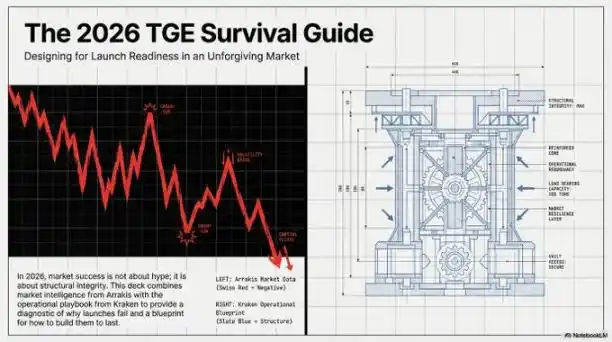
The good news? The surviving 15% aren't just lucky. They are meticulous, and their methods are replicable.

"Poor performance in the first week is basically a death sentence. Data shows that only 9.4% of tokens that fell in their first week managed to recover." — Arrakis Research

This statement is worth pondering.

Summary

  • Your token's failure isn't bad luck; it's because you didn't design it to succeed in the first place.
  • 85% of tokens launched in 2025 declined over the year. This is a design problem, not a market problem.
  • Launching with a Fully Diluted Valuation (FDV) exceeding $1 billion is essentially giving money to people who will never use your product, helping them 'cash out at the top'.
  • Staking, governance, and custody are not 'add-on features'; they are the token's immune system. Without them, the token collapses immediately upon launch.
  • Only 9.4% of tokens that fell in their first week recovered. The first week's performance essentially determines life or death.

The 'Physical Laws' Behind TGE

Here's a useful mental model, borrowing concepts from physics. Every token launch has two opposing forces:

  • Selling Pressure = Gravity. It exists objectively, is patient, and doesn't care about your grand vision.
  • Real Demand = Rocket Engine.

The issue isn't whether gravity exists (it always does), but whether your engine is powerful enough to escape it. Unfortunately, most teams build rockets without engines and then blame the planet's gravity.
Who Sells on Day One? (It's Not That They're Bad)

Many founders make a big mistake here: seeing selling as betrayal. It's not; it's simple math.

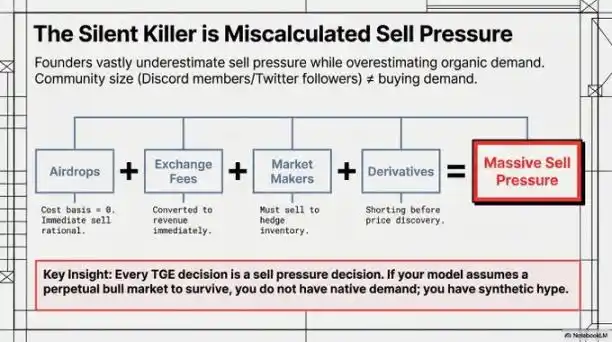
Airdrop users have a cost basis of zero. It's perfectly rational to convert something obtained for free into real money. Data shows that 80% of airdrop users sell their tokens within the first 24 hours of receiving them. This isn't disloyalty; it's human nature.

Centralized exchanges receive tokens as listing fees; this is their revenue. Liquidating their inventory is justified and reasonable.

If market makers are working on a 'loan model' partnership, to hedge risk and prepare stablecoins for quoting, they must also sell a portion of the borrowed tokens. This isn't betrayal either; it's a feature of the model you agreed to, with its inherent math.

Early short sellers act before the price stabilizes. They are veterans, often having been around longer than your project. They are not the problem; your failure to anticipate them is the problem.

Many projects design their tokens assuming the above actors don't exist. But they are real. Either you factor them in, or they will 'teach you a lesson'.
The Valuation Trap (How to Fool Yourself with Math)

The most expensive vanity item in crypto isn't profile pictures (PFPs); it's an outrageously high Fully Diluted Valuation (FDV).

The common trick: the team releases only 5% of the tokens into circulation ('low float') but publicly claims an FDV of $1 billion.

The market does the math: is the price of the remaining 95% of locked tokens calculated as if they will 'never unlock'? But that's impossible; they will eventually be released. When that day comes, the price plummets like a 'ski jump'.

The data is staggering, and every founder should see it:
FDV at Launch

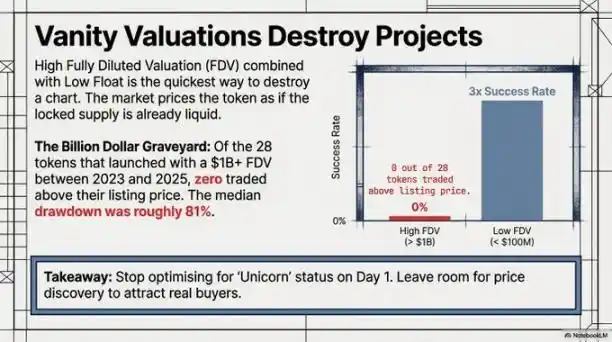
  • Above $1 billion: By year-end, not a single token was above its launch price. Median decline: 81%.
  • Below $100 million: The probability of performing well in the first month is 3 times higher than for tokens with an FDV over $500 million.

A 100% failure rate. Not 70%, not 90%, but 100%.

Yet founders keep doing it because '$1 billion FDV' looks great in press releases and makes early investors' paper gains look good before they can actually sell. Essentially, it's a 'pricing illusion' that the market mercilessly bursts.

Obsessing over launch day FDV is like judging a company's success by how pretty its PowerPoint is. It might impress those who don't look long-term. A lower valuation leaves room for genuine price discovery, enabling sustainable growth. Low-key launches often survive; vanity launches mostly die.

Four Talismans (The Things That Actually Work)

Arrakis summarized four key pillars that distinguish who survives from who just pays tuition. We add our own insights.

Talisman 1: Sybil — Filter Before Airdrop

A comparison of two cases makes it clear:
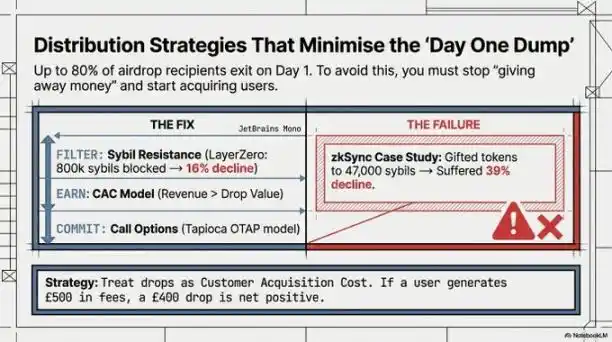
  • @LayerZero_Core put in the hard work, identifying 800,000 'Sybil addresses' (fake accounts farming the airdrop) before the token launch. These recipients would only sell immediately and never return. Result: only a 16% drop in the first month.
  • zkSync did little filtering, resulting in 47,000 Sybil addresses receiving the airdrop. Result: a 39% drop over the same period.

The difference between 16% and 39% is the price of not doing the homework.

Sybil resistance sounds tedious, but think clearly: you are paying for real users, not feeding parasites. Those airdrop farmers don't want your product; they only want your token. Make it costlier for those who don't use your product to get the token.

Talisman 2: Revenue-Based Airdrop — Treat Airdrop as 'Customer Acquisition Cost'

Change your perspective on airdrops: don't see them as 'community rewards', see them as 'customer acquisition cost'.
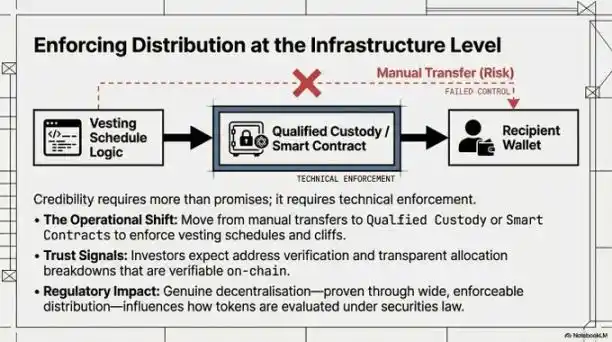
If a user contributed $500 in fees to your protocol, and you reward them with $400 worth of tokens. Even if they sell all tokens immediately, this 'acquisition' is still a net gain ($100 net profit). Real economic activity has already occurred; the token sell-off is just an entry in the ledger, not a disaster.

Talisman 3: Infrastructure Readiness — Don't Roll Out a Car Without an Engine

Staking and governance functionalities must be available the moment the token launches. Not 'coming soon', not 'in development', but 'available immediately'.

If not, the result will be:

Early supporters get the token and find they can neither stake it for yield nor participate in voting. Capital sits idle. Idle, non-yielding capital gets sold. This isn't disloyalty; it's basic investment logic.
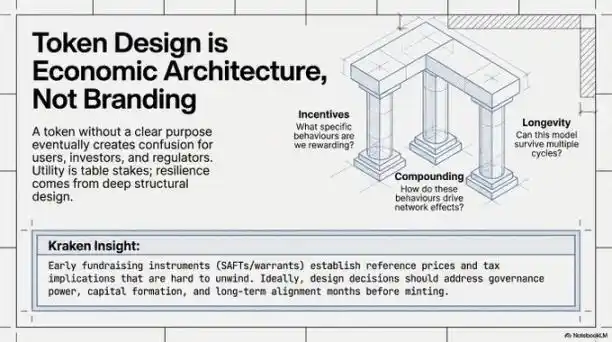
Additionally, a qualified custody solution must be in place from day one. This is a hard requirement institutional investors will check. If custody is still just a 'multisig' without a compliant framework, large funds simply won't enter. This isn't being difficult; it's their risk management.

Talisman 4: Choosing the Right Market Maker — Understand the Service You're Buying

Market makers provide 'liquidity' (market depth), not 'demand' (buyers). This is crucial. Some founders hire market makers thinking they're hiring a 'price protection squad'. They only make existing buying and selling smoother; they can't conjure up buyers.

  • The 'Engagement Model' is more transparent and better.
  • The 'Loan Model' can be useful, but the market maker's own hedging needs inherently conflict with your goal of stabilizing the price.
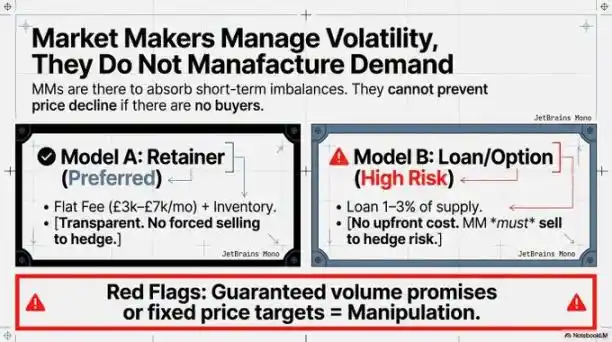
Danger signs when choosing a market maker:

  • Guaranteed volume targets
  • Unwilling to accept your terms
  • Promising to support the price under heavy selling pressure

These might indicate they plan to use wash trading (fake volume) instead of legitimate market making.

Liquidity should be concentrated. Spreading $1 million across three chains results in shallow 'depth' on each chain, unable to withstand any pressure. It's better to choose one main battlefield and create deep liquidity there. Depth in one place is better than thin coverage in three.
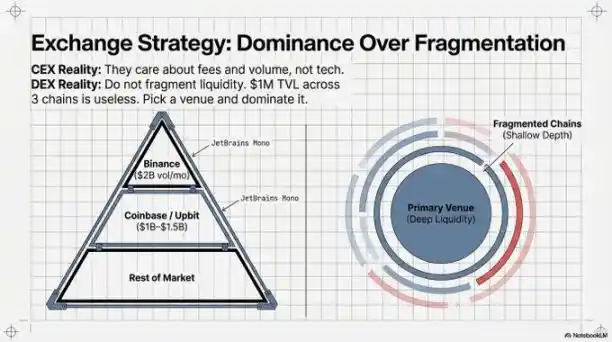
The Ultimate Goal: Decentralization

The infrastructure and distribution mentioned earlier are defensive measures. The real long-term goal is for the protocol to mature truly in four aspects:

  • Development Decentralization: Not just the core team can write code; third parties can also participate in development through grant programs.
  • Governance Decentralization: Transparent decision-making process, multi-party participation, proposals that are actually implemented.
  • Value Distribution Decentralization: Economic design allows more participants to benefit, not just enriching an internal circle.
  • Access Decentralization: Global users can participate in staking, voting, etc., through low-barrier, compliant means, not limited to crypto veterans.

The brilliance of the Arrakis framework lies here. A protocol that is only well-prepared at launch but does not advance true decentralization is merely postponing 'centralization risk', not solving it.

Final Thoughts

Arrakis's research is one of the most rigorous analyses of TGE in the first quarter of this year. The core argument is correct: a token launch is about deploying infrastructure, not running a marketing campaign.
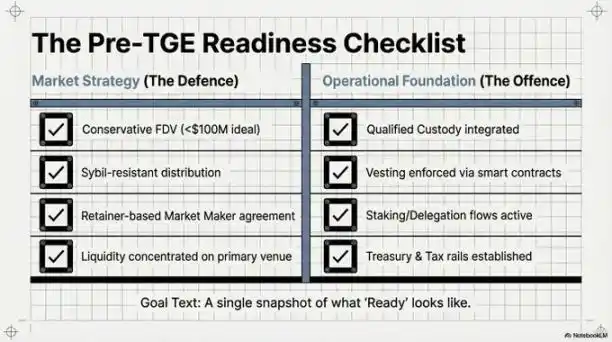
Teams that treat it as marketing often produce beautiful 'first-week charts', followed by a 'ski jump' decline. Teams that treat it as infrastructure—meticulously analyzing sell pressure sources, preparing months in advance, not chasing inflated FDV, filtering out airdrop farmers—they often become the surviving 15%.

We want to add one point: real demand for the token must come from the protocol's inherent utility, not from marketing hype. People must genuinely need this token to access the value created by the protocol. If the token's only use is 'governing a protocol no one uses', then even perfect Sybil resistance and compliant custody are useless. Governing something useless has no value.

Before thinking about how to launch, think about how to create real demand first.

Пов'язані питання

QAccording to the article, what percentage of token launches in 2025 ended with negative returns, and what is the primary reason for this failure rate?

A85% of token launches in 2025 ended with negative returns. The primary reason is not bad market conditions but flawed token design and economic models from the start.

QWhat is the critical mistake many founders make regarding the Fully Diluted Valuation (FDV) of their token at launch?

AThe critical mistake is launching with an excessively high FDV (e.g., over $1 billion), often with a very low circulating supply. This creates a 'pricing illusion' that is inevitably shattered when the remaining tokens unlock, leading to a massive price decline. The data shows a 100% failure rate for tokens launched with an FDV over $10 billion.

QWhat are the two opposing forces in the 'physics' model used to describe a Token Generation Event (TGE)?

AThe two opposing forces are Selling Pressure, which is likened to gravity—a constant, patient force—and Real Demand, which is likened to a rocket engine that must be powerful enough to overcome that gravity.

QName two of the four 'talismans' or key pillars identified by Arrakis Research that are crucial for a successful token launch.

ATwo of the four talismans are: 1) Sybil Resistance (filtering out fake users before the airdrop) and 2) Revenue-Based Airdrops (treating the airdrop as a customer acquisition cost rather than just a community reward).

QWhy is it essential for staking and governance functionalities to be available immediately at the token's launch, according to the article?

AStaking and governance must be available immediately because without them, capital from early supporters is idle and unproductive. Idle capital that isn't earning yield is far more likely to be sold, creating immediate and unsustainable selling pressure on the token.

Пов'язані матеріали

7 Months After the Collapse of Huiwang, Southeast Asia's Escrow Platforms Undergo a Major Reshuffle

Following the collapse of Huione Pay—dubbed the "Alipay of Southeast Asia"—seven months ago, the region's underground financial guarantee platform sector is undergoing a significant reshuffle. This power vacuum has been swiftly filled by emerging platforms such as XinBi, Tiger/Navigator, JinBei (renamed JinBo), Dali/Tiancheng, and FullyLight. These platforms, operating largely via Telegram and offering services like escrow for illicit transactions, have absorbed the vast user base and markets left behind by Huione. While positioning themselves as "trust intermediaries," their primary clientele consists of networks involved in online scams, money laundering, illegal gambling, and even human trafficking. For instance, the Tiger/Navigator platform explicitly provides "escrow" services for kidnapping-for-ransom operations ("强押车交易"). Data underscores the immense scale: Huione alone processed over $103 billion in cryptocurrency payments and facilitated over $31 billion through its escrow market before its downfall, linking it to Cambodia's notorious Prince Group. Since its collapse, competitors have seen explosive growth. For example, the XinBi platform has accumulated over $1.6 billion in total USDT revenue, while platforms like NewPay, OkPay (under Dali), and FullyLight Wallet collectively processed over $4.8 billion in USDT in a single year. This ecosystem thrives in regions like Cambodia and Myanmar, where regulatory gaps allow these platforms to act as critical financial infrastructure for sprawling cybercrime industries, from scam compounds to online casinos. The article concludes that the moniker "Southeast Asian Alipay" is a misnomer, obscuring the platforms' fundamental role in enabling serious criminal enterprises rather than representing legitimate financial innovation.

Odaily星球日报38 хв тому

7 Months After the Collapse of Huiwang, Southeast Asia's Escrow Platforms Undergo a Major Reshuffle

Odaily星球日报38 хв тому

The Changing Landscape: What Are Crypto VCs Experiencing?

Title: The Shifting Landscape of Crypto Venture Capital The era of dedicated crypto venture capital funds is undergoing a significant transformation. Once essential for navigating the sector's complexity and high risk, these specialized funds are now facing an identity crisis as the market matures. This shift mirrors historical patterns in other specialized investment classes like cleantech and SPACs, where initial information advantages dissipate as technologies become mainstream and integrated into existing industry frameworks. The article argues that crypto is reaching a critical inflection point, transitioning from a "building phase" to an "integration phase." Major players like Stripe, BlackRock, and Visa now engage with crypto not for its novel mechanics but as a foundational financial infrastructure. Their needs—regulatory compliance, banking partnerships, distribution channels—align with traditional fintech, a domain easily understood by large, generalist funds like Sequoia and Founders Fund. This evolution creates a "barbell effect" within the VC landscape. On one end are massive, diversified platforms that can incorporate crypto as one vertical among many. On the other are small, nimble funds focused on niche, experimental projects. The middle ground—medium-sized dedicated crypto funds—is being squeezed out. Their typical fund size makes it impossible to generate sufficient returns solely from early-stage crypto bets, yet they cannot compete with giants for later-stage deals. Consequently, leading crypto-native firms like Paradigm and Framework Ventures are expanding into AI, robotics, and other sectors, driven partly by LP pressure for better returns amid a broader VC DPI crisis. Others, like Dragonfly and a16z, have narrowed their crypto focus predominantly to financial infrastructure like stablecoins, reframing the sector's core narrative. For crypto entrepreneurs, this consolidation presents challenges. While generalist funds offer larger checks and broader resources, crypto projects now compete fiercely with AI for attention and capital within these firms. Furthermore, the long-term, non-commercial foundational work that built the ecosystem—funded by dedicated crypto VCs—is less likely to attract generalist capital focused on direct returns. The conclusion is that "crypto investor" as a standalone category is becoming obsolete, akin to "internet investor." Crypto is becoming a baseline infrastructure layer. The future will see a barbell structure: large-scale growth financing handled by generalist funds, while pioneering, speculative projects are funded by small, specialized vehicles. The dedicated crypto funds of the 2017-2021 boom, which incubated core infrastructure, are giving way to this new, bifurcated reality.

Foresight News56 хв тому

The Changing Landscape: What Are Crypto VCs Experiencing?

Foresight News56 хв тому

As Consensus Accelerates, What Are Young Investors Betting On?

Title: As Consensus Forms Faster, What Are Young Investors Betting On? In the rapid evolution of tech investment, a new generation of young investors is navigating a landscape where AI, robotics, commercial aerospace, and quantum computing are advancing simultaneously. Traditional investment logic based on financial models is giving way to a need for deep technical understanding and the ability to act before industry consensus forms. An analysis of trends from the "WAIC FUTURE TECH" list of young investment leaders reveals key shifts in focus. The first major trend is the movement of AI from the digital screen into the physical world. Investment is shifting from large language models and chatbots towards embodied AI, robotics, AI hardware, and edge computing. While demonstrations generate excitement, the real challenge lies in achieving scalable, reliable, and cost-effective delivery in complex real-world environments like factories and logistics. Success depends not just on algorithms but on the integration of sensors, actuators, and control systems. Second, the competitive focus for large models is moving beyond raw capability toward building an "intelligence flywheel." The goal is to create self-reinforcing systems where user interaction generates data, improving the model, which in turn enhances the user experience and attracts more engagement. Companies that successfully embed AI into workflows to create these closed-loop systems can build lasting value that isn't easily erased by the next model upgrade. Third, facing a potential bottleneck in high-quality human-generated data, investors are looking at new underlying technologies. Reinforcement learning and self-play, as demonstrated by AlphaGo Zero, offer paths for AI to generate its own experience. Scientific foundation models, which aim to build general AI capabilities for fields like life sciences and materials discovery, represent a non-consensus direction that could unlock new frontiers of knowledge and data. Finally, in deep-tech areas like quantum computing, commercial aerospace, and space-based infrastructure, patient capital is essential. These fields have long, uncertain development and validation cycles involving complex engineering, supply chains, and regulations. Investment here requires a long-term view, focusing on foundational team capabilities and the eventual emergence of market demand, even if commercial returns are distant. Collectively, these trends illustrate how young investors are adapting to a new era. They are learning to make earlier, technically-informed judgments, balance hype with real-world viability, and provide the patient capital needed to build the deep-tech foundations of the future.

marsbit1 год тому

As Consensus Accelerates, What Are Young Investors Betting On?

marsbit1 год тому

Торгівля

Спот
活动图片





