“Why Didn’t You Buy 2x Long SK Hynix?”

marsbitОпубліковано о 2026-05-16Востаннє оновлено о 2026-05-16

Анотація

The article discusses the immense popularity of the "2x Long SK Hynix ETF" (07709.HK) in Hong Kong, which became the world's largest single-stock leveraged ETF by May 2026. Launched in October 2025, the ETF's net value soared over 1000% in seven months, significantly outperforming the 324% gain of SK Hynix's underlying stock, driven by the AI boom and a critical shift in industry demand from computing power to memory. It highlights the mechanics and risks of daily-rebalanced leveraged ETFs. In a smooth bullish market, they generate amplified returns, but during volatile periods—exemplified by market swings during geopolitical tensions in the Strait of Hormuz in March-April 2026—they suffer severe "volatility decay," where choppy price action can cause losses far exceeding twice the drop of the underlying asset. The piece frames SK Hynix, as NVIDIA's primary HBM supplier, within the classic cycle of the memory chip industry—a commoditized sector prone to boom-and-bust cycles of shortage, price hikes, overcapacity, and crashes. While current AI-driven demand and high margins (Q1 2026毛利率~79%) create a "super cycle," the article questions its sustainability. It warns that extreme profits will inevitably tempt competitors like Samsung and Micron to ramp up HBM production, potentially eroding scarcity. Furthermore, the entire narrative remains tethered to the massive AI capital expenditure of tech giants. In conclusion, the ETF's trajectory symbolizes the accelerated, all-in nat...

This month in South Korea, if you are neither an SK Hynix employee nor hold SK Hynix stock, you are most likely 'having a tough time.'

As soon as the massive Q1 profits were announced, investment banks—never shy about fanning the flames—not only actively revised up their profit forecasts for Hynix this year but also raised the bonus expectations of Hynix employees. Leveraging the company's principle of allocating 10% of annual operating profit as a bonus pool, they calculated year-end bonuses amounting to millions of RMB per capita. In doing so, they conveniently placed the capitalists at rival Samsung in a rather unflattering and awkward position.

Since then, anything even remotely associated with Hynix's IP has been met with frenzied追捧.

Hynix work uniforms have become a priority pass in the Korean相亲market; real estate agents in Icheon City, where its headquarters is located, experienced a dream-like quarter, with housing prices and transaction volumes rising in multiple areas along the Hynix commuter bus routes; even the tangentially related China-South Korea semiconductor ETFs were driven to premium rates of around 30%, frequently triggering temporary trading halts.

Even the Hong Kong stock market, long criticized for lacking tech substance, managed to perk up.

As of May 13, 2026, the Hong Kong-listed CSOP SK Hynix Daily 2x Leveraged ETF (07709.HK) (hereinafter referred to as the 2x Long Hynix ETF) saw its asset规模approach HK$60 billion, surpassing the long-time leader in the US market, the 2x Long Tesla ETF (TSLL.NASDAQ), to become the world's largest single-stock leveraged derivative product by size.

No matter how niche an investment product is, when the market rallies to this extent, anyone surfing the web—even if just following tech and digital influencers—can't help but occasionally encounter enthusiastic netizens' in-your-face question in the comments section: 'Why didn't you buy 2x Long SK Hynix?'

The Fatal Leverage

When the 2x Long Hynix ETF was first listed on the Hong Kong Exchange on October 16, 2025, its issuance size was less than HK$5 billion. Calculating based on the closing price on May 13, 2026, over these 7 months, this leveraged ETF's net asset value has surged by 1011.58%, while its规模ballooned more than 13-fold.

云迹科技, which debuted on the same day in Hong Kong as the so-called 'first hotel robot stock' and has seen its股价rise steeply, only achieved a market cap less than 4 times its IPO valuation.

If you think this demonstrates the terrifying efficiency of 2x leverage, consider that SK Hynix's underlying stock in the Korean market gained 'only' 324.49% cumulatively from October 17 last year to May 13 this year. Bolstered by a sustained upward rally, this leveraged ETF even generated an excess return of 362% beyond its theoretical 2倍收益. Faced with such a暴力撒币spectacle, labeling it a 'triple leverage' product seems more appropriate.

However, zooming out over the past 7 months, this paper-thin excess is temporary.
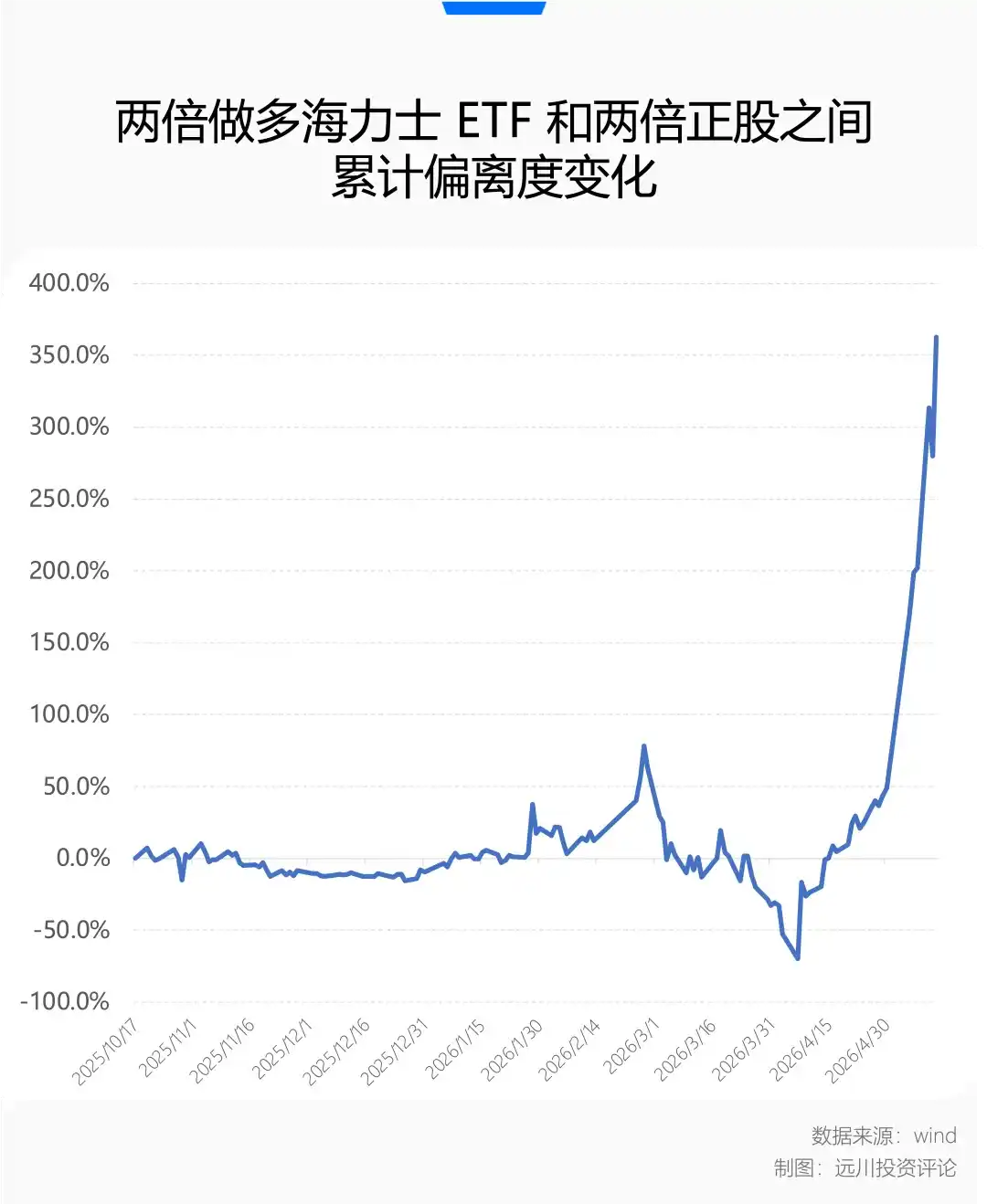
Just two months ago, the Strait of Hormuz陷入薛定谔的封锁, and global markets panicked amidst an abrupt oil and gas supply disruption. In the seesawing and rapidly shifting situation, the market did not experience a traditional one-sided decline. Instead, it became schizophrenic in this atypical geopolitical conflict.

During the day, it might trade on the避险logic of 'World War III erupting, supply chains breaking,' only to swiftly switch to the 'de-escalation, return to the tech主线' FOMO狂欢 at night based on ambiguous statements from the White House spokesperson. This模糊性and uncertainty in the evolution path were amplified by the rapid spread on social media, translating into wild sell-offs targeting tech stocks or frantic bottom-fishing on every dip. The传导was extreme.

While common sense tells us wars eventually end, and daily AI industry token consumption keeps accelerating, when market volatility becomes too intense, the曲折过程cannot be entirely ignored.

It was during this period that more people felt the波动损耗inherent in this leveraged ETF product.

Looking at actual trading data from March to April 2026, Hynix's stock price declined amidst剧烈震荡. A decline is problematic in itself, but the multiple violent rebounds exceeding 10% during the period were the real salt in the wound.

For the 2x Long Hynix ETF, which rebalances its leverage daily, a one-sided decline might be somewhat tolerable; a high-volatility,震荡下行trend is the real meat grinder. During the most agonizing phase, it跌超过50% more than twice the underlying stock's decline.

In theory, without considering other transaction fees and management expenses, the product's daily rebalancing mechanism means that in a one-sided bull market, yesterday's profits automatically become today's 'principal,' on which an additional 2x leverage is applied, generating magnified超额正收益. Conversely, in a one-sided暴跌, because the daily calculation基数shrinks, its actual losses would be less than the theoretical 2x.

However, once it enters a '涨跌交替' volatile, range-bound market, the leveraged ETF reveals its狰狞的一面.

The 2x Long Hynix ETF repeatedly experienced '多空双杀'—after a big gain yesterday and rebalancing, a drop today would inflict heavier losses; then, after rebalancing again, another rebound tomorrow would incur losses once more due to the reduced基数.

The反复摩擦from alternating gains and losses causes the product's actual net value drawdown to far exceed twice the decline of the underlying stock, creating significant negative波动损耗that erodes investors'本金.

However, now the market has returned to the AI主线,狂热资金is once again rallying and pouring in, bringing about one-sided暴涨and皆大欢喜.

As Hynix's market cap repeatedly hits new highs, and as this hundred-billion-scale leveraged ETF product ignites狂热交投, the market inevitably returns to that age-old question: In this round of industrial revolution, do cycles truly not exist?

The Silicon-Based Cyclical Stock

One must admit that, judging by its listing timing, the 2x Long Hynix ETF was practically叠加满了with the加持of 'destiny, luck, and风水.'

For a considerable period before, memory was not the absolute focal point for going long on the AI主线in secondary markets. After all, since humanity boarded the information age express in the 90s, memory has often been the sector littered with casualties after periods of烈火烹油, where the terror of cycles far outweighs the梦幻of growth.

Memory chips (especially traditional DRAM and NAND) are highly standardized大宗商品. The memory sticks produced by different manufacturers, aside from the brand贴纸, have almost no differences in physical performance, akin to silicon-based猪肉股. The entire industry has long been trapped in a brutal cyclical loop:

Shortage → Price surge → Giants疯狂扩产→产能过剩→价格雪崩→ Losses & production cuts → Shortage again.

Each upcycle is冠以'super cycle' under超级乐观expectations. Each downcycle is marked by惨烈price wars and billions in losses, leaving累累尸骨.

After enduring the半导体寒冬of 2022-2023, the surviving memory triumvirate—Micron, Samsung, Hynix—tacitly cut capital expenditures, abandoning the strategy of恶意扩产that hurts the enemy a thousand while自损八百.
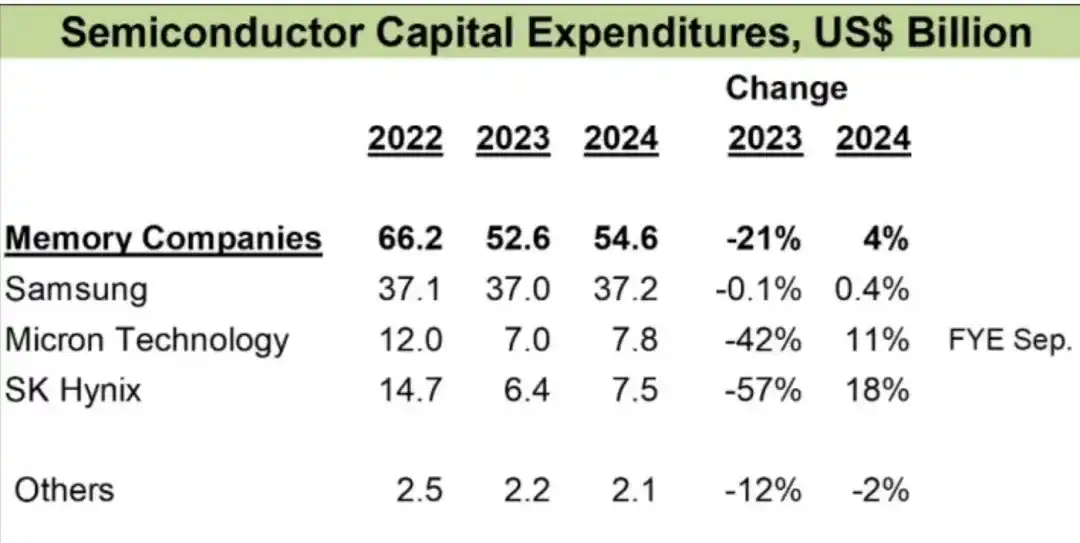
Image Source: IC Insights

Then the AI narrative arrived, replaying the shortage-and-price-hike script, essentially installing money-printing machines for everyone.

Especially starting from the second half of last year, as the competitive focus in the AI industry端shifted from 'training' to 'inference,' demand重心for infrastructure shifted from 'computing power' to 'storage power,' and supply bottlenecks moved from bandwidth to capacity, widespread memory shortages became the hottest trading narrative.

At this point, anyone still mentioning 'wasn't the end of AI supposed to be electricity?' is most likely someone who missed the rally.

Post-Q3 2025, AI industry news was almost exclusively about memory chip shortages—sometimes reports that巨头们had HBM orders booked through 2027 and beyond; other times notifications to clients that DDR5 was also in short supply, apologizing that now, whether高端or低端, it's about across-the-board price hikes.

Hynix, as NVIDIA's primary supplier for HBM, captured极高的先发优势and market share. The timely上市of the 2x Long Hynix ETF practically coincided perfectly with the golden days when memory sticks' price per gram surpassed黄金and one box could trade for an apartment in Shanghai.

So, does hopping on the AI express allow escape from周期引力? The important thing isn't to draw a conclusion now, but to identify where changes might occur.

Hynix has established a dominant,一家独大position behind the yield壁垒of HBM. In Q1 2026, SK Hynix's quarterly毛利率reached a historical peak of around 79%, even surpassing NVIDIA's profitability during the same period.

Human nature tells us that极致超额利润will inevitably attract蜂拥而上的产能扩张欲. The tacit understanding seemingly reached among memory giants through 'production cuts' is untrustworthy in the face of absolute暴利.

Therefore, whether Samsung or Micron's yields will breakthrough at some future point, potentially discounting the scarcity narrative of HBM and increasing分歧between bulls and bears leading to sector震荡, is a variable requiring持续跟踪.

Beyond changes on the supply side,争议on the demand side hasn't completely烟消云散just because of accelerating Agent adoption and increasing token consumption.

Ultimately, Hynix's疯狂is built upon NVIDIA's疯狂; and NVIDIA's疯狂is built upon downstream tech giants'每年上千亿美金的 AI capital expenditures.

Capex边际变化remains the greatest引力in secondary markets for all AI-related anxiety and pride.

Epilogue

Whether you buy the 2x Long Hynix ETF or not, it will become a微妙注脚when we look back on this era in the future.

In this era, bulls and bears are often talking about two different things: bulls on AI industry信仰, bears on macro地缘担忧.

People habitually翻开历史书, trying to find parallels in the internet狂飙of the millennium or earlier macro upheavals. But each round of technological revolution unfolds differently. This time, the '不一样' lies in: the颠覆速度of this industrial revolution is史无前例.

AI is reshaping global productivity and生产关系的at an unprecedented acceleration. This extreme '快' has broken the漫长的渗透与发酵过程of traditional tech cycles. It doesn't give the market much time to slowly digest valuations, nor does it offer much轮动机会for 'old-school stocks' to get a bit of眷顾from泛滥的流动性.

Whether industry giants or secondary market capital, all are forced to complete their站队与定价within an extremely short time window. Hence, stock price gains are measured in multiples; hence, seasoned AI practitioners have already默认that in this era, six months counts as a长期.

However, the storm over the Strait of Hormuz once again placed this round of tech revolution under the commonality shared by all past tech cycles: industry determines the终局and收益率, while macro influences the路径and波动率. What caused the巨大负向偏离in the 2x Long Hynix ETF was not an中断in the AI进程, but the极度摇摆of global macro expectations during that one-plus month.

And the软肋of the real world isn't confined to just that 33-kilometer narrowest point of the Strait of Hormuz.


Пов'язані питання

QWhat is the primary risk of holding a daily-rebalanced leveraged ETF like the 2x Long SK Hynix ETF, according to the article?

AThe primary risk is volatility decay (or negative volatility drag) in a volatile, non-trending market. In a market with frequent large up and down swings, the daily rebalancing mechanism can cause the ETF's actual losses to significantly exceed twice the losses of the underlying stock due to compounding effects on a shrinking base, eroding investor capital.

QWhat major global event in early 2026 caused significant volatility and negatively impacted the performance of the 2x Long SK Hynix ETF?

AThe uncertain blockade of the Strait of Hormuz caused significant market volatility. The situation's ambiguity and rapid shifts in market sentiment between 'wartime supply chain disruption' and 'de-escalation back to the AI theme' led to violent swings in tech stocks, creating a high-volatility environment that exposed the leveraged ETF to severe volatility decay.

QWhy is SK Hynix currently experiencing record profitability, and what specific product is central to this success?

ASK Hynix is experiencing record profitability primarily due to its dominant position as the primary supplier of High Bandwidth Memory (HBM) to Nvidia. The severe shortage of HBM and other memory chips driven by the AI industry's shift from 'training' to 'inference' has allowed Hynix to command premium prices, achieving a gross margin of approximately 79% in Q1 2026.

QDespite the current AI-driven boom, what fundamental characteristic of the memory chip industry suggests that cyclicality might return?

AMemory chips (DRAM and NAND) are highly standardized commodities, leading to a brutal cycle of shortage→price hikes→capacity expansion→oversupply→price collapse. The article argues that the current默契 (tacit agreement) among major players to limit expansion may not hold in the face of extreme profits, and breakthroughs in HBM yield by competitors like Samsung or Micron could challenge Hynix's scarcity narrative, reintroducing cyclical pressures.

QWhat does the article imply is the ultimate driver of SK Hynix's and Nvidia's current 'madness' in the stock market?

AThe article implies that the ultimate driver is the massive annual AI capital expenditure (capex) of downstream tech giants, amounting to hundreds of billions of dollars. Hynix's success is built on Nvidia's, and Nvidia's is built on this sustained, enormous investment from large companies. The marginal changes in this capex remain the biggest source of anxiety and pride in the AI investment narrative.

Пов'язані матеріали

Blocked Its Own Treasure, WeChat AI Steps Up

Tencent's stock surged over 10% on June 2nd amid reports that WeChat, with 1.43 billion monthly users, is finalizing tests for a native AI Agent. The reported feature, accessible by swiping right from the main interface, allows users to issue commands in natural language. The AI then decomposes tasks and automatically calls upon relevant Mini Programs within WeChat to complete actions like ordering food, booking tickets, or making payments, creating a closed-loop service execution system. This strategic shift follows the internal conflict and subsequent "blocking" of Tencent's standalone AI app, Yuanbao, by WeChat for violating sharing rules during a 2026 Spring Festival promotion. The incident highlighted a lack of internal consensus and exposed the weakness of competing in the standalone AI assistant arena against rivals like ByteDance's Doubao (345M MAU) and Alibaba's Qianwen. The new WeChat AI Agent aims to leverage WeChat's unique assets—its massive user base, standardized Mini Program APIs, WeChat Pay, and identity system—to move from simple content generation to actual task execution. Analysts note this changes the competitive landscape from model benchmarks to which AI can connect to more real-world services. However, success depends on key variables: the capability of Tencent's underlying Hunyuan model, managing massive inference costs, and redesigning incentives for Mini Program developers whose traffic might be bypassed. The move is seen as an attempt to keep user service intent within WeChat's ecosystem as AI begins to redefine how users access services.

marsbitЩойно

Blocked Its Own Treasure, WeChat AI Steps Up

marsbitЩойно

ByteDance Adopts Arm CPUs, Jensen Huang: So Sad I Didn't Buy Arm

**Summary:** At Computex 2026, Arm CEO Rene Haas announced that ByteDance and Oracle have adopted Arm's self-designed Arm AGI data center CPU. The company expects significant revenue growth from this product, projecting $20 billion in demand for the 2027/2028 fiscal years. Haas noted that restricting AI-capable CPUs from the US to China is nearly impossible due to their widespread applications. Arm's stock has surged dramatically this year, notably rising 16% after NVIDIA's Arm-based Vera CPU and RTX Spark announcements. A highlight was the informal, humorous on-stage conversation between Haas and NVIDIA CEO Jensen Huang. Huang joked about NVIDIA's failed attempt to acquire Arm and playfully lamented selling his Arm shares. Both executives showed a clear sense of camaraderie and shared regret over the missed merger. Key technical topics were discussed: 1. **AI PC Design:** Huang explained NVIDIA's RTX Spark superchip (with a 20-core Arm CPU) is designed for future AI agents that will autonomously run and use tools on PCs, blending local and cloud processing. 2. **Agent vs. OS:** Huang emphasized the operating system remains crucial, as AI agents rely on its APIs and tools to function. 3. **Growth Constraints:** He identified the shift to "useful AI" that generates profitable tokens as a primary driver for immense, almost limitless, computational demand. Haas outlined Arm's strategy across PC and data centers. For PCs, Arm collaborates with partners like NVIDIA and MediaTek, offering its compute subsystem (CSS) for custom SoCs. In data centers, its Arm AGI CPU (built on TSMC's 3nm process) has gained major partners including OpenAI, Meta, and now ByteDance and Oracle. Arm presented a multi-year roadmap for its in-house CPU line. The article concludes that while GPUs dominated the AI training race, the explosion of AI agents is shifting significant focus to CPUs for inference, state management, and tool orchestration. The industry is trending towards vertical integration, with companies like cloud providers designing chips and chip/IP firms offering full solutions, all competing to deliver more efficient computing per watt.

marsbit20 хв тому

ByteDance Adopts Arm CPUs, Jensen Huang: So Sad I Didn't Buy Arm

marsbit20 хв тому

New Wall Street Play: Yen Shorts Still Adding, But Japan Stocks Don't Rely on Carry Trade Unwinding

On June 3rd, USD/JPY hit 160.44, its highest level since July 2024, while the Nikkei 225 surged past 68,000 points. Contrary to popular narratives of an imminent "carry trade unwind" akin to August 2024, data reveals a more complex picture. Speculative net short positions in yen futures have actually increased, reaching -114,667 contracts by late May, suggesting traders are doubling down rather than retreating. Meanwhile, Japan's Finance Ministry conducted its largest-ever single-round FX intervention (11.73 trillion yen) in April-May but failed to hold the 160 yen line. The Nikkei's rally is not driven by carry trade dynamics. Foreign investors are aggressively buying Japanese stocks, with net purchases in 2026 running nearly 16 times higher than 2025 levels. This inflow is concentrated in AI and semiconductor-related stocks like SoftBank and Socionext, fueled by positive sector outlooks, rather than being a flight from unwinding yen shorts. Furthermore, the Nikkei has continued climbing despite the Bank of Japan's (BOJ) rate hikes to 0.75%. This disconnect exists because the current equity boom is fueled by AI-driven foreign investment, not reliant on cheap yen funding. However, this relationship remains fragile. Should the BOJ hike rates further (e.g., to 1.0%) while dollar weakness increases carry trade costs, the trajectories of the yen and Japanese stocks could reconverge, potentially triggering volatility.

marsbit25 хв тому

New Wall Street Play: Yen Shorts Still Adding, But Japan Stocks Don't Rely on Carry Trade Unwinding

marsbit25 хв тому

Broadcom's Q3 Guidance Misses Expectations by $12 Billion, After-Hours Trading Plummets Over 13%, AI Narrative "Cooling"?

On June 3, Broadcom released record Q2 FY26 results with revenue of $22.19B, up 48% YoY, and AI chip sales of $10.8B, up 143%. Adjusted EPS of $2.44 beat estimates. However, its Q3 AI semiconductor revenue guidance of $16B, while up over 200% YoY, fell roughly $1.2B (7%) short of analyst consensus expectations of $17.2B. This miss, coupled with slightly weaker-than-expected software revenue, triggered a severe market reaction. CEO Hock Tan maintained the FY26 AI revenue outlook of over $100B but did not raise it, disappointing investors who had priced in more robust growth. The stock plummeted over 13% in after-hours trading, erasing roughly $270B in market cap. The sell-off extended to peers like Marvell. A key concern for markets, particularly for Chinese optical module suppliers, was Tan's comment that the contribution of AI networking (e.g., Ethernet switches, optical interconnect chips) to AI revenue, currently near 40%, is expected to normalize to around 30% over time, signaling a potential peak in growth for that segment. Despite the guidance shortfall, Tan reiterated that AI demand remains "insatiable" and reaffirmed the long-term target of exceeding $100B in AI revenue by FY27. The reaction highlights the heightened sensitivity and premium valuation placed on AI-exposed stocks, where anything less than stellar guidance can prompt significant profit-taking. The broader question is whether this represents a cooling AI narrative or a correction in overstretched valuations.

marsbit25 хв тому

Broadcom's Q3 Guidance Misses Expectations by $12 Billion, After-Hours Trading Plummets Over 13%, AI Narrative "Cooling"?

marsbit25 хв тому

Торгівля

Спот
Ф'ючерси

Популярні статті

Як купити T

Ласкаво просимо до HTX.com! Ми зробили покупку Threshold Network Token (T) простою та зручною. Дотримуйтесь нашої покрокової інструкції, щоб розпочати свою криптовалютну подорож.Крок 1: Створіть обліковий запис на HTXВикористовуйте свою електронну пошту або номер телефону, щоб зареєструвати обліковий запис на HTX безплатно. Пройдіть безпроблемну реєстрацію й отримайте доступ до всіх функцій.ЗареєструватисьКрок 2: Перейдіть до розділу Купити крипту і виберіть спосіб оплатиКредитна/дебетова картка: використовуйте вашу картку Visa або Mastercard, щоб миттєво купити Threshold Network Token (T).Баланс: використовуйте кошти з балансу вашого рахунку HTX для безперешкодної торгівлі.Треті особи: ми додали популярні способи оплати, такі як Google Pay та Apple Pay, щоб підвищити зручність.P2P: Торгуйте безпосередньо з іншими користувачами на HTX.Позабіржова торгівля (OTC): ми пропонуємо індивідуальні послуги та конкурентні обмінні курси для трейдерів.Крок 3: Зберігайте свої Threshold Network Token (T)Після придбання Threshold Network Token (T) збережіть його у своєму обліковому записі на HTX. Крім того, ви можете відправити його в інше місце за допомогою блокчейн-переказу або використовувати його для торгівлі іншими криптовалютами.Крок 4: Торгівля Threshold Network Token (T)Легко торгуйте Threshold Network Token (T) на спотовому ринку HTX. Просто увійдіть до свого облікового запису, виберіть торгову пару, укладайте угоди та спостерігайте за ними в режимі реального часу. Ми пропонуємо зручний досвід як для початківців, так і для досвідчених трейдерів.

450 переглядів усьогоОпубліковано 2024.12.10Оновлено 2026.06.02

Як купити T

Обговорення

Ласкаво просимо до спільноти HTX. Тут ви можете бути в курсі останніх подій розвитку платформи та отримати доступ до професійної ринкової інформації. Нижче представлені думки користувачів щодо ціни T (T).

活动图片












