Why Did NVIDIA's Bond Issue Go Unnoticed While SpaceX's Caused a Plunge?

marsbitОпубліковано о 2026-06-23Востаннє оновлено о 2026-06-23

Анотація

The article analyzes the contrasting market reactions to recent bond issuances by SpaceX and NVIDIA. While NVIDIA's $25 billion bond offering was met with strong demand and seen as securing long-term capital for its already profitable AI business, SpaceX's move to raise at least $20 billion in bonds (primarily to refinance bridge loans) triggered a sell-off in its stock (SPCX). The key difference lies in the stage of cash flow validation for their respective core narratives. For NVIDIA, the AI boom is generating substantial, visible revenue and profits, making debt a tool to amplify a proven growth curve. For SpaceX, despite a strong cash position post-IPO and a revenue-generating business in Starlink, its valuation is heavily tied to future, capital-intensive projects like Starship, global satellite networks, and potential AI infrastructure. The bond issuance acted as a trigger, shifting market focus from SpaceX's long-term vision to the pressing question of whether Starlink's profits can fund these ambitious, unproven ventures before they generate their own returns. Thus, the market penalizes not the act of borrowing itself, but the perceived gap between high capital expenditure and the speed of cash flow realization. SpaceX's valuation recovery hinges on demonstrating that Starlink's profitability can outpace the burn rate of its futuristic projects or that those projects (like Starship achieving reliable, low-cost reusability) can soon transition from costly visions to ...

TL;DR

Around June 22, SpaceX pursued at least a $20 billion bond financing following its IPO, primarily to repay previous bridge loans. Subsequently, the SpaceX-linked security SPCX faced selling pressure in the secondary market. On June 23, it traded around $154.60 intraday, below its first-day closing price but still above the $135 IPO price.
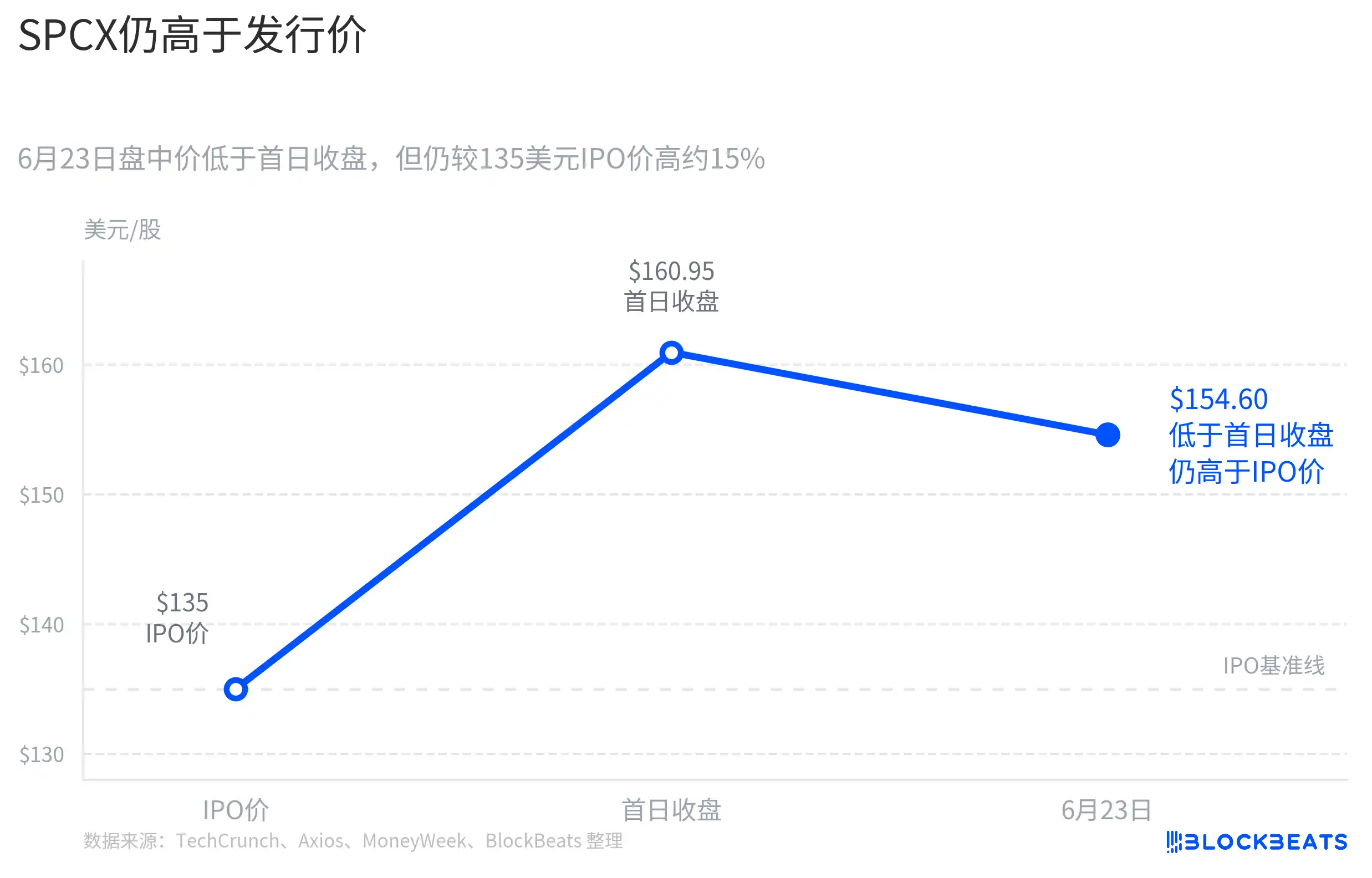
This price movement should not be simplistically attributed to the bond event alone, but the financing news indeed acted as a trigger. It swiftly shifted the nascent space narrative in the public markets back to cash flow concerns: the market began recalculating how much funding SpaceX's long-term projects would require and which business segment would cover them.

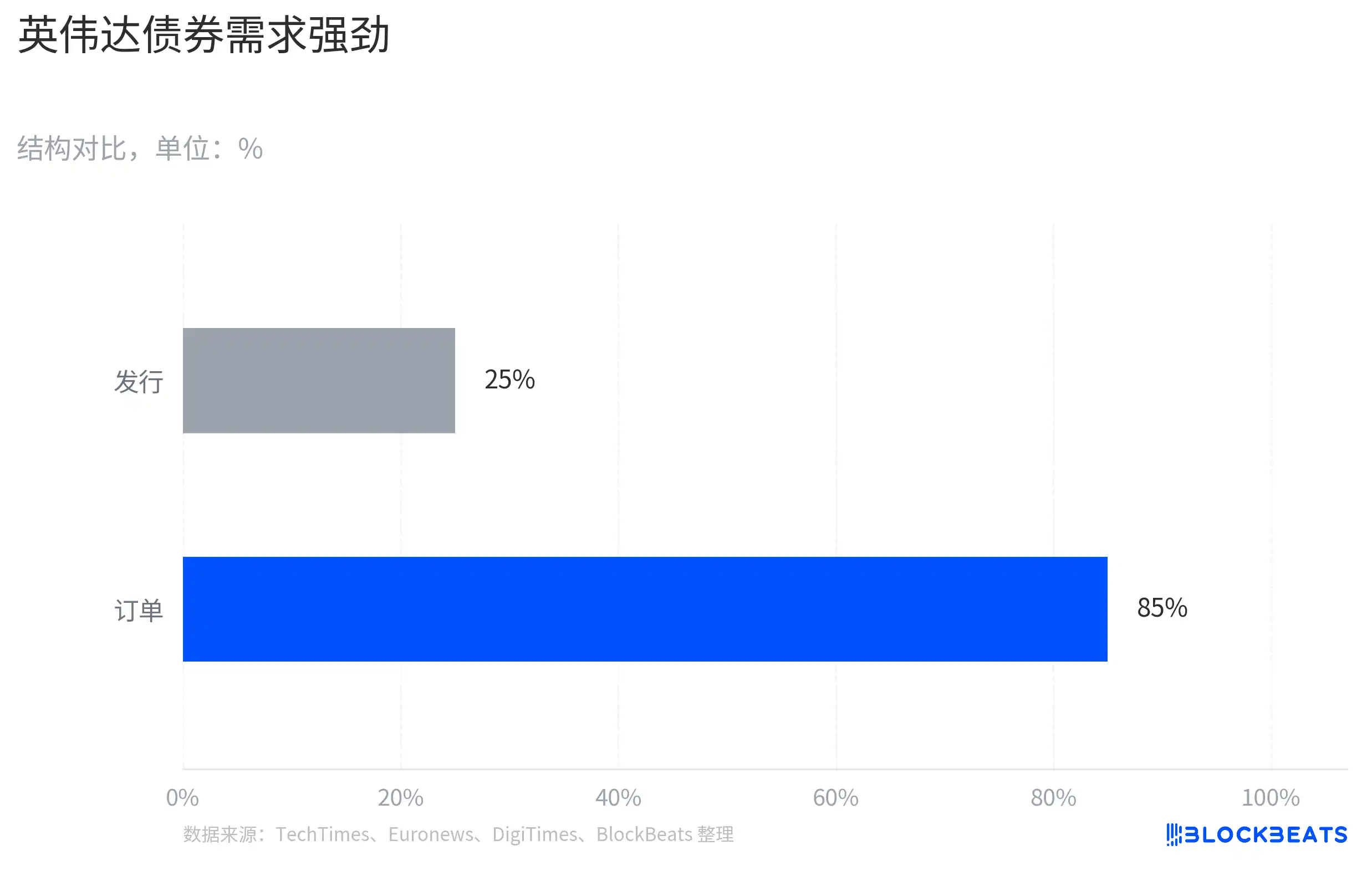
NVIDIA serves as the most crucial reference point. On June 15, NVIDIA issued $25 billion in high-grade bonds, with order demand reportedly reaching approximately $85 billion. The issuance size was also increased from an initial plan of about $20 billion. Both companies raised funds under grand narratives, but market reactions were entirely different: NVIDIA's bond issue was more readily perceived as locking in long-term capital, whereas SpaceX's immediately subjected the company to a capital expenditure stress test.

The difference lies not in the act of issuing bonds itself, but in the market's level of trust regarding cash flows. NVIDIA's AI demand has already been validated by revenue and profits, making its debt more akin to amplifying a growth curve that is already realized. SpaceX, however, needs to answer another question: can the money earned by Starlink sustain Starship, the satellite network, AI infrastructure, and even more distant space visions?

SpaceX's Financing Forces the Market to Recalculate Capex

The bond issue itself isn't the problem. For high-credit companies, replacing short-term bridge loans with long-term debt is often just capital structure management. SpaceX's reported at least $20 billion bond financing was also primarily framed as repaying previous bridge loans, and should not be simply interpreted as negative news.

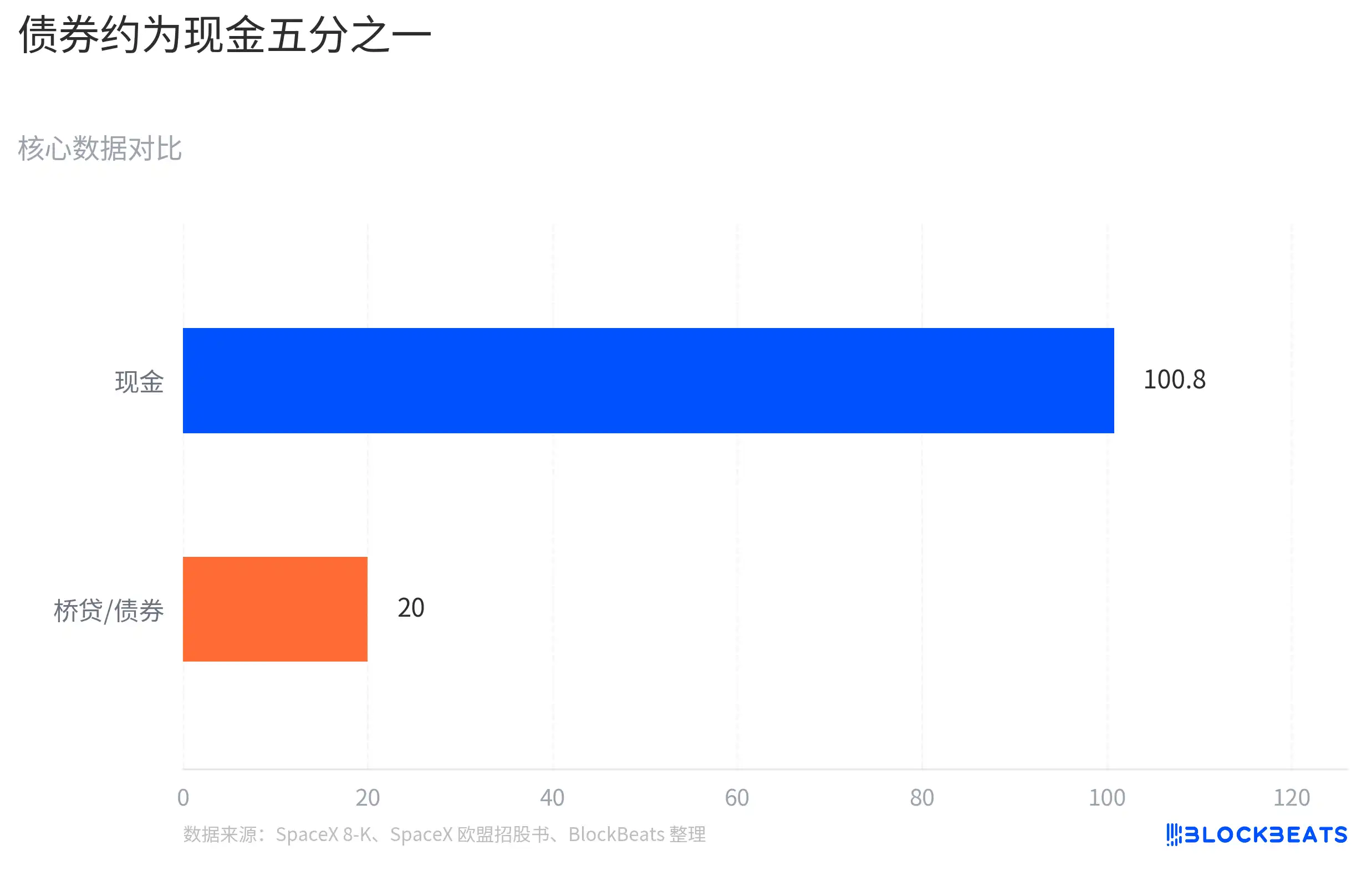
SpaceX isn't reliant on the bond market for survival either. Filings indicated that as of June 19, the company's cash and cash equivalents were approximately $100.8 billion. Having cash on hand at the hundred-billion-dollar level post-IPO suggests the company's financial structure is, at the very least, not poor.

However, abundant cash doesn't mean the market won't recalculate future spending velocity. More critical is the structure of the bridge loan: SpaceX already had a $20 billion unsecured bridge loan in March, maturing on September 2, 2027, with an extension option. The subsequent at least $20 billion bond financing is primarily described as refinancing or repaying this bridge loan.

The bonds will alter how the market views SpaceX. Equity investors can prepay for the long-term upside of Starship, Mars transportation, and space infrastructure. Debt investors are more concerned with cash flow, capital expenditures, and debt repayment schedules. When SpaceX pursues a large bond financing shortly after going public, the market naturally shifts the question from "How far can Musk's space story go?" to "How much more will these projects cost before they materialize?"

SpaceX already has profitable businesses; the market is questioning whether these businesses can cover the costs of all the long-term, capital-intensive projects the company is simultaneously advancing. Starlink is the most tangible cash flow engine currently, with growing satellite internet subscribers and revenues setting it apart from many purely conceptual space companies.

But SpaceX's valuation isn't built solely on Starlink. It's also built on Starship's high-frequency reusability, global satellite network expansion, Mars transportation, and potentially new narratives tied to AI infrastructure. These narratives are grand, and they are also expensive. Starship requires ongoing testing, iteration, and launch capacity development. The satellite network requires replenishment and upgrades. If AI infrastructure becomes further integrated into SpaceX's capital story, investors will also need to assess when this segment will generate revenue.

Therefore, the bonds aren't the sole reason for SpaceX's dip, but they were a clear trigger. They reminded the market that once the space narrative enters the public markets, it's not enough to prove the vision is grand; one must also demonstrate sufficient self-sustaining capability.
AI Narrative and Space Narrative Are at Different Realization Stages

NVIDIA's concurrent bond issue provides a clear reference point. On June 15, NVIDIA issued $25 billion in high-grade bonds, with order demand reportedly reaching approximately $85 billion. The market did not primarily interpret this debt as a pressure point but rather viewed it more as a strong company locking in long-term capital.
The difference stems from the stage of cash flow underlying the bonds. NVIDIA's AI demand has already materialized in its financials through data center revenue, customer orders, and profit margins. Investors are debating how long this growth curve can last. For NVIDIA, issuing debt is more like adding financial flexibility to an already realized growth trajectory.

SpaceX's situation is different. It also has the Starlink cash flow engine and ample cash post-IPO, but its valuation incorporates more long-term, heavy capital projects that are not yet fully commercialized. When the market sees SpaceX issuing bonds, the question isn't "Can it borrow?" but rather "Will future project cash burn outpace cash flow realization?"

This doesn't mean space commercialization has lost value, nor does it mean the market has dismissed SpaceX. A more accurate description is that the AI narrative has become visible revenue for NVIDIA, while the space narrative still requires more stage-by-stage proof for SpaceX. Starship's value hinges on demonstrating higher frequency, lower cost, and more reliable reusability. Mars transportation and space infrastructure are even further out. If AI infrastructure becomes a new growth driver, it will also need real customers, real revenue, and an explainable capital return.

This highlights the most easily overlooked distinction in deep-tech investing. A company can possess strong technology, a strong brand, and a strong founder, but as long as cash flow validation lags behind capital investment, debt will be viewed by the market as a source of pressure.

The phrase "Mars burns cash" is catchy but incomplete. SpaceX has a path to commercialization; it's just that multiple future projects require continued capital infusion. NVIDIA's opposite reaction makes this contrast even clearer: what the market rewards is not the visionary label, but the speed at which the story translates into revenue, profit, and free cash flow.

The Pace of Cash Flow Coverage Determines the Recovery Potential

SpaceX's potential for recovery hinges on whether the market can see Starlink's profit expansion covering the heavier capital expenditure curve. As long as Starship remains in a high-investment phase, the satellite network still requires continuous updates, and AI infrastructure still lacks a clear path to monetization, investors will repeatedly calculate cash burn.

Bond pricing will provide an initial signal. If the final spread, coupon, and order demand show the credit market is willing to provide long-term funds at a relatively low cost, it indicates investors still accept SpaceX's longer timeframe for realizing its space infrastructure story. If financing costs are high or the market demands a higher risk premium, equity valuation will continue to face pressure.

More crucial is progress on the business front. If Starship delivers stronger validation regarding high-frequency reusability and launch cost reduction, the business models for Starlink, deep space transportation, and even space infrastructure will be revalued. Conversely, if subsequent disclosures show Starlink's growth cannot cover the expansion of other projects, debt will continue to remind the market that SpaceX remains in a capital-intensive visionary phase.
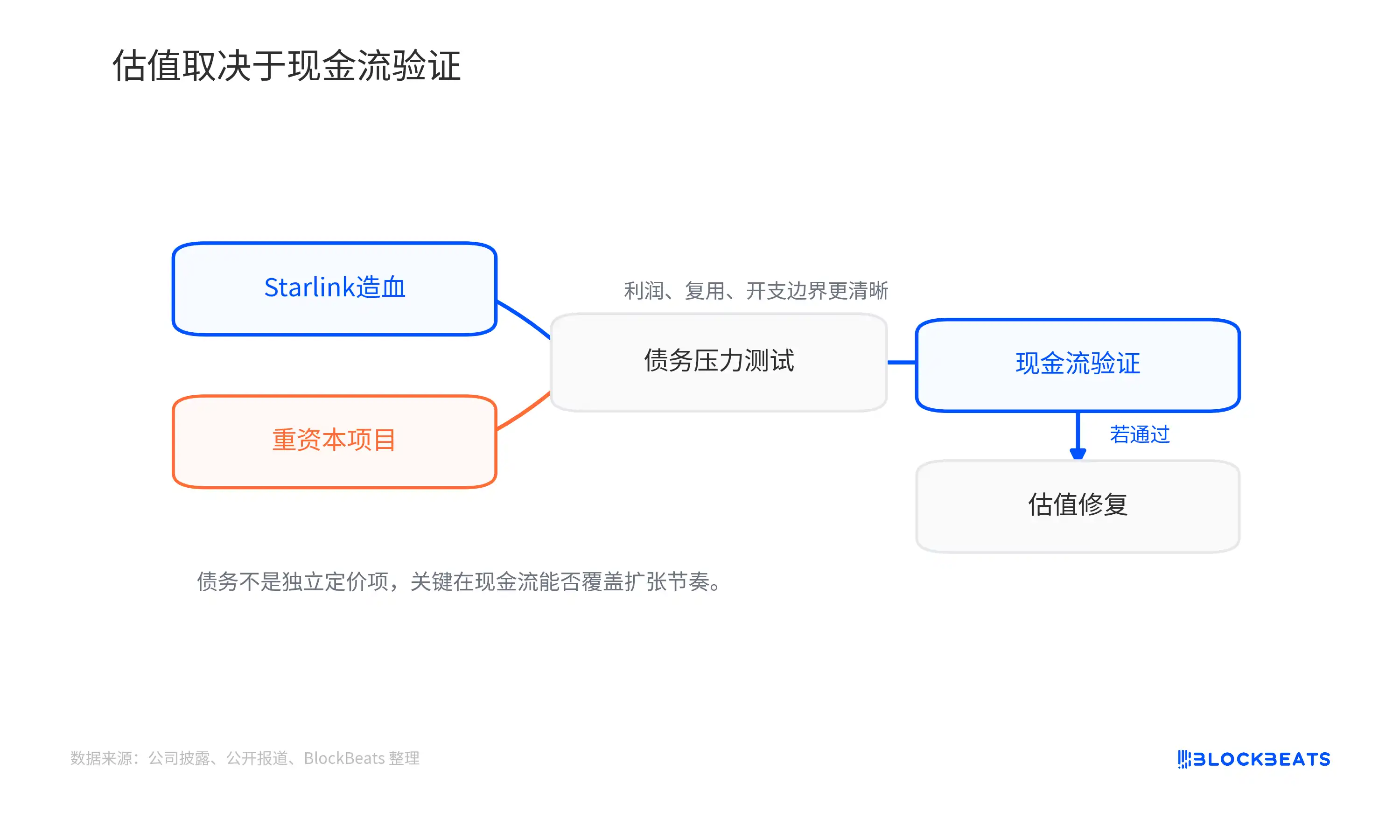
This is also the core tension in SpaceX's current valuation. It has hundred-billion-dollar-level cash on its balance sheet and a cash flow engine like Starlink, but the public market won't price the company based on cash reserves alone. Only when Starlink's profits, Starship's reusability progress, and the boundaries of capital expenditures all become clearer will debt potentially be re-evaluated from a pressure point back to a growth tool.


Трендові криптовалюти

Пов'язані питання

QWhat was the market's reaction to SpaceX's bond issuance announcement, and how did it compare to NVIDIA's?

AFollowing SpaceX's announcement of a bond issuance of at least $20 billion, its related SPCX experienced selling pressure in the secondary market. This reaction was a key trigger for market concerns. In contrast, when NVIDIA issued $25 billion in bonds, the order book reached approximately $85 billion, and the offering was upsized. The market viewed NVIDIA's bond issuance as a way to secure long-term capital for a growing, already-proven business.

QWhat core question does SpaceX's bond issuance raise for investors regarding its business model?

ASpaceX's bond issuance forces investors to shift focus from the company's long-term vision to a more immediate financial question: Can the cash flow from the currently profitable Starlink business cover the immense capital expenditures required for other long-term, high-cost projects like Starship, global satellite network expansion, and potential AI infrastructure initiatives?

QAccording to the article, what is the fundamental difference between the market's perception of NVIDIA's and SpaceX's bond issuances?

AThe fundamental difference lies in the stage of cash flow validation for their respective narratives. NVIDIA's AI narrative has already been validated through substantial revenue, orders, and profits, so its debt is seen as amplifying a proven growth curve. SpaceX's space narrative, however, still requires significant proof of commercialization and faces major capital outlays before its most ambitious projects can generate returns.

QWhat determines whether SpaceX's bond issuance will eventually be seen as a growth tool rather than a pressure point?

AThe key determining factor is the speed at which Starlink's profit growth can cover the capital expenditure curve of SpaceX's other projects. If Starship demonstrates significant progress in reusability and cost reduction, and Starlink's expansion proves financially robust, debt can be re-evaluated as a strategic tool. Conversely, if capital spending outpaces cash flow generation, debt will remain a source of investor concern.

QWhat does the article suggest is the 'core contradiction' in SpaceX's current valuation?

AThe core contradiction is that while SpaceX has a massive cash reserve of approximately $100 billion and a cash-generating engine like Starlink, the public market does not value the company based on cash alone. Valuation hinges on the clarity and progress of integrating Starlink's profits with the financial demands and commercial prospects of Starship and other capital-intensive, long-term projects.

Пов'язані матеріали

Deep Insight: Decentralized Inference is Not Hype, but a Key Track for AI to Break Through Centralized Monopoly

Decentralized Reasoning: Beyond the Hype, a Key to Breaking AI's Centralized Monopoly A future scenario where a powerful AI model is banned by a major government illustrates the core value proposition of decentralized AI: resistance to censorship. The core bet of decentralized inference networks is mitigating this risk, with other benefits like cost being secondary. The path is extremely difficult, involving four key challenges: 1. **Running Massive Models:** Distributing a single model across a decentralized GPU swarm requires sophisticated techniques like pipeline and speculative decoding to overcome crippling network latency, aiming for usable speeds (e.g., 30-40 tokens/second). 2. **Proving Model Integrity:** Verifying that a node runs the correct model is critical. Solutions range from cryptographically secure but slow ZKML to faster, economically-secure methods like statistical fingerprints, deterministic re-execution, or live-weight proofs, each involving trade-offs between integrity, latency, and cost. 3. **Ensuring Prompt Privacy:** Simply sharding a model does not protect user inputs from nodes. Robust solutions currently require trusted hardware (TEEs) or advanced cryptography (FHE), which are not yet widely deployed in consumer swarms. 4. **Building a Real Market:** Identifying the ideal customer is tough. Beyond speculative AI agents, the viable market currently consists of startups embedding AI and projects needing batch processing (e.g., synthetic data generation), where decentralized aggregation can be an advantage over low-latency needs. The article analyzes several projects tackling these problems, such as Dolphin Network (live-weight proofs), Inference.net (statistical verification), Morpheus (TEE-based), and Darkbloom (Apple Secure Enclave). It provides a framework: decentralization is a "tax" for latency-sensitive applications (e.g., chat) but a potential supply-side advantage for throughput-oriented tasks (e.g., batch processing). The long-term vision is a closed data loop where decentralized inference generates valuable data (traces, preferences) to feed decentralized training networks, which in turn produce better open-weight models for the inference networks. A due diligence checklist advises focusing on projects that: are truly decentralized at specific layers; have a credible integrity method; offer real cost benefits; ensure genuine privacy; handle node reliability; have paying users; and are built by teams with deep AI expertise. The ultimate goal should be products that appeal beyond the crypto-native audience, using crypto mechanisms invisibly to deliver better cost, performance, or privacy.

Foresight News9 хв тому

Deep Insight: Decentralized Inference is Not Hype, but a Key Track for AI to Break Through Centralized Monopoly

Foresight News9 хв тому

The Final Piece of Franklin Templeton's Crypto Ambition

Franklin Templeton Completes Crypto Ambition with Acquisition of 250 Digital On June 22, Franklin Templeton announced the acquisition of 250 Digital and established Franklin Crypto, a new division focused on actively managed cryptocurrency strategies for institutional investors. The unit is led by Christopher Perkins and Seth Ginns. This acquisition marks a key piece in Franklin Templeton's multi-year crypto strategy, which began in 2018 with a digital assets team. The firm's crypto product suite now spans three layers: tokenized funds like the blockchain-based money market fund BENJI (~$831M AUM); a series of passive ETFs including Bitcoin (EZBC, ~$368M), Ethereum (EZET), XRP (XRPZ, ~$252M), Solana (SOEZ), and a multi-crypto index fund (EZPZ); and the newly added active management strategies from Franklin Crypto. The company has also expanded its crypto ecosystem through investments in projects like Ethena and Crossmint, and collaborations with blockchains such as Aptos and Sui. With approximately $18B in digital asset AUM and a total firm AUM of ~$1.78T, Franklin Templeton is positioning itself as a comprehensive crypto asset manager for pensions and sovereign wealth funds. In contrast, competitor Fidelity Investments has taken a different path, focusing early on building its own custody and trading infrastructure. Fidelity's Bitcoin ETF (FBTC) holds over $11B, significantly larger than Franklin Templeton's equivalent offering. Both giants' moves underscore the deepening trend of traditional finance entering the crypto space.

Foresight News33 хв тому

The Final Piece of Franklin Templeton's Crypto Ambition

Foresight News33 хв тому

Торгівля

Спот
Ф'ючерси

Популярні статті

Що таке $S$

Розуміння SPERO: Комплексний огляд Вступ до SPERO Оскільки ландшафт інновацій продовжує еволюціонувати, виникнення технологій web3 та криптовалютних проектів відіграє ключову роль у формуванні цифрового майбутнього. Один з проектів, який привернув увагу в цій динамічній сфері, — це SPERO, позначений як SPERO,$$s$. Ця стаття має на меті зібрати та представити детальну інформацію про SPERO, щоб допомогти ентузіастам та інвесторам зрозуміти його основи, цілі та інновації в рамках web3 та крипто-сектору. Що таке SPERO,$$s$? SPERO,$$s$ — це унікальний проект у криптопросторі, який прагне використати принципи децентралізації та технології блокчейн для створення екосистеми, що сприяє залученню, корисності та фінансовій інклюзії. Проект розроблений для полегшення взаємодії між користувачами новими способами, надаючи їм інноваційні фінансові рішення та послуги. У своїй основі SPERO,$$s$ прагне надати можливості індивідам, забезпечуючи інструменти та платформи, які покращують користувацький досвід у криптовалютному просторі. Це включає в себе можливість більш гнучких методів транзакцій, сприяння ініціативам, що підтримуються спільнотою, та створення шляхів для фінансових можливостей через децентралізовані додатки (dApps). Основна концепція SPERO,$$s$ обертається навколо інклюзивності, прагнучи зменшити розриви в традиційній фінансовій системі, використовуючи переваги технології блокчейн. Хто є творцем SPERO,$$s$? Особистість творця SPERO,$$s$ залишається дещо невідомою, оскільки є обмежені публічно доступні ресурси, що надають детальну інформацію про його засновників. Ця відсутність прозорості може бути наслідком зобов'язання проекту до децентралізації — етики, яку багато проектів web3 поділяють, ставлячи колективні внески вище за індивідуальне визнання. Зосереджуючи обговорення навколо спільноти та її колективних цілей, SPERO,$$s$ втілює суть наділення без виділення конкретних осіб. Таким чином, розуміння етики та місії SPERO є більш важливим, ніж ідентифікація єдиного творця. Хто є інвесторами SPERO,$$s$? SPERO,$$s$ підтримується різноманітними інвесторами, починаючи від венчурних капіталістів до ангельських інвесторів, які прагнуть сприяти інноваціям у крипто-секторі. Зосередження цих інвесторів зазвичай узгоджується з місією SPERO — пріоритет надається проектам, які обіцяють технологічний прогрес у суспільстві, фінансову інклюзію та децентралізоване управління. Ці інвесторські фонди зазвичай зацікавлені в проектах, які не лише пропонують інноваційні продукти, але й позитивно впливають на спільноту блокчейн та її екосистеми. Підтримка з боку цих інвесторів підкріплює SPERO,$$s$ як значного конкурента в швидко змінюваній сфері крипто-проектів. Як працює SPERO,$$s$? SPERO,$$s$ використовує багатогранну структуру, яка відрізняє його від традиційних криптовалютних проектів. Ось деякі ключові особливості, які підкреслюють його унікальність та інноваційність: Децентралізоване управління: SPERO,$$s$ інтегрує моделі децентралізованого управління, надаючи користувачам можливість активно брати участь у процесах прийняття рішень щодо майбутнього проекту. Цей підхід сприяє відчуттю власності та відповідальності серед членів спільноти. Корисність токена: SPERO,$$s$ використовує свій власний криптовалютний токен, розроблений для виконання різних функцій в екосистемі. Ці токени дозволяють здійснювати транзакції, отримувати винагороди та полегшувати послуги, що пропонуються на платформі, підвищуючи загальну залученість та корисність. Шарова архітектура: Технічна архітектура SPERO,$$s$ підтримує модульність та масштабованість, що дозволяє безперешкодно інтегрувати додаткові функції та додатки в міру розвитку проекту. Ця адаптивність є надзвичайно важливою для збереження актуальності в постійно змінюваному крипто-ландшафті. Залучення спільноти: Проект підкреслює ініціативи, що підтримуються спільнотою, використовуючи механізми, які стимулюють співпрацю та зворотний зв'язок. Підтримуючи сильну спільноту, SPERO,$$s$ може краще задовольняти потреби користувачів та адаптуватися до ринкових тенденцій. Фокус на інклюзію: Пропонуючи низькі комісії за транзакції та зручні інтерфейси, SPERO,$$s$ прагне залучити різноманітну базу користувачів, включаючи осіб, які раніше не брали участі в крипто-просторі. Це зобов'язання до інклюзії узгоджується з його загальною місією наділення через доступність. Хронологія SPERO,$$s$ Розуміння історії проекту надає важливі уявлення про його розвиток та етапи. Нижче наведено пропоновану хронологію, що відображає значні події в еволюції SPERO,$$s$: Етап концептуалізації та ідеації: Початкові ідеї, що стали основою SPERO,$$s$, були сформовані, тісно пов'язані з принципами децентралізації та фокусом на спільноті в індустрії блокчейн. Запуск білого паперу проекту: Після концептуального етапу був випущений комплексний білий папір, що детально описує бачення, цілі та технологічну інфраструктуру SPERO,$$s$, щоб залучити інтерес та зворотний зв'язок від спільноти. Створення спільноти та ранні залучення: Активні зусилля були спрямовані на створення спільноти ранніх прихильників та потенційних інвесторів, що полегшило обговорення цілей проекту та отримання підтримки. Подія генерації токенів: SPERO,$$s$ провів подію генерації токенів (TGE) для розподілу своїх рідних токенів серед ранніх прихильників та встановлення початкової ліквідності в екосистемі. Запуск початкового dApp: Перший децентралізований додаток (dApp), пов'язаний з SPERO,$$s$, став доступним, дозволяючи користувачам взаємодіяти з основними функціями платформи. Постійний розвиток та партнерства: Безперервні оновлення та вдосконалення пропозицій проекту, включаючи стратегічні партнерства з іншими учасниками блокчейн-простору, сформували SPERO,$$s$ у конкурентоспроможного та еволюціонуючого гравця на крипто-ринку. Висновок SPERO,$$s$ є свідченням потенціалу web3 та криптовалют для революціонізації фінансових систем та наділення індивідів. Завдяки зобов'язанню до децентралізованого управління, залучення спільноти та інноваційно спроектованих функцій, він прокладає шлях до більш інклюзивного фінансового ландшафту. Як і з будь-якими інвестиціями в швидко змінюваному крипто-просторі, потенційним інвесторам та користувачам рекомендується ретельно досліджувати та обдумано взаємодіяти з поточними подіями в SPERO,$$s$. Проект демонструє інноваційний дух крипто-індустрії, запрошуючи до подальшого дослідження його численних можливостей. Хоча подорож SPERO,$$s$ ще триває, його основні принципи можуть справді вплинути на майбутнє того, як ми взаємодіємо з технологією, фінансами та один з одним у взаємопов'язаних цифрових екосистемах.

81 переглядів усьогоОпубліковано 2024.12.17Оновлено 2024.12.17

Що таке $S$

Що таке AGENT S

Агент S: Майбутнє автономної взаємодії в Web3 Вступ У постійно змінюваному ландшафті Web3 та криптовалюти інновації постійно переосмислюють, як люди взаємодіють з цифровими платформами. Один з таких новаторських проектів, Агент S, обіцяє революціонізувати взаємодію людини з комп'ютером через свою відкриту агентну структуру. Прокладаючи шлях для автономних взаємодій, Агент S прагне спростити складні завдання, пропонуючи трансформаційні застосування в штучному інтелекті (ШІ). Це детальне дослідження заглиблюється в складності проекту, його унікальні особливості та наслідки для сфери криптовалюти. Що таке Агент S? Агент S є революційною відкритою агентною структурою, спеціально розробленою для вирішення трьох основних викликів в автоматизації комп'ютерних завдань: Набуття специфічних знань у галузі: Структура інтелектуально навчається з різних зовнішніх джерел знань та внутрішнього досвіду. Цей подвійний підхід дозволяє їй створити багатий репозиторій специфічних знань у галузі, покращуючи її продуктивність у виконанні завдань. Планування на довгих горизонтах завдань: Агент S використовує планування з підкріпленням досвіду, стратегічний підхід, який полегшує ефективний розподіл та виконання складних завдань. Ця функція значно підвищує її здатність ефективно та результативно управляти кількома підзавданнями. Обробка динамічних, неоднорідних інтерфейсів: Проект представляє Інтерфейс Агент-Комп'ютер (ACI), інноваційне рішення, яке покращує взаємодію між агентами та користувачами. Використовуючи багатомодальні великі мовні моделі (MLLMs), Агент S може безперешкодно орієнтуватися та маніпулювати різноманітними графічними інтерфейсами користувача. Завдяки цим новаторським функціям Агент S надає надійну структуру, яка вирішує складнощі, пов'язані з автоматизацією людської взаємодії з машинами, прокладаючи шлях для численних застосувань у ШІ та за його межами. Хто є творцем Агент S? Хоча концепція Агент S є фундаментально новаторською, конкретна інформація про його творця залишається невідомою. Творець наразі невідомий, що підкреслює або початкову стадію проекту, або стратегічний вибір зберегти засновників у таємниці. Незважаючи на анонімність, акцент залишається на можливостях та потенціалі структури. Хто є інвесторами Агент S? Оскільки Агент S є відносно новим у криптографічній екосистемі, детальна інформація про його інвесторів та фінансових спонсорів не задокументована. Відсутність публічно доступних відомостей про інвестиційні фонди або організації, що підтримують проект, викликає питання щодо його фінансової структури та дорожньої карти розвитку. Розуміння підтримки є критично важливим для оцінки стійкості проекту та потенційного впливу на ринок. Як працює Агент S? В основі Агент S лежить передова технологія, яка дозволяє йому ефективно функціонувати в різних умовах. Його операційна модель побудована навколо кількох ключових функцій: Взаємодія з комп'ютером, подібна до людської: Структура пропонує розширене планування ШІ, прагнучи зробити взаємодії з комп'ютерами більш інтуїтивними. Імітуючи людську поведінку при виконанні завдань, вона обіцяє підвищити досвід користувачів. Наративна пам'ять: Використовується для використання високорівневого досвіду, Агент S використовує наративну пам'ять для відстеження історій завдань, тим самим покращуючи свої процеси прийняття рішень. Епізодична пам'ять: Ця функція надає користувачам покрокові інструкції, дозволяючи структурі пропонувати контекстуальну підтримку в міру виконання завдань. Підтримка OpenACI: Завдяки можливості працювати локально, Агент S дозволяє користувачам зберігати контроль над своїми взаємодіями та робочими процесами, узгоджуючи з децентралізованою етикою Web3. Легка інтеграція з зовнішніми API: Його універсальність і сумісність з різними платформами ШІ забезпечують те, що Агент S може безперешкодно вписатися в існуючі технологічні екосистеми, роблячи його привабливим вибором для розробників та організацій. Ці функціональні можливості колективно сприяють унікальному положенню Агент S у крипто-просторі, оскільки він автоматизує складні, багатоступеневі завдання з мінімальним втручанням людини. У міру розвитку проекту його потенційні застосування в Web3 можуть переосмислити, як відбуваються цифрові взаємодії. Хронологія Агент S Розробка та етапи Агент S можуть бути узагальнені в хронології, яка підкреслює його значні події: 27 вересня 2024 року: Концепція Агент S була представлена в комплексній науковій статті під назвою “Відкрита агентна структура, яка використовує комп'ютери як людина”, що демонструє основи проекту. 10 жовтня 2024 року: Наукова стаття була опублікована на arXiv, пропонуючи детальне дослідження структури та її оцінки продуктивності на основі бенчмарку OSWorld. 12 жовтня 2024 року: Було випущено відеопрезентацію, що надає візуальне уявлення про можливості та особливості Агент S, ще більше залучаючи потенційних користувачів та інвесторів. Ці маркери в хронології не лише ілюструють прогрес Агент S, але й вказують на його прихильність до прозорості та залучення громади. Ключові моменти про Агент S У міру розвитку структури Агент S кілька ключових характеристик виділяються, підкреслюючи її новаторський характер та потенціал: Інноваційна структура: Розроблена для забезпечення інтуїтивного використання комп'ютерів, подібного до людської взаємодії, Агент S пропонує новий підхід до автоматизації завдань. Автономна взаємодія: Здатність автономно взаємодіяти з комп'ютерами через GUI означає стрибок до більш інтелектуальних та ефективних обчислювальних рішень. Автоматизація складних завдань: Завдяки своїй надійній методології він може автоматизувати складні, багатоступеневі завдання, роблячи процеси швидшими та менш схильними до помилок. Безперервне вдосконалення: Механізми навчання дозволяють Агенту S покращуватися на основі минулого досвіду, постійно підвищуючи свою продуктивність та ефективність. Універсальність: Його адаптивність до різних операційних середовищ, таких як OSWorld та WindowsAgentArena, забезпечує його здатність служити широкому спектру застосувань. Оскільки Агент S займає своє місце в ландшафті Web3 та криптовалюти, його потенціал покращити можливості взаємодії та автоматизувати процеси означає значний прогрес у технологіях ШІ. Завдяки своїй інноваційній структурі Агент S є прикладом майбутнього цифрових взаємодій, обіцяючи більш безперешкодний та ефективний досвід для користувачів у різних галузях. Висновок Агент S представляє собою сміливий крок вперед у поєднанні ШІ та Web3, з можливістю переосмислити, як ми взаємодіємо з технологією. Хоча проект все ще на ранніх стадіях, можливості для його застосування є величезними та переконливими. Завдяки своїй комплексній структурі, що вирішує критичні виклики, Агент S прагне вивести автономні взаємодії на передній план цифрового досвіду. У міру того, як ми заглиблюємося в сфери криптовалюти та децентралізації, проекти, подібні до Агент S, безсумнівно, відіграватимуть ключову роль у формуванні майбутнього технологій та співпраці людини з комп'ютером.

706 переглядів усьогоОпубліковано 2025.01.14Оновлено 2025.01.14

Що таке AGENT S

Як купити S

Ласкаво просимо до HTX.com! Ми зробили покупку Sonic (S) простою та зручною. Дотримуйтесь нашої покрокової інструкції, щоб розпочати свою криптовалютну подорож.Крок 1: Створіть обліковий запис на HTXВикористовуйте свою електронну пошту або номер телефону, щоб зареєструвати обліковий запис на HTX безплатно. Пройдіть безпроблемну реєстрацію й отримайте доступ до всіх функцій.ЗареєструватисьКрок 2: Перейдіть до розділу Купити крипту і виберіть спосіб оплатиКредитна/дебетова картка: використовуйте вашу картку Visa або Mastercard, щоб миттєво купити Sonic (S).Баланс: використовуйте кошти з балансу вашого рахунку HTX для безперешкодної торгівлі.Треті особи: ми додали популярні способи оплати, такі як Google Pay та Apple Pay, щоб підвищити зручність.P2P: Торгуйте безпосередньо з іншими користувачами на HTX.Позабіржова торгівля (OTC): ми пропонуємо індивідуальні послуги та конкурентні обмінні курси для трейдерів.Крок 3: Зберігайте свої Sonic (S)Після придбання Sonic (S) збережіть його у своєму обліковому записі на HTX. Крім того, ви можете відправити його в інше місце за допомогою блокчейн-переказу або використовувати його для торгівлі іншими криптовалютами.Крок 4: Торгівля Sonic (S)Легко торгуйте Sonic (S) на спотовому ринку HTX. Просто увійдіть до свого облікового запису, виберіть торгову пару, укладайте угоди та спостерігайте за ними в режимі реального часу. Ми пропонуємо зручний досвід як для початківців, так і для досвідчених трейдерів.

1.6k переглядів усьогоОпубліковано 2025.01.15Оновлено 2026.06.02

Як купити S

Обговорення

Ласкаво просимо до спільноти HTX. Тут ви можете бути в курсі останніх подій розвитку платформи та отримати доступ до професійної ринкової інформації. Нижче представлені думки користувачів щодо ціни S (S).

活动图片