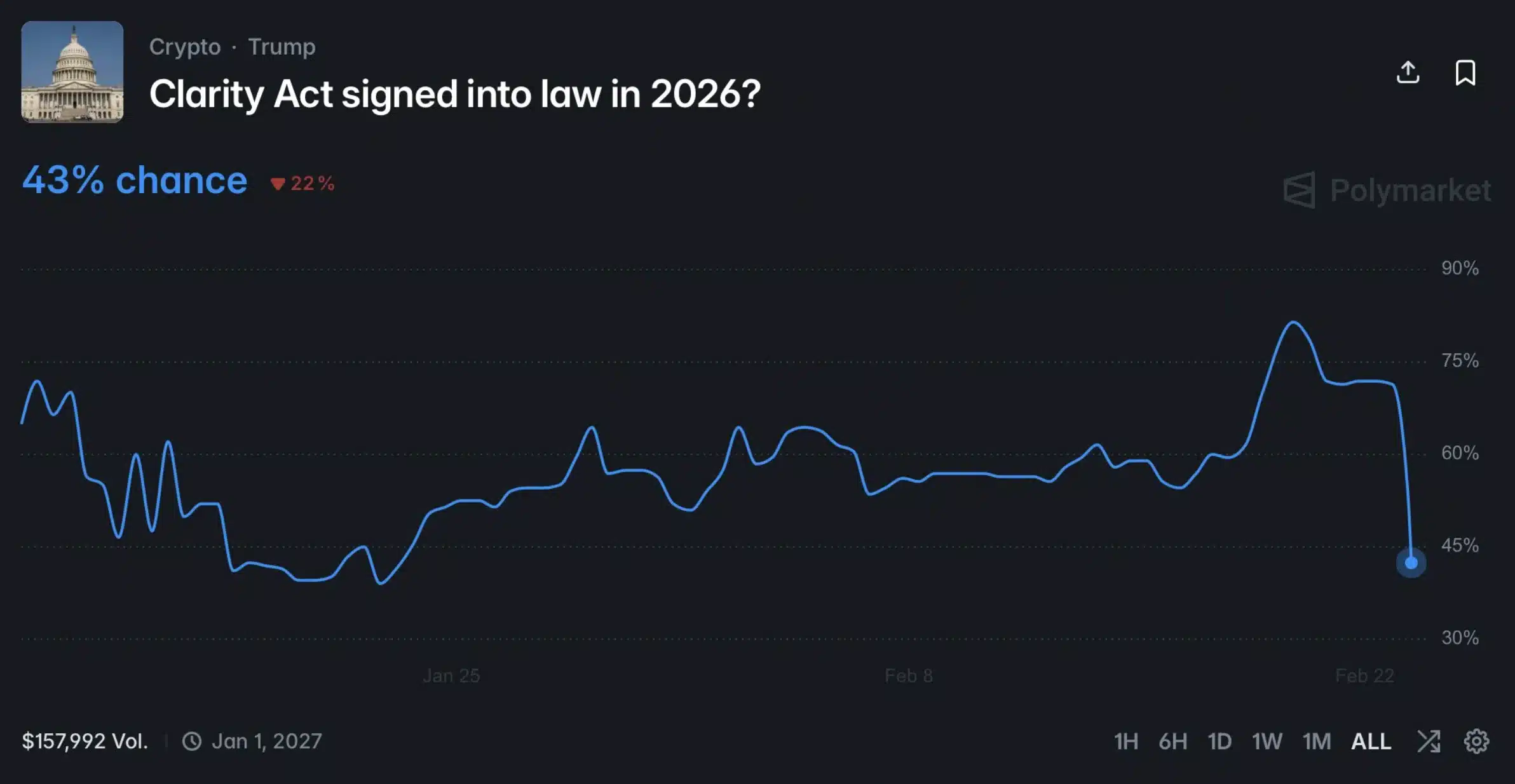
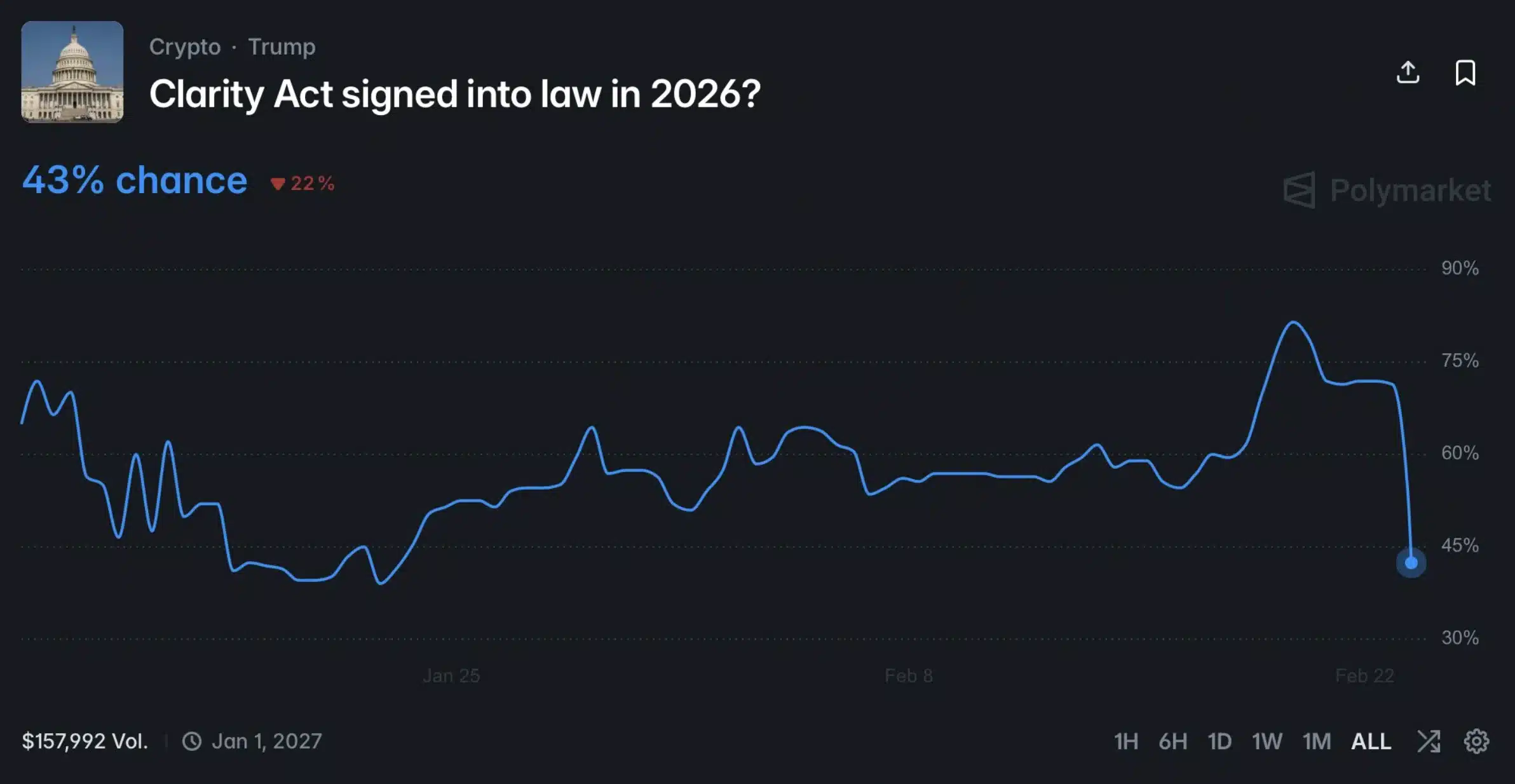
Why CLARITY Act faces crucial test as approval odds drop to 42%

ambcryptoОпубліковано о 2026-02-24Востаннє оновлено о 2026-02-24

Анотація

The CLARITY Act faces a critical test as its approval odds on Polymarket dropped sharply from 72% to 42%, reflecting declining market confidence. The White House is mediating between crypto firms (like Coinbase and Ripple) advocating for stablecoin features such as programmability and rewards, and banking groups concerned about deposit outflows and financial stability. A key disagreement revolves around whether crypto companies should be allowed to offer high yields on stablecoins, which banks fear could weaken the traditional financial system. The White House has set a March 1 deadline for a compromise, warning that failure could stall the bill. The latest draft imposes strict rules, with severe penalties for attempts to disguise interest payments. Its future also depends on Senator Tim Scott’s support. While some industry leaders remain optimistic about passage by April, the political deadlock and tight timeline pose significant roadblocks.

As expectations grow around the possible approval of the CLARITY Act, the White House held its third round of talks this week, where a so-called “compromise” began to take shape.

During the event held at ETHDenver, Patrick Witt from the White House Crypto Council said that the gap between both sides has “shrunk considerably” after a long private meeting last week.

On one side were major crypto players, including Coinbase, Ripple, and Andreessen Horowitz, advocating for the preservation of stablecoins’ unique features, such as programmability and rewards.

The other side included major banking groups, such as the American Bankers Association and the Bank Policy Institute, which focused on safeguarding the traditional banking system.

What is the main point of disagreement?

That being said, the main disagreement comes from fear of the unknown. Banks worry that if crypto companies are allowed to offer high rewards on stablecoins, people may pull their money out of banks. This could weaken banks and harm the economy.

However, crypto supporters see this differently. They believe banks are trying to block competition. In their view, banning yield gives banks unfair control over people’s savings and slows down innovation.

Now that the White House is taking direct control of the draft law, the crypto industry knows regulation is coming.

The White House has set a firm March 1 deadline, warning that if negotiators fail to finalize the bill by then, it could stall or collapse.

The latest draft includes strict rules to prevent loopholes. If companies try to disguise interest as “rewards,” they could face action from the SEC, Treasury, and CFTC, with fines of up to $500,000 per day.

This shows the administration is focused on tight control, not a soft compromise, keeping stablecoins close to the traditional banking system.

Roadblocks remain

However, the bill’s future still depends on Senator Tim Scott, who has yet to reschedule a key meeting. If talks succeed, the long delay may finally end. If not, the CLARITY Act could remain stuck in political deadlock.

Remarking on the same, Witt said,

“I believe if we solve this, it’s going to start a domino effect here, and I think things could move pretty fast once it’s resolved.”

Weighing in on the sentiment, Dan Gambardello added,

“Seems like they’re just playing games...”

Source: Dan Gambardello/X
Even though Patrick Witt says talks are improving and both sides are working honestly, many people in the market think the deal may still fail.

CLARITY Act odds are decreasing

In just one day, the odds on Polymarket for the CLARITY Act passing dropped sharply, from 72% to 42%. This shows that traders and investors are losing confidence.

Data from Santiment also suggests that people are starting to expect the bill to stall or collapse.

But some people are still optimistic,

Additionally, many leaders in the crypto industry are still hopeful about the CLARITY Act.

On the 20th of February, Ripple CEO Brad Garlinghouse also said that he believes the bill could pass as early as April.

For now, the crypto community and investors are waiting nervously. They want to see if Washington can finally deliver the clear rules it has been promising for years.


Final Summary

  • The CLARITY Act is entering its most critical phase, with the 1st of March deadline leaving little room for further delays.
  • Talks between crypto firms and banks have narrowed differences, but key disagreements over stablecoin rewards remain unresolved.


Пов'язані питання

QWhat is the main point of disagreement between crypto companies and banks regarding the CLARITY Act?

AThe main disagreement stems from banks' fear that if crypto companies are allowed to offer high rewards on stablecoins, people may withdraw their money from traditional banks, potentially weakening the banking system and harming the economy. Crypto supporters, however, view this as banks trying to block competition and maintain unfair control over people's savings, which slows down innovation.

QWhat is the deadline set by the White House for finalizing the CLARITY Act, and what is the consequence of missing it?

AThe White House has set a firm deadline of March 1st. It has warned that if negotiators fail to finalize the bill by then, the legislation could stall or collapse entirely.

QAccording to the article, what has happened to the market's prediction for the CLARITY Act's approval?

AThe odds for the CLARITY Act passing on Polymarket dropped sharply from 72% to 42% in just one day, indicating that traders and investors are losing confidence and starting to expect the bill to stall or fail.

QWho is a key political figure whose support is critical for the future of the CLARITY Act?

ASenator Tim Scott is a key figure, as the bill's future depends on him rescheduling a crucial meeting. His actions will determine if the long delay ends or if the act remains in political deadlock.

QWhat are the potential penalties for companies that try to disguise interest payments as 'rewards' under the latest draft of the act?

ACompanies that try to disguise interest as 'rewards' could face enforcement action from the SEC, Treasury, and CFTC, with fines of up to $500,000 per day for such violations.

Пов'язані матеріали

Within Strategy's Framework, STRC's Dividend Yield Remains at 12% as Share Price Stays Below Par Value

Michael Saylor, Executive Chairman of Strategy (MSTR), confirmed that the dividend rate for its STRC perpetual preferred shares will remain at 12.00% through August 2026. The rate has increased from 9% at its July 2025 launch to the current high via a "ratchet" mechanism, which permanently raises the rate by 0.5% whenever the share price falls below $95. This mechanism is intended to push the price back toward its $100 par value and support Strategy's "at-the-market" (ATM) program for issuing new shares to fund Bitcoin purchases. However, the mechanism has not worked as intended. STRC shares closed at $89.46 on July 31, remaining about 10-11% below par value despite the record-high dividend. Competition from rival Strive's higher-yielding SATA securities has pressured demand. The persistent discount has forced Strategy to suspend new STRC issuances via its ATM program, limiting this funding channel for Bitcoin acquisitions. STRC's struggles reflect Bitcoin's own volatility, as the preferred shares historically move in tandem. Analysts have warned the ratchet structure carries long-term, one-way risk. A law firm is investigating Strategy's ability to maintain dividend payments if Bitcoin's price stays low. Retail investors own roughly 83% of outstanding STRC shares, a group seen as prone to panic selling during downturns. In response, Strategy has established financial reserves, including a liquidity cushion covering about 26 months of dividend/interest obligations, and a $2 billion share buyback program alongside a Bitcoin monetization framework, though the company emphasized it is not obligated to sell any Bitcoin.

cryptonews.ru31 хв тому

Within Strategy's Framework, STRC's Dividend Yield Remains at 12% as Share Price Stays Below Par Value

cryptonews.ru31 хв тому

Analyst: Bitcoin's Price Will Drop to $60k in August, Then Rebound to $70k

Financial analyst Andrey Poroshin has provided a new forecast for Bitcoin's price dynamics in August. Poroshin, an analyst at the Bitbanker exchange, expects the cryptocurrency market to experience a downturn this month, with prices retesting the $60,000 level due to a lack of supportive macroeconomic catalysts. He noted that the recent US Federal Reserve decision to hold interest rates did not significantly impact the market, while inflation remains above the 2% target. Poroshin stated that Bitcoin is ending July under pressure from moderate volatility and a lack of new macroeconomic stimuli, leading to continued market caution. According to his base scenario, Bitcoin will drop to a range of $60,000 to $62,000 before recovering to $70,000. He pointed out that even $70,000 remains below the cost of mining in the US, which has prompted some miners to shift towards AI data center operations. Poroshin cited the winding down of BitMEX's operations as a potential catalyst for a price rebound, suggesting the exit of weaker players often coincides with market reversals and reduced short-term selling pressure. He believes Bitcoin is currently less susceptible to geopolitical shocks, such as the Iran-US conflict, and does not expect significant market changes in August related to the pending CLARITY Act. Looking ahead, Poroshin forecasts that September will bring more active price fluctuations driven by potential Fed rate decisions and possible discussions or approval of the CLARITY Act.

cryptonews.ru31 хв тому

Analyst: Bitcoin's Price Will Drop to $60k in August, Then Rebound to $70k

cryptonews.ru31 хв тому

Торгівля

Спот
活动图片