Why CLARITY Act faces crucial test as approval odds drop to 42%

ambcryptoОпубліковано о 2026-02-24Востаннє оновлено о 2026-02-24

Анотація

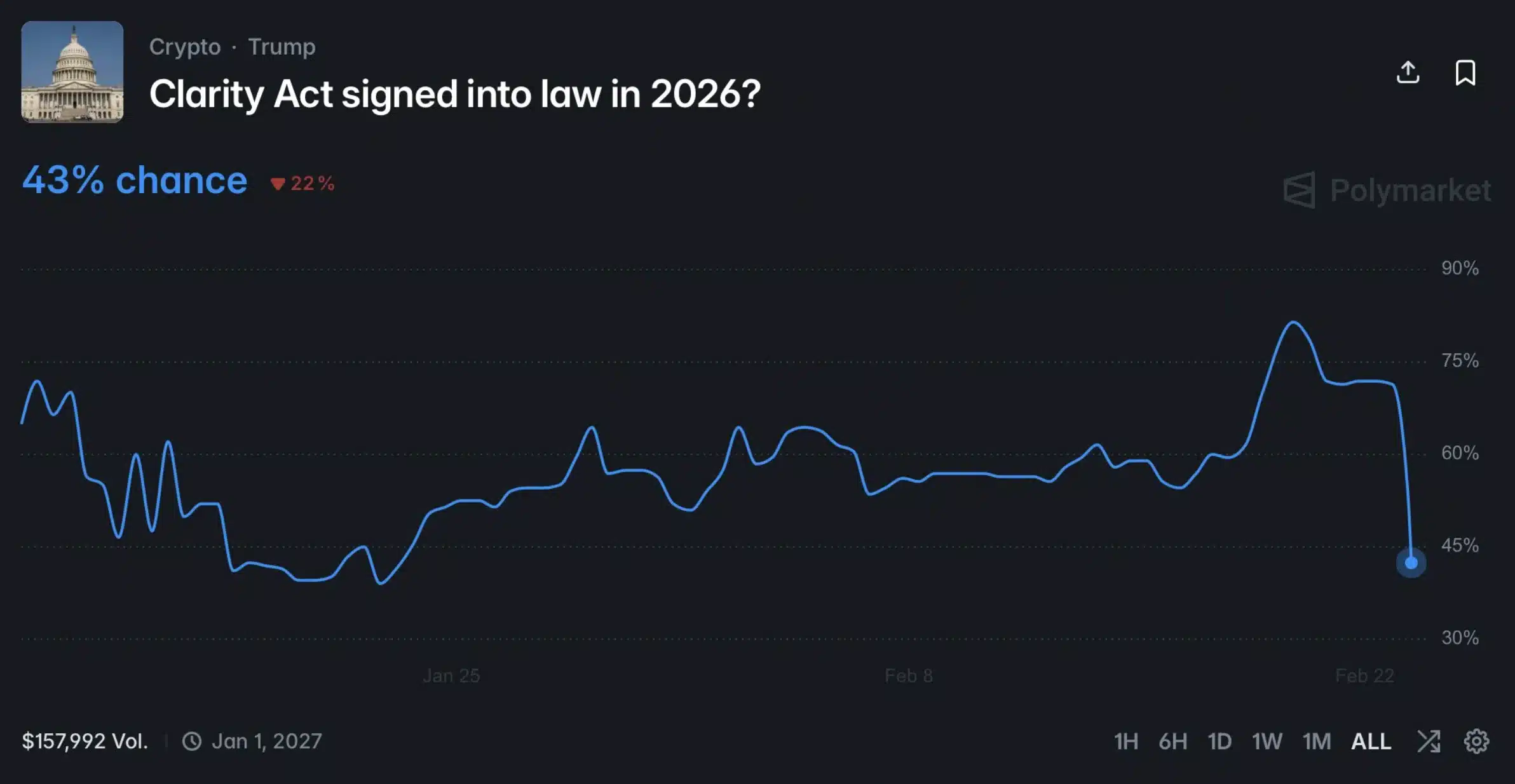
The CLARITY Act faces a critical test as its approval odds on Polymarket dropped sharply from 72% to 42%, reflecting declining market confidence. The White House is mediating between crypto firms (like Coinbase and Ripple) advocating for stablecoin features such as programmability and rewards, and banking groups concerned about deposit outflows and financial stability. A key disagreement revolves around whether crypto companies should be allowed to offer high yields on stablecoins, which banks fear could weaken the traditional financial system. The White House has set a March 1 deadline for a compromise, warning that failure could stall the bill. The latest draft imposes strict rules, with severe penalties for attempts to disguise interest payments. Its future also depends on Senator Tim Scott’s support. While some industry leaders remain optimistic about passage by April, the political deadlock and tight timeline pose significant roadblocks.

As expectations grow around the possible approval of the CLARITY Act, the White House held its third round of talks this week, where a so-called “compromise” began to take shape.

During the event held at ETHDenver, Patrick Witt from the White House Crypto Council said that the gap between both sides has “shrunk considerably” after a long private meeting last week.

On one side were major crypto players, including Coinbase, Ripple, and Andreessen Horowitz, advocating for the preservation of stablecoins’ unique features, such as programmability and rewards.

The other side included major banking groups, such as the American Bankers Association and the Bank Policy Institute, which focused on safeguarding the traditional banking system.

What is the main point of disagreement?

That being said, the main disagreement comes from fear of the unknown. Banks worry that if crypto companies are allowed to offer high rewards on stablecoins, people may pull their money out of banks. This could weaken banks and harm the economy.

However, crypto supporters see this differently. They believe banks are trying to block competition. In their view, banning yield gives banks unfair control over people’s savings and slows down innovation.

Now that the White House is taking direct control of the draft law, the crypto industry knows regulation is coming.

The White House has set a firm March 1 deadline, warning that if negotiators fail to finalize the bill by then, it could stall or collapse.

The latest draft includes strict rules to prevent loopholes. If companies try to disguise interest as “rewards,” they could face action from the SEC, Treasury, and CFTC, with fines of up to $500,000 per day.

This shows the administration is focused on tight control, not a soft compromise, keeping stablecoins close to the traditional banking system.

Roadblocks remain

However, the bill’s future still depends on Senator Tim Scott, who has yet to reschedule a key meeting. If talks succeed, the long delay may finally end. If not, the CLARITY Act could remain stuck in political deadlock.

Remarking on the same, Witt said,

“I believe if we solve this, it’s going to start a domino effect here, and I think things could move pretty fast once it’s resolved.”

Weighing in on the sentiment, Dan Gambardello added,

“Seems like they’re just playing games...”

Source: Dan Gambardello/X
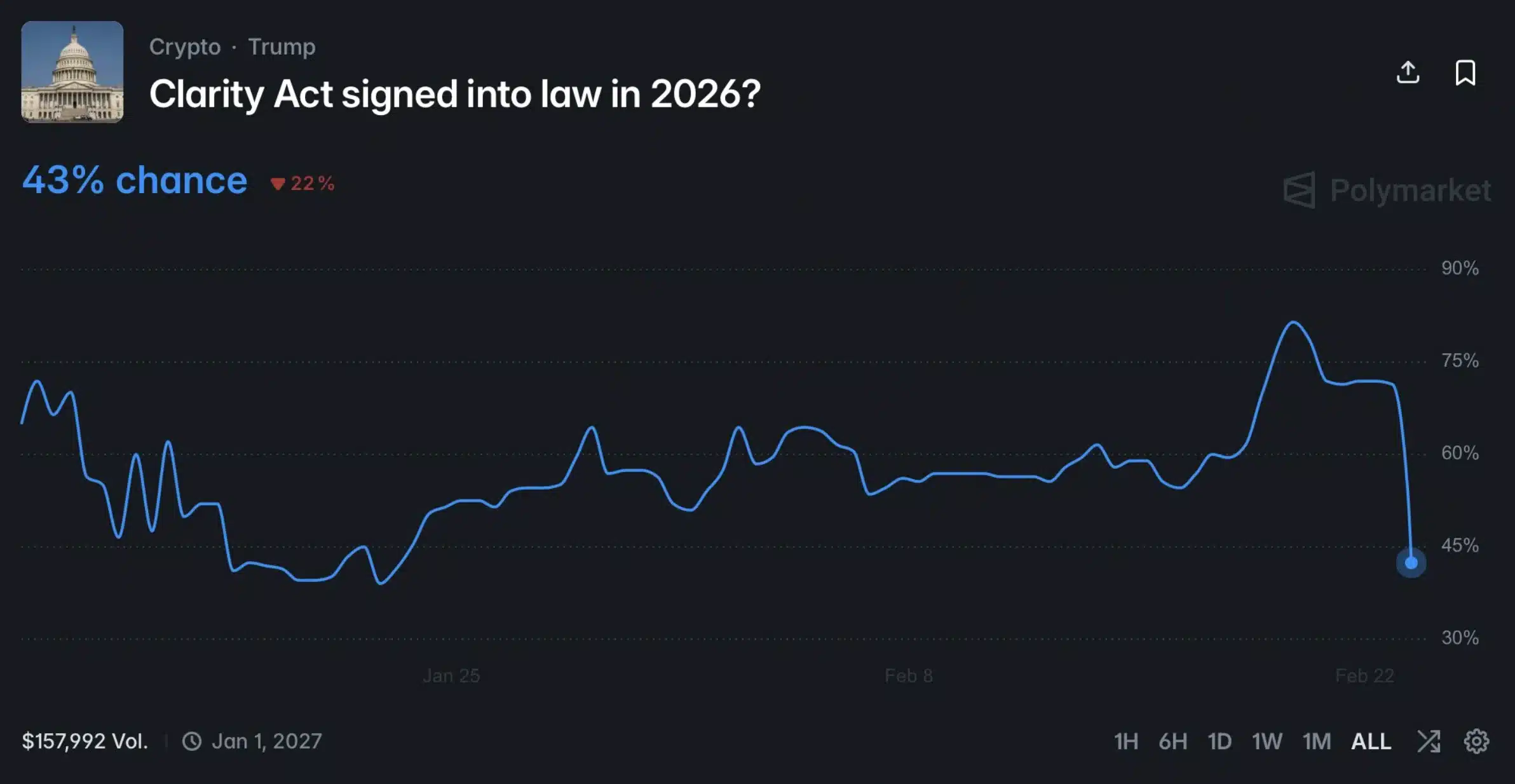
Even though Patrick Witt says talks are improving and both sides are working honestly, many people in the market think the deal may still fail.

CLARITY Act odds are decreasing

In just one day, the odds on Polymarket for the CLARITY Act passing dropped sharply, from 72% to 42%. This shows that traders and investors are losing confidence.

Data from Santiment also suggests that people are starting to expect the bill to stall or collapse.

But some people are still optimistic,

Additionally, many leaders in the crypto industry are still hopeful about the CLARITY Act.

On the 20th of February, Ripple CEO Brad Garlinghouse also said that he believes the bill could pass as early as April.

For now, the crypto community and investors are waiting nervously. They want to see if Washington can finally deliver the clear rules it has been promising for years.


Final Summary

  • The CLARITY Act is entering its most critical phase, with the 1st of March deadline leaving little room for further delays.
  • Talks between crypto firms and banks have narrowed differences, but key disagreements over stablecoin rewards remain unresolved.


Пов'язані питання

QWhat is the main point of disagreement between crypto companies and banks regarding the CLARITY Act?

AThe main disagreement stems from banks' fear that if crypto companies are allowed to offer high rewards on stablecoins, people may withdraw their money from traditional banks, potentially weakening the banking system and harming the economy. Crypto supporters, however, view this as banks trying to block competition and maintain unfair control over people's savings, which slows down innovation.

QWhat is the deadline set by the White House for finalizing the CLARITY Act, and what is the consequence of missing it?

AThe White House has set a firm deadline of March 1st. It has warned that if negotiators fail to finalize the bill by then, the legislation could stall or collapse entirely.

QAccording to the article, what has happened to the market's prediction for the CLARITY Act's approval?

AThe odds for the CLARITY Act passing on Polymarket dropped sharply from 72% to 42% in just one day, indicating that traders and investors are losing confidence and starting to expect the bill to stall or fail.

QWho is a key political figure whose support is critical for the future of the CLARITY Act?

ASenator Tim Scott is a key figure, as the bill's future depends on him rescheduling a crucial meeting. His actions will determine if the long delay ends or if the act remains in political deadlock.

QWhat are the potential penalties for companies that try to disguise interest payments as 'rewards' under the latest draft of the act?

ACompanies that try to disguise interest as 'rewards' could face enforcement action from the SEC, Treasury, and CFTC, with fines of up to $500,000 per day for such violations.

Пов'язані матеріали

Annual Salary of Millions Competing for Electricians, Meta Rushes to Open Its Own Technical School

The AI boom is facing an unexpected bottleneck: a severe shortage of skilled construction workers and electricians. As tech giants like Meta, OpenAI, and Alphabet race to build massive data centers—such as OpenAI's $16 billion "Stargate" project—they are hitting a critical labor wall. The U.S. needs an estimated 130,000 more electricians, 240,000 construction workers, and 150,000 supervisors by 2030 for AI infrastructure alone, but tens of thousands of electrician jobs go unfilled each year. While AI companies offer high premiums, with electricians earning up to $280,000 annually, worker scarcity still causes massive losses—delays on a single project can cost $14.2 million per month. The complexity of building AI data centers, which require immense power (equivalent to powering hundreds of thousands of homes), sophisticated electrical systems, and advanced liquid cooling solutions, demands highly skilled technicians who are in short supply. To combat this, companies are investing heavily in training. Meta has committed $115 million to a free training school offering tuition, housing, and stipends, targeting 5,000 new workers. OpenAI is partnering with unions to secure skilled labor. These efforts are paying off, with a significant rise in Gen Z interest in trade schools over college. However, the power demands are staggering. AI data centers are driving a rapid surge in electricity consumption, projected to account for up to 12% of U.S. power use by 2028 and raising costs for consumers. Furthermore, the construction boom is project-based, leading to a potential future glut of trained workers once building peaks, which could depress wages industry-wide. The race for AI supremacy now depends as much on skilled hands as on advanced chips.

marsbit1 год тому

Annual Salary of Millions Competing for Electricians, Meta Rushes to Open Its Own Technical School

marsbit1 год тому

OpenAI No Longer Sells Its Most Expensive Model for Profit

OpenAI is shifting its business strategy away from promoting its most expensive, flagship models for every task. Recent price cuts—80% for GPT-5.6 Luna and 20% for Terra—signal a deeper change: the company now actively advises users that many tasks don't require the most powerful model. Instead, OpenAI recommends a tiered approach: use the high-end GPT-5.6 Sol for complex planning and analysis, then delegate execution to cheaper models like Luna. This mirrors moves by Anthropic, which recently launched Claude Opus 5 at half the price of its top model, Fable 5. Both companies are de-emphasizing flagship models as primary revenue drivers, using them instead for brand prestige and technological showcases. The industry is entering a "mass-market" phase, similar to automotive, where high-volume, cost-effective models handle daily operations and drive scale. OpenAI's price reductions are partly enabled by AI models themselves optimizing underlying code and infrastructure, creating a self-reinforcing cycle of efficiency gains and cost reduction. Competition is shifting from "who is smartest" to "who offers the best value." The goal is no longer selling individual models but fostering widespread API adoption and ecosystem lock-in. By making AI calls cheap and ubiquitous, companies like OpenAI aim to become the indispensable, utility-like infrastructure powering automated workflows—the "water and electricity" of software, quietly embedded everywhere.

marsbit1 год тому

OpenAI No Longer Sells Its Most Expensive Model for Profit

marsbit1 год тому

Торгівля

Спот
活动图片