Why Aave’s $42B risk model faces its first real test after Chaos Labs’ exit

ambcryptoОпубліковано о 2026-04-07Востаннє оновлено о 2026-04-07

Анотація

Risk management is central to DeFi protocol performance, especially during volatile periods. Aave, with $42.34B in TVL and $16.55B in loans, relies on continuous risk model adjustments rather than fixed settings. External teams like Chaos Labs have historically updated liquidation thresholds, borrow limits, and collateral rules in response to market conditions. Chaos Labs’ recent exit signals strain in Aave’s risk framework as the protocol scales. Their departure reflects deeper misalignments in risk management strategy and comes despite their critical role in overseeing Aave’s growth from $5.2B to over $26B in TVL. The exit also highlights operational and financial challenges, as the engagement remained unprofitable even with a proposed $5M budget. Aave now faces its first major test in risk continuity. Responsibility shifts to internal teams and other providers like LlamaRisk, but questions remain about response speed and coordination—especially as Aave introduces greater complexity with V4. While systems are currently stable, any delay in adjustments could allow risks to accumulate. Market confidence may now depend less on past performance and more on how effectively Aave manages this transition.

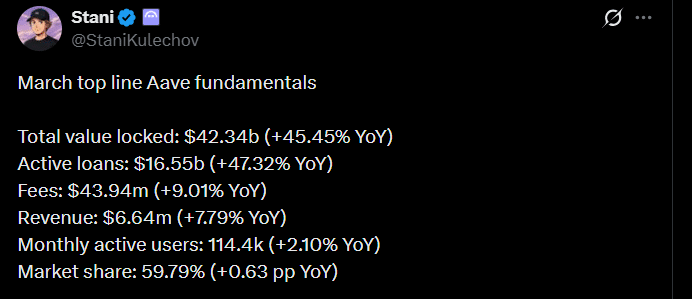
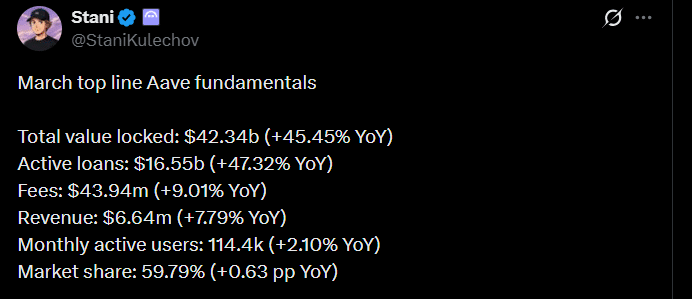
Risk management in DeFi now plays a central role in how protocols perform, especially during volatile periods. As Q1 2026 ended, Aave [AAVE] managed about $42.34 billion in TVL and $16.55 billion in loans; it relies on continuous adjustments rather than fixed settings.

Source: Stani Kulechov on X

External teams like Chaos Labs update liquidation thresholds, borrow limits, and collateral rules as conditions change.

As these updates happen more often, the system responds faster to market stress. This improves stability and user confidence, although it also means protocols depend more on external risk models as complexity increases.

Chaos Labs exit signals strain in Aave’s risk model

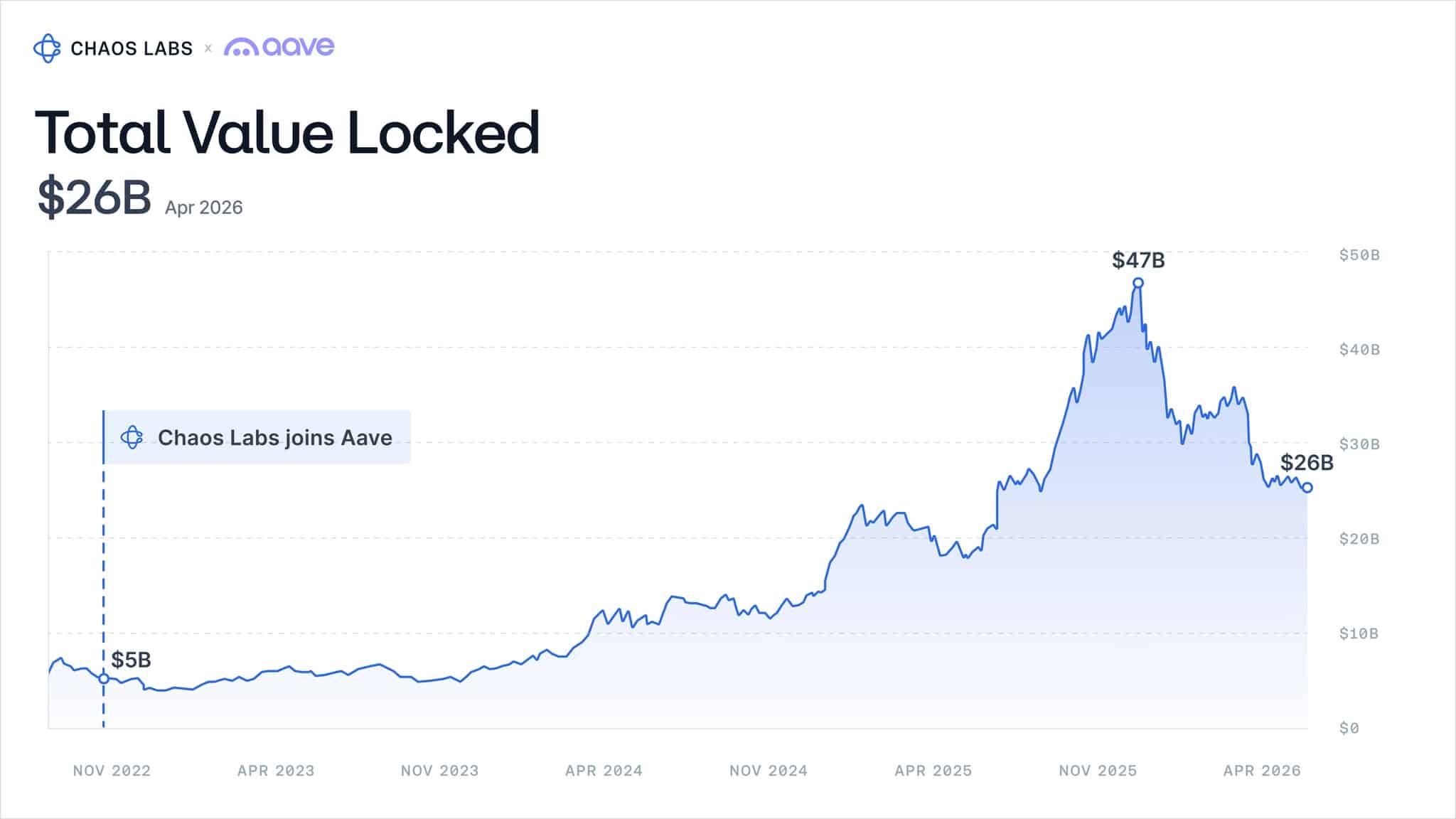
Chaos Labs’ exit signals more than a contributor change; it reflects growing strain in how Aave manages risk as it scales. For three years, Chaos Labs priced every loan while Aave’s TVL expanded from $5.2 billion to over $26 billion, processing $2.5 trillion in deposits and more than $2 billion in liquidations, according to Chaos Labs report.

Source: Governance. Aave.com

Yet, the exit was driven by deeper misalignment on how risk should be handled going forward. As core contributors left, workload and operational risk increased, while Aave V4 introduced greater complexity on an unfamiliar structure.

Stani Kulechov, founder and Aave’s CEO, applauded them in a post stating, “We also want to thank the entire Chaos Labs team for their contributions over the years, as they have helped bring the protocol we built into its current level of maturity.”

Consequently, the engagement remained loss-making despite a proposed $5 million budget. This shift suggests that as protocols grow, maintaining high-quality risk oversight becomes harder, which could affect long-term stability if demand outpaces control.

Aave’s risk continuity now faces its first real test

Aave now enters a critical transition as it absorbs the exit of a key risk contributor, shifting focus from performance to continuity.

With Chaos Labs gone, responsibility shifts to internal teams and providers like LlamaRisk, raising questions about response speed. Stani noted that “LlamaRisk already serves as a risk contributor to the Aave DAO and has deep familiarity with the protocol’s architecture and parameters. We support LlamaRisk increasing their budget to accommodate this additional workload and expanding their team as needed. “

As Aave expands toward V4, risk complexity increases, which places more pressure on coordination.

In the short term, systems remain stable; however, any slowdown in adjustments could allow risks to build gradually. This shift suggests that market confidence may now depend less on past performance and more on how effectively this transition is managed.


Final Summary

  • Aave stability relied on continuous risk updates, but Chaos Labs’ exit raises questions about maintaining the same responsiveness.
  • Aave now enters a transition where slower adjustments could increase risk, shifting focus from past performance to execution.

Пов'язані питання

QWhat was the total value locked (TVL) and loan amount managed by Aave as Q1 2026 ended?

AAave managed about $42.34 billion in TVL and $16.55 billion in loans as Q1 2026 ended.

QWhy did Chaos Labs exit from its role in Aave's risk management?

AChaos Labs' exit was driven by deeper misalignment on how risk should be handled going forward, increased workload and operational risk as core contributors left, and the introduction of greater complexity with Aave V4 on an unfamiliar structure. The engagement also remained loss-making despite a proposed $5 million budget.

QWhat are the potential risks for Aave following Chaos Labs' departure?

AFollowing Chaos Labs' exit, potential risks include slower response speeds in risk adjustments, which could allow risks to build gradually. There is also increased pressure on coordination as Aave expands toward V4, and market confidence may now depend more on how effectively the transition is managed rather than past performance.

QWho is taking over the risk management responsibilities for Aave after Chaos Labs' exit?

AResponsibility shifts to internal teams and providers like LlamaRisk, which already serves as a risk contributor to the Aave DAO and has deep familiarity with the protocol's architecture and parameters.

QHow did Aave's TVL grow during Chaos Labs' three-year contribution?

ADuring Chaos Labs' three-year contribution, Aave's TVL expanded from $5.2 billion to over $26 billion.

Пов'язані матеріали

Fu Peng's First Public Speech in 2026: What Exactly Are Crypto Assets? Why Did I Join the Crypto Asset Industry?

Fu Peng, a renowned macroeconomist and now Chief Economist at New火 Group, delivered his first public speech of 2026 at the Hong Kong Web3 Festival. He explained his perspective on crypto assets and why he joined the industry, framing it within the context of macroeconomic trends and financial evolution. Fu emphasized that crypto assets are transitioning from an early, belief-driven phase to a mature, institutionally integrated asset class. He drew parallels to the 1970s-80s, when technological advances (like computing) revolutionized traditional finance, leading to the rise of FICC (Fixed Income, Currencies, and Commodities). Similarly, current advancements in AI, data, and blockchain are reshaping finance, with crypto assets becoming part of a new "FICC + C" (C for Crypto) framework. He noted that institutional capital, including traditional hedge funds, avoided early crypto due to its speculative nature but are now engaging as regulatory clarity emerges (e.g., stablecoin laws, CFTC classifying crypto as a commodity). Fu predicted that 2025-2026 marks a turning point where crypto becomes a standardized, financially viable asset for diversified portfolios, akin to commodities or derivatives in traditional finance. Fu defined Bitcoin not as "digital gold" in a simplistic sense but as a value-preserving, financially tradable asset. He highlighted that crypto's future lies in regulated, institutional adoption, moving away from retail-dominated trading. His entry into crypto signals this maturation, where traditional finance integrates crypto into mainstream asset management.

marsbit7 хв тому
Fu Peng's First Public Speech in 2026: What Exactly Are Crypto Assets? Why Did I Join the Crypto Asset Industry?

marsbit7 хв тому

Justin Sun Sues Trump Family: What $75 Million Bought Was Only a Blacklist

Justin Sun, founder of Tron, has filed a lawsuit in federal court against World Liberty Financial (WLF), alleging he was made the "primary target of a fraudulent scheme" after investing $75 million. Sun claims the investment secured him an advisor title and WLFI tokens, which were later frozen by WLF, causing "hundreds of millions in losses." The dispute began in late 2024 when Sun's investment helped revive WLF's struggling token sale, which ultimately raised $550 million. Shortly after, the SEC dropped its lawsuit against Sun following Donald Trump's inauguration. However, relations soured when Sun refused WLF's demands for additional funding. In August 2025, WLF added a "blacklist" function to its smart contract, allowing it to unilaterally freeze tokens. Sun's holdings, worth approximately $107 million, were frozen, and he was threatened with token destruction. The lawsuit highlights WLF's structure, which directs 75% of token sale profits to the Trump family, who had earned $1 billion by December 2025. WLF's CEO is Zach Witkoff, son of U.S. Middle East envoy Steve Witkoff. The project faces scrutiny for opaque operations, including a controversial loan arrangement on the Dolomite platform, co-founded by a WLF advisor. Despite Sun's history with the SEC, the case underscores centralization risks within DeFi, as WLF controls governance and holds powers to freeze assets arbitrarily. Sun's tokens remain frozen as legal proceedings begin.

marsbit15 хв тому

Justin Sun Sues Trump Family: What $75 Million Bought Was Only a Blacklist

marsbit15 хв тому

$500 to Buy OpenAI Stock: Silicon Valley's Most Respectable Liquidity Invitation

Silicon Valley's largest venture capital platform, AngelList, has launched a new fund called USVC, allowing U.S. retail investors to buy into high-profile AI companies like OpenAI, Anthropic, and xAI with a minimum investment of $500—no accredited investor status required. Promoted by AngelList co-founder Naval Ravikant, the fund is framed as an opportunity for ordinary people to access high-growth private tech investments traditionally reserved for VCs. However, critics argue it functions more like an exit vehicle for early insiders. USVC acquires shares not through primary rounds but largely via secondary transactions—purchasing stakes from early investors, VC funds, and employees looking to cash out at peak valuations. With companies like xAI heavily weighted in the portfolio, the fund effectively channels retail money into providing liquidity for insiders who entered at much lower valuations. The fund’s structure raises concerns: shares are illiquid, with no secondary market, and buybacks are limited and discretionary. The actual annual fee reaches 3.61%, far above the advertised 1% management fee. This model parallels the "low float, high fully diluted valuation" strategy seen in crypto, where early investors profit by selling to latecomers at inflated prices. The timing—alongside similar moves by platforms like Robinhood—suggests that Silicon Valley’s sudden interest in retail inclusion may be less about democratizing access and more about securing exits for insiders.

marsbit46 хв тому

$500 to Buy OpenAI Stock: Silicon Valley's Most Respectable Liquidity Invitation

marsbit46 хв тому

Торгівля

Спот
Ф'ючерси
活动图片