Why 21Shares believes ‘passive strategies’ for crypto ETFs are outdated

ambcryptoОпубліковано о 2026-03-26Востаннє оновлено о 2026-03-26

Анотація

21Shares President Duncan Moir argues that passive 'HODL' strategies for crypto ETFs are becoming outdated. Instead, the firm advocates for active management to capture yield and diversification opportunities in the growing asset class. Key strategies include yield-generating products like a preferred stock ETP offering an 11.5% dividend, staking rewards in ETFs, and thematic offerings such as a Bitcoin-and-gold ETP. While U.S. investor interest remains focused on large coins, European institutions are exploring newer assets and application layers. Despite a decline in total crypto ETF AUM to $130 billion, active strategies aim to drive future demand.

For most Bitcoin OGs in the space, the main crypto investment strategy has always been ‘HODL,’ which has been enough to outperform most assets in certain periods.

Early asset managers who entered the sector also adopted a similar passive strategy for their respective crypto ETFs (exchange-traded funds). They have been holding the crypto assets in the hope that, in three, six, or 12 months, their value would appreciate.

According to 21Shares president Duncan Moir, however, crypto ETFs are transitioning from passive management to active strategies. Moir noted that the sector was a ‘nascent’ and ‘growing asset class’ that fits perfectly with active management.

At the core of this new strategy is scaling yield streams and extra earning opportunities beyond just holding the crypto assets. From a regional crypto ETF demand, Moir said,

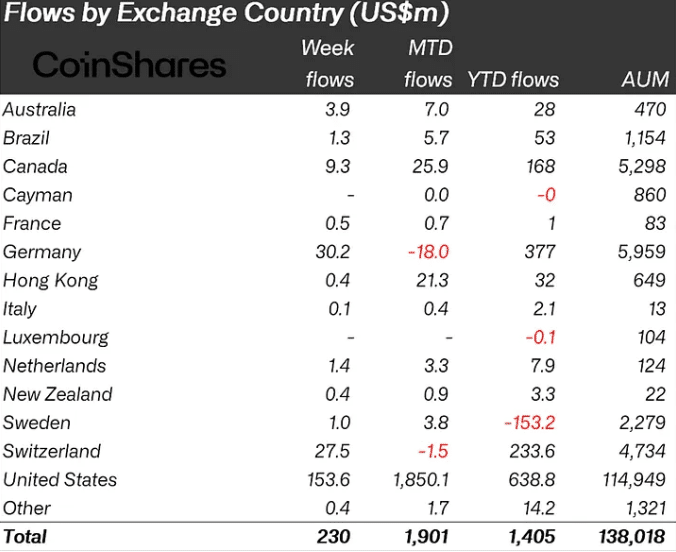
The interest is still concentrated in the larger coins in the US. In Europe, institutional clients are more interested in newer assets and the application layer beyond the Layer-1.
Source: CoinShares

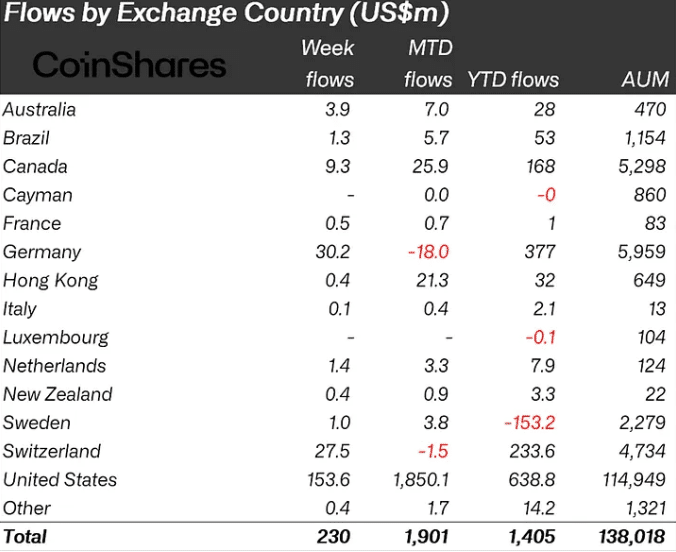
In fact, on a year-to-date (YTD) basis, the U.S. leads with $638 million in crypto inflows, followed closely by Germany at $377 million and Switzerland at $233 million.

Crypto ETFs evolution and diversification

For Moir, the mature investor base in Europe, who already hold Bitcoin and Ethereum, is looking to expand their crypto allocation with better offerings.

This led to 21Shares launching an ETP tied to Strategy’s preferred stock, Stretch (STRC), which offers an annual dividend yield of up to 11.5% payable monthly. This is one of the Strategy’s ways of raising capital for Bitcoin buys.

Moir noted that the product has been an instant success across several regions, underscoring a strong appetite for yield-bearing assets that are feasibly accessible via traditional platforms.

Additionally, crypto ETF staking rewards have become another active strategy to maximize investors’ returns.

Grayscale and BlackRock’s push for staking rewards in their respective Spot ETH ETFs is one example of asset managers seeking more opportunities for investors.

Finally, Moir said they also look for major thematic trends or future shifts that can be maximized. The approach informed the launch of 21Shares’ Bitcoin-and-gold ETP, based on the rising demand for safe havens amid debasement trade and rising U.S. fiscal debt.

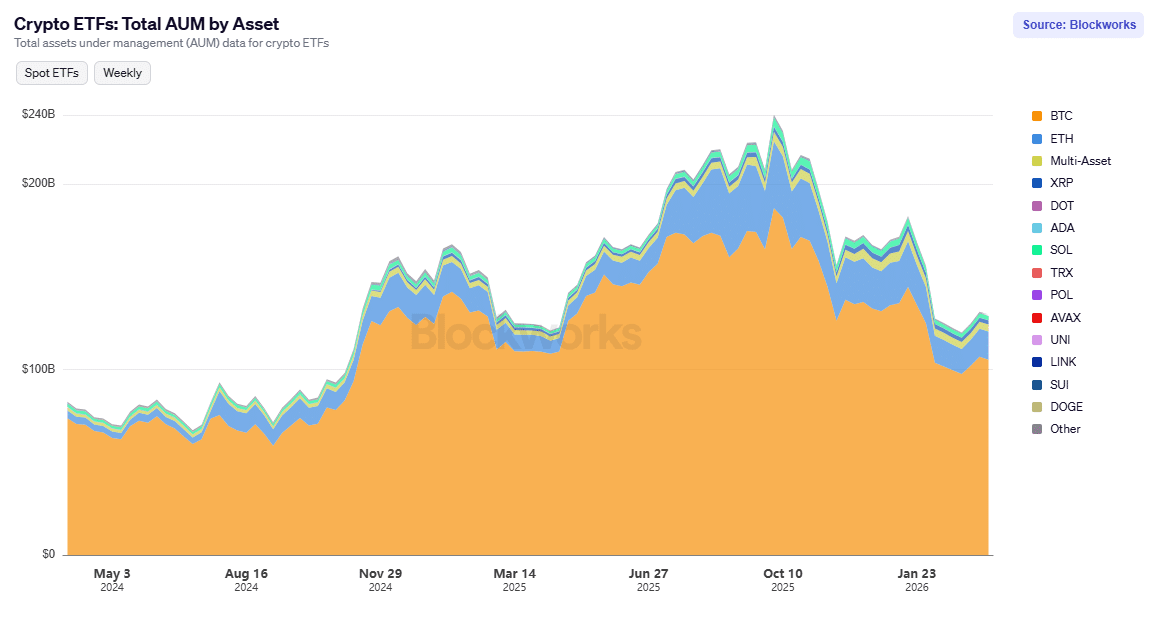
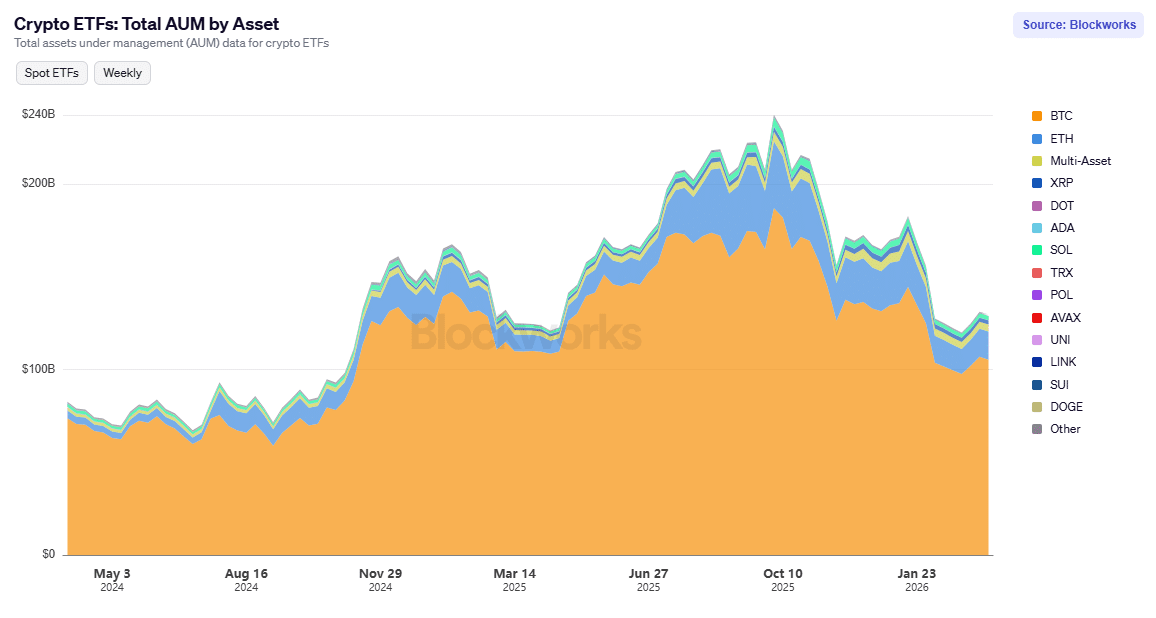
It remains to be seen how the new active strategy will drive demand into crypto ETFs. As of writing, the total crypto ETF assets under management (AUM) were about $130 billion, down from nearly $240 billion at the peak of 2025.
Source: Blockworks

Final Summary

  • 21Shares’ Duncan Moir said that active strategies will be at the center of the next crypto ETF management.
  • Yield-focused wrappers and staking rewards are some active strategies asset managers are deploying for investors.


Пов'язані питання

QAccording to 21Shares president Duncan Moir, why are crypto ETFs transitioning from passive to active strategies?

ABecause crypto sector is a 'nascent' and 'growing asset class' that fits perfectly with active management, focusing on scaling yield streams and extra earning opportunities beyond just holding crypto assets.

QWhat regional differences in crypto ETF demand does Duncan Moir highlight between the US and Europe?

AIn the US, interest is concentrated in larger coins, while in Europe, institutional clients are more interested in newer assets and the application layer beyond Layer-1.

QWhat are two specific active strategies mentioned that asset managers are using to maximize investor returns?

AYield-focused wrappers (like the ETP tied to Stretch offering 11.5% annual dividend) and staking rewards in crypto ETFs.

QWhat was the rationale behind 21Shares launching a Bitcoin-and-gold ETP?

AIt was based on the rising demand for safe havens amid debasement trade and rising U.S. fiscal debt, capitalizing on major thematic trends.

QWhat is the current total assets under management (AUM) for crypto ETFs as mentioned in the article?

AAbout $130 billion, down from nearly $240 billion at the peak of 2025.

Пов'язані матеріали

From Survival to Accelerated Growth: The Journey of Zcash's Three-Year Rise as Told by the Founder of ZODL

**From Survival to Accelerated Growth: Zcash Founder Details the 3-Year Rise** Three years ago, Zcash (ZEC) was a struggling pioneer in privacy technology, with a price near $30, low shielded supply (11%), and a community mired in governance disputes. Today, ZEC trades around $600, with over 31% of its supply (~$3B) in user-controlled shielded pools. This transformation resulted from breaking key constraints. First, **governance shackles were removed**. The old model guaranteed funding to two entities (ECC and ZF) regardless of performance, creating a monopoly. In 2024, ECC rejected further direct funding, forcing a change. The NU6 upgrade ended direct funding, allocating 8% to community grants and 12% to a protocol-controlled treasury for retroactive rewards, expiring in 2028 unless renewed by overwhelming consensus. The entities also relinquished their trademark-based veto power, freeing community governance. Second, the **product focus shifted** from pure cryptography to user growth. Previously, engineering excelled at privacy tech but failed to attract users. In early 2024, the team (later ZODL) pivoted to building products users wanted, like the Zodl wallet (default privacy, hardware support, cross-asset swaps). This drove shielded supply to grow over 400% in ZEC terms, with 86.5% of recent transactions being shielded, representing real user adoption. Third, the **narrative evolved** from the limiting "privacy coin" label to "unstoppable private money." This clarified Zcash's value proposition: a Bitcoin-like monetary policy with verifiable private payments via advanced cryptography. This structural narrative—protocol (Zcash), asset (ZEC), gateway (Zodl)—enabled broader exchange listings, institutional interest, and ETF filings. Finally, **organizational constraints were broken**. In early 2026, the ECC team left its non-profit structure after disputes over control, forming Zcash Open Development Lab (ZODL). ZODL raised $25M from top VCs (Paradigm, a16z, etc.), gaining the capital and agility of a startup to scale consumer products. Current metrics show strong momentum: social discussion volume for ZEC surged 15,245% in a year, with 81% positive sentiment. The focus is now on enhancing user experience (Zodl wallet), scalability (Tachyon project targeting Visa-level throughput with 25-second blocks), and post-quantum security (quantum-recoverable wallets coming soon). Zcash is positioned to become faster, more usable, scalable, and quantum-resistant.

marsbit11 хв тому

From Survival to Accelerated Growth: The Journey of Zcash's Three-Year Rise as Told by the Founder of ZODL

marsbit11 хв тому

Five Counterparty Risk Architectures: A Settlement-Layer Methodology for Classifying TradFi Models in Crypto Exchanges

**Summary:** This companion piece reframes the five TradFi-on-crypto exchange architectures, previously classified by "architectural fingerprint," through the lens of counterparty risk. The core question is: whose balance sheet bears the loss first in a stress scenario, and has it historically done so? Each of the five models corresponds to a distinct risk holder with its own documented failure modes. * **Model 1 (Stablecoin-Settled CEX Perpetuals):** Risk is held by the stablecoin issuer (e.g., reserve composition, bank connectivity) and the CEX's own book. History includes Tether's banking disconnections (2017) and reserve misrepresentations (CFTC 2021 Order). * **Model 2 (CFD Brokers):** Risk resides on the broker's balance sheet (B-book model). Regulatory differences (e.g., ESMA's mandatory negative balance protection vs. Mauritius FSC's lack thereof) define loss allocation rules, as seen in the 2015 SNB event (Alpari UK insolvency). * **Model 3 (Off-Chain Custody & Transfer Agent Chain):** Risk lies with the off-chain custodian/platform. User asset recovery depends on Terms of Use and corporate structure, exemplified by the Celsius bankruptcy ruling (2023) where Earn Account assets were deemed property of the estate. * **Model 4 (DEX Perpetual Protocols):** No single balance sheet bears risk. Loss absorption relies on a protocol's insurance fund and Auto-Deleveraging (ADL) mechanism, as demonstrated in the GMX V1 (2022) and dYdX v3 YFI (2023) incidents. * **Model 5 (Regulated CCP - DCM-DCO-FCM):** The most institutionalized model concentrates risk in the Central Counterparty (CCP). However, history shows CCPs can employ non-standard tools under extreme stress, such as mass trade cancellation (LME Nickel, 2022) or enabling negative price settlements (CME WTI, 2020). The report argues that regulatory choices and counterparty risk structures are co-extensive, not in an upstream-downstream relationship. It concludes with five separate observation checklists (not predictions) for monitoring the structural vulnerabilities of each risk model.

marsbit28 хв тому

Five Counterparty Risk Architectures: A Settlement-Layer Methodology for Classifying TradFi Models in Crypto Exchanges

marsbit28 хв тому

Торгівля

Спот
Ф'ючерси
活动图片




