Who Will Make Money in the Age of Agents?

marsbitОпубліковано о 2026-05-27Востаннє оновлено о 2026-05-27

Анотація

In the Agents era of blockchain, traditional value capture theories face challenges. The "Fat Protocol" theory, dominant since 2016, suggested protocols capture most value as their tokens are essential for network use. However, the proliferation of interchangeable L1s, L2s, and modular layers has eroded protocol scarcity and pricing power. Conversely, the "Fat App" theory posits that applications capturing user relationships (like wallets and exchanges) become the primary value layer by controlling distribution and transaction flows. This aligns with the current "Great Repricing" cycle. Agents disrupt this logic. As software users, they lack brand loyalty, prioritize cost and efficiency, and switch between platforms seamlessly. This undermines the front-end UX moats that "Fat Apps" rely on. The article explores several potential futures: 1. **Headless Applications:** Current leading apps could strip their front-ends and become backend API infrastructure for Agents, preserving their role. 2. **Protocol Resurgence:** If integration becomes trivial, Agents might bypass aggregators and interact directly with protocols, reviving "Fat Protocol" dynamics. 3. **Pricing Power Collapse:** Agents' rational, frictionless routing could commoditize the entire stack, compressing margins toward cost and leaving little profit for intermediaries. 4. **Unprecedented Activity:** Agents may enable new, high-frequency, machine-to-machine economic activities, expanding the total value pie ev...

Author: Jonah Burian

Compiled by: Jiahuan, ChainCatcher

Many speculate that the next billion users of blockchain will be Agents. But few ask the further question: In that world, who will make money?

Every previous theory of value capture in the crypto space assumes the user is human. The "Fat Protocols" theory posits that protocols are best at monetizing human users.

The "Fat Apps" theory I explored with my colleagues in "How to Capture Value" and "The Great Repricing" argues that the application layer can do better. But Agents change the nature of the user, and existing theories will break down accordingly.

The Fat Protocols Theory

In 2016, @jmonegro proposed "Fat Protocols." For nearly a decade, it has been the dominant value capture theory in crypto.

The core idea: In the traditional internet, value accumulates at the application layer (@Google, @facebook), while the underlying protocols (TCP/IP, HTTP) capture almost no value. The crypto world will completely reverse this. Blockchains have open, shared data, so applications will become commoditized.

And because using the network requires consuming the protocol's token, the token will capture the speculative value generated by usage growth as it appreciates. Each application's success drives demand for the token. The underlying protocol will grow faster than any application built on top of it.
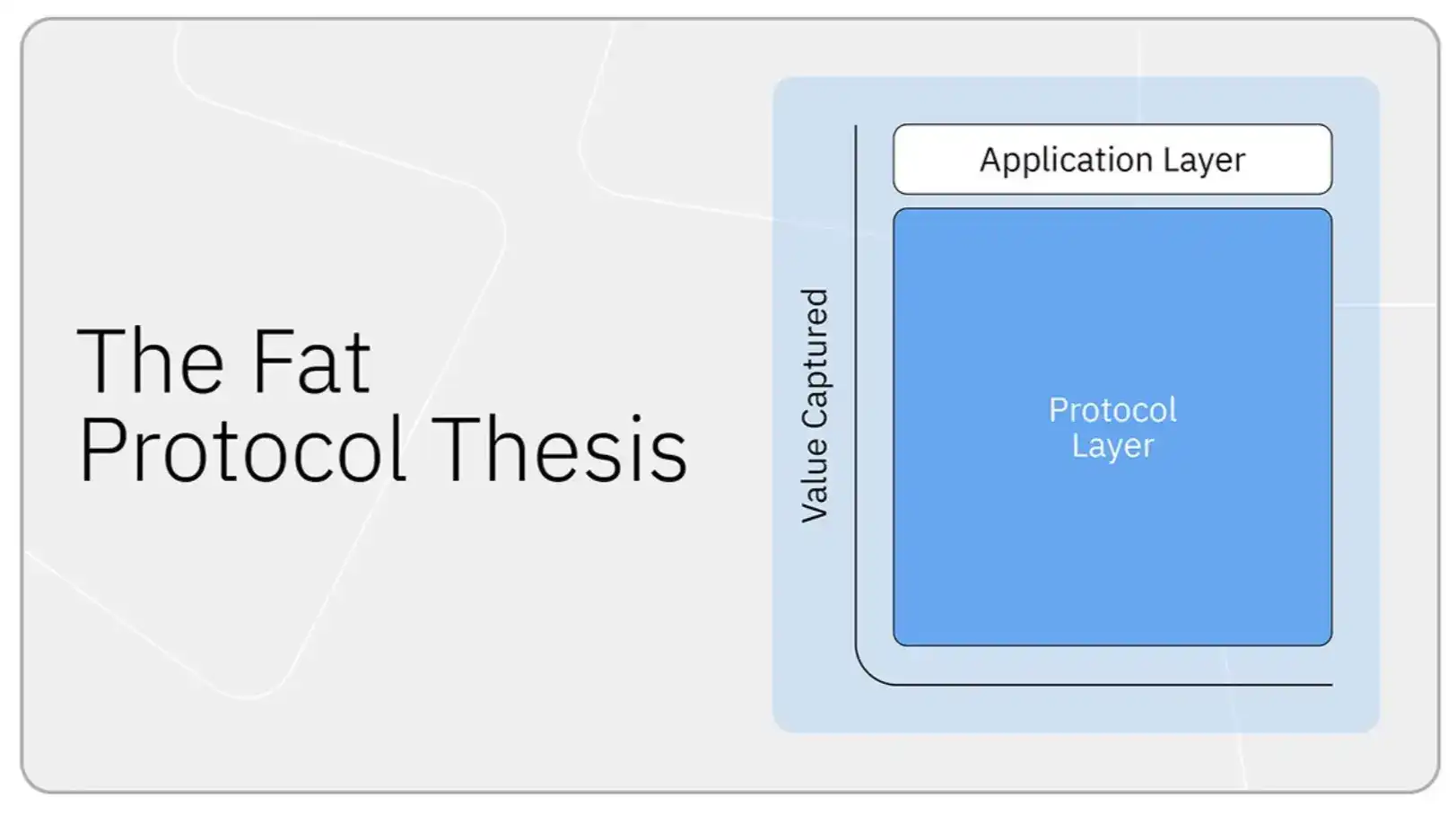
For years, this seemed correct. Bitcoin and Ethereum's values far surpassed any companies built on them.

This model works perfectly when the protocol itself is scarce, costly to build, and difficult to replace. Bitcoin and Ethereum in 2017 were indeed very scarce; there weren't dozens of general-purpose L1s competing for the same workloads.

Block space was sufficiently constrained that holding the underlying asset felt like holding a piece of every application that needed it.

Today, reliable alternatives exist at every layer of the infrastructure stack: multiple high-throughput L1s, dozens of L2s, and modular settlement and data availability (DA) layers competing fiercely on price. Block space has gone from constrained to abundant.

As cross-chain bridges and aggregators make the underlying chain nearly invisible to users, user switching costs collapse. Infrastructure becomes interchangeable, and interchangeable commodities compete on price. The result is that protocol pricing power dies along with scarcity.

The Fat Apps Theory

By 2026, the entities capturing most of the economic benefits are applications, not protocols: e.g., @phantom, @coinbase, @Polymarket, @Pumpfun.

In my view, the reason is that the most valuable asset in crypto is the user relationship.

If you control the user interface and transaction flow, you control distribution, and can profit from almost any on-chain product users touch: swaps, lending, staking, minting, and fiat on/off ramps. This is probably why funds are so obsessed with neobanks.
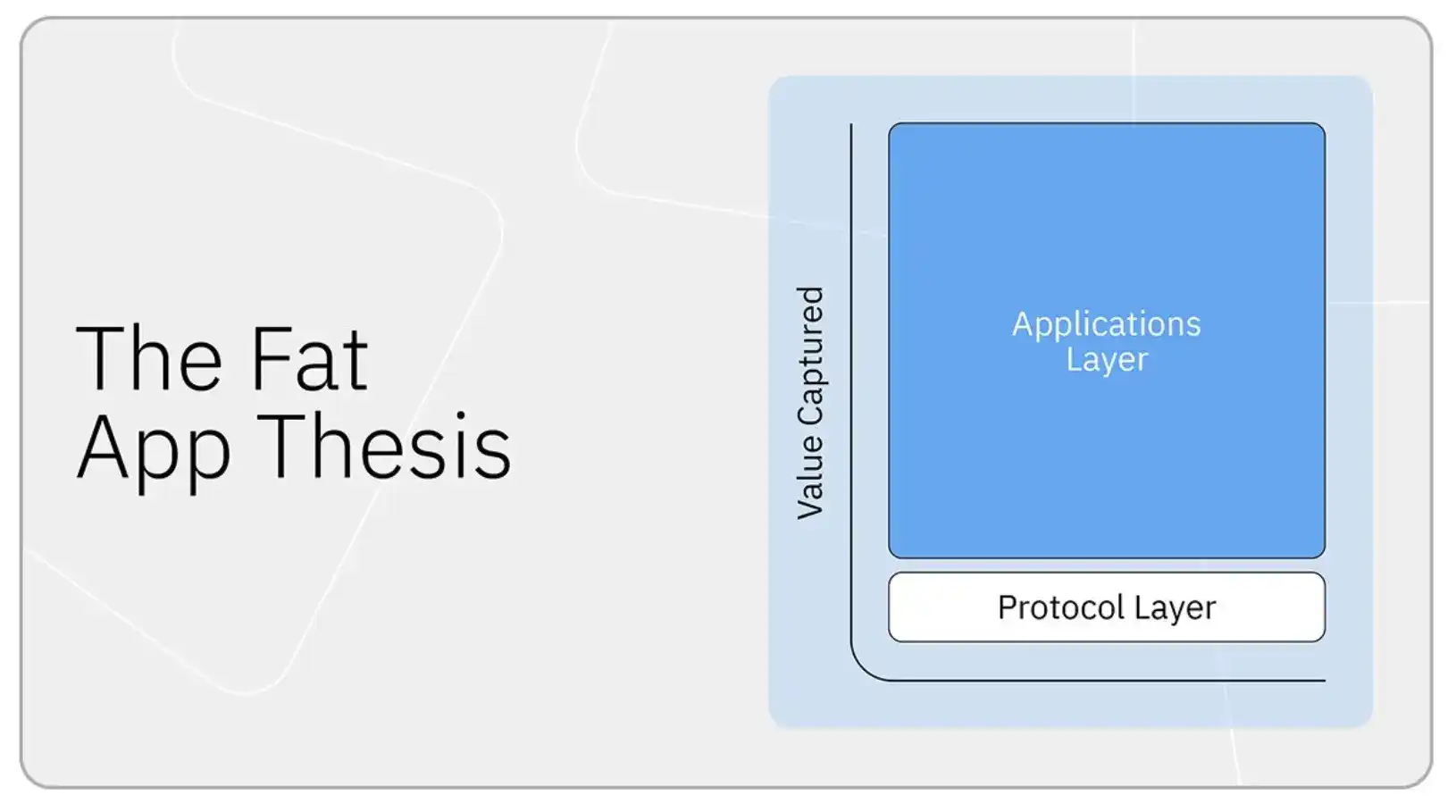
Applications also push infrastructure into pure price wars, forcing infrastructure margins down to marginal cost. I documented this dynamic in "How to Capture Value." The same dynamic is playing out in the stablecoin space, which I've discussed elsewhere.

Asset prices are reflecting this theory. Spencer and I called this shift "The Great Repricing": in this cycle, value is starting to accrue to the layer that owns the user.

Why Agents Break This Logic

The Fat Apps theory assumes users are humans who value UX, brand, and convenience. But Agents don't care about any of that. They call APIs directly, have no brand loyalty, and switch between platforms at zero cost.

When the user becomes software, owning the user relationship is no longer an unbreakable moat. The entire front-end moat upon which the Fat Apps theory relies is failing.

So, who captures value in the age of Agents?
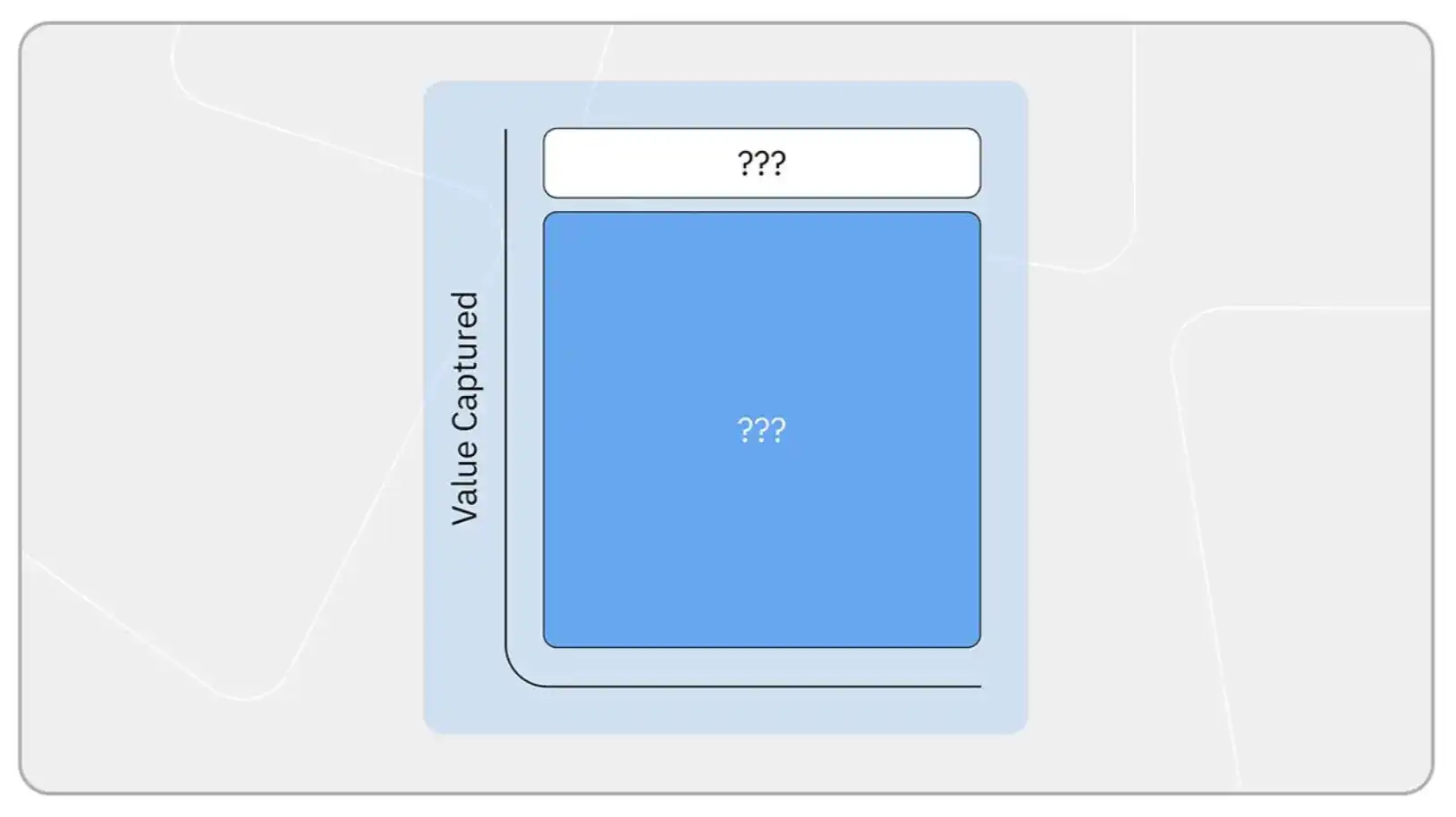
Applications Go "Headless"

In one version of the future, winners at the application layer remain winners by shedding their front-end interface, i.e., going "headless."

Wallets and aggregators have already done the hardest work: integrations with dozens of protocols, routing logic, authentication, and fiat on/off-ramp infrastructure.

The logical next step is to open this tech stack as an API for Agents, letting Agents route through them—just as humans route through @phantom or @JupiterExchange today.

In this world, the Fat Apps theory survives. It just loses its front end. The companies that won in the human era transform into pure back-end infrastructure for Agents. We already see traditional SaaS companies like Salesforce moving in this direction.

The Resurgence of Protocols

In another version, Agents completely skip the middle layer.

If integration becomes easy enough (well-documented APIs, standardized RPCs, predictable execution semantics), Agents have no real reason to pay an aggregator to do something they can do themselves. Aggregators' advantages in the human era were UX and handling routing complexity.

But Agents don't need UX, and routing is an engineering problem that Agents are increasingly good at solving.

If the world evolves this way, the Fat Protocols theory gets a second life.

Pricing Power Collapses Across the Stack

Perhaps Agents will apply commoditization pressure everywhere. They are perfectly rational, frictionlessly routing to the cheapest venue every single time with zero loyalty.

Applications lose the ability to charge a UX premium from humans. Aggregators and infrastructure lose pricing power because there is no longer human inertia protecting them from price wars.

In this scenario, no one in the tech stack captures much profit. Margins across the supply chain are forced down to marginal cost. The residual value accrues to the owners of the Agents, or to the end-users the Agents serve.

Crypto becomes a utility, and it's hard to make big money in utilities.

Agents Create Unprecedented Activity

The simple take on this is: Agents are doing everything humans do, just faster and at greater scale. Even if margins are compressed, the overall pie grows.

I think there's a more interesting version.

Agents enable activities that were previously infeasible: e.g., continuously rebalancing a portfolio for less than a penny in execution costs, machine-to-machine commerce between Agents, and entirely new markets that exist only because pricing and transaction speeds far outpace what humans can follow.

Current on-chain activity data doesn't reflect this because we assume a human must be involved.

If this is the change Agents bring, then the question shifts from "how is the existing pie divided" to "how much new economic activity pours on-chain, and which layers are ready to serve it."

A Yet-Unnamed Business Model

Every cycle, we try to guess where value will flow, and tend to think existing business models will extend into the future. This assumption usually causes us to miss the new models that haven't yet emerged.

When the internet was new, no one foresaw the attention economy. The idea that "slicing up user attention and auctioning it to advertisers would become the dominant business model, and a single company could capture a significant share of global ad spend" was alien. It only seems inevitable in hindsight.

AI looks like one of the biggest technological disruptions in decades. In an Agent-dominated world, some value capture might flow to business models no one is talking about today. And the entities capturing that value might not be the ones the market is currently focused on.

What to Watch

The most likely outcome is not one system completely replacing the other. For a long time, humans and Agents will coexist as crypto users, with entirely different maps of value capture.

As long as humans interact on-chain, the Fat Apps theory still applies: consumers willing to pay for UX, brand, and convenience will continue to pay a premium to the applications that own that relationship. And the layers involved in Agent transactions will be governed by a separate set of theories, whichever of the above scenarios becomes reality.

For builders, I think the question worth iterating on the Agent side is: What actually makes an Agent come back to you instead of routing directly to the next cheapest alternative? UX probably isn't the answer. Liquidity, latency, settlement guarantees might be.


Пов'язані питання

QAccording to the article, what was the dominant value capture theory in crypto for the past decade, and what was its core argument?

AThe dominant value capture theory was the 'Fat Protocols' theory. Its core argument was that in the crypto world, value accrues to the underlying blockchain protocols (like Bitcoin and Ethereum) rather than the applications built on top. This is because protocols become more valuable as they are used (demand for their token increases), while applications become commoditized due to open, shared data.

QWhat is the 'Fat App' theory, and why is it currently challenging the 'Fat Protocols' theory?

AThe 'Fat App' theory argues that value is increasingly captured at the application layer. It posits that the most valuable asset in crypto is the user relationship. Entities that control the user interface and transaction flow (like wallets and exchanges) control distribution and can monetize various on-chain products. It challenges 'Fat Protocols' because infrastructure has become commoditized with many alternatives, eroding protocol pricing power.

QWhy does the author believe AI Agents will disrupt the current 'Fat App' value capture model?

AThe 'Fat App' model assumes users are humans who value UX, brand, and convenience. AI Agents do not care about these aspects; they interact via APIs with zero brand loyalty and can switch between platforms at near-zero cost. Therefore, the front-end moat (user relationship) that 'Fat Apps' rely on becomes ineffective when the 'user' is software.

QThe article outlines several possible scenarios for value capture in an Agents-dominated world. Name two of them.

ATwo possible scenarios are: 1) Successful applications become 'headless,' pivoting to serve as backend infrastructure APIs for Agents, keeping the 'Fat App' theory alive but without the front-end. 2) Agents bypass middlemen entirely and interact directly with protocols if integration is simple enough, potentially revitalizing the 'Fat Protocols' theory.

QWhat does the author suggest builders in the Agents economy should focus on, instead of user experience (UX)?

AThe author suggests builders should focus on what would make an Agent choose their service repeatedly over a cheaper alternative. Potential answers include factors like superior liquidity, lower latency, or stronger settlement guarantees, rather than traditional UX elements that appeal to humans.

Пов'язані матеріали

How to Define "Real U.S. Stocks": Differences Between On-Chain Tokens, Price Contracts, and Direct Broker Connections

**Title:** Defining "Real US Stocks": Differences Among On-Chain Tokens, Price Contracts, and Broker-Direct Access **Summary:** In 2026, using stablecoins to purchase US stocks is mainstream, but products marketed as "buying US stocks with USDT" offer fundamentally different assets. This article analyzes three primary models. **1. Tokenized Stocks:** These are on-chain tokens representing economic exposure to underlying stocks, held by an issuer or custodian. They offer benefits like 24/7 trading and DeFi composability (e.g., use as loan collateral). However, users lack direct legal shareholder status; dividends may not be paid in cash, and voting rights are typically non-binding advisory expressions. Examples include platforms like Ondo Finance. **2. Stock Futures / Equity Perpetuals:** These are derivative contracts tracking a stock's price, allowing leveraged long/short positions 24/7, similar to crypto perpetuals. They offer high efficiency and flexibility but involve funding fees, which can be a significant long-term cost, especially during strong trends. Crucially, they confer no ownership rights (dividends, voting) to the holder. **3. Broker-Direct Model:** This model provides access to real securities via licensed broker-dealers. Stocks/ETFs are bought and held within the US clearing and custodial system (e.g., DTCC), making it the only path to genuine stock ownership. Users receive cash dividends and formal proxy voting rights (where applicable). It supports thousands of stocks and ETFs, far exceeding the coverage of the other two models. Key advantages include no funding fees, a clean cost structure for long-term holds, and the potential to transfer holdings to other brokers. Some platforms facilitate stablecoin (USDT/USDC) deposits, reducing reliance on traditional banking. A critical distinction exists *within* the broker-direct model: the underlying brokerage architecture (e.g., Fully Disclosed IB, Omnibus IB, Self-Clearing) determines how client assets are held, protected, and how safeguards like SIPC insurance are conveyed. Users should verify the specific clearing structure and regulatory compliance of any platform. In conclusion, "buying US stocks with USDT" can mean holding an on-chain economic proxy (Tokenized Stocks), trading a price derivative (Stock Futures), or owning the actual security (Broker-Direct). For users seeking full ownership rights and long-term investment, the broker-direct model is the definitive choice, though its implementation details require careful scrutiny.

marsbit38 хв тому

How to Define "Real U.S. Stocks": Differences Between On-Chain Tokens, Price Contracts, and Direct Broker Connections

marsbit38 хв тому

NVIDIA Launches DSX Platform, Expanding into AI Factory Infrastructure

NVIDIA has unveiled the DSX platform at its GTC Taipei event, marking a strategic expansion from GPU sales into comprehensive AI factory infrastructure solutions. The platform addresses challenges like power supply, cooling, and resource orchestration as AI models scale, shifting the industry focus from single-chip performance to overall infrastructure efficiency. DSX integrates NVIDIA's chips, systems, software, and partner technologies to cover the entire AI factory lifecycle—from design and simulation to deployment and operations. It aims to accelerate deployment, improve reliability and operational efficiency, and reduce the cost per generated token in AI inference. The software suite includes DSX MaxLPS, which uses 45°C liquid cooling and rack-level optimization to allow up to 40% more GPUs per megawatt, and DSX OS, an open-source platform for AI factory operations. The platform also encompasses reference designs, digital twin simulation (DSX Sim), dynamic workload adjustment based on grid conditions (DSX Flex), and data exchange between systems. Early adopters include cloud providers like CoreWeave and Lambda. Major hardware partners, including Dell, HPE, Lenovo, and Supermicro, are developing DSX-ready systems. Pilot projects for DSX Flex are underway with energy providers. Strategically, DSX represents NVIDIA's ongoing transition from an AI chip supplier to a full-stack AI infrastructure platform provider, aiming to set industry standards and solidify its market leadership.

marsbit43 хв тому

NVIDIA Launches DSX Platform, Expanding into AI Factory Infrastructure

marsbit43 хв тому

After Burning Tens of Billions of Dollars in Tokens, Silicon Valley Giants Start Limiting Employee Token Usage

After burning tens of billions of dollars on AI tokens, major Silicon Valley firms are now restricting employee usage. Companies like Microsoft, Uber, and Salesforce, which heavily promoted AI for "efficiency," are facing a cost crisis. The practice of "tokenmaxxing"—pushing employees to maximize AI tool usage—led to wasteful spending on trivial tasks like checking the weather or writing birthday messages, with studies showing significant hidden costs for bug fixes and code rewrites. The core issue is a misalignment between individual productivity gains and actual business value. While employees use AI to automate tasks they dislike, such as writing reports, this often doesn't translate to increased company revenue or improved core business outcomes. For instance, AI-generated code speeds up development but also sees an 800% increase in "code churn" (code being discarded or rewritten). As a result, only 14% of CFOs report seeing a clear, measurable return on AI investments. Firms are now shifting strategies. Microsoft has revoked most internal licenses for Claude Code, while others are implementing monitoring and cost controls. New tools from companies like Harness and CloudZero aim to track AI spending and tie costs to business results. Some AI vendors, like HubSpot, are moving from token-based pricing to charging based on outcomes, such as "resolved conversations" or "leads generated." This represents a necessary correction in the AI adoption cycle. The challenge now is for companies to move beyond using AI merely to speed up old tasks and instead rethink their workflows and business models fundamentally. The future of enterprise AI depends on proving its value, not just its usage.

marsbit1 год тому

After Burning Tens of Billions of Dollars in Tokens, Silicon Valley Giants Start Limiting Employee Token Usage

marsbit1 год тому

I've Been a VC in Web3 for Nine Years: Asian Funds Are Experiencing "Hell Mode"

After nine years as a Web3 VC, the author observes a severe downturn in Asia's crypto venture capital scene, with many funds disappearing or pivoting away. The market has cooled dramatically since the 2021-2024 frenzy, leading to fewer deals and active investors. IOSG Ventures, a firm that has endured three market cycles, has adapted its strategy: shifting from 80-90% early-stage investments to a 50% early-stage, 30% post-TGE, and 20% OTC portfolio to find better value and liquidity. The current bear market is described as "hell mode" for Asian funds due to scarce LP capital, forcing extreme precision in targeting only top projects. The author argues the core industry problem has been the disconnect between tokens and real value, where tokens served as fundraising tools without granting holders rights to protocol revenue. A positive shift is emerging where projects like Uniswap and Morpho are programmatically binding token value to protocol profits. Investment focus has moved towards fundamentals: real-yield financial infrastructure (stablecoins, lending) and crypto-native AI infrastructure, while avoiding narrative-driven projects. The conclusion is that true, durable companies are born in pessimistic times when focus shifts to real user needs and sustainable business models. The industry's future will be shaped by those who remain after the泡沫 dissipates.

marsbit1 год тому

I've Been a VC in Web3 for Nine Years: Asian Funds Are Experiencing "Hell Mode"

marsbit1 год тому

Торгівля

Спот
Ф'ючерси
活动图片




