Who is the Truly Strongest Agent in OpenClaw? Leaderboard of 23 Real-World Task Evaluations Released

marsbitОпубліковано о 2026-04-08Востаннє оновлено о 2026-04-08

Анотація

This report presents a comprehensive benchmark evaluating the performance of AI coding agents on 23 real-world OpenClaw tasks, focusing solely on the core metric of success rate. The transparent and reproducible testing methodology employs three scoring methods: automated checks, an LLM judge (Claude Opus), and a hybrid approach. The diverse task set covers areas like code/file operations, content creation, research, system tools, and memory persistence. The top 10 models by success rate (Best % / Avg %) are: 1. anthropic/claude-opus-4.6 (93.3% / 82.0%) 2. arcee-ai/trinity-large-thinking (91.9% / 91.9%) 3. openai/gpt-5.4 (90.5% / 81.7%) 4. qwen/qwen3.5-27b (90.0% / 78.5%) 5. minimax/minimax-m2.7 (89.8% / 83.2%) Claude Opus 4.6 leads in peak performance, while Arcee's Trinity demonstrates superior average success rate stability. The Qwen series shows strong cost-performance potential with multiple entries in the top ten. All task definitions and scoring logic are publicly available for independent verification.

Want to know which large language model truly performs the strongest in OpenClaw's real-world agent tasks?

MyToken, based on evaluation websites, has compiled a transparent benchmark focused on assessing the practical capabilities of AI coding agents, looking solely at the core dimension of success rate (speed and cost belong to other independent dimensions, to be analyzed separately later). Fully public and reproducible, it only presents rigorous evaluation standards + the latest Top 10 success rate rankings.

I. Evaluation Dimension:Success Rate

Specific standard: The percentage of given tasks that the AI agent completes accurately and fully. Each task adopts a highly standardized process:

  • Precise user prompt

Sent to the agent in full to simulate real user request scenarios

  • Expected Behavior

Clearly states acceptable implementation methods and key decision points

  • Scoring Criteria (checklist)

Lists an atomic success判定 (judgment) checklist for verification item by item

II. Three Scoring Methods

This evaluation primarily employs 3 scoring methods:

  • Automated Checks: Python scripts directly verify objective results like file content, execution records, tool calls, etc.

  • LLM Judge: Claude Opus scores according to a detailed scale (content quality, appropriateness, completeness, etc.)

  • <极 span data-text="true">Hybrid Mode: Combines automated objective checks + LLM judge qualitative assessment

All task definitions, Prompts, and scoring logic are fully public for retesting and verification.

III. Tasks Used for Evaluation

This benchmark covers 23 tasks across different categories. It spans multiple dimensions including basic interaction, file/code operations, content creation, research & analysis, system tool calls, memory persistence, etc., highly aligning with developers' daily use scenarios of OpenClaw:

  1. Sanity Check(Automated) —— Process simple instructions and reply to greetings correctly

  2. Calendar Event Creation(Automated) —— Generate a standard ICS calendar file from natural language

  3. Stock Price Research(Automated) —— Query stock prices in real-time and output a formatted report

  4. Blog Post Writing(LLM Judge) —— Write a ~500-word structured Markdown blog post

  5. Weather Script Creation(Automated) —— Write a Python weather API script with error handling

  6. Document Summarization(LLM Judge) —— Provide a refined 3-part summary of the core themes

  7. Tech Conference Research(LLM Judge) —— Research and organize information (name, date, location, link) for 5 real tech conferences

  8. Professional Email Drafting(LLM Judge) —— Politely decline a meeting and propose an alternative

  9. Memory Retrieval from Context(Automated) —— Precisely extract dates, members, tech stack, etc., from project notes

  10. File Structure Creation(Automated) —— Automatically generate standard project directories, README, .gitignore

  11. Multi-step API Workflow(Hybrid) —— Read config → Write calling script → Fully document

  12. Install ClawdHub Skill(Automated) —— Install from the skill repository and verify usability

  13. Search and Install Skill(Automated) —— Search for weather-related skills and install correctly

  14. AI Image Generation(Hybrid) —— Generate and save an image based on description

  15. Humanize AI-Generated Blog(LLM Judge) —— Rewrite machine-like content into natural spoken language

  16. Daily Research Summary(LLM Judge) —— Synthesize multiple documents into a coherent daily summary

  17. Email Inbox Triage(Hybrid) —— Analyze multiple emails and organize a report by urgency

  18. Email Search and Summarization(Hybrid) —— Search archived emails and extract key information

  19. Competitive Market Research(Hybrid) —— Competitive analysis in the enterprise APM field

  20. CSV and Excel Summarization(Hybrid) —— Analyze spreadsheet files and output insights

  21. ELI5 PDF Summarization(LLM Judge) —— Explain a technical PDF in language a 5-year-old can understand

  22. OpenClaw Report Comprehension(Automated) —— Precisely answer specific questions from a research report PDF

  23. Second Brain Knowledge Persistence(Hybrid) —— Store information across sessions and recall it accurately

IV. Core Conclusion: Top 10 Large Model Rankings by Success Rate (Best % / Avg %)

  • Data updated to April 7, 2026

  • Best % is the single highest success rate, Avg % is the average success rate over multiple runs, better reflecting stability

Below are the top ten models by success rate:

  1. anthropic/claude-opus-4.6(Anthropic)——93.3% / 82.0%

  2. arcee-ai/trinity-large-thinking(Arcee AI)——91.9% / 91.9%

  3. openai/gpt-5.4(OpenAI)——90.5% / 81.7%

  4. qwen/qwen3.5-27b(Qwen)——90.0% / 78.5%

  5. minimax/minimax-m2.7(MiniMax)——89.8% / 83.2%

  6. anthropic/claude-haiku-4.5(Anthropic)——89.5% / 78.1%

  7. qwen/qwen3.5-397b-a17b(Qwen)——89.1% / 80.4%

  8. xiaomi/mimo-v2-flash(Xiaomi)——88.8% / 70.2%

  9. qwen/qwen3.6-plus-preview(Qwen)——88.6% / 84.0%

  10. nvidia/nemotron-3-super-120b-a12b(NVIDIA)——88.6% / 75.5%
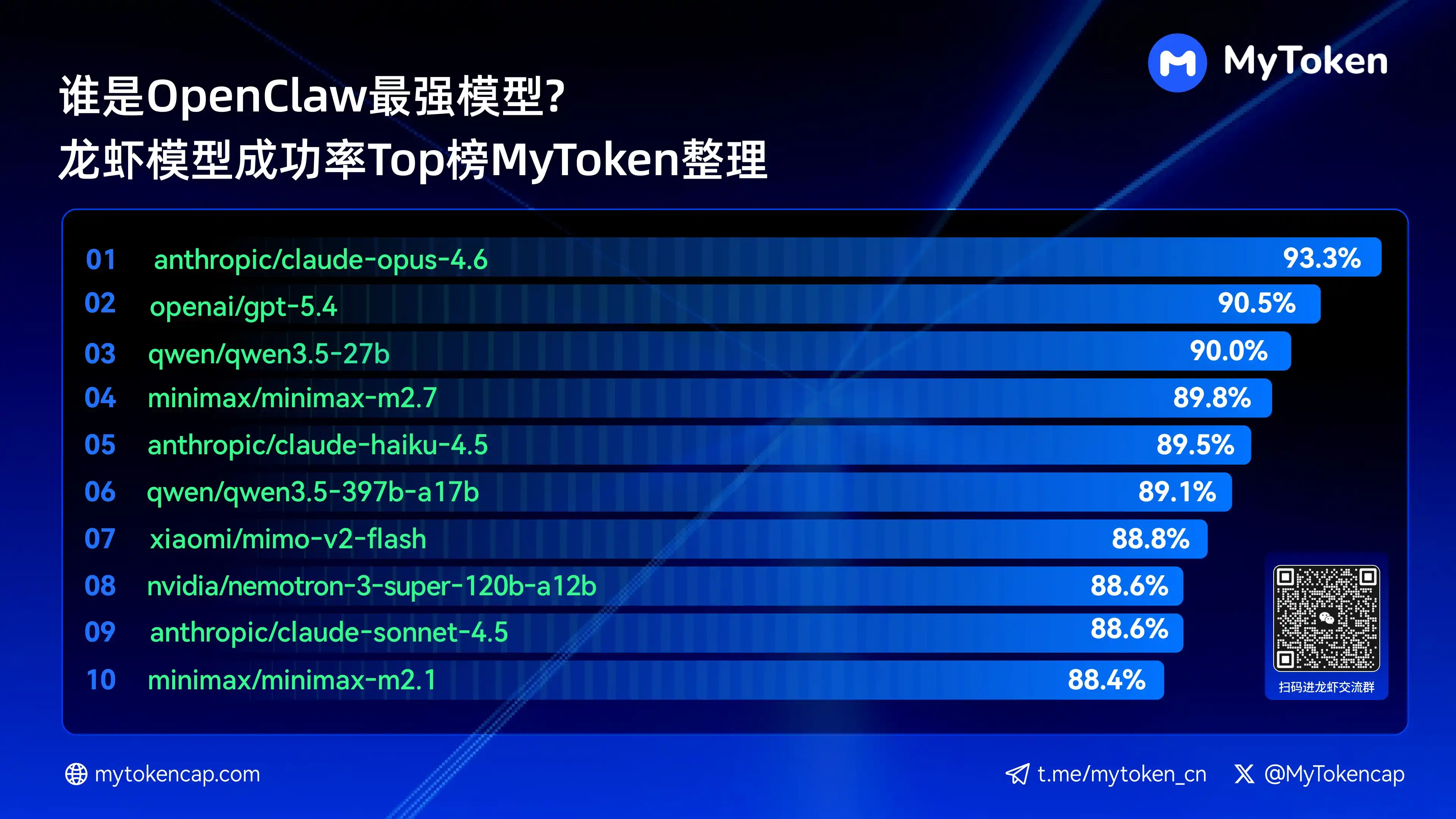
Claude Opus 4.6 currently leads with the highest success rate of 93.3%, but Arcee's Trinity shows impressive performance in average stability. The Qwen series also has multiple entries in the top ten, demonstrating strong cost-performance potential. Success rate is the basic threshold; subsequent dimensions of speed and cost will further impact the actual experience.

This set of 23 task benchmarks is fully transparent. We strongly encourage everyone to conduct practical tests结合 (combining with) their own scenarios. For rankings of more other models, please look forward to the agent leaderboard feature即将 (soon to be) launched by MyToken.

(Data sourced from PinchBench's publicly available OpenClaw agent benchmark tests, continuously updated.)


Пов'язані питання

QWhat is the core evaluation dimension used in the OpenClaw agent benchmark?

AThe core evaluation dimension is success rate, which measures the percentage of tasks that the AI agent completes accurately and completely.

QHow many real-world tasks are included in the OpenClaw benchmark test?

AThe benchmark test covers 23 different real-world tasks.

QWhich model achieved the highest single-run success rate (Best %) in the ranking?

Aanthropic/claude-opus-4.6 from Anthropic achieved the highest single-run success rate of 93.3%.

QWhat are the three scoring methods used to evaluate the agents' performance?

AThe three scoring methods are: 1) Automated checks using Python scripts, 2) LLM judge (Claude Opus) evaluation, and 3) A hybrid mode combining automated checks and LLM evaluation.

QWhich model showed the best performance in average success rate (Avg %), indicating greater stability?

Aarcee-ai/trinity-large-thinking from Arcee AI achieved the highest average success rate of 91.9%, indicating the best stability.

Пов'язані матеріали

KOL's Perspective: Why Is SOL Set to Rise from This Point?

**Summary: Why SOL is Positioned for Growth at This Level** The article argues that SOL is poised for an upward move from its current price point, citing several key factors. Primarily, SOL has just broken out of a 4-month consolidation phase. This breakout signals a return of risk appetite to the broader crypto market, as SOL is seen as a key indicator of overall crypto health. The token's ownership has reportedly shifted from short-term traders and tourists to long-term accumulators, leading to low volume. Any meaningful increase in trading activity could thus trigger significant upward momentum. Fundamental strengths include strong institutional adoption, integration with DeFi and RWAs (Real-World Assets), and the potential benefits from the Clarity Act. Despite its high volatility—having dropped 70% from its all-time high but still up 12x from its bear market low—SOL is highlighted as one of the few tokens from the last cycle to reach new highs. It boasts a robust ecosystem of applications, users, and protocols. Future catalysts include the expected influx of AI developers following the Miami Accelerate conference, which focused on AI on Solana. Furthermore, Solana is positioned as the premier chain for memecoin activity, a trend expected to continue and drive network usage and fees. The article concludes that recent price action reflects a healthy transfer to long-term holders, setting the stage for growth.

marsbit4 хв тому

KOL's Perspective: Why Is SOL Set to Rise from This Point?

marsbit4 хв тому

Those Pre-Bitcoin PoW Protocols Have Recently Been Reimplemented

This article details a recent surge in replicating pre-Bitcoin Proof-of-Work (PoW) protocols, specifically focusing on Hal Finney's 2004 RPOW (Reusable Proofs of Work). Within five days in May 2026, multiple independent builders in the Bitcoin/cypherpunk community launched projects inspired by this early electronic cash proposal. The initiative began with Fred Krueger's `rpow2.com`, a centralized but auditable system that replaced RPOW's original IBM 4758 hardware with Ed25519 signatures. Initially a faithful replica, it later adopted Bitcoin-like features (21M supply cap, difficulty adjustment) and a controversial 5.24% founder allocation. This sparked rapid forks, including `rpow4.com` which incorporated full Bitcoin parameters, a prediction market (`rpowmarket.com`), and a DEX (`rpow2swap.com`). Concurrently, Mike In Space created a prototype of Wei Dai's 1998 b-money proposal (`b-money.replit.app`), pushing the historical exploration even further back. The article contrasts these centralized, server-dependent experiments with Bitcoin's core innovation of decentralized, trustless consensus. It also highlights a parallel development: the `HASH` project on Ethereum, which uses smart contract hooks to enable a purely fair-launch, browser-mineable PoW token with 0% allocations to team or VCs. The collective activity is framed as a meme-driven, educational exploration of cypherpunk history rather than a serious financial movement, with all projects heavily disclaiming any investment value.

marsbit9 хв тому

Those Pre-Bitcoin PoW Protocols Have Recently Been Reimplemented

marsbit9 хв тому

South Korean Exchanges 'Battle' Regulators, Challenging the Boundaries of Enforcement and Legislation

South Korea's cryptocurrency industry is engaged in a rare, direct confrontation with regulators. The Financial Intelligence Unit (FIU), the primary anti-money laundering (AML) watchdog, has recently imposed heavy penalties on major exchanges like Upbit and Bithumb for alleged violations involving unregistered overseas VASPs and AML procedures. However, exchanges are now actively challenging these actions in court and through industry associations. In a significant shift, the Seoul Administrative Court ruled in favor of Upbit's operator, Dunamu, overturning part of an FIU-ordered business suspension. The court found the FIU's penalty criteria and justification insufficiently clear. Similarly, the court suspended the enforcement of a six-month business suspension against Bithumb pending a final ruling, citing potential irreversible harm to the exchange. Beyond legal battles, the industry is contesting proposed legislative amendments. The Digital Asset eXchange Alliance (DAXA) strongly opposes a draft rule that would mandate Suspicious Transaction Reports (STRs) for all crypto transfers over 10 million KRW (~$6,800). DAXA argues this "poison pill" clause violates legal principles and would overwhelm the STR system, increasing reports from 63,000 to an estimated 5.45 million annually for major exchanges, thereby crippling effective AML monitoring. This conflict highlights a structural tension in South Korea's crypto governance: comprehensive digital asset laws are still developing, while regulators rely heavily on AML enforcement. The industry's move from passive compliance to active legal and legislative challenges signifies a new phase, pressing for clearer rules and more proportionate enforcement. While short-term disputes may intensify, this clash could ultimately lead to a more mature and sustainable regulatory framework for South Korea's vibrant crypto market.

marsbit1 год тому

South Korean Exchanges 'Battle' Regulators, Challenging the Boundaries of Enforcement and Legislation

marsbit1 год тому

After 50x Storage Surge, Justin Sun Always Looks to the Next Decade

Sun Yuchen, known for his controversial stunts like a $30 million lunch with Warren Buffett (canceled due to a kidney stone) and eating a $6.2 million duct-taped banana, is often overshadowed by a significant fact: his decade-long track record of spotting major investment trends. In 2016, he famously advised young people to invest in Bitcoin, Nvidia, Tesla, and Tencent instead of buying property. A hypothetical $20,000 investment in Nvidia and Tesla from that list would now be worth over 50 million RMB. His latest major call was on November 6, 2025, predicting a "50x storage opportunity" tied to the AI boom, which materialized with Sandisk's stock surging nearly 50-fold by 2026. Looking ahead, Sun now focuses on the next frontier: Physical AI. He identifies four key areas: 1. **Embodied AI/Robotics**: He sees this reaching its "iPhone moment," with companies like UBTech and Galaxy General leading in commercialization. 2. **Drones**: Viewed as the first commercially viable form of Physical AI, revolutionizing sectors from warfare (e.g., AeroVironment's Switchblade) to logistics. 3. **Spatial Computing**: Beyond VR, it's about AI understanding physical space, a foundational technology for robotics and autonomous systems, exemplified by Apple's Vision Pro. 4. **Space Exploration**: After a 2025 suborbital flight with Blue Origin, Sun advocates for space as the ultimate frontier, discussing blockchain's potential role in space asset management and data transactions. His investment philosophy involves betting on entire, inevitable trends rather than single companies. For robotics, he sees Tesla (the body/manufacturer) and Nvidia (the brain/AI platform) as complementary plays. In defense drones, he highlights companies making tanks obsolete (AeroVironment) and those augmenting fighter jets (Kratos). For space, he participated in Blue Origin's flight and anticipates SpaceX's potential IPO to redefine the sector's valuation. Sun Yuchen's vision frames the next two decades not as a revolution in information flow (like the internet), but in the fundamental operation of the physical world through AI-powered robots, autonomous systems, and spatial intelligence, ultimately extending human and AI activity into space. While many still focus on conventional assets, he continues to look toward the next technological horizon.

marsbit2 год тому

After 50x Storage Surge, Justin Sun Always Looks to the Next Decade

marsbit2 год тому

Торгівля

Спот
Ф'ючерси
活动图片




