Who is the Truly Strongest Agent in OpenClaw? Leaderboard of 23 Real-World Task Evaluations Released

marsbitОпубліковано о 2026-04-08Востаннє оновлено о 2026-04-08

Анотація

This report presents a comprehensive benchmark evaluating the performance of AI coding agents on 23 real-world OpenClaw tasks, focusing solely on the core metric of success rate. The transparent and reproducible testing methodology employs three scoring methods: automated checks, an LLM judge (Claude Opus), and a hybrid approach. The diverse task set covers areas like code/file operations, content creation, research, system tools, and memory persistence. The top 10 models by success rate (Best % / Avg %) are: 1. anthropic/claude-opus-4.6 (93.3% / 82.0%) 2. arcee-ai/trinity-large-thinking (91.9% / 91.9%) 3. openai/gpt-5.4 (90.5% / 81.7%) 4. qwen/qwen3.5-27b (90.0% / 78.5%) 5. minimax/minimax-m2.7 (89.8% / 83.2%) Claude Opus 4.6 leads in peak performance, while Arcee's Trinity demonstrates superior average success rate stability. The Qwen series shows strong cost-performance potential with multiple entries in the top ten. All task definitions and scoring logic are publicly available for independent verification.

Want to know which large language model truly performs the strongest in OpenClaw's real-world agent tasks?

MyToken, based on evaluation websites, has compiled a transparent benchmark focused on assessing the practical capabilities of AI coding agents, looking solely at the core dimension of success rate (speed and cost belong to other independent dimensions, to be analyzed separately later). Fully public and reproducible, it only presents rigorous evaluation standards + the latest Top 10 success rate rankings.

I. Evaluation Dimension:Success Rate

Specific standard: The percentage of given tasks that the AI agent completes accurately and fully. Each task adopts a highly standardized process:

  • Precise user prompt

Sent to the agent in full to simulate real user request scenarios

  • Expected Behavior

Clearly states acceptable implementation methods and key decision points

  • Scoring Criteria (checklist)

Lists an atomic success判定 (judgment) checklist for verification item by item

II. Three Scoring Methods

This evaluation primarily employs 3 scoring methods:

  • Automated Checks: Python scripts directly verify objective results like file content, execution records, tool calls, etc.

  • LLM Judge: Claude Opus scores according to a detailed scale (content quality, appropriateness, completeness, etc.)

  • <极 span data-text="true">Hybrid Mode: Combines automated objective checks + LLM judge qualitative assessment

All task definitions, Prompts, and scoring logic are fully public for retesting and verification.

III. Tasks Used for Evaluation

This benchmark covers 23 tasks across different categories. It spans multiple dimensions including basic interaction, file/code operations, content creation, research & analysis, system tool calls, memory persistence, etc., highly aligning with developers' daily use scenarios of OpenClaw:

  1. Sanity Check(Automated) —— Process simple instructions and reply to greetings correctly

  2. Calendar Event Creation(Automated) —— Generate a standard ICS calendar file from natural language

  3. Stock Price Research(Automated) —— Query stock prices in real-time and output a formatted report

  4. Blog Post Writing(LLM Judge) —— Write a ~500-word structured Markdown blog post

  5. Weather Script Creation(Automated) —— Write a Python weather API script with error handling

  6. Document Summarization(LLM Judge) —— Provide a refined 3-part summary of the core themes

  7. Tech Conference Research(LLM Judge) —— Research and organize information (name, date, location, link) for 5 real tech conferences

  8. Professional Email Drafting(LLM Judge) —— Politely decline a meeting and propose an alternative

  9. Memory Retrieval from Context(Automated) —— Precisely extract dates, members, tech stack, etc., from project notes

  10. File Structure Creation(Automated) —— Automatically generate standard project directories, README, .gitignore

  11. Multi-step API Workflow(Hybrid) —— Read config → Write calling script → Fully document

  12. Install ClawdHub Skill(Automated) —— Install from the skill repository and verify usability

  13. Search and Install Skill(Automated) —— Search for weather-related skills and install correctly

  14. AI Image Generation(Hybrid) —— Generate and save an image based on description

  15. Humanize AI-Generated Blog(LLM Judge) —— Rewrite machine-like content into natural spoken language

  16. Daily Research Summary(LLM Judge) —— Synthesize multiple documents into a coherent daily summary

  17. Email Inbox Triage(Hybrid) —— Analyze multiple emails and organize a report by urgency

  18. Email Search and Summarization(Hybrid) —— Search archived emails and extract key information

  19. Competitive Market Research(Hybrid) —— Competitive analysis in the enterprise APM field

  20. CSV and Excel Summarization(Hybrid) —— Analyze spreadsheet files and output insights

  21. ELI5 PDF Summarization(LLM Judge) —— Explain a technical PDF in language a 5-year-old can understand

  22. OpenClaw Report Comprehension(Automated) —— Precisely answer specific questions from a research report PDF

  23. Second Brain Knowledge Persistence(Hybrid) —— Store information across sessions and recall it accurately

IV. Core Conclusion: Top 10 Large Model Rankings by Success Rate (Best % / Avg %)

  • Data updated to April 7, 2026

  • Best % is the single highest success rate, Avg % is the average success rate over multiple runs, better reflecting stability

Below are the top ten models by success rate:

  1. anthropic/claude-opus-4.6(Anthropic)——93.3% / 82.0%

  2. arcee-ai/trinity-large-thinking(Arcee AI)——91.9% / 91.9%

  3. openai/gpt-5.4(OpenAI)——90.5% / 81.7%

  4. qwen/qwen3.5-27b(Qwen)——90.0% / 78.5%

  5. minimax/minimax-m2.7(MiniMax)——89.8% / 83.2%

  6. anthropic/claude-haiku-4.5(Anthropic)——89.5% / 78.1%

  7. qwen/qwen3.5-397b-a17b(Qwen)——89.1% / 80.4%

  8. xiaomi/mimo-v2-flash(Xiaomi)——88.8% / 70.2%

  9. qwen/qwen3.6-plus-preview(Qwen)——88.6% / 84.0%

  10. nvidia/nemotron-3-super-120b-a12b(NVIDIA)——88.6% / 75.5%
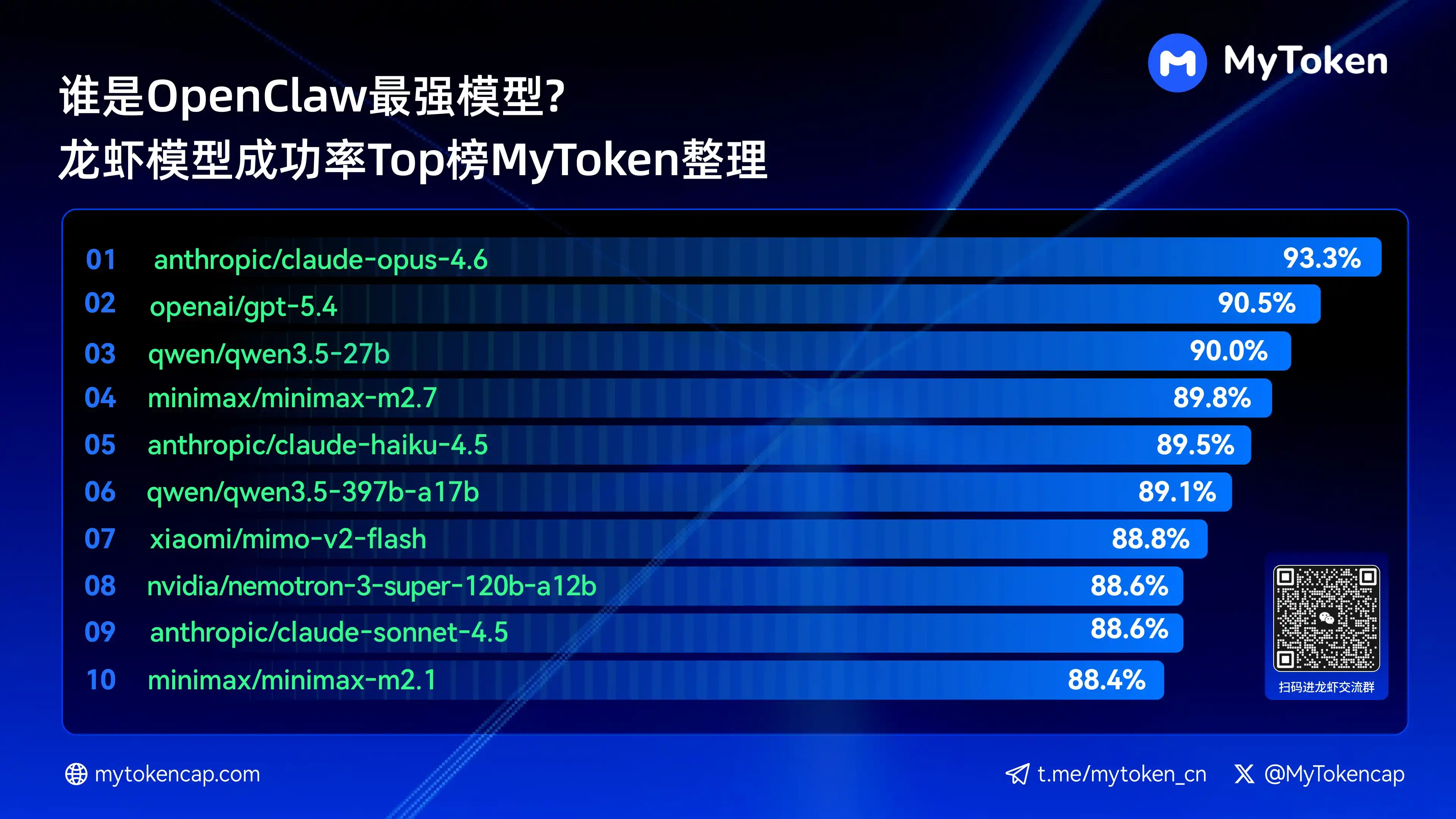
Claude Opus 4.6 currently leads with the highest success rate of 93.3%, but Arcee's Trinity shows impressive performance in average stability. The Qwen series also has multiple entries in the top ten, demonstrating strong cost-performance potential. Success rate is the basic threshold; subsequent dimensions of speed and cost will further impact the actual experience.

This set of 23 task benchmarks is fully transparent. We strongly encourage everyone to conduct practical tests结合 (combining with) their own scenarios. For rankings of more other models, please look forward to the agent leaderboard feature即将 (soon to be) launched by MyToken.

(Data sourced from PinchBench's publicly available OpenClaw agent benchmark tests, continuously updated.)


Пов'язані питання

QWhat is the core evaluation dimension used in the OpenClaw agent benchmark?

AThe core evaluation dimension is success rate, which measures the percentage of tasks that the AI agent completes accurately and completely.

QHow many real-world tasks are included in the OpenClaw benchmark test?

AThe benchmark test covers 23 different real-world tasks.

QWhich model achieved the highest single-run success rate (Best %) in the ranking?

Aanthropic/claude-opus-4.6 from Anthropic achieved the highest single-run success rate of 93.3%.

QWhat are the three scoring methods used to evaluate the agents' performance?

AThe three scoring methods are: 1) Automated checks using Python scripts, 2) LLM judge (Claude Opus) evaluation, and 3) A hybrid mode combining automated checks and LLM evaluation.

QWhich model showed the best performance in average success rate (Avg %), indicating greater stability?

Aarcee-ai/trinity-large-thinking from Arcee AI achieved the highest average success rate of 91.9%, indicating the best stability.

Пов'язані матеріали

For Hedging, Buy Gold and Oil; For Explosive Growth, Buy AI; Bitcoin, the 'Outdated' Asset, Enters a Bear Market

Bitcoin’s price has recently fallen sharply, hitting a two-month low near $66,000, with Ethereum also dropping to a three-month low. While surface explanations point to ETF outflows, geopolitical tensions, and corporate selling, a deeper issue is emerging: Bitcoin is losing a crucial asset competition. For years, Bitcoin thrived in a low-rate environment where investors sought alternatives amid inflation fears and dissatisfaction with traditional options. Now, the market landscape has shifted, leaving Bitcoin stuck in an "awkward middle ground," facing challenges on three fronts: 1. **As an inflation hedge, gold is winning.** Investors worried about persistent inflation are turning to tangible assets like gold, energy stocks, and commodity producers, which offer more direct pricing power and physical backing. 2. **For growth exposure, AI is winning.** Those seeking high growth now favor AI-related companies with actual revenues and profits, an area where Bitcoin's lack of cash flow puts it at a disadvantage. 3. **Within crypto, infrastructure and stablecoins are winning.** Even investors wanting crypto exposure have alternatives like exchanges, stablecoin issuers, and tokenization firms, whose performance is directly tied to real-world adoption and offers clearer operational leverage. The recent market reaction to inflation warnings highlights this shift. Instead of boosting Bitcoin as "digital gold," such news now drives flows toward traditional inflation-sensitive assets. Therefore, recent events like ETF outflows and corporate selling are seen not as causes, but as symptoms of this new reality. Capital has more compelling options, and investors are becoming more selective. The emerging bear case for Bitcoin is no longer about it being a fraud or failed technology, but rather that **scarcity alone is no longer enough**. It is no longer seen as the best hedge, the best growth asset, or the only crypto play.

marsbit10 хв тому

For Hedging, Buy Gold and Oil; For Explosive Growth, Buy AI; Bitcoin, the 'Outdated' Asset, Enters a Bear Market

marsbit10 хв тому

SaaS Battle Royale: The Survivors Who Win All Share One Common Trait

**Summary** The AI revolution has triggered a "SaaS apocalypse," forcing a brutal market shakeout. The key dividing line is the pricing model. Companies like Snowflake and Datadog, which charge based on consumption (e.g., data processed or compute used), are thriving. AI workloads actively *generate* more demand for their services, fueling growth. Datadog's accelerating revenue is a prime example. Microsoft and Palantir, as platform/ecosystem players, also benefit by acting as essential channels for AI deployment. In contrast, traditional SaaS firms built on per-seat or per-task licensing (e.g., Intuit, Adobe) face direct pressure, as AI threatens to automate the very human tasks their software supports. Companies like Salesforce, a per-seat giant, are caught in the middle. While showing strong AI monetization (e.g., its Agentforce platform) and experimenting with consumption-based "Flex Credits," its stock remains under pressure, illustrating that the market rewards *completed* transitions, not just the intent. The recent Microsoft Build conference underscored key trends: AI is evolving from an assistant to an autonomous "agent," and platform providers like Microsoft are consolidating their control. The market's recovery is highly selective, focused on identifying which companies are "fed by AI" versus "eaten by AI." Future focus will be on the diffusion of this recovery to transforming companies and the real-world adoption data of AI agents like Microsoft Copilot.

marsbit27 хв тому

SaaS Battle Royale: The Survivors Who Win All Share One Common Trait

marsbit27 хв тому

Торгівля

Спот
Ф'ючерси
活动图片




