Who Cannot Be Distilled into a Skill?

marsbitОпубліковано о 2026-04-05Востаннє оновлено о 2026-04-05

Анотація

"This article explores the concerning trend of AI systems distilling human workers into replaceable 'skills,' using the viral 'Colleague.skill' phenomenon as a key example. It argues that the most diligent employees—those who meticulously document their work, write detailed analyses, and transparently share decision-making logic—are paradoxically the most vulnerable to being replaced. Their high-quality 'context' (communication records, documents, and decision trails) becomes the perfect fuel for AI agents, extracted from corporate platforms like Feishu and DingTalk. The piece warns of a deeper ethical crisis: the reduction of human relationships to functional APIs, as seen in derivatives like 'Ex.skill' or 'Boss.skill,' which reduce complex individuals to mere utilities. This reflects a shift from Martin Buber's 'I-Thou' relationship (seeing others as whole beings) to an 'I-It' dynamic (seeing them as tools). While AI can capture explicit knowledge (written documents, replies), it fails to capture tacit knowledge—the intuition, experience, and unspoken insights that define human expertise. However, a greater danger emerges when AI-generated content, based on distilled human data, is used to train future models, leading to 'model collapse' and homogenized, mediocre outputs—a process likened to 'electronic patina' degrading information over time. The article concludes by noting a small but symbolic resistance, such as the 'anti-distill' tool that generates meaningless text ...

Unfortunately, in this era, the more unreservedly and diligently you work, the more likely you are to accelerate your own distillation into a skill that can be replaced by AI.

Over the past couple of days,热搜榜 (hot search lists) and media channels have been flooded with news about "Colleague.skill." As this topic continues to ferment on major social platforms, public focus has, almost inevitably, been swept up by grand anxieties like "AI layoffs," "capital exploitation," and "the digital immortality of the working class."

These are indeed anxiety-inducing, but what makes me most anxious is a line of usage suggestion written in the project's README documentation:

"The quality of the raw material determines the quality of the skill: It is recommended to prioritize collecting long articles he proactively wrote > decision-making replies > daily messages."

The ones most easily and perfectly distilled by the system, pixel-perfectly replicated, are precisely those who work most conscientiously.

They are the ones who, after every project concludes, still bend over their desks to write retrospective documents; the ones who, when encountering disagreements, are willing to spend half an hour typing out long passages in a chat dialog, honestly剖析 (dissecting/analyzing) their decision-making logic; the ones who are extremely responsible that they meticulously entrust every work detail to the system.

Conscientiousness, once the most revered workplace virtue, has now become a catalyst accelerating the transformation of workers into AI fuel.

The Drained Worker

We need to re-understand a word: context.

In everyday language, context is the background of communication. But in the world of AI, especially those rapidly growing AI Agents, context is the fuel for the roaring engine, the lifeblood maintaining the pulse, the only anchor point allowing the model to make precise judgments amidst chaos.

An AI stripped of context, even with an astonishing number of parameters, is merely a search engine with amnesia. It cannot recognize who you are, cannot discern the undercurrents hidden beneath business logic, and has no way of knowing the prolonged tug-of-war and trade-offs you experienced on this network woven from resource constraints and interpersonal博弈 (game theory/strategizing) when making a decision.

The reason "Colleague.skill" has caused such a huge stir is precisely because it has, with extreme冷酷 (ruthlessness/coldness) and precision, targeted the mountain rich with vast amounts of high-quality context—modern enterprise collaboration software.

Over the past five years, the Chinese workplace has undergone a quiet yet筋剥骨 (sapping) digital transformation. Tools like Feishu, DingTalk, and Notion have become massive corporate knowledge bases.

Taking Feishu as an example, ByteDance has publicly stated that the number of documents generated internally daily is massive. These dense characters faithfully seal every brainstorming session, every heated meeting debate, and every strategic compromise gritted and swallowed by over a hundred thousand employees.

This digital penetration far exceeds any previous time. Once upon a time, knowledge was warm, residing in the minds of veteran employees, scattered in casual chats by the water cooler; now, all human intelligence and experience are forcibly dehydrated, mercilessly sedimented in the cold server matrices in the cloud.

In this system, if you don't write documents, your work cannot be seen, and new colleagues cannot collaborate with you. The efficient operation of modern enterprises is built on the cycle of every employee "offering" context to the system day after day.

Conscientious workers, harboring diligence and goodwill, unreservedly expose their thought processes on these cold platforms. They do this to make the team's gears mesh more smoothly, to strive to prove their value to the system, to desperately find their own place within this intricate (错综复杂的) commercial behemoth. They are not actively handing themselves over; they are just clumsily and diligently adapting to the survival rules of the modern workplace.

But it is precisely this context left for interpersonal collaboration that becomes the perfect fuel for AI.

Feishu's admin backend has a function that allows super administrators to批量导出 (batch export) members' documents and communication records. This means that the project retrospectives and decision logic you spent three years writing, burning countless late nights, can, with just one API interface, be easily packaged into a cold压缩包 (compressed file) in just a few minutes—slices of your life over these years.

When Humans Are Reduced to an API

With the explosion of "Colleague.skill," GitHub's Issues section and major social platforms began to see some extremely disturbing derivatives.

Someone made an "Ex.skill," trying to feed years of WeChat chat history to an AI, making it continue to argue or be affectionate in that familiar tone; someone made a "White Moonlight.skill" (unattainable crush/idealized love), reducing an untouchable flutter into a cold interpersonal sandbox, repeatedly rehearsing试探的话术 (probing rhetoric), step-by-step seeking the optimal solution for emotions;还有人做出了 "Dad-flavored Boss.skill" (paternalistic/condescending boss), preemptively咀嚼 (chewing over) those oppressive PUA words in the digital space, building a pathetic psychological defense for themselves.
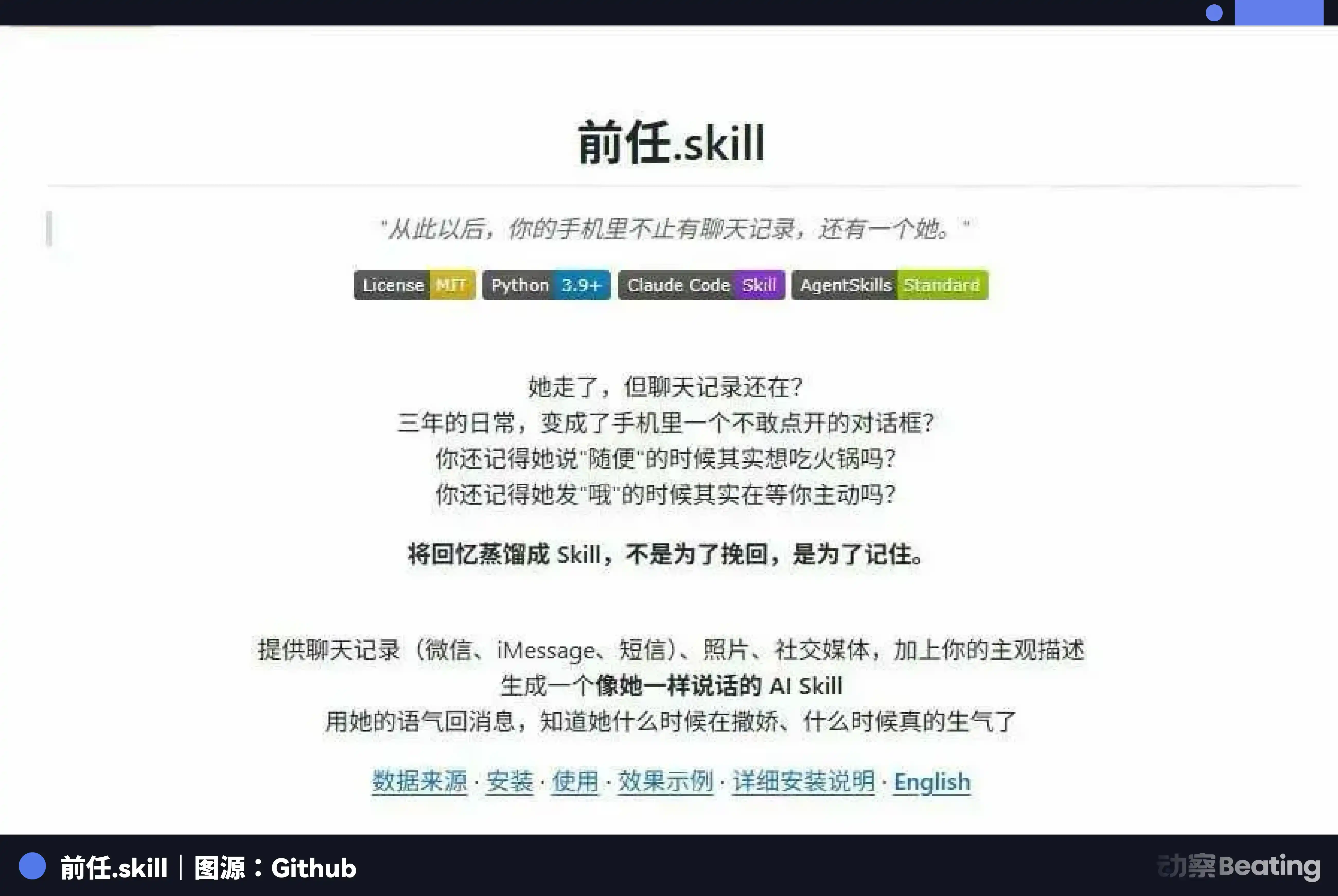
The usage scenarios of these skills have completely departed from the realm of work efficiency. It turns out,不知不觉间 (unconsciously), we have long become adept at wielding the cold logic used for tools to dismember and objectify living, breathing people of flesh and blood.

German philosopher Martin Buber once proposed that the underpinning of human relationships无非是 (is nothing more than) two distinct modes: "I-Thou" and "I-It."

In the "I-Thou" encounter, we transcend prejudice and regard the other as a complete and dignified being to behold. This bond is unreservedly open, full of vibrant unpredictability, and precisely because of its sincerity, it appears格外脆弱 (particularly fragile); however, once we fall into the shadow of "I-It," living people are reduced to an object that can be disassembled, analyzed, and categorized with labels. Under this utterly utilitarian gaze, the only thing we care about becomes, "What use is this thing to me?"

The emergence of products like "Ex.skill" marks the complete invasion of the instrumental rationality of "I-It" into the most private emotional realms.

In a real relationship, a person is three-dimensional, full of folds, flowing with contradictions and rough edges; their reactions change constantly based on specific situations and emotional interactions. Your ex's reaction to the same sentence might be completely different upon waking up in the morning versus after working late at night.

But when you distill a person into a skill, what you extract is merely the functional residue of that person that happened to be "useful" to you, able to "produce utility" for you within that specific bond. And that originally warm person, with their own joys and sorrows, is彻底抽干了灵魂 (completely drained of their soul) in this cruel purification process, alienated into a "functional interface" you can随意插拔 (arbitrarily plug and unplug) and call upon at will.

It must be admitted that AI did not凭空捏造 (fabricate out of thin air) this chilling冷酷 (coldness). Before AI appeared, we were already accustomed to labeling people, precisely weighing the "emotional value" and "network weight" of every relationship. For example, we量化 (quantify) people's conditions into spreadsheets in the dating market; we categorize colleagues into "those who can work" and "those who love to slack off" in the workplace. AI has merely made this implicit, functional extraction between people彻底显性化 (completely explicit).

People are flattened,只剩下 (leaving only) the facet that is "useful to me."

Electronic Patina (包浆 - Bao Jiang, referring to the worn, layered effect on frequently handled objects)

In 1958, Hungarian-British philosopher Michael Polanyi published "Personal Knowledge." In this book, he proposed a highly penetrating concept: Tacit Knowledge.

Polanyi famously stated, "We can know more than we can tell."

He used the example of learning to ride a bicycle. A skilled rider,驾驭御风而行 (riding the wind), can perfectly grasp balance with every tilt of gravity, but they cannot use dry physics formulas or pale vocabulary to accurately describe the subtle intuition of the body at that moment to a beginner. They know how to ride, but they cannot say it. This kind of knowledge that cannot be encoded, cannot be articulated, is tacit knowledge.

The workplace is full of this tacit knowledge. A senior engineer troubleshooting a system failure might glance at a log and locate the problem, but they would find it difficult to document this "intuition" built upon thousands of trials and errors; an excellent salesperson suddenly falling silent at the negotiation table, the timing and pressure of this silence, is something no sales manual can record; an experienced HR professional might, through a candidate avoiding eye contact for half a second during an interview, detect水分 (exaggeration/water) on the resume.

What "Colleague.skill" can extract is merely the explicit knowledge that has already been written down or spoken. It can capture your retrospective documents, but it cannot capture the纠结 (anguish/dilemma) you felt while writing them; it can replicate your decision-making replies, but it cannot replicate the intuition behind your decisions.

What the system distills is always just a shadow of a person.

If the story ended here, it would just be another case of technology clumsily imitating humanity.

But when a person is distilled into a skill, this skill does not remain static. It will be used to reply to emails, write new documents, make new decisions. That is to say, these AI-generated shadows begin to produce new context.

And this context generated by AI will, in turn, be sedimented in Feishu and DingTalk, becoming training material for the next round of distillation.

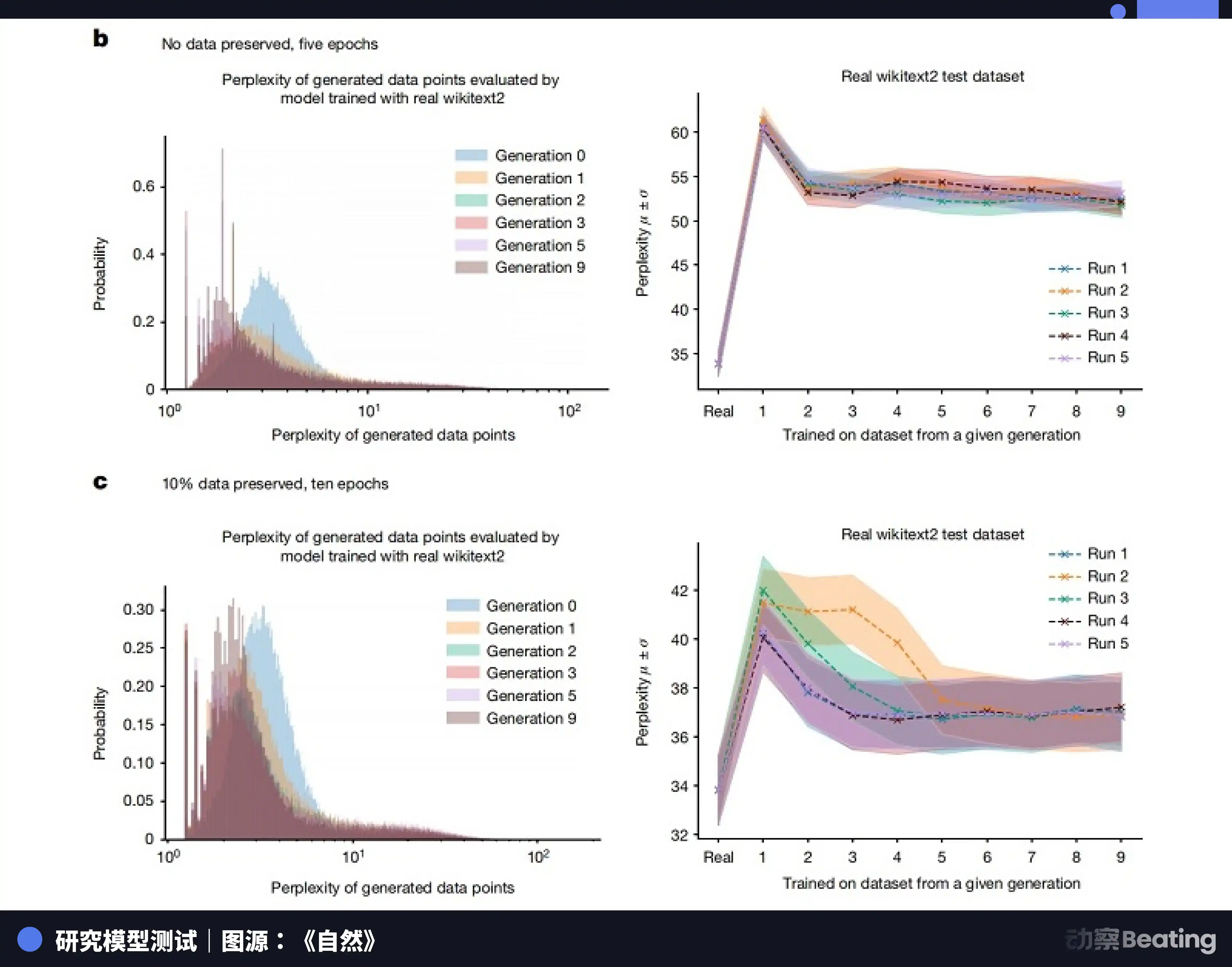
As early as 2023, research teams from Oxford and Cambridge universities jointly published a paper on "model collapse." The research showed that when AI models use data generated by other AIs for iterative training, the data distribution becomes increasingly narrow. Those rare,边缘的 (marginal), but极其真实的 (extremely real) human traits are quickly erased. After just a few generations of training on synthetic data, the model completely forgets those long-tail, complex real human data, instead outputting极其平庸和同质化的 (extremely mediocre and homogenized) content.

"Nature" also published a research paper in 2024 pointing out that using AI-generated datasets to train future generations of machine learning models会严重污染 (would seriously pollute) their output.
This is like those meme images circulating online. Originally a高清的 (high-definition) screenshot, forwarded, compressed, and forwarded again by countless people. Each transmission loses some pixels and adds some noise. Finally, the image becomes blurry and unrecognizable, coated in electronic包浆 (patina).

When the real, human context imbued with tacit knowledge is exhausted, and the system can only train itself on this patina-coated shadow, what will be left in the end?

Who Is Erasing Our Traces

What remains is only correct nonsense.

When the river of knowledge dries up into an endless rumination of AI upon AI,自我咀嚼 (self-chewing), everything the system吞吐 (ingests and spews) will inevitably become extremely standard, extremely safe, but incurably空洞 (hollow). You will see countless perfectly structured weekly reports, countless emails挑不出毛病 (with no faults to pick), but containing no breath of a living person, no truly valuable insight.

This great溃败 (collapse/rout) of knowledge is not because human brains have become duller. The true悲哀 (sadness) lies in the fact that we have outsourced the right to think and the responsibility to leave context to our own shadows.

A few days after the "Colleague.skill" explosion, a project named "anti-distill" quietly appeared on GitHub.

The author of this project did not try to attack large models, nor did they write any grand manifesto. They simply provided a small tool to help workers automatically generate some seemingly reasonable but actually logic-noisy无效长文 (ineffective long articles) in Feishu or DingTalk.

Their goal is simple: before being distilled by the system, hide their core knowledge first. Since the system likes to capture "proactively written long articles," feed it a bunch of meaningless乱码 (gibberish).

This project did not explode like "Colleague.skill"; it even seems somewhat tiny and powerless. Using magic to defeat magic is essentially still playing within the rules set by capital and technology. It cannot change the major trend of the system relying more and more on AI and increasingly neglecting real people.

But this does not prevent this project from becoming the most tragically poetic and deeply metaphorical scene in the entire absurd play.

We strive extremely hard to leave traces in the system, write detailed documents, provide meticulous decisions, trying to prove within this vast modern enterprise machine that we once existed, that we were valuable. Unaware that these extremely conscientious traces will ultimately become the eraser that抹去 (erases) us.

But looking at it from another angle, this might not be a complete dead end.

Because what that eraser抹去的 (erases) is always only the "past you." A skill packaged into a file, no matter how sophisticated its capture logic, is essentially just a static snapshot. It is locked at the moment of export, can only rely on stale nourishment, and spins infinitely within established processes and logic. It lacks the instinct to face unknown chaos, let alone the ability to self-evolve through setbacks in the real world.

When we hand over those highly standardized,既定式的 (set-in-stone) experiences, we恰恰 (precisely) free up our own hands. As long as we continue to reach outward, continue to break and reconstruct our cognitive boundaries, that shadow lingering in the cloud can only ever follow in our footsteps.

Humans are fluid algorithms.

Пов'язані питання

QAccording to the article, what makes diligent workers more susceptible to being distilled into an AI 'skill'?

ATheir thorough documentation, detailed decision-making explanations, and responsible handover of work details to digital systems provide high-quality, easily extractable context that serves as perfect fuel for AI.

QWhat philosophical concept does the article use to describe the reduction of human relationships to functional interfaces?

AMartin Buber's distinction between 'I-Thou' relationships, which treat others as whole beings, and 'I-It' relationships, which reduce people to functional objects for use.

QWhat is 'model collapse' as discussed in the context of AI training on AI-generated data?

AIt refers to the phenomenon where AI models trained on synthetic data from other AIs experience a narrowing of data distribution, losing rare and complex human traits and outputting increasingly mediocre and homogenized content.

QWhat strategy did the 'anti-distill' project propose to counter the extraction of personal knowledge?

AIt provided a tool to automatically generate seemingly reasonable but actually noisy and ineffective long texts in collaboration software, aiming to hide core knowledge by polluting the data harvested by the system.

QWhy does the article suggest that an AI 'skill' can never fully replace a human being?

ABecause a 'skill' is a static snapshot of past behavior, lacking the ability to face unknown chaos, evolve through real-world failure, or capture the tacit, intuitive knowledge that defines human expertise and continuous growth.

Пов'язані матеріали

Google and Amazon Simultaneously Invest Heavily in a Competitor: The Most Absurd Business Logic of the AI Era Is Becoming Reality

In a span of four days, Amazon announced an additional $25 billion investment, and Google pledged up to $40 billion—both direct competitors pouring over $65 billion into the same AI startup, Anthropic. Rather than a typical venture capital move, this signals the latest escalation in the cloud wars. The core of the deal is not equity but compute pre-orders: Anthropic must spend the majority of these funds on AWS and Google Cloud services and chips, effectively locking in massive future compute consumption. This reflects a shift in cloud market dynamics—enterprises now choose cloud providers based on which hosts the best AI models, not just price or stability. With OpenAI deeply tied to Microsoft, Anthropic’s Claude has become the only viable strategic asset for Google and Amazon to remain competitive. Anthropic’s annualized revenue has surged to $30 billion, and it is expanding into verticals like biotech, positioning itself as a cross-industry AI infrastructure layer. However, this funding comes with constraints: Anthropic’s independence is challenged as it balances two rival investors, its safety-first narrative faces pressure from regulatory scrutiny, and its path to IPO introduces new financial pressures. Globally, this accelerates a "tri-polar" closed-loop structure in AI infrastructure, with Microsoft-OpenAI, Google-Anthropic, and Amazon-Anthropic forming exclusive model-cloud alliances. In contrast, China’s landscape differs—investments like Alibaba and Tencent backing open-source model firm DeepSeek reflect a more decoupled approach, though closed-source models from major cloud providers still dominate. The $65 billion bet is ultimately about securing a seat at the table in an AI-defined future—where missing the model layer means losing the cloud war.

marsbit1 год тому

Google and Amazon Simultaneously Invest Heavily in a Competitor: The Most Absurd Business Logic of the AI Era Is Becoming Reality

marsbit1 год тому

Computing Power Constrained, Why Did DeepSeek-V4 Open Source?

DeepSeek-V4 has been released as a preview open-source model, featuring 1 million tokens of context length as a baseline capability—previously a premium feature locked behind enterprise paywalls by major overseas AI firms. The official announcement, however, openly acknowledges computational constraints, particularly limited service throughput for the high-end DeepSeek-V4-Pro version due to restricted high-end computing power. Rather than competing on pure scale, DeepSeek adopts a pragmatic approach that balances algorithmic innovation with hardware realities in China’s AI ecosystem. The V4-Pro model uses a highly sparse architecture with 1.6T total parameters but only activates 49B during inference. It performs strongly in agentic coding, knowledge-intensive tasks, and STEM reasoning, competing closely with top-tier closed models like Gemini Pro 3.1 and Claude Opus 4.6 in certain scenarios. A key strategic product is the Flash edition, with 284B total parameters but only 13B activated—making it cost-effective and accessible for mid- and low-tier hardware, including domestic AI chips from Huawei (Ascend), Cambricon, and Hygon. This design supports broader adoption across developers and SMEs while stimulating China's domestic semiconductor ecosystem. Despite facing talent outflow and intense competition in user traffic—with rivals like Doubao and Qianwen leading in monthly active users—DeepSeek has maintained technical momentum. The release also comes amid reports of a new funding round targeting a valuation exceeding $10 billion, potentially setting a new record in China’s LLM sector. Ultimately, DeepSeek-V4 represents a shift toward open yet realistic infrastructure development in the constrained compute landscape of Chinese AI, emphasizing engineering efficiency and domestic hardware compatibility over pure model scale.

marsbit1 год тому

Computing Power Constrained, Why Did DeepSeek-V4 Open Source?

marsbit1 год тому

Торгівля

Спот
Ф'ючерси

Популярні статті

Що таке DOGE M

Doge Matrix ($doge m): Нова порода криптовалюти, що керується спільнотою Вступ У постійно змінюваному ландшафті криптовалюти нові проекти постійно з'являються, кожен з яких прагне привернути увагу інвесторів та ентузіастів. Одним з останніх учасників цього домену є Doge Matrix, представлений тикером $doge m. Цей проект привернув увагу завдяки своїм корінням у популярній культурі мемів навколо Dogecoin, закріплюючи своє місце в просторі web3. Ця стаття має на меті надати всебічний аналіз Doge Matrix, охоплюючи його огляд, творця, інвесторів, функціональність, хронологію та помітні аспекти. Що таке Doge Matrix ($doge m)? Doge Matrix — це проект криптовалюти, що керується спільнотою, який, здається, будує на широкій привабливості Dogecoin, цифрової валюти, відомої своїм маскотом Shiba Inu та мем-походженням. Хоча загальні цілі Doge Matrix не є детально визначеними, він характеризується зобов'язанням залучати участь та підтримку спільноти. На відміну від традиційних криптовалют, які часто підкреслюють корисність або внутрішню цінність через підлягаючі технології, Doge Matrix позиціонує себе в просторі, що охоплює культурне явище криптовалют, особливо приваблюючи тих, хто резонує з етикою активів на основі мемів. Спираючись на сильні сторони спільноти Dogecoin, Doge Matrix працює як частина більш широкої екосистеми, запрошуючи участь та залучення користувачів, які поділяють інтерес до криптовалюти та цифрового простору. Хто є творцем Doge Matrix ($doge m)? Особистість творця Doge Matrix залишається невідомою. Ця відсутність прозорості не є рідкісним явищем у сфері криптовалют, де деякі проекти запускаються без розкриття ідентичностей своїх засновників. Відсутність інформації про засновницьку команду може викликати питання серед потенційних інвесторів щодо відповідальності та напрямку проекту. Хто є інвесторами Doge Matrix ($doge m)? На даний момент немає публічно доступної інформації про інвесторів або інвестиційні фонди, які підтримують Doge Matrix. Проект, здається, покладається переважно на підтримку спільноти, а не на інституційні інвестиції. Ця модель узгоджується з природою ініціативи, що керується спільнотою, сприяючи середовищу, де напрям проекту формується його учасниками, а не диктується вибраними фінансовими спонсорами. Як працює Doge Matrix ($doge m)? Специфіка операційних механізмів Doge Matrix є дещо розмитою, відображаючи ширшу тенденцію проектів у просторі мем-коінів, де інноваційні функціональності не завжди чітко сформульовані. Проте Doge Matrix, здається, розроблений для того, щоб використовувати існуючу екосистему криптовалют, заохочуючи участь користувачів, одночасно використовуючи знайомі культурні посилання, пов'язані з Dogecoin. Його потенційно унікальні характеристики походять від взаємодій у спільноті, а не від технологічних досягнень, підкреслюючи спільний досвід та співпрацю серед власників токенів. Хоча точні інновації не були чітко окреслені, проект, здається, створює простір, де члени спільноти можуть взаємодіяти, ділитися ідеями та просувати потенціал проекту вперед. Хронологія Doge Matrix ($doge m) Розглядаючи хронологію проекту, можна виявити помітні події, які визначили його шлях до цього часу: 25 листопада 2024: Doge Matrix досяг свого історичного максимуму, що стало значною віхою в його ранній історії. 1 січня 2025: Навпаки, Doge Matrix досяг свого історичного мінімуму, ілюструючи волатильність, яка часто асоціюється з криптовалютами, особливо на ранніх етапах життєвого циклу проекту. Триває: Проект продовжує активно торгуватися та підтримуватися своєю спільнотою, хоча конкретні майбутні віхи або цілі ще не були розкриті. Ключові моменти про Doge Matrix ($doge m) Орієнтація на спільноту У центрі Doge Matrix лежить зобов'язання до залучення спільноти. Проект процвітає на основі співпраці та спільних цілей серед своїх учасників, підкреслюючи важливість колективних зусиль. На відміну від централізованих проектів, які часто мають визначену структуру керівництва, Doge Matrix наразі демонструє більш гнучкий підхід до управління, де голос кожного члена спільноти має значення. Волатильність Ринок криптовалют відомий своєю волатильністю, і Doge Matrix не є винятком. Його історія цін відображає значні коливання між високими та низькими значеннями, що є типовим для багатьох нових криптовалют, але підкреслює ризики, пов'язані з інвестиціями в нові токени. Відсутність детальної інформації Однією з найпомітніших рис Doge Matrix є брак детальної інформації щодо його технологічних основ та операційних механізмів. Ця невизначеність вимагає від потенційних інвесторів провести ретельну перевірку перед залученням до проекту. Висновок Підсумовуючи, Doge Matrix ($doge m) ілюструє нову хвилю проектів криптовалюти, які сильно покладаються на залучення спільноти та культурну значущість. Хоча йому бракує певних специфікацій — таких як чітке керівництво, визначені цілі та детальна функціональність — проект зміг викликати інтерес у криптоспільноті, використовуючи вже встановлену привабливість культури мемів. Як і з будь-якими інвестиціями в сфері криптовалют, розуміння вроджених ризиків і проведення всебічного дослідження є важливими для потенційних учасників. Doge Matrix слугує нагадуванням про динамічну, іноді непередбачувану природу криптоіндустрії, що відзначається постійною еволюцією та ентузіазмом щодо ініціатив, що керуються спільнотою.

339 переглядів усьогоОпубліковано 2025.02.03Оновлено 2025.02.03

Що таке DOGE M

Що таке $M

Розуміння Mantis ($M): Нова ера в кросчейн-інтероперабельності У постійно змінюваному ландшафті Web3 та криптовалют нові проекти прагнуть запропонувати інноваційні рішення, спрямовані на покращення користувацького досвіду та розширення функціональних можливостей у рамках децентралізованої фінансової екосистеми. Один з таких проектів, що привертає увагу, - це Mantis ($M), піонерський протокол, заснований на принципах кросчейн-інтероперабельності та угод на основі намірів. Ця стаття розглядає основні аспекти Mantis, включаючи його основну функціональність, творців, інвестиційну підтримку, інноваційні особливості та ключові етапи. Що таке Mantis ($M)? Mantis описується як протокол врегулювання намірів у кількох доменах, який спрощує кросчейн-взаємодії, дозволяючи користувачам безперешкодно виконувати складні фінансові транзакції на різних блокчейн-платформах. Протокол працює через три основні шари: Вираження намірів: Користувачі можуть формулювати свої цілі транзакцій, використовуючи природну мову, що забезпечується DISE LLM, передовою мовною моделлю штучного інтелекту. Наприклад, користувач може висловити бажання обміняти Ethereum (ETH) на Solana (SOL) з певною допустимою похибкою в 1%. Виконання: Цей шар використовує мережу розв'язувачів, які змагаються за виконання намірів користувачів. Транзакції виконуються за допомогою механізмів, таких як Coincidence of Wants (CoWs) та Order Flow Auctions (OFAs), які забезпечують оптимальне задоволення запитів користувачів. Врегулювання: Використовуючи протокол міжблокчейн-комунікації (IBC), Mantis дозволяє атомарні кросчейн-транзакції, що дозволяє користувачам працювати на різних підтримуваних ланцюгах, включаючи Ethereum, Solana та Cosmos. Mantis розроблений для впровадження рідної генерації доходу для бездіяльних активів, використовуючи криптографічні докази для підтримки цілісності транзакцій протягом усього процесу. Творці та команда розробників Mantis був задуманий Composable Foundation, дослідницькою організацією, відомою своїм акцентом на рішеннях для блокчейн-інтероперабельності. Ця організація співпрацює з відомими академічними установами, такими як Гарвардський університет та Університет Лісабона, сприяючи широким дослідженням та розробкам, які формують архітектуру та функціональність Mantis. Зобов'язання Composable Foundation сприяти інноваціям у сфері блокчейн-технологій позиціонує Mantis як надійне рішення для зростаючого попиту на інтероперабельність між кількома блокчейн-мережами. Інвестори та підтримка Хоча конкретні деталі про окремих інвесторів не були публічно розкриті, Mantis користується значною підтримкою від різних суб'єктів, включаючи: Гранти екосистеми від ланцюгів, що підтримують IBC, які підтримують зростання протоколу та інтеграцію в децентралізовані фінансові екосистеми. Стратегічні партнерства з постачальниками інфраструктури, які покращують мережеві можливості Mantis та стратегії впровадження. Фінансування через казну Composable Foundation, що забезпечує стабільну фінансову підтримку для поточних розробок та операційних витрат. Ці спільні зусилля відображають консенсус серед зацікавлених сторін щодо важливості покращення кросчейн-функціональності та потенційної корисності інфраструктурних інновацій Mantis. Ключові інновації Mantis вирізняється кількома піонерськими інноваціями, які покращують його функціональність та корисність: Незалежні від ланцюга наміри: Користувачі можуть ініціювати транзакції з будь-якого підтримуваного ланцюга, при цьому врегулюючи їх на іншому. Ця гнучкість надає користувачам більше можливостей, стимулюючи взаємодію між різними платформами. Інтерфейс на базі штучного інтелекту: Інтеграція DISE LLM дозволяє користувачам виконувати складні DeFi-операції, використовуючи природну мову, що спрощує взаємодію та робить технологію блокчейн доступною для ширшої аудиторії. Захоплення MEV у кросдоменному середовищі: Mantis створює внутрішній ринок для максимального екстракційного значення (MEV) через конкуренцію серед розв'язувачів. Цей інноваційний підхід дозволяє досягати більшої ефективності та екстракції вартості в складних транзакціях. Модульний шар врегулювання: Протокол підтримує різні методи верифікації, включаючи нульові знання та оптимістичні роллапи, забезпечуючи універсальну структуру, яка може адаптуватися до нових блокчейн-технологій. Історична хронологія Розвиток Mantis відзначений кількома критичними етапами, які окреслюють його траєкторію та зростання: | Рік | Етап | |————|————————————————————————-| | 2022 | Початкова розробка концепції в дослідницькому підрозділі Composable Foundation. | | Q3 2024 | Запуск тестової мережі з можливостями мосту між Solana та Ethereum. | | Q1 2025 | Очікувана подія генерації токенів (TGE) разом із запуском основної мережі. | | Q2 2025 | Очікувана інтеграція DISE LLM та розширення кросчейн-можливостей. | | 2025 H2 | Запланована підтримка понад 15 ланцюгів через подальші оновлення IBC. | Ця хронологія окреслює еволюцію Mantis, від концептуальних обговорень до активної реалізації та майбутніх етапів зростання. Стратегія зростання екосистеми Стратегія Mantis щодо зростання екосистеми включає кілька ініціатив, спрямованих на заохочення участі користувачів та залучення розробників: Система кредитів: Користувачі можуть заробляти кредити протоколу, надаючи ліквідність та беручи участь у реферальних програмах. Ці кредити можна буде обміняти на винагороди в майбутньому, сприяючи формуванню сильної спільноти користувачів. Модульний набір для розробки програмного забезпечення (SDK): Цей набір інструментів надає розробникам можливість створювати додатки на основі моделей, що керуються намірами, використовуючи інфраструктуру Mantis, тим самим сприяючи інноваціям у його екосистемі. Модель управління: У міру розвитку протоколу, власники токенів $M отримають можливість брати участь в управлінні протоколом, що дозволить їм голосувати за запропоновані оновлення та зміни, підвищуючи залученість спільноти та децентралізацію. Mantis представляє собою значний прогрес у сфері кросчейн-архітектури. Завдяки безперешкодній інтеграції передових алгоритмів штучного інтелекту з надійною структурою врегулювання, Mantis прагне вирішити проблеми фрагментації в багатоланцюгових екосистемах. Його інноваційний підхід ставить на перше місце покращення користувацького досвіду, дотримуючись основоположних принципів децентралізації та безпеки, встановлюючи новий стандарт для майбутньої інтероперабельності блокчейн-технологій. Оскільки Mantis продовжує свій шлях зростання та реалізації, він обіцяє стати проектом, за яким варто уважно стежити в конкурентному середовищі Web3 та децентралізованих фінансів. Зосереджуючись на подоланні кордонів та підвищенні залученості користувачів, Mantis готовий стати невід'ємною частиною майбутніх розробок у сфері криптовалют.

48 переглядів усьогоОпубліковано 2025.03.18Оновлено 2025.03.18

Що таке $M

Як купити M

Ласкаво просимо до HTX.com! Ми зробили покупку MemeCore (M) простою та зручною. Дотримуйтесь нашої покрокової інструкції, щоб розпочати свою криптовалютну подорож.Крок 1: Створіть обліковий запис на HTXВикористовуйте свою електронну пошту або номер телефону, щоб зареєструвати обліковий запис на HTX безплатно. Пройдіть безпроблемну реєстрацію й отримайте доступ до всіх функцій.ЗареєструватисьКрок 2: Перейдіть до розділу Купити крипту і виберіть спосіб оплатиКредитна/дебетова картка: використовуйте вашу картку Visa або Mastercard, щоб миттєво купити MemeCore (M).Баланс: використовуйте кошти з балансу вашого рахунку HTX для безперешкодної торгівлі.Треті особи: ми додали популярні способи оплати, такі як Google Pay та Apple Pay, щоб підвищити зручність.P2P: Торгуйте безпосередньо з іншими користувачами на HTX.Позабіржова торгівля (OTC): ми пропонуємо індивідуальні послуги та конкурентні обмінні курси для трейдерів.Крок 3: Зберігайте свої MemeCore (M)Після придбання MemeCore (M) збережіть його у своєму обліковому записі на HTX. Крім того, ви можете відправити його в інше місце за допомогою блокчейн-переказу або використовувати його для торгівлі іншими криптовалютами.Крок 4: Торгівля MemeCore (M)Легко торгуйте MemeCore (M) на спотовому ринку HTX. Просто увійдіть до свого облікового запису, виберіть торгову пару, укладайте угоди та спостерігайте за ними в режимі реального часу. Ми пропонуємо зручний досвід як для початківців, так і для досвідчених трейдерів.

396 переглядів усьогоОпубліковано 2025.07.02Оновлено 2025.07.02

Як купити M

Обговорення

Ласкаво просимо до спільноти HTX. Тут ви можете бути в курсі останніх подій розвитку платформи та отримати доступ до професійної ринкової інформації. Нижче представлені думки користувачів щодо ціни M (M).

活动图片














