White House Ignites, BSC Spreads Like Wildfire: A Meme Carnival Bidding Farewell to the 'Imperial Decree Model'

marsbitОпубліковано о 2026-01-21Востаннє оновлено о 2026-01-21

Анотація

A meme coin frenzy erupted on January 21 after the White House posted on X mentioning "victory, eviction, and memes." Within minutes, meme tokens named "memes" were launched on both Solana and BSC chains. Contrary to expectations, the Solana version—typically favored due to its active ecosystem and "first is first" advantage—was outperformed by the BSC version. At its peak, the BSC meme reached a market cap of $28 million with 7,300 holders, while Solana’s version peaked at $3.6 million with 3,900 holders. Real-time user engagement also favored BSC, with nearly 3,000 simultaneous online participants compared to Solana’s sub-1,000. This outcome challenges the long-standing perception that BSC meme coins rely heavily on endorsements from Binance founders CZ and He Yi—a model often mockingly referred to as "Shandong style." Both CZ and He Yi have recently publicly discouraged the practice of creating meme coins based on parsing words from their social posts. CZ explicitly warned followers against buying tokens inspired by his tweets, while He Yi criticized “word-parsing” and “bootlicking” behaviors, urging the community to focus on real project development instead. The surprising success of the BSC memes token—launched 20 minutes after Solana’s version—suggests a possible shift in BSC’s meme culture, moving away from top-down influence toward more organic, community-driven momentum. Whether this marks a lasting change in BSC’s meme ecosystem remains an open question.

Author|Golem(@web 3_golem)
The Meme market today witnessed another legendary "golden dog" story.

On January 21st at 11:10, the official White House account posted on X platform mentioning "victory, eviction operations, and memes". One minute later, a Meme token of the same name, $memes, quickly appeared on the Solana chain; 20 minutes later, a version on the BSC chain was also born. An official Meme race between the two chains began.

From an empirical perspective, the Solana version should have the advantage—not only is the ecosystem active, but it also aligns with the "First is first" consensus. However, the result was surprising: the BSC chain version of $memes surpassed it in market capitalization. According to GMGN data, the BSC version's market cap reached a high of $28 million, with 7,300 holding addresses; while the Solana version's peak was only $3.6 million, with 3,900 holding addresses.

The focus of player attention can also be seen through GMGN's new feature: 3 hours after the token's birth, the number of simultaneous online users for the Solana version remained below 1,000, while the BSC version once approached 3,000.

Although some questioned whether the BSC version's market cap was due to "pump and dump schemes by big players aiming to harvest," the genuine market attention doesn't lie—this time, BSC truly won.

The community often joked that BSC's Meme model was like "Shandong Studies in the crypto circle," where only projects related to CZ and He Yi could succeed, raising concerns about the ecosystem's sustainability. However, BSC's victory in this Meme sprint not only sparked a wave of regret from those who missed out (FOMO), but also prompted the community to reconsider the evolution of its Meme model. As GMGN founder Haze stated: "The BSC 3.0 era has arrived." (Odaily Note: Haze holds 1.93% of BSC chain $memes, ranking second on the holdings list.)

CZ and He Yi Publicly State They Do Not Support "Word-Picking Memes"

I previously shared my thoughts on the BSC Meme model during an Odaily editorial meeting, suggesting that CZ and He Yi were essentially "held hostage" by the community. The current BSC model, which relies on "imperial decrees" for cold starts, feigns continuous interaction, lists on Binance Alpha, and finally gets "poured out" (a likely reference to a meme or specific outcome), is actually a consensus within the BSC community. Although this model started with CZ's unintentional actions in early 2025, they don't actually like it. However,发展到目前这个地步 (developed to this point), CZ and He Yi are powerless to change the situation.

When I published this view, it was merely a conjecture. Recent public statements from CZ and He Yi have proven it to be true. On January 13th, CZ posted saying that while he likes Meme coins, if players blindly follow the trend and buy Meme coins "picked" from his tweets, they are almost certain to lose money.

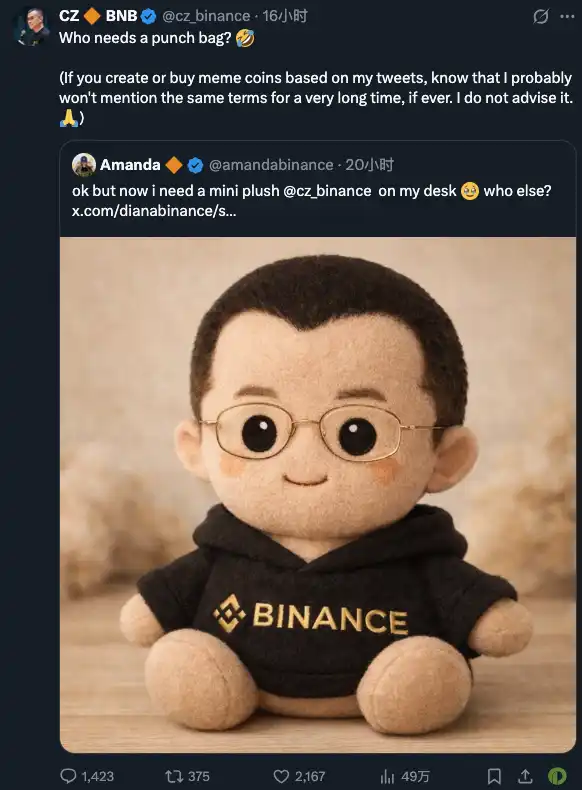
To prevent everyone from blindly chasing these "word-picking Memes," CZ's tweets have become more cautious. Yesterday, CZ reposted a plush toy created by a user based on his image, which was an ordinary thing, but CZ still specifically noted: If you create or buy Meme coins based on my tweets, please note that I may not mention the same words again for a long time, maybe never. I do not recommend you do this. He even added a 🙏 icon at the end, showing CZ's concern for the community.
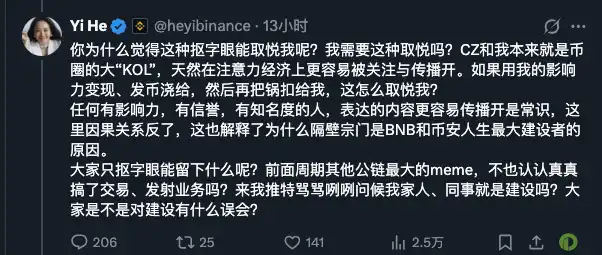
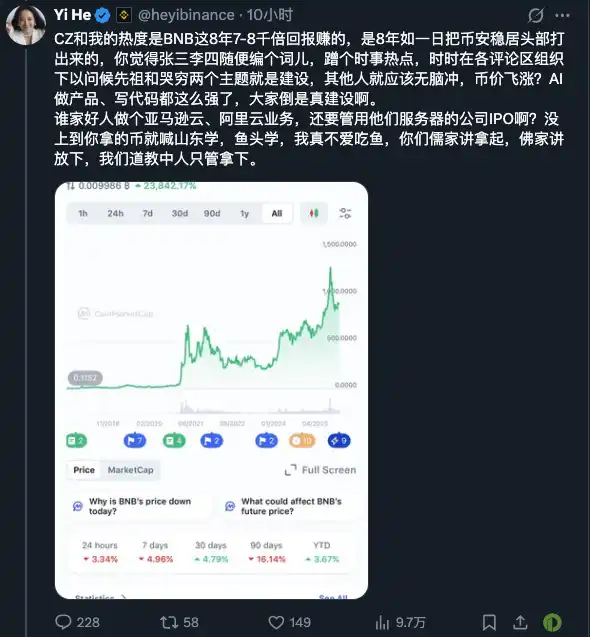
Compared to CZ's tactfulness, He Yi's attitude towards the community's "word-picking Memes" was more blunt. In the early hours of January 21st, under a user's post, He Yi not only stated that Binance would severely punish all internal insider trading and bribery, but also "assertively" said that she does not need to rely on Binance Alpha listing Memes that pick words from her tweets for pleasure, and also advised the community to focus on real development, not to mistake "word-picking and flattery" as genuine constructive effort and be self-satisfied. He Yi also mentioned that she doesn't like eating fish (a likely reference to a specific meme or context, perhaps '山东学 Shandong Studies'), and told players not to cry "Shandong Studies" just because Binance Alpha didn't list the tokens she supported.
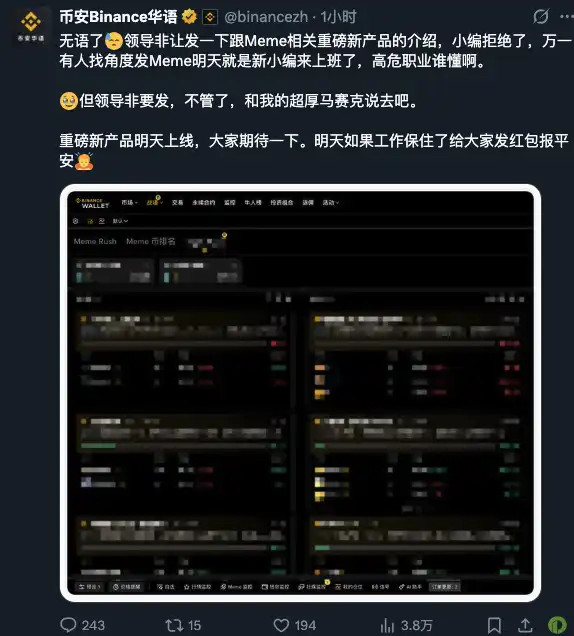
Under the influence of CZ and He Yi's public statements against "word-picking Memes," Binance's official announcements about Memes have also become cautious. On January 21st, Binance's Chinese-language account posted about launching a new Meme product feature, but to prevent the community from finding angles to launch Meme coins, the editor specifically added a very thick mosaic. Although somewhat戏谑 (playful/mocking), it sufficiently shows the cautious attitude of the entire Binance team, both towards Meme coins picking words from CZ and He Yi's tweets, and those picking words from Binance's official announcements.
Is BSC Meme Finally Going to Be Different?

Laymen watch the热闹 (excitement), experts watch the门道 ( intricacies). He Yi's remarks not only felt very "human" (活人感), but seasoned Meme players realized that the previous BSC Meme model is collapsing from the top down. The successful BSC chain $memes that outperformed on the morning of January 21st might be just an appetizer. Ironically, $memes was also born from the art of "word-picking," only this time it was the White House.

Additionally, after the White House posted the tweet, He Yi reposted it (now deleted). This repost, unrelated to Binance and He Yi herself, seemed slightly突兀 (abrupt/out of place) on her homepage timeline, and the community was confused about the reason for the repost. How much credit He Yi's repost deserves for the BSC version of $memes, launched 20 minutes later, outperforming Solana's $memes is also questionable.

Finally, we might still have to ask that unchanging question: Will BSC really be different this time?


Трендові криптовалюти

Пов'язані питання

QWhat was the unexpected outcome in the meme coin race between Solana and BSC following the White House's post?

AContrary to expectations, the Solana version of the 'memes' coin did not dominate. The BSC version achieved a higher market cap, reaching a peak of $28 million with 7,300 holder addresses, compared to Solana's $3.6 million with 3,900 holders.

QWhat is the 'Saint Edict Mode' or 'Shandong Mode' that the community often associated with BSC meme coins?

AIt refers to a meme coin model on BSC where projects were believed to only find success if they were related to or endorsed by Binance executives like CZ and He Yi, often by 'extracting keywords' from their social media posts.

QHow did CZ and He Yi publicly express their stance on 'keyword extraction meme' coins?

ACZ stated that while he likes meme coins, buying ones created by extracting keywords from his tweets will almost certainly lead to losses and he does not recommend it. He Yi was more direct, stating she does not need meme coins based on her posts for pleasure and advised the community to focus on real development.

QWhat evidence suggests that Binance is being cautious to avoid sparking new 'keyword extraction' meme coins?

AThe official Binance Chinese account posted an announcement about a new meme product feature but heavily pixelated the text to prevent the community from finding angles to create new meme coins based on the post.

QWhat does the success of the BSC 'memes' coin in this event potentially signal for the future of BSC meme coins?

AThe event, coupled with the executives' statements, suggests a potential shift away from the old 'Saint Edict Mode.' The success of a meme coin not directly tied to Binance executives might indicate the arrival of a new, more community-driven 'BSC 3.0' era for memes.

Пов'язані матеріали

After Three Consecutive Quarters of Decline, Can the Crypto Market Find a Window for Stabilization in Q3?

The cryptocurrency market has just concluded its worst-performing quarter since 2022, with total capitalization dropping 12.6% to $2.1 trillion. All core metrics indicate capital is leaving the sector, not just rotating within it. Bitcoin fell 14.2% and Ethereum dropped 25.4% in Q2, breaking their previous correlation with US tech stocks. A key driver is the reversal in US spot Bitcoin ETF flows, which saw a net outflow of approximately $4.67 billion in Q2, including a record monthly outflow near $4.5 billion in June. While recent data suggests long-term holders are accumulating again, sustained ETF outflows mean continued selling pressure. Market focus is now singularly on the Federal Reserve. The upcoming July FOMC meeting is seen as the most critical event for Q3. A dovish signal could support Bitcoin reclaiming a $68,000-$84,000 range, while a hawkish stance might establish a new trading band around $50,000-$56,000. Additionally, regulatory uncertainty persists, with the progress of the crucial *CLARITY Act* stalling in the Senate, reducing its perceived 2026 passage probability to 40-45%. Despite the broad downturn, a few sectors showed growth. Prediction markets saw nominal volume surge 48.7% year-over-year to $113.8 billion, and tokenized collectibles transaction volume rose 143% quarterly to $1.4 billion. The Real-World Asset (RWA) tokenization sector also continued steady growth, now representing ~$28.1 billion in on-chain value. The market's foundation for an extreme crash appears limited, with Bitcoin price hovering near its 200-week moving average. However, the trading paradigm has shifted from narrative-driven speculation to decisions based on price action, policy developments, and interest rate expectations, making a broad sentiment-driven rally unlikely in the near term.

marsbit1 год тому

After Three Consecutive Quarters of Decline, Can the Crypto Market Find a Window for Stabilization in Q3?

marsbit1 год тому

BIT Trading Moment: BTC Still Suppressed by Weekly 200 EMA, Rejection May Restart Decline; Storage and Semiconductors that Surged Last Night Begin Falling in Evening Trading

**Crypto & Stock Market Wrap: Bitcoin Tests Resistance, Stocks Retreat After AI Surge** Bitcoin consolidates around $66,000, facing key resistance near $68,000—an area seen as a major psychological and technical hurdle where previous rallies have failed. Analysts note the cryptocurrency is caught between its 200-week moving average (~$63,333) and 200-week EMA (~$68,328). A clear break above $68k is needed to signal a stronger bullish trend, while a rejection could lead to a retest of $63k support. Market sentiment remains cautious, with low futures open interest pointing to a low-liquidity rebound rather than a full bull market. Bitcoin spot ETFs saw another $203 million inflow. US stock futures pointed lower after a strong Tuesday session led by a massive rebound in semiconductors and memory stocks. The rally was fueled by renewed optimism about AI-driven hardware demand, with Micron, SanDisk, and SK Hynix surging. However, those gains reversed in pre-market trading. Super Micro Computer (SMCI) soared over 20% after hours on strong guidance and a record backlog. Other standouts included Rocket Lab and nuclear energy plays Oklo and X-Energy. Rising oil prices (Brent above $91) and climbing Treasury yields (10-year near 4.64%), however, are reigniting inflation concerns and acting as a headwind for equities. In Asia, markets were mixed. South Korea's KOSPI pared early gains to close slightly higher as semiconductor stocks like SK Hynix gave back initial surges. Japan's Nikkei edged lower as the yen hit a fresh 38-year low against the dollar, raising fears of potential market intervention. Key events to watch include the Samsung Galaxy launch, AMD's AI event, and a slew of major tech earnings from Alphabet, Tesla, and IBM after the close on Wednesday, followed by the ECB meeting and Intel's earnings on Thursday.

marsbit1 год тому

BIT Trading Moment: BTC Still Suppressed by Weekly 200 EMA, Rejection May Restart Decline; Storage and Semiconductors that Surged Last Night Begin Falling in Evening Trading

marsbit1 год тому

Former CFTC Chairman, Circle President Tarbert: Preaching Long-Termism While Cashing Out $30 Million Himself

Former CFTC Chairman and Circle President Heath Tarbert has consistently advocated for a long-term vision in public, urging patience from investors as Circle’s stock price has fallen significantly from its peak. However, it has been revealed that since Circle’s IPO, Tarbert has continuously sold his CRCL shares through pre-arranged trading plans, cashing out approximately $30 million, without making any public market purchases. This contrast between his public messaging and personal actions has drawn criticism. Tarbert joined Circle in July 2023 as Chief Legal Officer, leveraging his regulatory experience to help guide the company through its IPO and expansion. Despite promoting stablecoins as long-term infrastructure, he established a 10b5-1 trading plan just before Circle went public, leading to substantial stock sales over the following year. In March 2026, he initiated another plan to sell more shares. His career trajectory highlights a pattern of moving between high-level regulatory roles and influential positions in the financial sector. After resigning as CFTC Chairman in early 2021, he joined Citadel Securities as Chief Legal Officer just 27 days later, during a period of intense regulatory scrutiny for the firm. He later joined Circle, aiding its efforts to navigate regulatory challenges for its public listing. While Tarbert's expertise in policy and compliance is valuable to companies like Circle, his actions—advocating long-term confidence while personally divesting—raise questions about the alignment between his public statements and his private financial decisions, leaving investors who followed his advice to bear the market risks.

marsbit2 год тому

Former CFTC Chairman, Circle President Tarbert: Preaching Long-Termism While Cashing Out $30 Million Himself

marsbit2 год тому

Gate Research Institute: The 'Wall Street-ization' Wave of Crypto Financial Products – Competition or Integration?

The article titled "Gate Research Institute: Are Crypto Financial Products Sparking a 'Wall Street' Wave—Competition or Convergence?" explores the evolving relationship between the crypto ecosystem and traditional finance (TradFi). The piece begins by reflecting on Bitcoin's original 2009 vision of decentralization, disintermediation, and moving away from banks. It then contrasts this with the 2024 landscape, where key crypto assets like Bitcoin are increasingly held through Wall Street products like ETFs issued by giants like BlackRock. The article questions whether this signifies that TradFi is systematically taking over the rights to issue, price, custody, and distribute crypto financial assets. The core argument is that this is not a zero-sum takeover but rather a bidirectional convergence where each side addresses the other's weaknesses. Crypto offers 24/7 global markets, programmable settlement, and open access but lacks compliant channels, institutional-grade custody, deep fiat liquidity, and mainstream distribution. TradFi possesses these but is constrained by legacy systems, limited operating hours, and slow settlement. Two primary convergence paths are highlighted: * **Path A (CEX to TradFi):** Exemplified by Gate, which has progressed from offering tokenized stocks and CFDs to providing direct, real stock trading (US, Hong Kong, South Korea) within its platform, using USDT. * **Path B (TradFi to Crypto):** Exemplified by Robinhood, which has integrated crypto trading, acquired exchanges like Bitstamp, and is moving traditional assets like stocks onto the blockchain via tokenization and its own Layer 2. Both paths are ultimately competing to become the next-generation, unified financial account—a "super account" where users can seamlessly trade cryptocurrencies, stocks, ETFs, RWA (Real World Assets), and tokenized treasury products in one interface. The growth of RWA and tokenized treasuries (e.g., BlackRock's BUIDL) is presented as the asset-layer fusion, providing stable, yield-bearing assets on-chain and acting as a bridge between the two worlds. In conclusion, the "Wall Street-ization" of crypto is framed as a mutual transformation. Decentralized ideals persist in the protocol layer, while at the application layer, a more efficient, global, and accessible unified capital market is emerging from this convergence. The future competition lies not between crypto exchanges and stockbrokers, but between platforms vying to offer the most comprehensive asset coverage, liquidity, and user experience within a single account.

marsbit2 год тому

Gate Research Institute: The 'Wall Street-ization' Wave of Crypto Financial Products – Competition or Integration?

marsbit2 год тому

Торгівля

Спот

Популярні статті

Що таке MEME 2.0

Memecoin 2.0: Поява $MEME 2.0 у світі криптовалюти Вступ У постійно змінному ландшафті криптовалюти з'явився новий претендент. Memecoin 2.0, що символізується як $MEME 2.0, підносить концепцію мем-криптовалют на захоплюючий новий рівень. Як побічний продукт оригінального Memecoin, цей проєкт привернув увагу крипто-спільноти, змістивши акцент з типової фінансової вигоди на захоплюючий і розважальний досвід. Працюючи на блокчейні Ethereum, Memecoin 2.0 сміливо переосмислює залучення спільноти у криптосфері. Що таке Memecoin 2.0, $MEME 2.0? У своїй основі, Memecoin 2.0 є криптовалютним проєктом, який надає пріоритет спільнотному духу і розвагам, пов'язаним з мем-культурою. На відміну від звичайних криптовалют, які зосереджені на практичних випадках використання та матеріальних вигодах, Memecoin 2.0 вирізняється тим, що обіймає легшу сторону цифрової валюти. Цей проєкт існує без обіцянок утиліти, структурованої дорожньої карти чи фінансових повернень, зосереджуючи увагу на створенні яскравої спільноти навколо мемів та спільних розваг. Зробивши це, він використовує зростаючу тенденцію мем-культури у онлайн-пробі, що робить його унікальним гравцем у світі цифрових активів. Творець Memecoin 2.0, $MEME 2.0 Не зважаючи на численні дослідження витоків Memecoin 2.0, чітка особистість його творця залишається невідомою. Ця анонімність не є рідкістю у крипто-спільноті, де багато проєктів очолюються особами або групами, які надають перевагу залишатися за лаштунками. Відсутність публічно доступної інформації про творця може розглядатися як стратегічний крок, що ставить в центр уваги залучення спільноти, а не індивідуальної популярності у цій сфері. Інвестори Memecoin 2.0, $MEME 2.0 Інформації щодо інвесторів або фінансової підтримки Memecoin 2.0 замало. Відсутність деталей може свідчити про те, що проєкт є самофінансованим або що його увага до спільноти, а не традиційних інвестиційних структур, привабила інший тип підтримки. Оскільки світ мем-криптовалют зазвичай передбачає більше участі низового рівня, а не інституційних інвестицій, цей підхід узгоджується з етосом проєктів, що управляються спільнотою. Як працює Memecoin 2.0, $MEME 2.0? Memecoin 2.0 повністю працює на блокчейні Ethereum, використовуючи його потужні функції безпеки та масштабованості. Використовуючи сильні сторони Ethereum, Memecoin 2.0 може запропонувати безпечне середовище для взаємодії користувачів, забезпечуючи при цьому, що транзакції є ефективними та економічними. Одна з унікальних характеристик Memecoin 2.0 полягає в його структурі, що керується спільнотою. Цінність та популярність токена $MEME 2.0 походять з активної участі його користувачів, а не з вродженої утиліти. Ця концепція підкреслює акцент проєкту на розважальному аспекті криптовалюти, натякаючи на те, що сміх та залучення спільноти є справжніми валютами, що ведуть до його успіху. Крім того, проєкт вписується в ширшу екосистему мем-криптовалют, де цінність кожної мем-криптовалюти коливається залежно від культури, тенденцій і участі спільноти, а не традиційних економічних принципів. Хронологія Memecoin 2.0, $MEME 2.0 Щоб краще зрозуміти еволюцію та віхи Memecoin 2.0, ось хронологія, що підкреслює значні події в його історії: 2024: Зародження Memecoin 2.0 вважається відгалуженням оригінального Memecoin, яке встановлює себе в процвітаючому контексті мем-криптовалют, працюючи на блокчейні Ethereum. 13 липня 2024: Memecoin 2.0 офіційно позиціонує себе як мем-криптовалюта, орієнтована на спільноту, в мережі Ethereum, підкреслюючи свій підхід, зосереджений на розвагах, який запрошує користувачів брати участь у його розвитку. Ключові моменти про Memecoin 2.0, $MEME 2.0 Кілька критичних характеристик визначають Memecoin 2.0: Спільнотно-центричний підхід: Основною метою Memecoin 2.0 є створення веселого, захоплюючого досвіду для спільноти, використовуючи колективне задоволення, що випливає з меметичної культури. Побудовано на Ethereum: Робота на блокчейні Ethereum надає проєкту важливу інфраструктуру, що забезпечує безпеку та масштабованість. Відсутність утиліти або дорожньої карти: У вражаючому відході від традиційних криптовалют, Memecoin 2.0 не обіцяє жодних утилітарних функцій або фінансових повернень, підтверджуючи свою прихильність до участі спільноти та соціального залучення. Акцент на меметичній культурі: Обіймаючи гумористичні та культурні аспекти мем-періоду, Memecoin 2.0 надає платформу для користувачів для залучення до крипти офлайн та онлайн. Додатковий контекст: Значення мем-криптовалют Мем-криптовалюти з'явилися як окрема класифікація криптовалюти, часто керуючись гумором та легким підходом до торгівлі. Ці валюти, як правило, не мають значної утиліти або розробницьких дорожніх карт, залучаючи користувачів обіцянкою розваг, взаємодії в спільноті та культурної значущості. В рамках ширшої екосистеми криптовалют, мем-криптовалюти відновлюють важливість залучення спільноти, протистоячи лише прибутковим підходам. Проєкти, такі як Memecoin 2.0, відкривають еру, в якій розваги можуть гармонізувати з фінансовими прагненнями, перетворюючи блокчейн на ігровий майданчик для творчості та соціальної взаємодії. Висновок Memecoin 2.0, або $MEME 2.0, втілює нову хвилю криптовалюти, яка надає пріоритет залученню спільноти над жорсткими фінансовими структурами. Зосереджуючись на гуморі та соціальній взаємодії, він використовує захоплення навколо мем-культури. Працюючи на блокчейні Ethereum, Memecoin 2.0 використовує можливості технології, залишаючись непохитним у своїй прихильності до розважальної цінності цифрової валюти. Коли простір навколо криптовалют продовжує еволюціонувати, Memecoin 2.0 служить доказом того, що майбутнє цифрових активів може значною мірою залежати від спільних досвідів, сміху та надійних зв'язків у спільноті. У непередбачуваному світі крипто, можливо, радість може бути такою ж цінною, як і традиційний фінансовий прибуток.

151 переглядів усьогоОпубліковано 2024.04.04Оновлено 2024.12.03

Що таке MEME 2.0

Як купити MEME

Ласкаво просимо до HTX.com! Ми зробили покупку Memeland (MEME) простою та зручною. Дотримуйтесь нашої покрокової інструкції, щоб розпочати свою криптовалютну подорож.Крок 1: Створіть обліковий запис на HTXВикористовуйте свою електронну пошту або номер телефону, щоб зареєструвати обліковий запис на HTX безплатно. Пройдіть безпроблемну реєстрацію й отримайте доступ до всіх функцій.ЗареєструватисьКрок 2: Перейдіть до розділу Купити крипту і виберіть спосіб оплатиКредитна/дебетова картка: використовуйте вашу картку Visa або Mastercard, щоб миттєво купити Memeland (MEME).Баланс: використовуйте кошти з балансу вашого рахунку HTX для безперешкодної торгівлі.Треті особи: ми додали популярні способи оплати, такі як Google Pay та Apple Pay, щоб підвищити зручність.P2P: Торгуйте безпосередньо з іншими користувачами на HTX.Позабіржова торгівля (OTC): ми пропонуємо індивідуальні послуги та конкурентні обмінні курси для трейдерів.Крок 3: Зберігайте свої Memeland (MEME)Після придбання Memeland (MEME) збережіть його у своєму обліковому записі на HTX. Крім того, ви можете відправити його в інше місце за допомогою блокчейн-переказу або використовувати його для торгівлі іншими криптовалютами.Крок 4: Торгівля Memeland (MEME)Легко торгуйте Memeland (MEME) на спотовому ринку HTX. Просто увійдіть до свого облікового запису, виберіть торгову пару, укладайте угоди та спостерігайте за ними в режимі реального часу. Ми пропонуємо зручний досвід як для початківців, так і для досвідчених трейдерів.

366 переглядів усьогоОпубліковано 2024.12.12Оновлено 2026.06.02

Як купити MEME

Обговорення

Ласкаво просимо до спільноти HTX. Тут ви можете бути в курсі останніх подій розвитку платформи та отримати доступ до професійної ринкової інформації. Нижче представлені думки користувачів щодо ціни MEME (MEME).

活动图片













