Where Will DeFi Go Next?

marsbitОпубліковано о 2026-01-12Востаннє оновлено о 2026-01-12

Анотація

The DeFi sector has approached its previous all-time high in Total Value Locked (TVL), reaching $225 billion in late 2025, yet growth has stagnated with only a 10% increase over four years. This indicates that the current user base—largely crypto-native—may have reached saturation. The next phase of growth must come from attracting mainstream users. Stablecoins have seen significant expansion, with USDT and USDC surpassing $260 billion in combined market cap, exceeding the entire DeFi TVL. The rise of yield-bearing stablecoins and Real-World Assets (RWA), now over $20 billion, reflects strong demand for on-chain yield. However, these products remain largely confined to crypto-savvy users. Compared to the fintech sector, which manages over $2 trillion in customer assets, DeFi remains a niche. To break through, DeFi must prioritize simple, secure, and收益-focused products that appeal to ordinary users, rather than complex financial structures or speculative mechanisms. Embedded DeFi integrations within fintech apps could help bridge this gap, but consumer-facing protocols that simplify access to yield will be key to capturing the next wave of adoption.

Editor's Note: DeFi is once again approaching its historical high but has failed to break through significantly, revealing not a lack of products but a bottleneck in user growth. The expansion of stablecoins, yield-bearing stablecoins, and RWA indicates that the demand for moving funds on-chain and earning yields remains strong, yet it has not been truly brought to the mass market.

This article argues that the next step for DeFi lies not in more complex structures or speculative designs, but in simple, secure, yield-focused products, along with user-friendly access and distribution methods for ordinary users. Only when DeFi begins to target fintech users, rather than solely serving crypto-native audiences, can a new growth cycle truly begin.

Below is the original text:

Current Situation

In 2025, DeFi's total value locked (TVL) reached a new historical high, but it did not significantly exceed the peak of 2021. As the market gradually cools, a question worth revisiting is: where will the next wave of capital and users come from?

Driven by DeFi Summer, TVL climbed to $204 billion by the end of 2021. Subsequently, following the collapse of events like FTX and the market entering a bear phase, the capital scale declined steadily. Later, DeFi struggled to recover, reaching $225 billion in October 2025. However, a mere 10% growth over four years can hardly be considered explosive. The earliest participants in DeFi—primarily crypto-native users and traders—may have nearly reached the "ceiling."
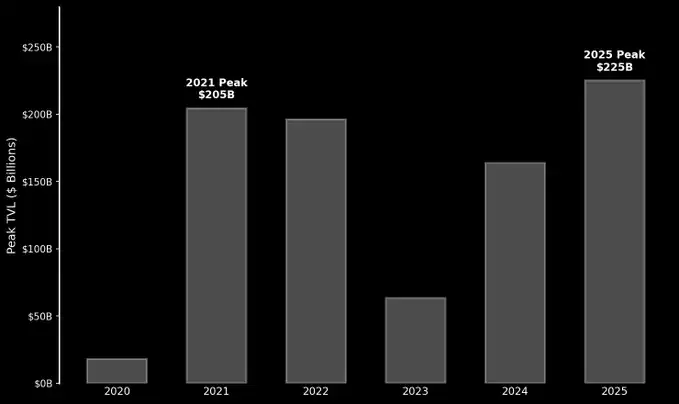
The proximity of these two peaks is indeed cause for caution, but it does not yet constitute a "survival crisis." The current user base—though highly engaged and loyal—is not large enough to propel DeFi to the next level on its own.

To achieve a breakthrough, DeFi needs to reach a larger audience. The good news is that such an audience does exist—it is still on the sidelines, waiting to be properly "onboarded" with the right tools and products.

A Glimmer of Hope

Over the past year, the stablecoin market has been one of the biggest beneficiaries. The amount of USD on-chain has reached a historical high, more than ever before. USDT and USDC have continued to grow steadily, with their combined market capitalization exceeding $260 billion—meaning that the scale of stablecoins alone is already larger than the entire DeFi market.
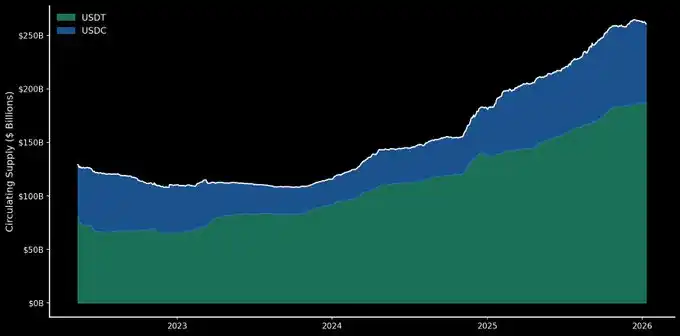
Even without parabolic growth in DeFi, people continue to mint stablecoins, indicating that the demand for moving funds on-chain remains strong. At the same time, an increasing number of users are beginning to access the yields provided by DeFi, and the growth in this area points to where the next breakthrough may come from.

The rise of yield-bearing stablecoins and RWA (real-world assets) further confirms this trend. According to @stablewatchHQ data, the scale of yield-bearing stablecoins has exceeded $20 billion, with products like sUSDS and sUSDe gaining significant adoption over the past year or so. Parallel to yield-bearing stablecoins, RWA has also made progress on-chain: these products, backed by traditional assets such as treasury bonds, offer real yields and are growing rapidly.

The problem is that they currently primarily cater to crypto-native users and large on-chain holders. As long as this remains the case, their potential will be underestimated. If they can be productized and packaged in a way that is more accessible to everyday users, yield-bearing stablecoins and RWA present enormous opportunities in the mass market.

Retail Has Not Yet Arrived

To understand the scale of this opportunity, it is helpful to compare DeFi with fintech. Currently, the entire DeFi TVL is approximately $164 billion. In contrast, global mobile fintech apps manage over $2 trillion in customer assets; the top 100 neobanks alone have assets totaling $2.4 trillion. By comparison, DeFi is currently almost a negligible fraction.
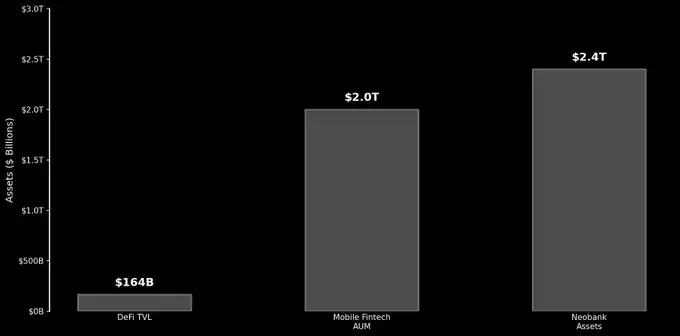
The notion that "if you build it, they will come" can only drive limited growth. If DeFi wants to continue expanding, it must compete for the ordinary users that have made fintech so vast.

In 2025, the success of protocols like Aave, Ethena, and Pendle has demonstrated a strong demand for yield among market participants. They were the highlights of the year, attracting significant capital and attention. If such products can be delivered to the masses in a clear, understandable, and low-barrier manner, the potential encompasses (literally) trillions of dollars in capital and tens of millions of potential users.

The Path Forward

The real test for DeFi in the coming year is whether it can make yield opportunities easily and safely accessible to ordinary people. Growth will not come from more complex financial structures, the 100th liquidity mining pool, the 100th perpetual futures DEX, or the millionth airdrop. Growth will come from simple, reliable products—built on decentralized protocols—that solve real problems for ordinary people. And yield should be center stage (ahem, Aave App, ahem).

Today, hundreds of millions of people use banking and fintech apps daily, already accustomed to managing their funds on their phones. If DeFi can capture even a small share of this, it will be enough to trigger a new wave of growth, and it will not once again stall at the $200 billion TVL level.

Embedded DeFi will play a crucial role in this—fintech companies and neobanks integrating on-chain yield capabilities directly into their products. But teams should not stop there. The protocols that are truly consumer-facing and at the forefront will capture the greatest upside; those that continue to optimize only for crypto-native users will ultimately be competing for a pie that may no longer be expanding.

DeFi will win.

Пов'язані питання

QWhat is the main reason DeFi has not experienced explosive growth despite reaching a new TVL high in 2025?

AThe main reason is that DeFi has primarily served crypto-native users and traders, who are nearing their 'ceiling,' and has failed to attract a broader audience of ordinary users.

QWhat evidence suggests that there is still strong demand for moving funds on-chain?

AThe stablecoin market has reached a new all-time high, with USDT and USDC combined市值 exceeding $260 billion, which is larger than the entire DeFi market.

QWhat types of products have shown significant growth and adoption in the past year, indicating potential for broader appeal?

AYield-bearing stablecoins (like sUSDS and sUSDe) and Real World Assets (RWA) have seen substantial growth, offering real yields and attracting significant adoption.

QHow does the size of DeFi's TVL compare to the assets managed by fintech applications and neobanks?

ADeFi's TVL is about $164 billion, while global mobile fintech apps manage over $2 trillion in customer assets, and the top 100 neobanks alone hold $2.4 trillion in assets, making DeFi a negligible fraction in comparison.

QWhat is the key challenge for DeFi to achieve its next growth cycle and attract mainstream users?

AThe key challenge is to create simple, secure, and收益-focused products that are easy for ordinary users to understand and use, rather than developing complex financial structures or relying solely on crypto-native optimizations.

Пов'язані матеріали

From South Korea to the United States: Blue-Collar Jobs Are Becoming Increasingly Popular, Thanks to AI

AI is reshaping the labor market's value proposition. The traditional four-year college degree is losing its appeal as a guaranteed career path, while skilled blue-collar trades like electricians, welders, and plumbers are experiencing historic demand and wage premiums. This shift is driven by dual pressures: AI's displacement of certain white-collar roles and a booming need for physical infrastructure and data center construction. Data confirms the trend. In the U.S., vocational school revenue surged, and a significant portion of recent layoffs are AI-related. Surveys show a majority of Gen Z adults plan to pursue blue-collar work, citing better job security against AI automation. Vocational education interest has exploded recently. Experts cite a psychological shift as younger generations seek tangible, AI-resistant careers and avoid high student debt. In many cases, salaries for skilled trades now match or exceed those requiring a bachelor's degree. In South Korea, semiconductor vocational high schools boast near-total employment, with graduates securing high-paying roles at companies like Samsung. The shortage is structural, exacerbated by a retiring baby boomer workforce and massive infrastructure projects. Companies like JPMorgan Chase, Meta, and Lowe's are investing heavily in training programs. However, overcoming historical stigma and a "perception gap" around trade careers remains a key challenge to closing the talent gap.

marsbit46 хв тому

From South Korea to the United States: Blue-Collar Jobs Are Becoming Increasingly Popular, Thanks to AI

marsbit46 хв тому

Qualcomm: AI Hype Subsides, When Will Smartphones Emerge from the Gloom?

Qualcomm reported its Q3 FY2026 results (ending June 2026), with revenue of $9.95B, down 4% YoY but above expectations. Gross margin declined to 53.1%, pressured by rising costs across manufacturing and memory. Key business segments showed mixed performance: Handset revenue fell 19.6% YoY to $5.09B, dragged by an 11% decline in non-Apple Android shipments and weaker high-end mix. Conversely, Automotive revenue surged 61% to $1.59B, and IoT grew 9% to $1.83B. Core operating profit dropped 41% YoY due to margin compression and higher expenses. Management's Q4 FY2026 guidance projects revenue of $9.7B-$10.5B, in line with consensus, but Non-GAAP EPS guidance of $2.05-$2.25 fell short of expectations. Amidst persistent weakness in its core handset market, Qualcomm is pursuing growth in AI, focusing on Edge AI (smartphones, PCs, automotive) and Data Center AI. Its data center strategy includes four pillars: AI accelerators (e.g., AI200), commercial CPUs (Dragonfly C1000), custom silicon, and connectivity solutions. While these initiatives initially boosted its stock, concerns over AI capital expenditure sustainability have since erased those gains. The company targets $5B in data center revenue for FY2027 and $15B for FY2029. The report concludes that with the traditional handset business still under pressure, the data center opportunity is currently viewed as a longer-term option, and a more conservative valuation based on core operations may be warranted until AI contributions materialize.

marsbit50 хв тому

Qualcomm: AI Hype Subsides, When Will Smartphones Emerge from the Gloom?

marsbit50 хв тому

From TPU to Self-Evolving Agents: How Jeff Dean Predicts the Next Step in AI

At the 2026 YC Startup School, Jeff Dean outlined his vision for AI's next phase, shifting focus from simply scaling models to building intelligent, autonomous systems. He believes AI's progress is no longer just about creating smarter models, but about integrating them into systems capable of long-term, iterative work, automated experimentation, and continuous learning. This evolution moves the competition from "who has the bigger model" to "who can best organize intelligence." Dean suggests AI capabilities are now comparable to a junior engineer, enabling the automation of complex workflows. However, the true challenge and opportunity lie in managing these AI "workers" at scale. He emphasizes the importance of **context engineering**—structuring tools, memory, and feedback loops—over raw model power. For startups, this means building deep expertise in niche domains where general models currently fail (near 0-1% success rates), leveraging proprietary data, specialized tools, and domain-specific evaluators. A recurring theme is re-examining fundamental constraints. Dean's past work, like moving Google's search index to memory or creating the TPU, stemmed from questioning outdated assumptions about hardware and cost. He sees similar inflection points today, particularly in **specialized inference hardware** to drastically reduce latency and energy consumption for real-time Agent operation. Notably, he points out that in modern AI systems, the dominant cost is often not computation but **data movement**. Reliable, long-running Agents require robust system design, borrowing concepts from distributed computing like checkpointing, state management, and parallel exploration to handle failures and maintain progress over days or weeks. As AI automates execution, the scarcest human skills will shift to **defining clear specifications**, **judging what problems are worth solving** (taste), and designing effective feedback loops. Ultimately, Dean's framework prioritizes understanding the problem deeply, identifying the true bottlenecks, and systematically building closed-loop systems where AI can not only perform tasks but also improve AI itself.

marsbit50 хв тому

From TPU to Self-Evolving Agents: How Jeff Dean Predicts the Next Step in AI

marsbit50 хв тому

Торгівля

Спот
活动图片





