When "Vibe Coding" Enters the Gaming World, What Is Verse8 Changing?

Odaily星球日报Опубліковано о 2026-03-04Востаннє оновлено о 2026-03-04

Анотація

"Vibe Coding" is reshaping game development, and platforms like Verse8 are at the forefront of this shift. The article begins with the author’s experience playing Mine8, a simple yet engaging game, highlighting how AI is lowering barriers in game creation. Unlike traditional tools, Verse8 allows users to generate playable games using natural language prompts, dramatically speeding up development—often to just hours. The platform functions like a "TikTok for games," enabling both play and creation. Its core engine, Agent8, handles complex backend tasks like asset generation, code debugging, and deployment, while the "Spin" feature lets users remix existing games easily. Integrated with Story Protocol, Verse8 also ensures on-chain IP ownership and rewards original creators as content evolves. With over 4,000 creators, 25,000 games, and 3.5 million daily active users, Verse8 is demonstrating real traction. Early metrics show significant growth in engagement and creation time. Though still in early stages—with no token launched yet—it offers reward mechanisms and collaborates with major IPs like Moonbirds and Azuki. Ultimately, Verse8 is transforming games from static entertainment into dynamic, creator-driven media—making game creation accessible and scalable within the Web3 economy.

Original | Odaily Planet Daily (@OdailyChina)

Author | DingDang (@XiaMiPP)
The Epiphany Starting from a "Simple" Mini-Game

After playing Mine8 for two days, I realized that I had been hooked on this extremely simple mini-game for so long. The gameplay isn't complicated: dig for treasures with a shovel within a limited time, where the shovel's damage and speed determine efficiency, but whether you actually find treasure depends more on luck. Occasionally opening a lucky box allows you to upgrade the shovel, adding a bit of anticipation for the next round. The mechanics aren't particularly novel, and the game interface isn't very polished, but it genuinely captured my attention.

However, what really made me stop and think wasn't the game itself, but the timing of its emergence.

"Vibe coding" is becoming one of the hottest keywords right now. Tools like Cursor and Lovable have already proven that anyone can build software just by describing their needs in natural language. Cursor achieved $100 million ARR (Annual Recurring Revenue) within 12 months, while Lovable became a unicorn in just 8 months.

While AI programming tools are spreading across general application fields, one massive sector remains relatively blank — gaming. It's complex, engineering-heavy, and has long development cycles, making it precisely the type of content form that is hardest to natural-language-ize.

Mine8, and the Verse8 behind it, are emerging in this very context.

Verse8: Not "More Mini-Games," but "More Creators"

If you only look at the surface, Verse8 can easily be misunderstood as a mini-game collection platform.

At first, you just click into a mini-game as usual. The rules aren't complicated, it's easy to get started, you finish a round and close it — it seems no different from any casual game.

But at some point, you suddenly realize one thing: this game isn't "finished"; it's "something that can be continued to be written."

On Verse8's page, creators don't need to face a traditional development backend. The Prompt itself is the entry point.

A single description can generate a playable game; an existing work can also be directly copied, modified, and republished. This means that "making a game" no longer requires full engineering preparation for the first time. You're not standing at the starting point of a project, but on top of content that is already running. A game can be generated in just a few hours, or even less.

Therefore, Verse8 serves not just players. What it truly attracts are those who originally lacked game development capabilities but possess the desire to express and create. Here, everyone is both a player and a potential developer at any moment — the barrier to creation is drastically lowered, and the speed at which ideas materialize is infinitely amplified.

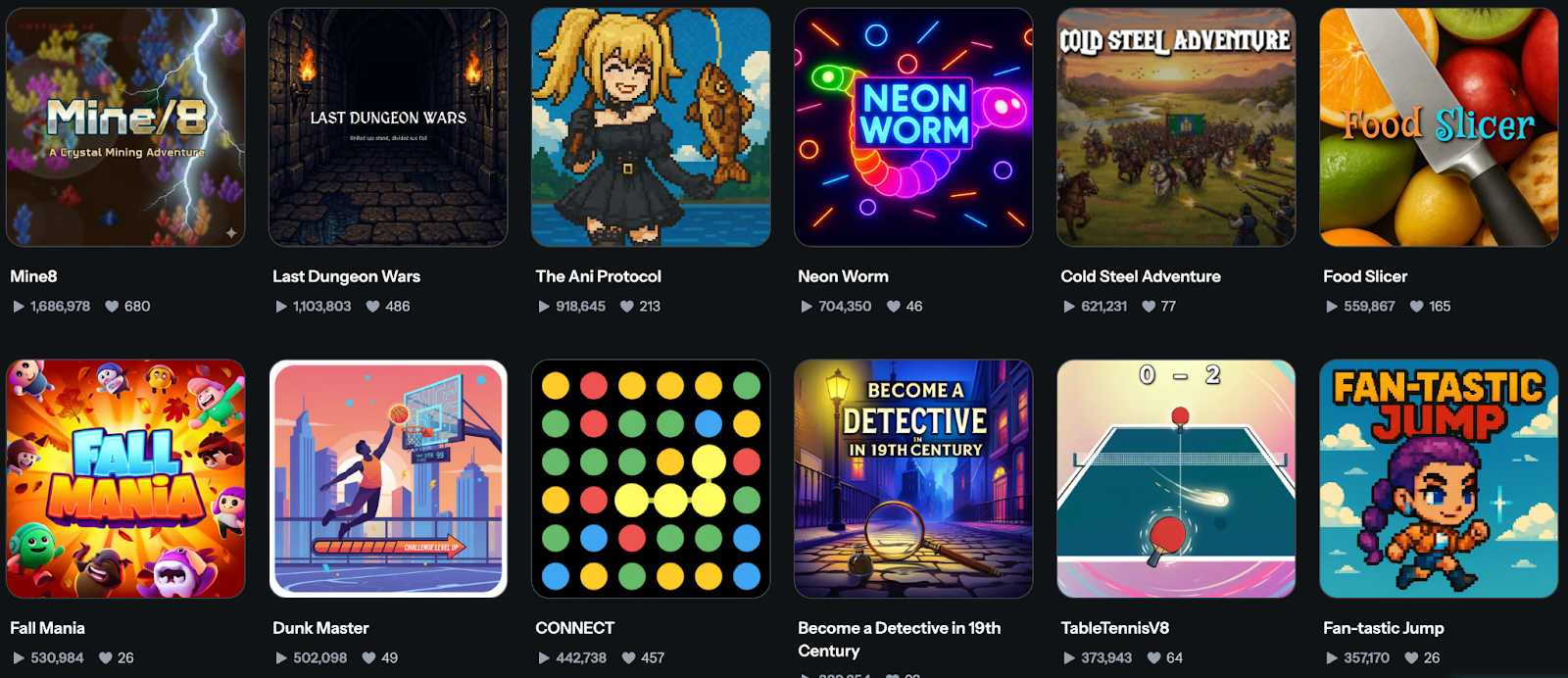
If an analogy must be drawn, Verse8 can be understood as the "TikTok for games". It allows anyone to create and publish a large number of AI-generated mini-games, with diverse themes, gameplay, and styles. The aforementioned Mine8 is currently the most popular mini-game on the platform. Likes, shares, and dissemination — the games themselves begin to take on a content-based, socialized form.
From "Play" to "Spin": An Infrastructure Serving the Creator Economy

On Verse8, the creation experience appears exceptionally lightweight. You just describe your idea in natural language, and out comes a runnable, interactive game that others can play. But this "lightness" isn't because things have actually become simpler; it's because the complexity is systematically hidden.

However, to achieve true Prompt-to-Play, Verse8 needs to simultaneously complete multiple high-complexity tasks in the backend. Text, images, audio, video, and code must be generated together. The generated results need to run instantly, be tested, have errors found and automatically fixed, and finally be deployed and distributed. In traditional game development, these processes often require multi-person collaboration and repeated debugging. In Verse8, they must be completed in a single generation process.

Bearing this "invisible engineering" is Verse8's core creation layer: Agent8.
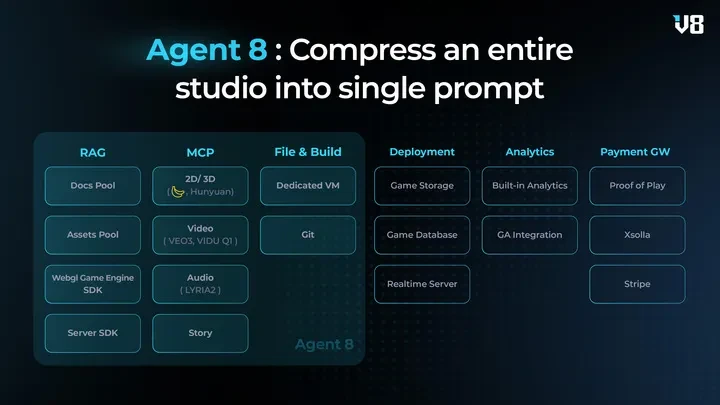
It's not just a simple generation tool; it's more like compressing an entire production team into a prompt. Agent8 has built-in templates for various mature game genres, including RPG, platformer, idle, FPS, etc., and directly integrates a WebGL engine, allowing generated content to be published and run in real-time without building or setting up servers.

At the same time, the asset production pipeline is highly automated. 2D assets are automatically adapted and optimized for the target platform; 3D models undergo rigging, format processing, and web optimization. Art, animation, and audio — the most time-consuming and experience-dependent parts — are compressed into the system's default internal processes. Creators see a "ready-to-go" result, not the engineering details behind it.
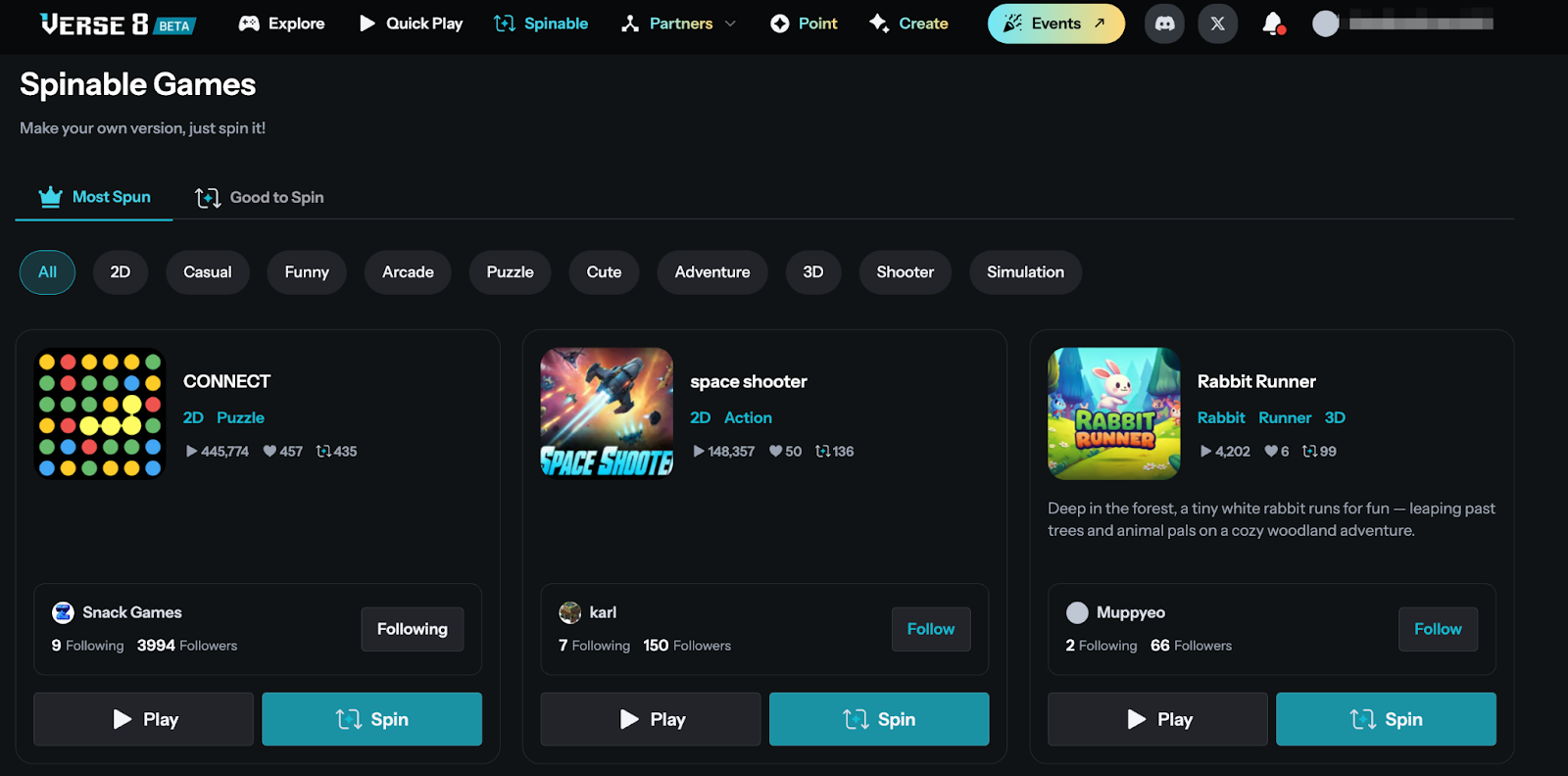
Think that's all? No. What truly gives creation scale is its Spin mechanism. Any published work can be copied with one click; the creator just needs to modify elements like the prompt, character settings, background, music, gameplay parameters, etc., and the AI will automatically regenerate a modified version that belongs to you. After modification, it can be directly published and shared.

On this foundation, Verse8 introduces Story Protocol as the on-chain IP and ownership layer. Every game, asset, and derivative content is automatically registered and its ownership established. The more a work is adapted, the higher the回报 (return) for the original creator. Creation is no longer just a one-time output but begins to have the potential for continuous reuse and amplification.

In the past, building a game with integrated assets often required weeks of manual debugging; now, Verse8 creators can complete it within two days, or even compress the production time to a few hours. What it truly solves is not whether the gameplay is novel enough, but whether creation can be scaled, replicated, and evolved.

When Games Shift from Entertainment to a New Battleground for Web3 Creator Economy

Games have always been an important part of the attention economy, but unlike text, images, video, or music, they never truly entered the creator economy system. The high development barriers and complex production processes long made "making games" the exclusive capability of a few professional teams. Even if ordinary creators had ideas, it was difficult to turn them into runnable, shareable works.

Verse8 is changing this structure. When the Prompt becomes the creation entry point, when games can be directly copied, rewritten, and quickly published, games begin to transform from a high-threshold entertainment product into a means of production that creators can directly use. They are no longer just objects to be chosen and experienced, but a medium that can be repeatedly processed and redistributed.

Under this change, the real competition between platforms is no longer just about vying for attention, but about who can host more creators, who can amplify creative efficiency, and who can enable content to continuously evolve and generate compound interest. Games, a relatively closed entertainment category, are beginning to shift towards an open content form.

What Verse8 promotes is not "more fun mini-games," but a role shift. When games transform from consumed content into a medium that can be continuously produced and rewritten, the battleground of the creator economy truly lands on games for the first time.

From "Usable" to "Actually Being Used"

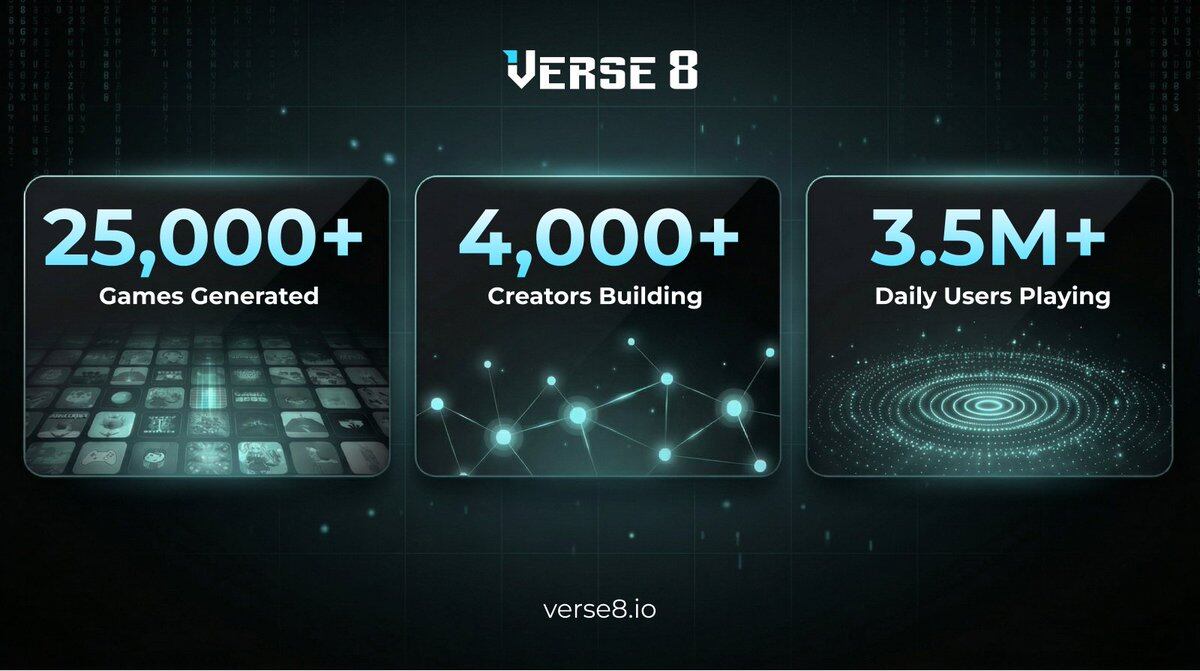
While the creation experience continues to be optimized, Verse8 has also formed a preliminary scaled user and creator base. Currently, the platform has attracted over 4,000 creators, launched more than 25,000 mini-games, and reached 3.5 million daily active users. For a platform still in its early stages, this data at least indicates one thing: this method of creation is not just conceptual.
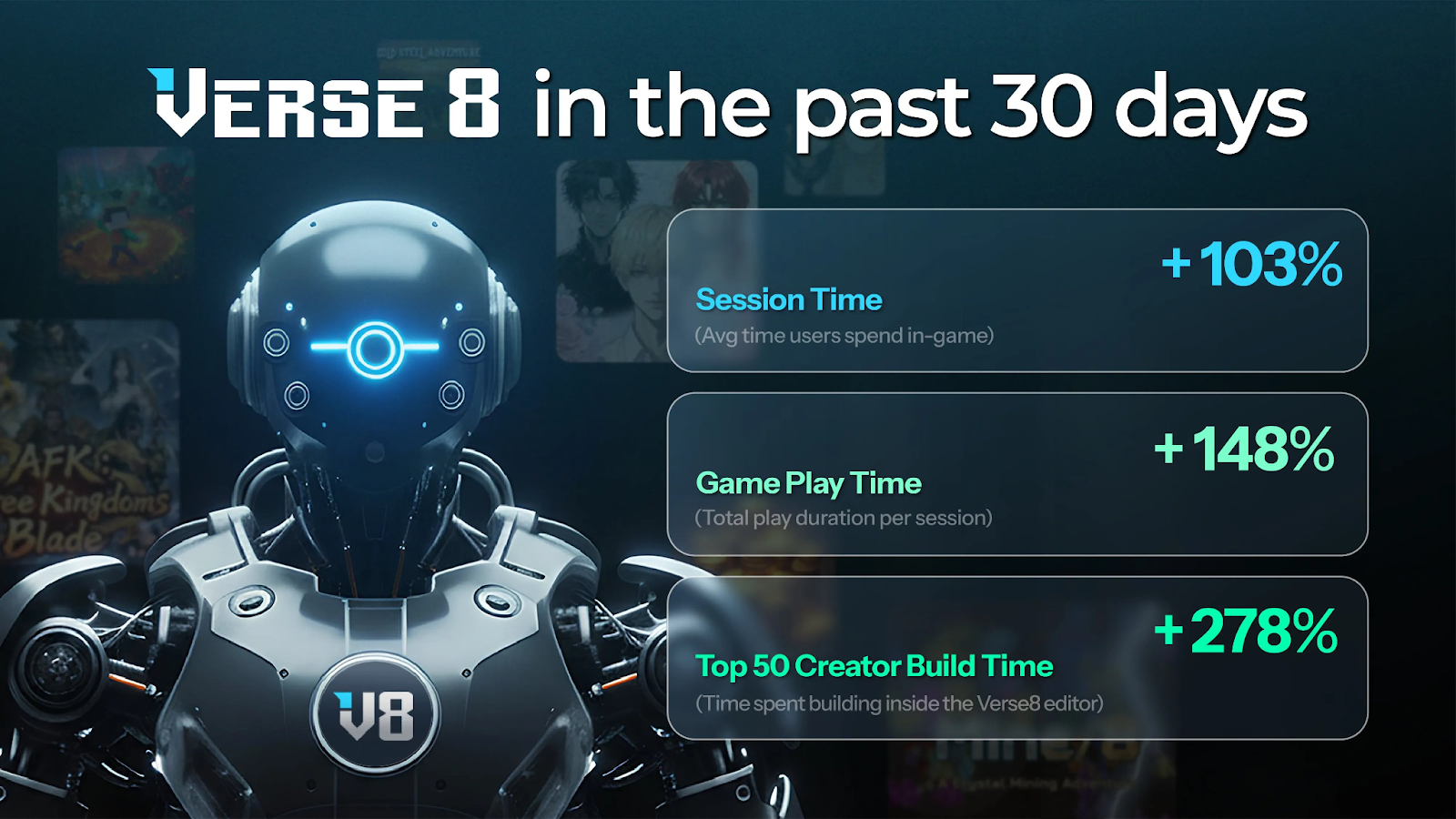
Over the past month, Verse8 has achieved significant quality improvements in creator-related metrics: session duration increased by 103%; game immersion time increased by 148%; creation build time increased by 278%.
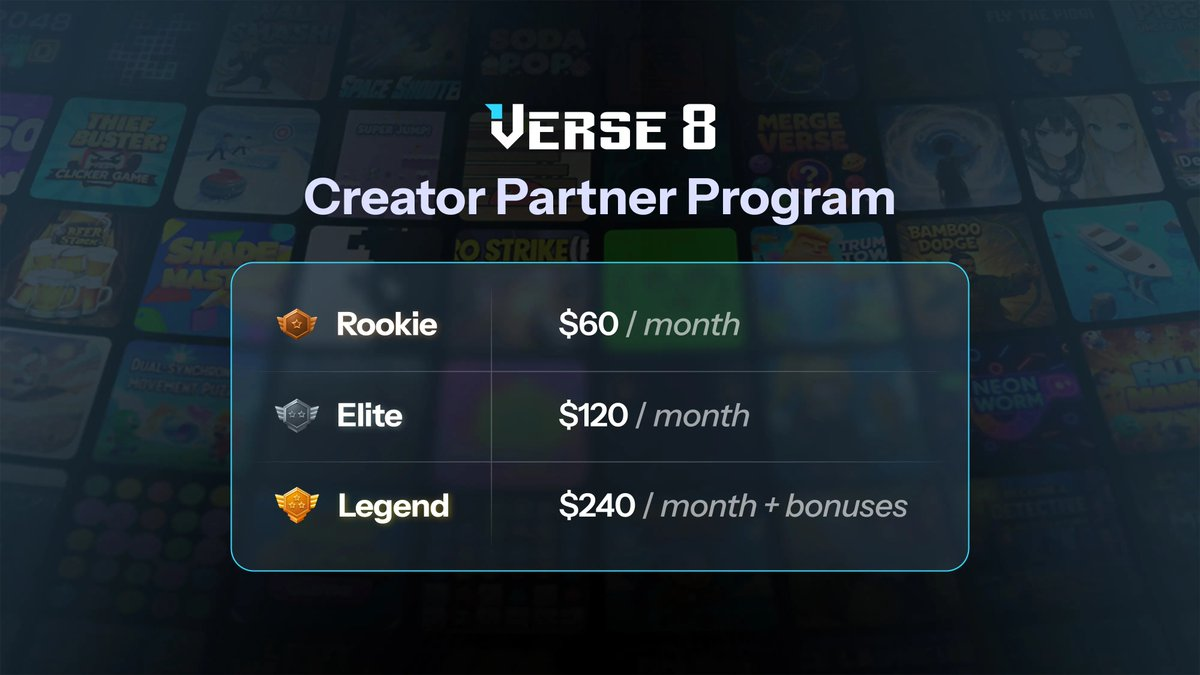
As a creative platform, Verse8 also collaborates with popular IPs like Moonbirds and Azuki, enabling creators to use these blue-chip IPs for AI Vibe Coding game creation with zero barriers and compliance, continuously attracting creators and driving the production of high-quality content. Meanwhile, the platform is advancing a Creator Partner Program, providing tiered incentives and resource support to help high-potential creators expand their influence. Participants also have the opportunity to receive incentives from a $10,000 reward pool.
It's important to emphasize that Verse8 is still in a very early stage and has not yet issued a token. But it has already provided a clear participation path for crypto users — earning points by completing tasks. In the near future, these points may be converted into actual economic incentives.

Conclusion

Attention is temporary, but creativity can last long.

In the Web3 era, Verse8 makes games no longer just content to be consumed, but a medium that can be produced, rewritten, and owned. When the barrier to expression is lowered, when the speed of creation is amplified, games are finally becoming a real territory within the creator economy.

Since inspiration strikes, why not open verse8.io and try vibe coding something. Your first game could be the starting point of the creator economy.


Пов'язані питання

QWhat is the core concept of 'Vibe Coding' as described in the article, and how does it relate to Verse8?

AThe core concept of 'Vibe Coding' is using natural language prompts to generate software, making development accessible to non-coders. Verse8 applies this concept specifically to the game development sector, allowing users to create and modify games through simple text descriptions, thus drastically lowering the barrier to entry for game creation.

QHow does Verse8's 'Spin mechanism' function, and what purpose does it serve for creators?

AVerse8's 'Spin mechanism' allows any published game to be copied with a single click. Creators can then modify elements like the prompt, character settings, background, music, or gameplay parameters. The AI will automatically regenerate a new, customized version of the game. This enables rapid iteration, remixing, and scaling of content, turning creation into a collaborative and evolutionary process.

QWhat role does Agent8 play in the Verse8 platform's infrastructure?

AAgent8 is Verse8's core AI-powered creation layer. It functions like a compressed development team, handling the complex backend work required for prompt-to-play generation. This includes generating and integrating code, 2D/3D assets, and audio; running and testing the game; fixing errors; and deploying it—all automatically and instantly, hiding the underlying engineering complexity from the user.

QWhat key metrics mentioned in the article indicate Verse8's early adoption and user engagement?

AKey metrics indicating Verse8's early adoption include: over 4,000 creators, more than 25,000 small games published, and 3.5 million daily active users. The platform has also seen significant quality improvements with a 103% increase in session duration, a 148% increase in game immersion time, and a 278% increase in creation build time over the past month.

QHow does Verse8 integrate with Web3 and creator economics according to the article?

AVerse8 integrates with Web3 by using Story Protocol as an on-chain IP and ownership layer. This automatically registers every game, asset, and derivative work, establishing clear ownership. The more a work is adapted by others, the higher the rewards for the original creator. The platform also has a points system for completing tasks, which may convert to economic incentives in the future, and runs a creator partner program with a financial reward pool.

Пов'язані матеріали

From South Korea to the United States: Blue-Collar Jobs Are Becoming Increasingly Popular, Thanks to AI

AI is reshaping the labor market's value proposition. The traditional four-year college degree is losing its appeal as a guaranteed career path, while skilled blue-collar trades like electricians, welders, and plumbers are experiencing historic demand and wage premiums. This shift is driven by dual pressures: AI's displacement of certain white-collar roles and a booming need for physical infrastructure and data center construction. Data confirms the trend. In the U.S., vocational school revenue surged, and a significant portion of recent layoffs are AI-related. Surveys show a majority of Gen Z adults plan to pursue blue-collar work, citing better job security against AI automation. Vocational education interest has exploded recently. Experts cite a psychological shift as younger generations seek tangible, AI-resistant careers and avoid high student debt. In many cases, salaries for skilled trades now match or exceed those requiring a bachelor's degree. In South Korea, semiconductor vocational high schools boast near-total employment, with graduates securing high-paying roles at companies like Samsung. The shortage is structural, exacerbated by a retiring baby boomer workforce and massive infrastructure projects. Companies like JPMorgan Chase, Meta, and Lowe's are investing heavily in training programs. However, overcoming historical stigma and a "perception gap" around trade careers remains a key challenge to closing the talent gap.

marsbit1 год тому

From South Korea to the United States: Blue-Collar Jobs Are Becoming Increasingly Popular, Thanks to AI

marsbit1 год тому

Qualcomm: AI Hype Subsides, When Will Smartphones Emerge from the Gloom?

Qualcomm reported its Q3 FY2026 results (ending June 2026), with revenue of $9.95B, down 4% YoY but above expectations. Gross margin declined to 53.1%, pressured by rising costs across manufacturing and memory. Key business segments showed mixed performance: Handset revenue fell 19.6% YoY to $5.09B, dragged by an 11% decline in non-Apple Android shipments and weaker high-end mix. Conversely, Automotive revenue surged 61% to $1.59B, and IoT grew 9% to $1.83B. Core operating profit dropped 41% YoY due to margin compression and higher expenses. Management's Q4 FY2026 guidance projects revenue of $9.7B-$10.5B, in line with consensus, but Non-GAAP EPS guidance of $2.05-$2.25 fell short of expectations. Amidst persistent weakness in its core handset market, Qualcomm is pursuing growth in AI, focusing on Edge AI (smartphones, PCs, automotive) and Data Center AI. Its data center strategy includes four pillars: AI accelerators (e.g., AI200), commercial CPUs (Dragonfly C1000), custom silicon, and connectivity solutions. While these initiatives initially boosted its stock, concerns over AI capital expenditure sustainability have since erased those gains. The company targets $5B in data center revenue for FY2027 and $15B for FY2029. The report concludes that with the traditional handset business still under pressure, the data center opportunity is currently viewed as a longer-term option, and a more conservative valuation based on core operations may be warranted until AI contributions materialize.

marsbit1 год тому

Qualcomm: AI Hype Subsides, When Will Smartphones Emerge from the Gloom?

marsbit1 год тому

From TPU to Self-Evolving Agents: How Jeff Dean Predicts the Next Step in AI

At the 2026 YC Startup School, Jeff Dean outlined his vision for AI's next phase, shifting focus from simply scaling models to building intelligent, autonomous systems. He believes AI's progress is no longer just about creating smarter models, but about integrating them into systems capable of long-term, iterative work, automated experimentation, and continuous learning. This evolution moves the competition from "who has the bigger model" to "who can best organize intelligence." Dean suggests AI capabilities are now comparable to a junior engineer, enabling the automation of complex workflows. However, the true challenge and opportunity lie in managing these AI "workers" at scale. He emphasizes the importance of **context engineering**—structuring tools, memory, and feedback loops—over raw model power. For startups, this means building deep expertise in niche domains where general models currently fail (near 0-1% success rates), leveraging proprietary data, specialized tools, and domain-specific evaluators. A recurring theme is re-examining fundamental constraints. Dean's past work, like moving Google's search index to memory or creating the TPU, stemmed from questioning outdated assumptions about hardware and cost. He sees similar inflection points today, particularly in **specialized inference hardware** to drastically reduce latency and energy consumption for real-time Agent operation. Notably, he points out that in modern AI systems, the dominant cost is often not computation but **data movement**. Reliable, long-running Agents require robust system design, borrowing concepts from distributed computing like checkpointing, state management, and parallel exploration to handle failures and maintain progress over days or weeks. As AI automates execution, the scarcest human skills will shift to **defining clear specifications**, **judging what problems are worth solving** (taste), and designing effective feedback loops. Ultimately, Dean's framework prioritizes understanding the problem deeply, identifying the true bottlenecks, and systematically building closed-loop systems where AI can not only perform tasks but also improve AI itself.

marsbit1 год тому

From TPU to Self-Evolving Agents: How Jeff Dean Predicts the Next Step in AI

marsbit1 год тому

Торгівля

Спот
活动图片




