When Transfers Become Truly Frictionless: How Sui Uses 'Zero Gas' to Become the Underlying Infrastructure for Stablecoin Payments

marsbitОпубліковано о 2026-06-22Востаннє оновлено о 2026-06-22

Анотація

Title: Sui Launches Zero-Gas Stablecoin Transfers to Become the Foundation for Stablecoin Payments Sui has introduced a zero-gas fee feature for peer-to-peer stablecoin transfers, eliminating the need for users or businesses to hold separate SUI tokens to pay transaction costs. This innovation, built on a new underlying account architecture called Address Balances, significantly reduces validator processing costs for eligible transactions. Currently, the feature applies to a whitelist of stablecoins for transfers meeting a minimum amount, effectively preventing spam. This development aims to unlock mainstream payment use cases for stablecoins—such as everyday purchases, remittances, and subscriptions—by removing cost and complexity barriers. It is also positioned to benefit high-frequency micro-payments for AI agents and institutional B2B payments, reducing operational friction. Major custody provider Fireblocks has already announced support. The move follows Sui processing over $1 trillion in stablecoin transfer volume since August 2025. Looking ahead, Sui plans to enhance this infrastructure with protocol-level confidential transactions later in 2026, aiming to provide scalable, free, and privacy-preserving payments. Together, these advancements strengthen Sui's goal of becoming the default settlement layer for stablecoin payments.

Author: Deep Tide TechFlow

If you go to an ATM to transfer money, and the ATM tells you that you must first buy "ATM usage coupons," you would probably think the ATM has gone crazy.

But this has been the operating rule for blockchain for over a decade: to make a transfer, first prepare the Gas.

As stablecoins play an increasingly critical role in the payment field, the cost of this threshold becomes clearer: new users are blocked outside, and payment scenarios are difficult to implement.

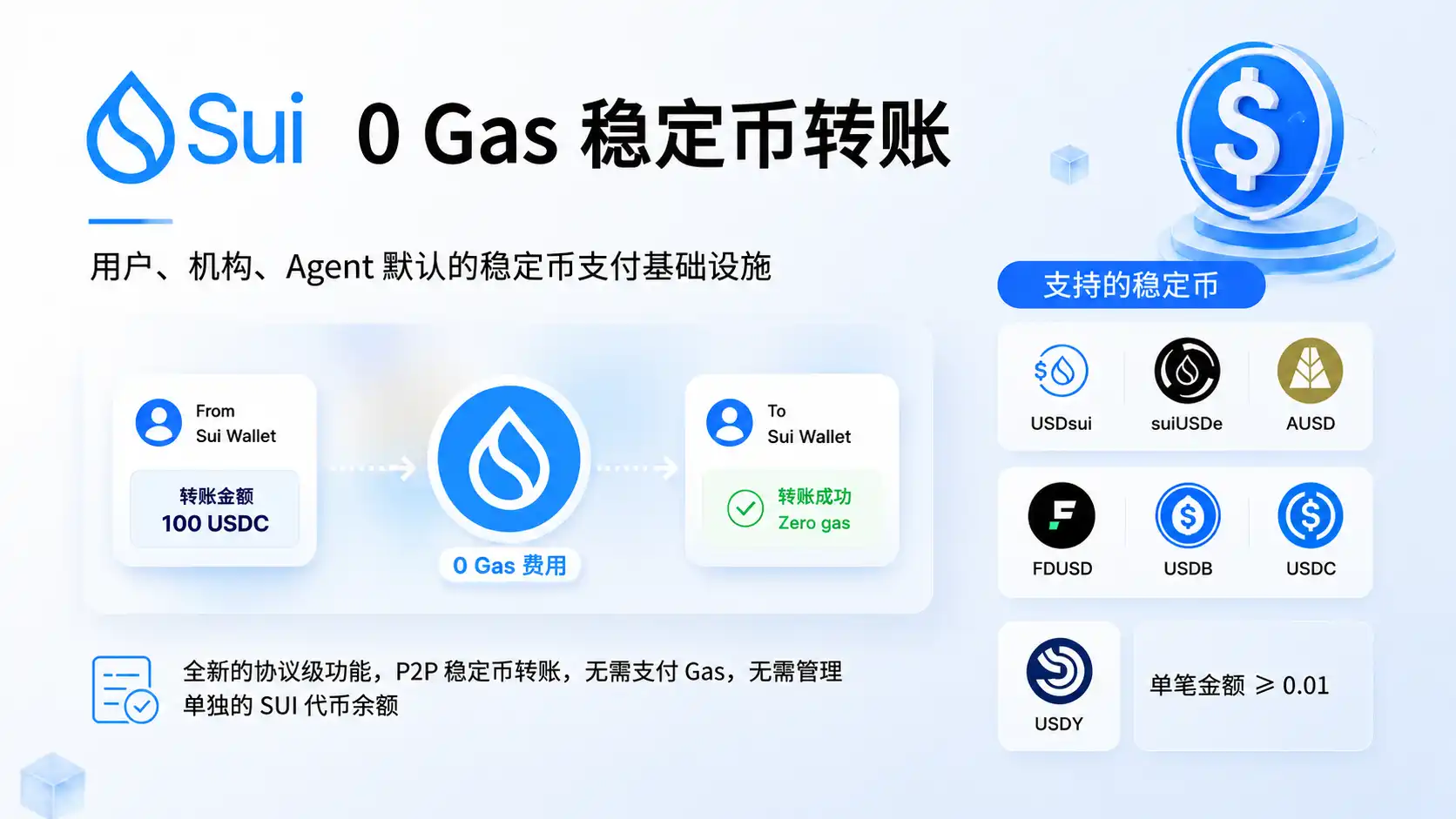
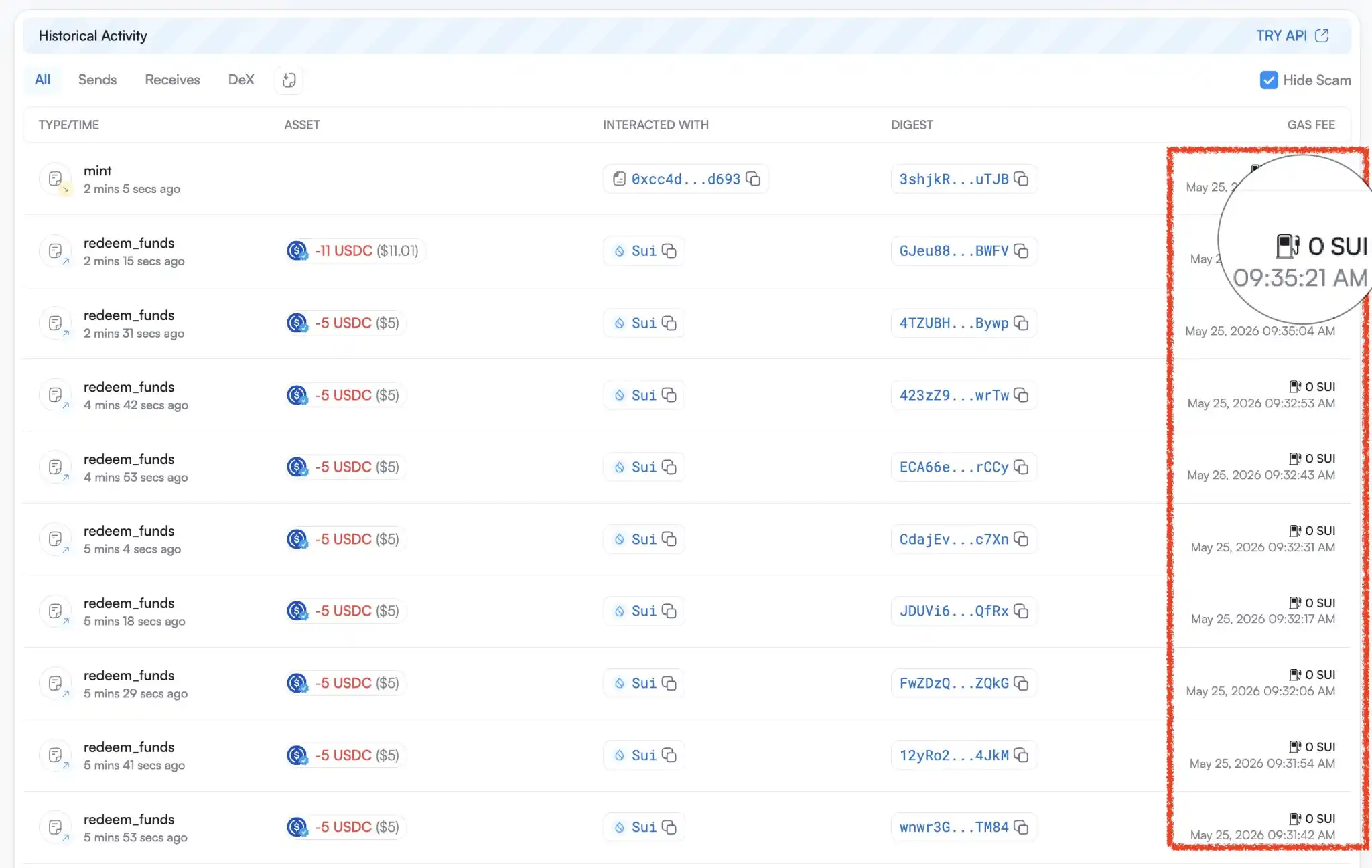
As a key initiative in building the "underlying infrastructure for stablecoin payments," on May 20, 2026, Sui announced the launch of a zero Gas stablecoin transfer feature, allowing users and enterprises to send stablecoins peer-to-peer without paying Gas fees, and without needing to manage a separate SUI token balance.

Although currently, this feature only supports P2P transfers of whitelisted stablecoins, stablecoins now have a real chance to transform from "crypto assets" into "payment infrastructure." The entity achieving this also further strengthens its position as a strong contender for the role of the "default foundation for stablecoin payments."
A New Kind of "Zero Gas": No One Is Paying for You in the Background

When mentioning zero Gas, most users' first reaction might be: Who paid the Gas for me?

This habitual thinking stems from past incomplete attempts at "zero Gas": either through subsidies or relays. The Gas never disappeared; someone was just quietly settling the bill in the background, a superficial solution that doesn't address the root cause.

Sui's "Zero Gas Stablecoin Transfer" targets the fundamental root.

It is built upon a new underlying account architecture called Address Balances. When tokens are sent using specific Move functions, they are automatically consolidated into the single balance of the recipient's address, eliminating the need to create or manage Coin objects. This saves the overhead of object creation, splitting, merging, and version tracking. The processing cost for validators is extremely low, low enough that they can refrain from charging users fees.

Costs are reduced, and boundaries must also be clearly defined: Under the highly restricted PTB mechanism, only P2P transfers of whitelisted stablecoins, with amounts no less than 0.01, are judged as zero Gas. This supports payment scenarios while isolating malicious transactions.
What Can This Infrastructure Run?

Firstly, it opens the door to daily payments. When the experience is frictionless and the cost is zero, those payment scenarios we once pinned high hopes on for stablecoins—including consumption, tipping, subscriptions, cross-border remittances, etc.—gain the potential for rapid penetration. Stablecoin payments, for the first time, possess the basic conditions to compete head-on with traditional payment tools, potentially even faster and better.

Of course, for high-frequency micro-payment scenarios, many will think of the Agent economy. In the past, actions like AI autonomous transactions and arbitrage required additional Gas management. The zero Gas stablecoin transfer will become the lowest-cost, least-resistance choice for Agents. Combined with Sui's high-performance advantages, it will further support the large-scale deployment of autonomous payment flows.

Another keyword is: Institutions. This is a group Sui officials specifically emphasize. Whether it's cross-border B2B payments, supplier settlements, or platform profit sharing, institutions often face higher payment friction. The protocol-level zero Gas mechanism transforms stablecoins into a payment tool that institutions can directly utilize.

Worth mentioning is that when the zero Gas feature was launched, Fireblocks had already announced support for address balances, and soon after, it supported Gas-free stablecoin transfers, further enhancing the accessibility of Sui's payment infrastructure for institutions. At the same time, several institutional-grade custody platforms and wallets have announced they will support zero Gas transactions.

Zero Gas: The First Half; Privacy: The Second Half

Since August 2025, stablecoin transfer volume on the Sui network has exceeded $1 trillion. This figure is sufficient to show that the underlying logic for stablecoin payments in the Sui ecosystem is already working. The launch of zero Gas stablecoin transfers will undoubtedly accelerate the construction of Sui's role as the "default foundation for stablecoin payments."

But this is only the first half of Sui's 2026 payment narrative.

Regarding the second half, the Mysten Labs product team has hinted multiple times: Protocol-level confidential transaction functionality will be launched within 2026, aiming to achieve large-scale, free payments with privacy protection.

Transfers will not only be cost-free but will also be able to hide transaction amounts and certain details, while retaining necessary audit and compliance capabilities.

This combination is crucial for adoption, especially for institutions. The higher the compliance requirements, the greater the value of confidential transactions.
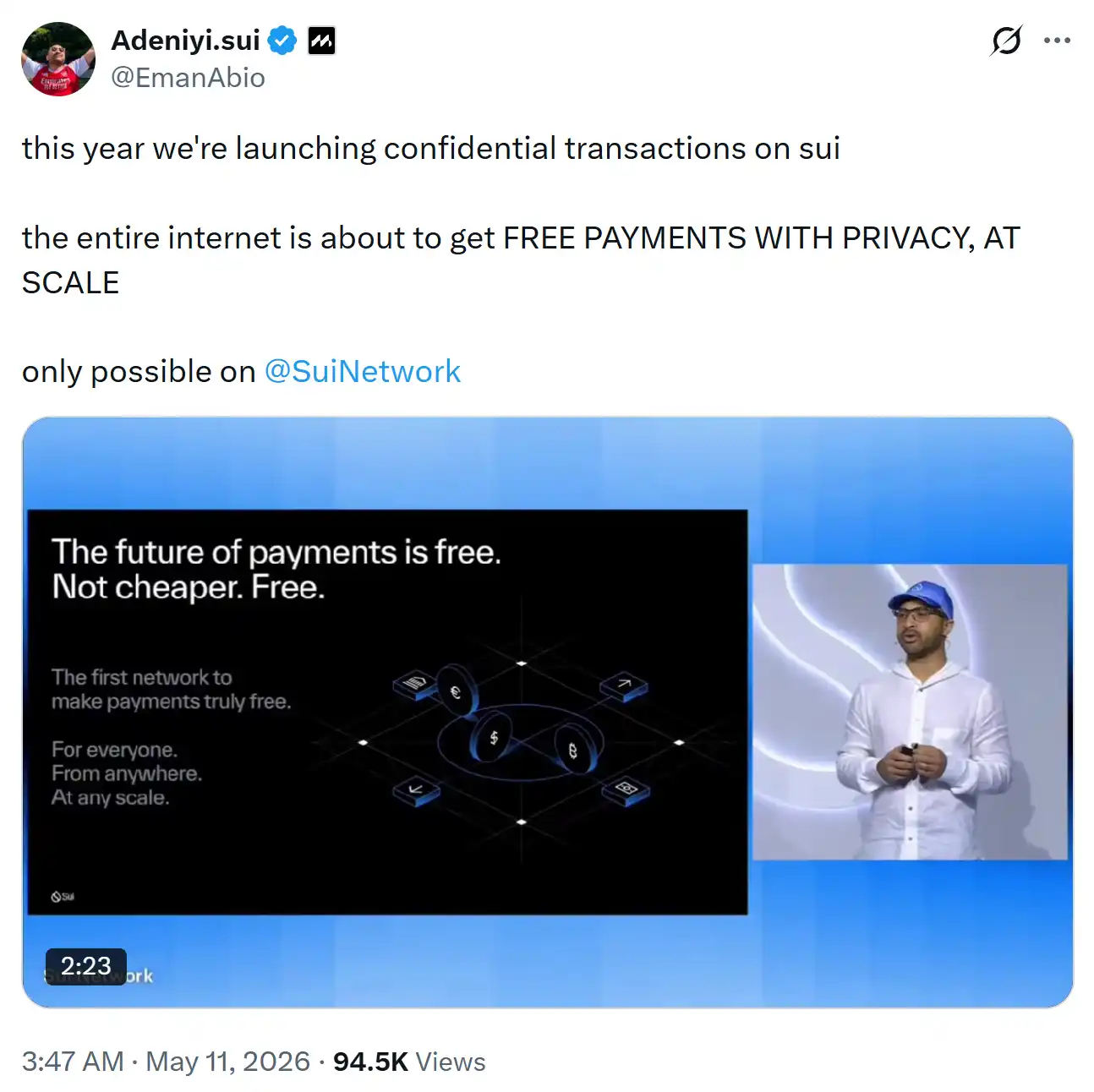
Let Money Flow Like Information.

This can be considered a phrase that runs through all of Sui's technological and ecosystem initiatives.

And now, from payments to Agents to institutions, the fuse that will decide large-scale adoption might just be lit by zero Gas stablecoin transfers.

Трендові криптовалюти

Пов'язані питання

QWhat is the main announcement made by Sui regarding stablecoin transfers, and when was it announced?

ASui announced a zero Gas stablecoin transfer function on May 20, 2026. This feature allows users and businesses to send stablecoins peer-to-peer without paying Gas fees and without needing to manage a separate SUI token balance.

QHow does Sui's 'zero Gas' mechanism for stablecoin transfers fundamentally differ from previous attempts at eliminating Gas fees?

AUnlike previous methods that relied on subsidies or relayers where someone else ultimately pays the Gas, Sui's approach targets the underlying architecture. It is built on the new Address Balances system, where tokens are sent using specific Move functions and automatically merged into the recipient's single balance. This eliminates the overhead of creating, splitting, merging, and tracking Coin objects, reducing validator processing costs so low that fees can be waived for the user.

QAccording to the article, what are some of the key use cases or scenarios enabled by zero Gas stablecoin transfers on Sui?

AThe key use cases include: 1) Everyday payments like consumption, tipping, subscriptions, and cross-border remittances. 2) High-frequency micropayments for the Agent/AI economy, enabling autonomous transactions with minimal cost. 3) Institutional payments such as cross-border B2B payments, supplier settlements, and platform revenue sharing, where reducing friction is crucial.

QWhat is the 'second half' or next major development in Sui's 2026 payment narrative mentioned in the article?

AThe 'second half' of Sui's 2026 payment narrative is the planned launch of a protocol-level confidential transaction feature within the year. The goal is to enable large-scale, free (zero Gas), and privacy-preserving payments that can hide transaction amounts and certain details while retaining necessary audit and compliance capabilities.

QWhat underlying technical principle allows Sui to offer zero Gas fees for eligible stablecoin transfers?

AIt is enabled by the new Address Balances account architecture. When tokens are sent using specific Move functions, they are automatically merged into the recipient's address balance without creating individual Coin objects. This drastically reduces the computational overhead (like object creation, splitting, merging, and version tracking) for validators, making the cost so low that fees are not charged to users for qualifying transactions.

Пов'язані матеріали

2026 Altcoin Season Guide: Current Values & Market Signals, Is It Time to Prepare for Altcoin Season?

Altcoin Season Guide 2026: Signals & Timing Analysis This guide explores the dynamics of an "altcoin season," defined as a 90-day period where at least 75% of the top 50 cryptocurrencies outperform Bitcoin (BTC). Historically signaling capital rotation from BTC to alternative assets ("alts"), these periods have evolved. Key differences for the 2026 market cycle include the "ETF Wall," where institutional capital via spot Bitcoin ETFs may remain concentrated in BTC, potentially slowing a broad altseason. A genuine, sustainable altseason now likely requires BTC profit-taking combined with new retail and on-chain liquidity entering the wider market. Analysts use tools like the Altseason Index (values >75 indicate an altseason) but also monitor key pairs like ETH/BTC and SOL/BTC for confirmation. Additional signals include a declining Bitcoin Dominance rate (ideally below 40-50%), accelerating altcoin total market cap growth, and surges in trading volume and social sentiment for alts. Modern altseasons are increasingly narrative-driven and selective, not uniform across all coins. Capital typically rotates in stages: from BTC to major altcoins (like ETH), then into leading narratives (e.g., AI, RWA, DePIN), and finally into mid/small-cap projects and meme coins. The peak phase is often marked by extreme greed, parabolic rises, and high leverage, serving as a cautionary signal. For preparation, investors are advised to build a quality watchlist based on fundamentals, product traction, and team strength. Strategies should include portfolio diversification, disciplined risk management (position sizing, stop-losses, stablecoin reserves), and capitalizing on sector rotations rather than chasing past winners. While precise timing is uncertain, historical patterns suggest strong altcoin rallies often follow Bitcoin halvings by 12-30 months. For the 2024 halving cycle, 2026-2027 could present favorable conditions if supported by macro liquidity, technological narratives, and a sustained drop in Bitcoin Dominance. A true, broad altseason is unlikely if Bitcoin experiences a sharp crash (>20%), as capital tends to flee the entire crypto market.

Foresight News50 хв тому

2026 Altcoin Season Guide: Current Values & Market Signals, Is It Time to Prepare for Altcoin Season?

Foresight News50 хв тому

This Might Be the Most Stunning Image at This Year's WAIC!

This article introduces Shangtang's newly released multimodal AI model, **SenseNova U1 Pro**, unveiled at WAIC 2026. The model is highlighted for its ability to generate **native 8K-resolution images** with exceptional detail and coherence, even in extremely wide-format compositions. It goes beyond simple image generation by employing a **"图文交错思维" (interleaved image-text reasoning)** workflow, where it can plan, sketch, refine, check, and correct its outputs to achieve a final, deliverable result. Key capabilities demonstrated include generating a long 8K scroll depicting the 9-year history of WAIC, a detailed 24 solar terms illustration, a complex academic poster, a琉璃 (colored glaze)-style landscape, and a ready-to-use movie poster. The model handles intricate prompts involving layout, text clarity, material textures, and stylistic consistency. The article draws a parallel between this evolution in image generation and the progression seen in AI coding—from simple code completion to autonomous project delivery. U1 Pro represents a shift from generating single images to providing **complete content delivery systems** for professional scenarios like infographics, urban planning, and commercial design. While challenges like generation time and professional workflow integration remain, the model signifies a move towards multimodal AI agents that are accountable for producing usable, high-quality outputs.

marsbit2 год тому

This Might Be the Most Stunning Image at This Year's WAIC!

marsbit2 год тому

How Did This Round of Deleveraging in the Korean Stock Market Occur?

This article details the timeline and mechanisms behind the deleveraging event in the South Korean stock market, focusing on the KOSPI index from late June to mid-July. The core trigger was the market's structure, heavily concentrated in Samsung Electronics and SK Hynix, which comprised over half of the KOSPI. The situation was amplified by the May 27th launch of single-stock double-leveraged ETFs on these two companies, which attracted massive retail investment and concentrated risk. The process unfolded in eight stages: 1. Initial price collapse on June 23rd after regulatory warnings, but without significant debt reduction. 2. A rebound from June 24-25 fueled by retail buying and ETF rebalancing, which actually increased leverage. 3. Foreign and institutional investors selling from June 26-30, with domestic retail investors becoming the marginal buyers, transferring risk to household balance sheets. 4. A shift in global semiconductor sentiment from July 1-3, causing leveraged ETFs to systematically sell during declines. 5. The market failing to rally on strong earnings (July 6-8), signaling a turn from technical correction to concerns over peak profitability. 6. A rise in forced liquidations and the cross-listing of SK Hynix ADRs, spreading leverage risks to US and Hong Kong markets (July 9-10). 7. A cascade of synchronized selling from various players on July 13th, followed by a mechanical, ETF-driven rebound. 8. Institutionalization of deleveraging on July 16th, marked by an interest rate hike and new regulatory restrictions on single-stock leveraged products. The author concludes this was not a simple semiconductor correction but a negative feedback loop involving foreign capital rebalancing, retail margin trading, daily ETF rebalancing, forced liquidations, shifting industry expectations, and tightening monetary and regulatory policy. Leveraged ETFs acted as a critical amplifier, not the initial spark. The price decline (-25%) far exceeded the reduction in margin debt (-11%), indicating the deleveraging was primarily expressed through asset prices rather than immediate balance sheet repair.

marsbit2 год тому

How Did This Round of Deleveraging in the Korean Stock Market Occur?

marsbit2 год тому

Торгівля

Спот

Популярні статті

Як купити GAS

Ласкаво просимо до HTX.com! Ми зробили покупку GAS (GAS) простою та зручною. Дотримуйтесь нашої покрокової інструкції, щоб розпочати свою криптовалютну подорож.Крок 1: Створіть обліковий запис на HTXВикористовуйте свою електронну пошту або номер телефону, щоб зареєструвати обліковий запис на HTX безплатно. Пройдіть безпроблемну реєстрацію й отримайте доступ до всіх функцій.ЗареєструватисьКрок 2: Перейдіть до розділу Купити крипту і виберіть спосіб оплатиКредитна/дебетова картка: використовуйте вашу картку Visa або Mastercard, щоб миттєво купити GAS (GAS).Баланс: використовуйте кошти з балансу вашого рахунку HTX для безперешкодної торгівлі.Треті особи: ми додали популярні способи оплати, такі як Google Pay та Apple Pay, щоб підвищити зручність.P2P: Торгуйте безпосередньо з іншими користувачами на HTX.Позабіржова торгівля (OTC): ми пропонуємо індивідуальні послуги та конкурентні обмінні курси для трейдерів.Крок 3: Зберігайте свої GAS (GAS)Після придбання GAS (GAS) збережіть його у своєму обліковому записі на HTX. Крім того, ви можете відправити його в інше місце за допомогою блокчейн-переказу або використовувати його для торгівлі іншими криптовалютами.Крок 4: Торгівля GAS (GAS)Легко торгуйте GAS (GAS) на спотовому ринку HTX. Просто увійдіть до свого облікового запису, виберіть торгову пару, укладайте угоди та спостерігайте за ними в режимі реального часу. Ми пропонуємо зручний досвід як для початківців, так і для досвідчених трейдерів.

216 переглядів усьогоОпубліковано 2024.12.12Оновлено 2026.06.02

Як купити GAS

Обговорення

Ласкаво просимо до спільноти HTX. Тут ви можете бути в курсі останніх подій розвитку платформи та отримати доступ до професійної ринкової інформації. Нижче представлені думки користувачів щодо ціни GAS (GAS).

活动图片