When Hyperliquid Steals Solana's 'Internet Capital Markets' Playbook

链捕手Опубліковано о 2026-05-19Востаннє оновлено о 2026-05-19

Анотація

The article discusses how Solana's grand vision of becoming an "Internet Capital Markets" platform is facing significant challenges in 2026, primarily from the unexpected rise of Hyperliquid. Solana's performance has weakened, with its token SOL experiencing the largest price decline among major cryptocurrencies. Its core narrative of building a global, chain-based marketplace for all assets is under pressure both internally and externally. Hyperliquid, originally a perpetual futures exchange, has evolved into a dedicated Layer 1 financial infrastructure network. Its focused, trading-centric approach is attracting capital and challenging the assumption that a "general-purpose" ecosystem like Solana is necessary for a capital market. Hyperliquid's success suggests that for high-frequency trading, superior performance, liquidity, and user experience may be more critical than a broad application ecosystem. Internally, Solana's strategy suffered a blow from a major hack on the Drift Protocol in April, resulting in over $200 million in losses. In response, Solana founder Anatoly Yakovenko has heavily promoted Phoenix as a new decentralized perpetual futures platform on Solana. While this boosted Phoenix's visibility, its trading volume remains far behind leading platforms. Solana's community has launched a rhetorical attack against Hyperliquid, questioning its decentralization due to its limited validator set and closed-source code. Critics, however, point out Solana's own dec...

Author: Hu Tao

In the cyclical waves of the cryptocurrency market, Solana once returned to its peak with the "Ethereum killer" narrative and extreme performance. However, as we enter 2026, this once high-performance machine is facing unprecedented deceleration pressure, first evident in its price.

In the past year, SOL's price has fallen by up to 73.5% from its high, the largest decline among all mainstream cryptocurrencies. In the recent month's market pullback, SOL's gains have also been very weak, significantly lagging behind other major cryptocurrencies like BTC and ETH.

Furthermore, Solana's core vision of "Internet Capital Markets" has suffered a major blow amidst internal and external challenges, forcing the Solana Foundation's senior team to speak out frequently recently, promoting their ecosystem on the public opinion front.

Solana's Core Narrative Hits a Wall

Over the past few years, Solana has been trying to tell a story far grander than just a "high-performance public chain."

In the definition of the Solana Foundation, Solana's endgame has transformed into "Internet Capital Markets"—a global trading network that brings stocks, commodities, futures, perpetual contracts, and all real-world assets on-chain.

Now, upon opening the official Solana website homepage, the most prominent slogan immediately greeting you is still: "Capital markets for every asset on Earth."
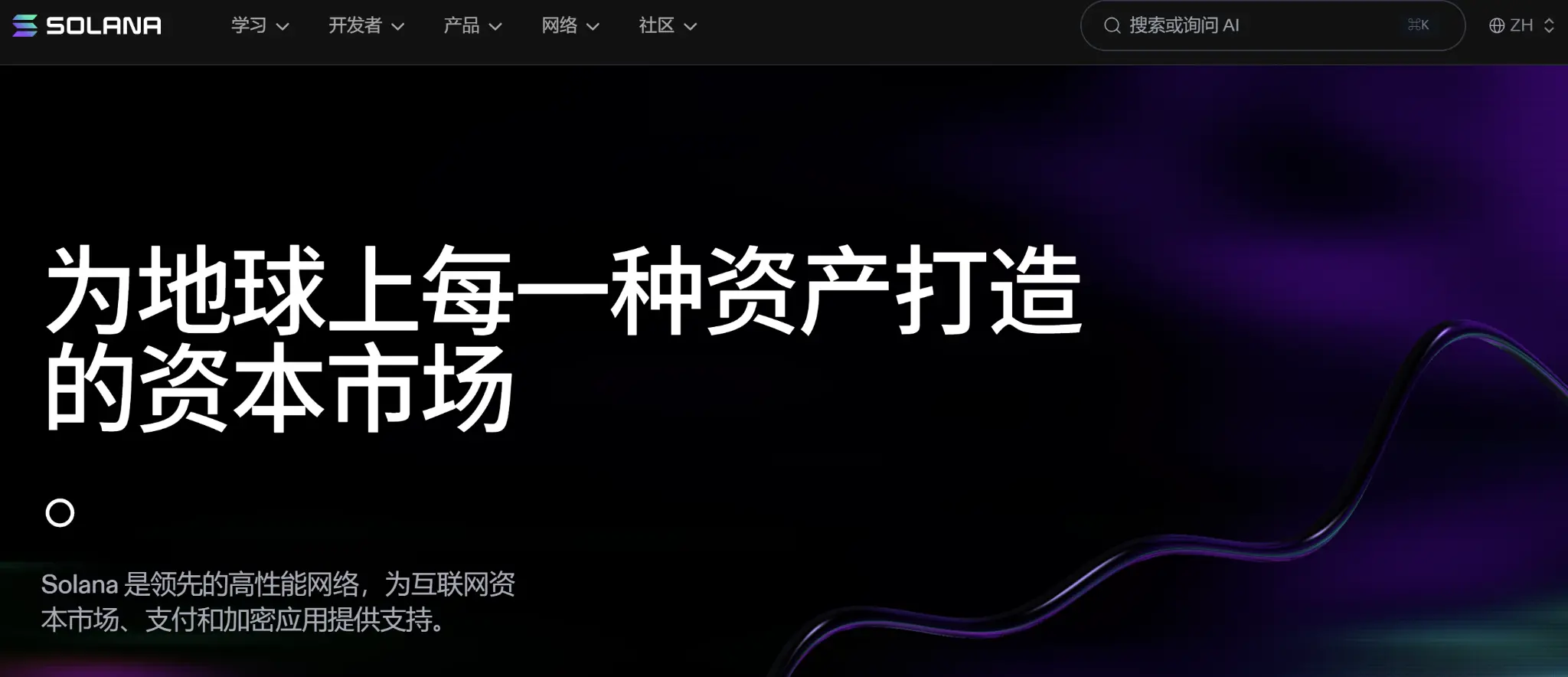
This means Solana aims not only to challenge Ethereum but also to replace traditional exchanges, brokers, and clearing systems, becoming the on-chain version of Nasdaq. High speed, low fees, high throughput, relatively mature user experience, and the strong backing of Wall Street capital once positioned Solana as the public chain closest to achieving this goal.

However, the problem is that as the "Internet Capital Markets" truly begin to take shape, the market is finding that Solana may not necessarily be at its core.

The Unexpected Impact of Hyperliquid

One of the biggest structural changes in the crypto industry over the past year has been the migration of the perpetual futures market away from traditional CEXs to on-chain platforms.

The biggest beneficiary of this trend is not Solana, nor Ethereum, Sui, or other networks, but Hyperliquid.

Initially, Hyperliquid was just an on-chain perpetual futures trading platform, but with the advancement of its Layer1 strategy, it has gradually evolved into a complete financial infrastructure network. Compared to Solana's broad and abstract "capital markets" vision, Hyperliquid has chosen a more focused, transaction-driven path.

For a long time, although the Solana ecosystem has hosted numerous DeFi projects, its core liquidity has always leaned more towards spot trading, Meme Coins, and on-chain speculation. The infrastructure truly capable of supporting institutional-grade trading depth, risk management, and high-frequency trading needs has never matured.

More critically, Hyperliquid has gradually proven something many previously overlooked: an "Internet Capital Markets" may not necessarily require a general-purpose ecosystem.

For high-frequency financial transactions, performance, matching, liquidity, and trading experience are far more important than "richness of on-chain applications." This means a vertical Layer1 specifically designed for financial transactions might be more suitable as the core of on-chain capital markets than a general-purpose public chain like Solana.

This is also why an increasing amount of capital, traders, and attention is converging on Hyperliquid.

After the Drift Incident, Solana Forced to Adjust Perpetual Futures Market Strategy

If Hyperliquid's rise externally squeezes the strategic space for Solana's "capital markets," then the Drift Protocol exploit incident tore open a massive gap from within.

In early April of this year, the Solana DeFi protocol Drift suffered a governance and oracle attack, resulting in over $200 million in losses.

As one of the most important perpetual futures protocols on Solana, Drift had been playing a central liquidity role in Solana DeFi. After the hack, the protocol's functions were directly paralyzed, a large number of assets, vaults, and associated protocols within the Solana ecosystem were affected, and market confidence rapidly deteriorated.

Perpetual futures are a fiercely contested territory in the DeFi space. Faced with the market vacuum left by Drift and the strategic gap in Solana's on-chain derivatives field, the Solana official team must vigorously promote a new alternative product to capture users and market share in this frontline battle for the "Internet Capital Markets" strategy.

At this point, the choices before Solana officials included a series of products like Pacifica, Phoenix, Jupiter, GMTrade, Bullet, and Blink. However, Solana founder Anatoly Yakovenko firmly chose Phoenix.

Over the past five days, Toly has posted at least twenty tweets or retweets related to Phoenix, either forwarding other industry figures' test experiences with Phoenix, directly recommending its use, or discussing his views on Phoenix.

Regarding such "favoritism," Toly has also explained multiple times that Pacifica does not execute trades on the Solana chain; its compatibility with Solana is as good as Hyperliquid's, while Jup is already mature, and he is more focused on early-stage teams building from 0 to 1. Meanwhile, Phoenix is decentralized and can be atomically composable with all other applications on Solana.

Driven by Toly's promotion, Phoenix's popularity has ranked among the top three on RootData's trending projects list for consecutive days, reaching its historical peak in the heat index.

However, in terms of trading volume, Phoenix still lags far behind other established perpetual futures platforms. According to DeFillama data, Phoenix's daily trading volume had long been less than $4 million, and recently, riding the market hype, it surpassed $80 million for the first time. Yet, it still ranks outside the top 20 among all perpetual platforms, with at least a 20-fold gap from the top 5 platforms (minimum $1.6 billion).

Solana's Public Relations Offensive and Internal Rifts

Faced with Hyperliquid's strong rise and the wounds within its own ecosystem, Solana supporters have chosen a seemingly "using the opponent's own spear as a shield" path—wielding decentralization as a weapon to launch a public opinion attack against Hyperliquid.

Solana Foundation member @harkl_ tweeted that Hyperliquid markets itself as a decentralized exchange, but the reality is 24 validator nodes, closed-source node code, a single bridge handling tens of billions of dollars, and a record of forced settlements during market volatility.

"Can you participate in any part of the protocol stack with your own resources without approval from a trusted third party? If not, then it's not permissionless. No matter what you do, you cannot run a Hyperliquid sequencer," Toly further stated.

This argument sparked heated debate in the crypto community. Supporters believe Toly hit Hyperliquid's core weakness—if there are fewer than 30 validator nodes, node code is not open-source, and the bridge is highly centralized, what is the fundamental difference between this so-called "on-chain capital market" and the custodial model of CEXs?

Opponents point out that Solana's own validator count has sharply dropped from 2560 to about 756, its Nakamoto Coefficient has fallen from 31 to 20, and the top twenty validators control over one-third of the staked share—in this context, discussing "decentralization" seems somewhat like "the pot calling the kettle black."

An even thornier issue comes from within the Solana ecosystem. The consistent "favoritism" shown by many Solana Foundation executives has caused discontent among developers of other protocols.

"They will promote what they think is best for themselves. Pushing others away just because a team meets a certain criterion is turning friends into enemies," said kdotcrypto, co-founder of Bulk.

The comment from Pacifica founder Constance was more restrained yet equally damaging: "We chose Solana in 2025, didn't take any funding from the Foundation, didn't raise from investors, just wanted to build the product first and let the market decide." This phrase "let the market decide" carries a veiled protest against the Solana Foundation's role as both "referee and player."

The most brutal truth of the crypto market is this: users don't care about grand narratives; they only care about depth, liquidity, and safety. Hyperliquid's rise is not just a technical victory but a dimensional strike against the "general-purpose public chain" narrative—it proves that the core of building capital markets may not be a sprawling ecosystem, but an ultimate matching engine.

Now, Solana is mired in a quagmire of competing with rivals over "decentralization metrics," and its championed Phoenix still faces a 20-fold trading volume chasm compared to mainstream derivatives platforms.

In this battle for the endgame of "Internet Capital Markets," if Solana cannot regain its dominance in the derivatives field in the second half of 2026, it may remain an excellent Meme playground, but its dream of "hosting global assets" will only drift further away.


Пов'язані питання

QWhat is the core narrative that Solana has been trying to build, and how is it currently being challenged according to the article?

ASolana's core narrative has evolved from being a 'high-performance blockchain' to becoming an 'Internet Capital Markets'—a global trading network for all assets. However, this vision is being challenged externally by Hyperliquid's rise as a vertical Layer1 for financial trading, and internally by the fallout from the Drift Protocol hack and strategic friction within its ecosystem.

QHow does Hyperliquid's approach to becoming a 'capital market' differ from Solana's, and why is it considered a threat?

AHyperliquid takes a more focused, transaction-driven path as a vertical Layer1 specifically designed for high-frequency financial trading, prioritizing performance, matching, liquidity, and trading experience. It is considered a threat because it proves that a specialized financial infrastructure may be more suitable for a capital market core than a general-purpose ecosystem like Solana, drawing away funds, traders, and attention.

QWhat internal event significantly damaged Solana's position in the perpetual futures market, and what was Solana's strategic response?

AThe significant internal event was the governance and oracle attack on the Drift Protocol in April, causing over $200 million in losses and paralyzing a core Solana DeFi protocol. In response, Solana founder Anatoly Yakovenko strongly endorsed and promoted Phoenix as a new decentralized perpetual futures platform to fill the strategic gap and regain market share.

QWhat criticism did Solana's leadership level against Hyperliquid, and what was the counter-argument from critics?

ASolana's leadership criticized Hyperliquid's decentralization, pointing to its limited number of validators (24), closed-source node code, and a single centralized bridge. Critics countered that Solana itself has seen a sharp decline in validators and an increase in stake concentration among top validators, making its focus on Hyperliquid's decentralization seem hypocritical, like 'the pot calling the kettle black.'

QWhat key challenge does the article suggest Solana must overcome to achieve its 'Internet Capital Markets' vision?

AThe article suggests that to achieve its 'Internet Capital Markets' vision, Solana must overcome its significant gap in the derivatives market. It needs to regain dominance in perpetual futures, as its promoted platform, Phoenix, still lags far behind leading platforms in trading volume. Without this, Solana risks remaining just a 'Meme paradise' rather than the global asset network it aims to be.

Пов'язані матеріали

Blocked Its Own Treasure, WeChat AI Steps Up

Tencent's stock surged over 10% on June 2nd amid reports that WeChat, with 1.43 billion monthly users, is finalizing tests for a native AI Agent. The reported feature, accessible by swiping right from the main interface, allows users to issue commands in natural language. The AI then decomposes tasks and automatically calls upon relevant Mini Programs within WeChat to complete actions like ordering food, booking tickets, or making payments, creating a closed-loop service execution system. This strategic shift follows the internal conflict and subsequent "blocking" of Tencent's standalone AI app, Yuanbao, by WeChat for violating sharing rules during a 2026 Spring Festival promotion. The incident highlighted a lack of internal consensus and exposed the weakness of competing in the standalone AI assistant arena against rivals like ByteDance's Doubao (345M MAU) and Alibaba's Qianwen. The new WeChat AI Agent aims to leverage WeChat's unique assets—its massive user base, standardized Mini Program APIs, WeChat Pay, and identity system—to move from simple content generation to actual task execution. Analysts note this changes the competitive landscape from model benchmarks to which AI can connect to more real-world services. However, success depends on key variables: the capability of Tencent's underlying Hunyuan model, managing massive inference costs, and redesigning incentives for Mini Program developers whose traffic might be bypassed. The move is seen as an attempt to keep user service intent within WeChat's ecosystem as AI begins to redefine how users access services.

marsbit30 хв тому

Blocked Its Own Treasure, WeChat AI Steps Up

marsbit30 хв тому

ByteDance Adopts Arm CPUs, Jensen Huang: So Sad I Didn't Buy Arm

**Summary:** At Computex 2026, Arm CEO Rene Haas announced that ByteDance and Oracle have adopted Arm's self-designed Arm AGI data center CPU. The company expects significant revenue growth from this product, projecting $20 billion in demand for the 2027/2028 fiscal years. Haas noted that restricting AI-capable CPUs from the US to China is nearly impossible due to their widespread applications. Arm's stock has surged dramatically this year, notably rising 16% after NVIDIA's Arm-based Vera CPU and RTX Spark announcements. A highlight was the informal, humorous on-stage conversation between Haas and NVIDIA CEO Jensen Huang. Huang joked about NVIDIA's failed attempt to acquire Arm and playfully lamented selling his Arm shares. Both executives showed a clear sense of camaraderie and shared regret over the missed merger. Key technical topics were discussed: 1. **AI PC Design:** Huang explained NVIDIA's RTX Spark superchip (with a 20-core Arm CPU) is designed for future AI agents that will autonomously run and use tools on PCs, blending local and cloud processing. 2. **Agent vs. OS:** Huang emphasized the operating system remains crucial, as AI agents rely on its APIs and tools to function. 3. **Growth Constraints:** He identified the shift to "useful AI" that generates profitable tokens as a primary driver for immense, almost limitless, computational demand. Haas outlined Arm's strategy across PC and data centers. For PCs, Arm collaborates with partners like NVIDIA and MediaTek, offering its compute subsystem (CSS) for custom SoCs. In data centers, its Arm AGI CPU (built on TSMC's 3nm process) has gained major partners including OpenAI, Meta, and now ByteDance and Oracle. Arm presented a multi-year roadmap for its in-house CPU line. The article concludes that while GPUs dominated the AI training race, the explosion of AI agents is shifting significant focus to CPUs for inference, state management, and tool orchestration. The industry is trending towards vertical integration, with companies like cloud providers designing chips and chip/IP firms offering full solutions, all competing to deliver more efficient computing per watt.

marsbit51 хв тому

ByteDance Adopts Arm CPUs, Jensen Huang: So Sad I Didn't Buy Arm

marsbit51 хв тому

New Wall Street Play: Yen Shorts Still Adding, But Japan Stocks Don't Rely on Carry Trade Unwinding

On June 3rd, USD/JPY hit 160.44, its highest level since July 2024, while the Nikkei 225 surged past 68,000 points. Contrary to popular narratives of an imminent "carry trade unwind" akin to August 2024, data reveals a more complex picture. Speculative net short positions in yen futures have actually increased, reaching -114,667 contracts by late May, suggesting traders are doubling down rather than retreating. Meanwhile, Japan's Finance Ministry conducted its largest-ever single-round FX intervention (11.73 trillion yen) in April-May but failed to hold the 160 yen line. The Nikkei's rally is not driven by carry trade dynamics. Foreign investors are aggressively buying Japanese stocks, with net purchases in 2026 running nearly 16 times higher than 2025 levels. This inflow is concentrated in AI and semiconductor-related stocks like SoftBank and Socionext, fueled by positive sector outlooks, rather than being a flight from unwinding yen shorts. Furthermore, the Nikkei has continued climbing despite the Bank of Japan's (BOJ) rate hikes to 0.75%. This disconnect exists because the current equity boom is fueled by AI-driven foreign investment, not reliant on cheap yen funding. However, this relationship remains fragile. Should the BOJ hike rates further (e.g., to 1.0%) while dollar weakness increases carry trade costs, the trajectories of the yen and Japanese stocks could reconverge, potentially triggering volatility.

marsbit55 хв тому

New Wall Street Play: Yen Shorts Still Adding, But Japan Stocks Don't Rely on Carry Trade Unwinding

marsbit55 хв тому

Broadcom's Q3 Guidance Misses Expectations by $12 Billion, After-Hours Trading Plummets Over 13%, AI Narrative "Cooling"?

On June 3, Broadcom released record Q2 FY26 results with revenue of $22.19B, up 48% YoY, and AI chip sales of $10.8B, up 143%. Adjusted EPS of $2.44 beat estimates. However, its Q3 AI semiconductor revenue guidance of $16B, while up over 200% YoY, fell roughly $1.2B (7%) short of analyst consensus expectations of $17.2B. This miss, coupled with slightly weaker-than-expected software revenue, triggered a severe market reaction. CEO Hock Tan maintained the FY26 AI revenue outlook of over $100B but did not raise it, disappointing investors who had priced in more robust growth. The stock plummeted over 13% in after-hours trading, erasing roughly $270B in market cap. The sell-off extended to peers like Marvell. A key concern for markets, particularly for Chinese optical module suppliers, was Tan's comment that the contribution of AI networking (e.g., Ethernet switches, optical interconnect chips) to AI revenue, currently near 40%, is expected to normalize to around 30% over time, signaling a potential peak in growth for that segment. Despite the guidance shortfall, Tan reiterated that AI demand remains "insatiable" and reaffirmed the long-term target of exceeding $100B in AI revenue by FY27. The reaction highlights the heightened sensitivity and premium valuation placed on AI-exposed stocks, where anything less than stellar guidance can prompt significant profit-taking. The broader question is whether this represents a cooling AI narrative or a correction in overstretched valuations.

marsbit55 хв тому

Broadcom's Q3 Guidance Misses Expectations by $12 Billion, After-Hours Trading Plummets Over 13%, AI Narrative "Cooling"?

marsbit55 хв тому

Торгівля

Спот
Ф'ючерси

Популярні статті

Як купити WAVES

Ласкаво просимо до HTX.com! Ми зробили покупку Waves (WAVES) простою та зручною. Дотримуйтесь нашої покрокової інструкції, щоб розпочати свою криптовалютну подорож.Крок 1: Створіть обліковий запис на HTXВикористовуйте свою електронну пошту або номер телефону, щоб зареєструвати обліковий запис на HTX безплатно. Пройдіть безпроблемну реєстрацію й отримайте доступ до всіх функцій.ЗареєструватисьКрок 2: Перейдіть до розділу Купити крипту і виберіть спосіб оплатиКредитна/дебетова картка: використовуйте вашу картку Visa або Mastercard, щоб миттєво купити Waves (WAVES).Баланс: використовуйте кошти з балансу вашого рахунку HTX для безперешкодної торгівлі.Треті особи: ми додали популярні способи оплати, такі як Google Pay та Apple Pay, щоб підвищити зручність.P2P: Торгуйте безпосередньо з іншими користувачами на HTX.Позабіржова торгівля (OTC): ми пропонуємо індивідуальні послуги та конкурентні обмінні курси для трейдерів.Крок 3: Зберігайте свої Waves (WAVES)Після придбання Waves (WAVES) збережіть його у своєму обліковому записі на HTX. Крім того, ви можете відправити його в інше місце за допомогою блокчейн-переказу або використовувати його для торгівлі іншими криптовалютами.Крок 4: Торгівля Waves (WAVES)Легко торгуйте Waves (WAVES) на спотовому ринку HTX. Просто увійдіть до свого облікового запису, виберіть торгову пару, укладайте угоди та спостерігайте за ними в режимі реального часу. Ми пропонуємо зручний досвід як для початківців, так і для досвідчених трейдерів.

279 переглядів усьогоОпубліковано 2024.12.11Оновлено 2026.06.02

Як купити WAVES

Обговорення

Ласкаво просимо до спільноти HTX. Тут ви можете бути в курсі останніх подій розвитку платформи та отримати доступ до професійної ринкової інформації. Нижче представлені думки користувачів щодо ціни WAVES (WAVES).

活动图片












