When Crypto Is No Longer Fun, When Multicoin Capital Loses Its Soul

marsbitОпубліковано о 2026-02-05Востаннє оновлено о 2026-02-05

Анотація

Kyle Samani, co-founder and managing partner of Multicoin Capital, has announced his departure from the firm’s daily operations and investment decisions, shifting his focus to other technology sectors such as AI and life sciences. Samani, widely regarded as one of crypto’s most influential and contrarian investors, played a key role in the firm’s early bet on Solana, which yielded massive returns. In a since-deleted social media post, Samani expressed that crypto is “not as fun as it used to be,” and no longer believes in the broader Web3 vision. He now sees blockchain primarily as a financial ledger with limited applications beyond finance, though he remains optimistic about privacy and DePIN sectors. Multicoin Capital’s investment activity has slowed significantly since late 2024, with only 10 deals since October 2024, far fewer than other top VCs. The firm’s major investments, such as Wormhole and Pyth Network, have also underperformed. Samani’s exit reflects a broader trend of key figures leaving crypto during a prolonged market downturn, citing disillusionment with the industry’s direction, unsustainable models, and weakened narratives. Despite this, firms like a16z and Pantera Capital remain active, suggesting the industry’s reassessment hasn’t yet turned into a full-scale exodus.

Author: Gu Yu, ChainCatcher

Today, Kyle Samani, co-founder and managing partner of Multicoin Capital, announced on his social media account that he will step down from the daily management and investment decisions of Multicoin Capital and will explore opportunities in other technology fields outside the crypto industry in the future. Multicoin subsequently stated that the fund will continue to operate normally, and existing investments and team structure will not be affected.

The "Best Crypto Investor" Chooses to Fade Away

This is undoubtedly big news in the crypto VC circle. For a long time, Kyle Samani frequently wrote long articles, participated in industry debates, maintained a clear stance on investment strategies, and, thanks to his early investment in Solana which brought hundreds of times returns, he was not only the soul of Multicoin Capital but also one of the most influential investors in the crypto industry with significant say.

Previously, Haseeb Qureshi, managing partner of Dragonfly, wrote an article about the three crypto investors he most admired, with Dan Robinson, Chris Dixon, and Kyle Samani ranking third, second, and first respectively.

"Kyle is one of the few truly contrarian investors in the cryptocurrency space. I disagree with almost all of his views. But his initial investments, and his firm belief in holding Solana through the trough after the FTX collapse, make him undoubtedly one of the greatest venture capitalists in cryptocurrency history," wrote Haseeb Qureshi.

And it is such a "historical best" who chose to resign at one of the bleakest moments in the crypto industry, which inevitably makes one ponder the underlying meaning: even the top VC investors can no longer persist? After all, a few years ago, even when the price of SOL fell below $10 due to the FTX incident, he still stuck to his investment views and eventually proved himself with a more than 25-fold increase.

And shortly after the news was announced, a tweet posted and quickly deleted by Kyle Samani on his X account earlier today was also dug up.

According to information, Kyle Samani, in response to a吐槽 (complaint) post by X user Taran (@Taran_ss), said: "Crypto just isn't as fun as many people (including myself) once thought. I used to believe in the Web3 vision, believed in dApps. Now I don't. Blockchains are essentially asset ledgers. They will reshape finance, but that's about it, not much more. DePIN is another area worth noting. Crypto will continue to get better, but all the really interesting questions have been answered, except for on-chain privacy/confidentiality. (I still firmly believe Zama will win this track.)"

In this reply, Kyle Samani clearly believes that crypto is no longer fun and no longer believes in the Web3 vision. Apart from reshaping finance, blockchain is unlikely to play a greater role in other areas. Privacy and DePIN are the only areas he still recognizes.

Multicoin Capital's letter to LPs further verified the matter of "Kyle losing interest in crypto." stating that "Kyle's interests have expanded from cryptocurrency to other technology fields such as artificial intelligence, life sciences, and robotics. He has decided to devote time to exploring these emerging technologies."

Data also reflects that Multicoin Capital's attitude and strategy are undergoing significant changes. According to RootData, since the second half of 2025, Multicoin Capital has only participated in 4 investment rounds, and only 10 since October 2024. This not only represents a significant slowdown in investment frequency compared to before but also lags明显 behind the investment frequency of other well-known VCs during the same period, ranking outside the top 50.
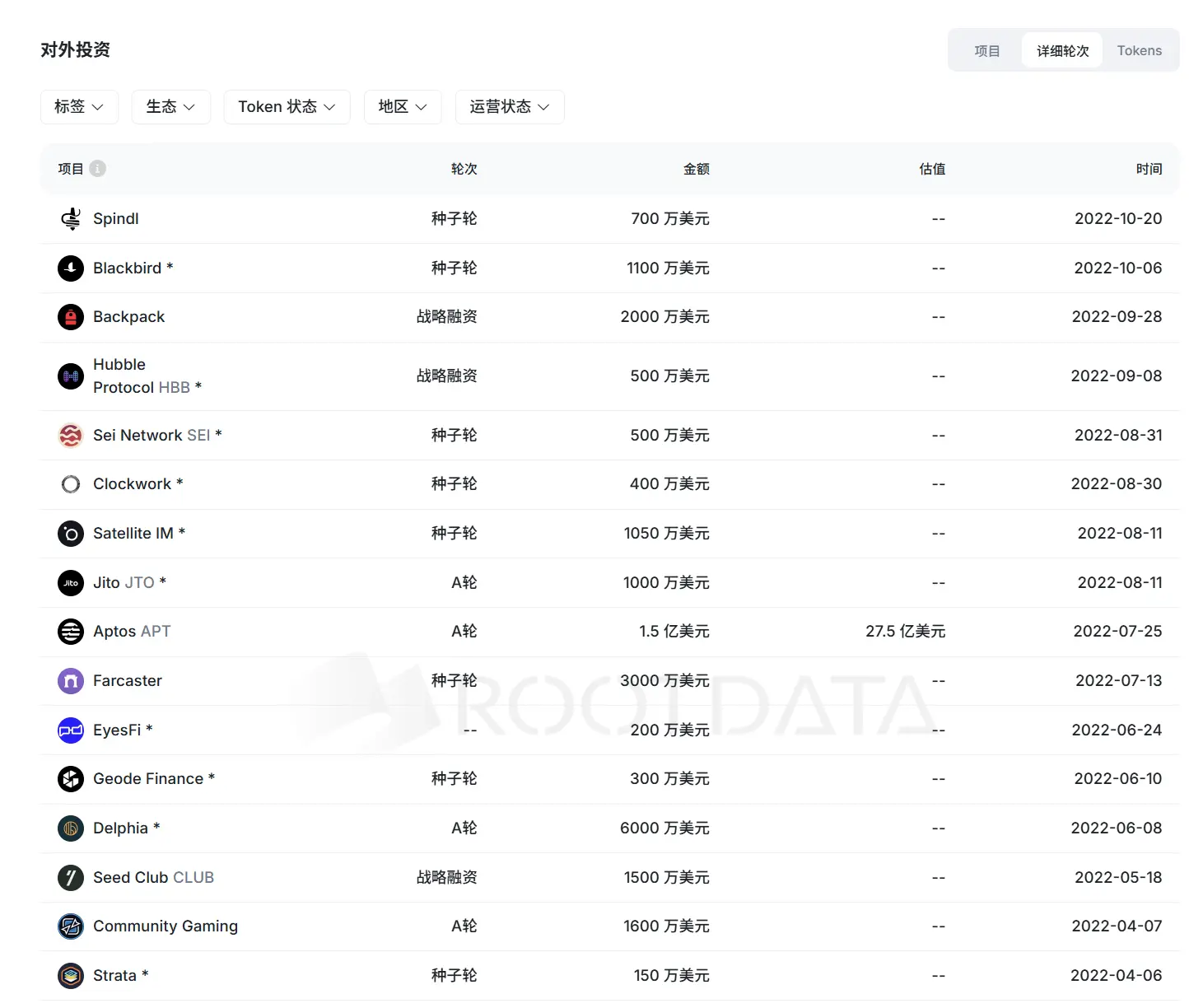
Multicoin Capital Investment Round History Source: RootData

These changes are partly due to the bleak market and performance. Among the projects Multicoin Capital heavily invested in in recent years, Wormhole, invested at a valuation of $2.5 billion (the total amount raised in this round was $225 million, second only to investment rounds in Forward Industries, FTX, and Solana), now has a token FDV of only $220 million. Pyth Network token FDV is only $480 million, and Solana's market value has fallen below $100 again.

At this point, the reason for Kyle Samani's departure is very clear: he believes the development direction of crypto has deviated from his expectations, even his values. The shattering of his ideals forced him to leave this place of disappointment and try to regain his passion in fields like AI and life sciences.

Next, Multicoin Capital will also have to face the situation after "losing its soul." Kyle Samani's exit will undoubtedly raise questions about its future direction and leadership: with the sharp slowdown in investment and organizational adjustments, will Multicoin Capital still be one of the industry's top research-oriented, conviction-driven VCs?

The Trough of Idealism

In fact, before Kyle Samani, many crypto investors and entrepreneurs have expressed similar views, resigning and choosing to temporarily leave the crypto industry. Just in January, a16z Crypto general partner Arianna Simpson announced her departure and plans to establish a new fund investing in various industries, not limited to crypto.

A more famous case is Ken Chan, former co-founder and CTO of Aevo. In an article published in November '25, he bluntly stated that he had wasted 8 years of his life on cryptocurrency and described the crypto industry as "the world's largest, most engaged super casino."

"Spending eight years in the cryptocurrency space completely destroyed my ability to discern sustainable business models. In crypto, you don't need a successful business or product to make money. The cryptocurrency industry is filled with tokens with extremely high market capitalizations but almost no users," Ken Chan believed. "This industry mentality is extremely harmful, and I believe it will lead to a long-term collapse of social mobility for the younger generation."

A series of接连出现的 cases are outlining a clearer trend: against the backdrop of a持续偏紧 macro environment, as the wealth effect of the crypto market明显减弱, the large-scale落地 of typical products is长期受阻, and the core narratives that once supported the industry's expansion are逐一证伪, the crypto industry is阶段性地 losing some of its earliest entrants and most idealistic builders and investors.

This loss does not mean a fundamental denial of crypto technology, but reflects that the patience driven by idealism is being tested by a continuously lengthening realization cycle. Before the return structure, industry order, and long-term expectations are重新建立, some core participants choose to exit阶段性地.

In past cycles, many VC investors have emphasized that high-return investments often occur when the market is "unloved," and bear markets are the best time to capture investment alpha. But now, even the "historical best investor" is choosing to turn and leave at this moment, which itself sends a signal worthy of serious consideration by the industry: the problem may no longer be just a cyclical market pullback, but the阶段性瓶颈 in the crypto industry's innovation capability, value orientation, and narrative vision is perhaps undergoing unprecedented scrutiny and re-evaluation.

Fortunately, more first-tier VCs like Coinbase Ventures, a16z, YZi Labs, and Pantera Capital remain active, with over 30 investments each in the past year. For the crypto industry in an adjustment period, the support from these VCs may not bring immediate prosperity, but it at least means that this round of re-evaluation has not yet turned into a complete exit.


Пов'язані питання

QWhy did Kyle Samani decide to step back from Multicoin Capital and the crypto industry?

AKyle Samani decided to step back because he no longer finds crypto interesting and has lost faith in the Web3 vision. He believes blockchain is primarily an asset ledger that will reshape finance but has limited applications beyond that, prompting him to explore other tech fields like AI and life sciences.

QWhat was Kyle Samani's reputation in the crypto investment community before his departure?

AKyle Samani was regarded as one of the most influential and top crypto investors, often described as a true contrarian. He was notably praised for his early investment in Solana and his steadfast belief in it during the FTX collapse, earning him recognition as one of the greatest venture capitalists in crypto history by figures like Haseeb Qureshi.

QHow has Multicoin Capital's investment activity changed recently according to the article?

AMulticoin Capital's investment activity has significantly slowed, with only 4 investment rounds since the second half of 2025 and 10 since October 2024. This pace is much slower than before and lags behind other prominent VCs, ranking outside the top 50 in investment frequency.

QWhat broader trend does Kyle Samani's exit reflect in the crypto industry?

AKyle Samani's exit reflects a broader trend of idealistic builders and investors leaving crypto due to diminished wealth effects, stalled product scalability, and disproven core narratives. It indicates a phase where patience is wearing thin, and some key participants are reassessing the industry's innovation capabilities and long-term vision.

QWhich areas does Kyle Samani still see potential in within the crypto space?

AKyle Samani still sees potential in on-chain privacy/confidentiality, specifically mentioning his belief in Zama winning that sector, and he acknowledges DePIN (Decentralized Physical Infrastructure Networks) as another notable area with promise.

Пов'язані матеріали

Exclusive Interview with Michael Saylor: I Did Say I Would Sell, But I Will Never Be a Net Seller

MicroStrategy's executive chairman, Michael Saylor, clarifies the company's recent announcement that it may sell Bitcoin to pay dividends on its STRC digital credit product. He emphasizes this does not make MicroStrategy a net seller of Bitcoin. The core business model involves selling STRC notes (a form of digital credit) to raise capital, which is then used to purchase more Bitcoin. Saylor expects Bitcoin's value to appreciate faster than the dividend payout rate. Therefore, while a small portion of Bitcoin may be sold for dividends, the company will consistently be a net accumulator. For example, in April, the company raised $3.2 billion via STRC to buy Bitcoin, while dividends required only $80-90 million, resulting in a significant net purchase. Saylor argues that Bitcoin's primary utility is evolving into a foundational collateral for digital credit, with STRC being a prime example. He notes that STRC now constitutes a majority of the U.S. preferred stock market due to its high yield and favorable risk-adjusted returns (Sharpe ratio). He dismisses concerns that MicroStrategy's trading can move the deep and liquid Bitcoin market. Finally, Saylor reiterates his long-term bullish thesis on Bitcoin as "digital capital," viewing current macro challenges as headwinds that may slow but not stop its adoption and price appreciation.

Odaily星球日报6 хв тому

Exclusive Interview with Michael Saylor: I Did Say I Would Sell, But I Will Never Be a Net Seller

Odaily星球日报6 хв тому

Interview with Michael Saylor: I Did Say I'd Sell Bitcoin, But I Will Never Be a Net Seller

**Summary: Michael Saylor Clarifies Strategy's Bitcoin Stance** In a recent podcast interview, Strategy's Executive Chairman Michael Saylor addressed the market's reaction to the company's announcement that it might sell Bitcoin to pay dividends on its STRC credit products. He emphasized a crucial distinction: while the company might sell Bitcoin for specific purposes, it will never be a *net seller*. Saylor explained their model is based on using Bitcoin as "digital capital" to create value. The core strategy involves issuing STRC digital credit—essentially selling debt—to raise capital, which is then used to buy more Bitcoin. He estimates Bitcoin appreciates at roughly 40% annually. A small portion of these capital gains (e.g., ~2.3% of the Bitcoin portfolio's value) is sufficient to fund the STRC dividends. Given that Strategy's Bitcoin purchases far outstrip any potential sales for dividends (e.g., buying $3.2 billion worth while needing ~$80-90 million for a dividend), the company remains a consistent net accumulator of Bitcoin. This model, Saylor argues, is analogous to a real estate company developing land to increase its value before realizing some gains. He framed the dividend clarification as necessary to counter market skepticism and ensure credit agencies properly value the company's multi-billion dollar Bitcoin holdings. Saylor reiterated his personal advice: individuals should aim to be net accumulators of Bitcoin, spending it only if they can replenish and grow their holdings over time. Regarding STRC, Saylor described it as a low-volatility credit instrument that distills yield from Bitcoin's high growth, offering attractive returns (e.g., ~11-12% yield) for risk-averse investors. He noted that Strategy's STRC issuance now constitutes about 60% of the U.S. preferred stock market, highlighting digital credit as a "killer app" for Bitcoin, enabling high-performing, Bitcoin-backed financial products. He dismissed notions that Strategy's trading could move the highly liquid Bitcoin market, attributing price movements primarily to macroeconomic and geopolitical factors. Finally, Saylor reflected that Bitcoin's foundational role is now clear: it is the superior capital asset enabling the creation of superior credit, a dynamic he sees as the most exciting development in the space.

marsbit13 хв тому

Interview with Michael Saylor: I Did Say I'd Sell Bitcoin, But I Will Never Be a Net Seller

marsbit13 хв тому

380,000 Apps Exposed, 2,000+ Apps Leaked Secrets: AI Programming Turns 'Intranet' into Public Internet

Israeli cybersecurity firm RedAccess uncovered a severe data exposure trend linked to "vibe coding" or AI-powered software development tools. Their research found approximately 38,000 publicly accessible web applications built with platforms like Lovable, Base44, Netlify, and Replit. Of these, an estimated 2,000 apps exposed sensitive corporate and personal data, including medical records, financial information, internal strategic documents, and customer chat logs. In some cases, access even granted administrative privileges. The core issue stems from default privacy settings that make applications public by default, combined with a lack of built-in security controls (like authentication) in the AI-generated code. This allows employees without security expertise—"citizen developers"—to easily create and deploy applications that bypass standard corporate security reviews. The exposed apps, often indexed by search engines, are trivially discoverable. While some platform providers (Replit, Lovable, Wix/Base44) argue that security configuration is the user's responsibility and question the validity of some findings, security researchers confirm the widespread reality of such exposures. This pattern, also noted in prior studies, highlights a critical security gap as AI democratizes app creation, potentially leading to massive, unintentional data leaks.

marsbit1 год тому

380,000 Apps Exposed, 2,000+ Apps Leaked Secrets: AI Programming Turns 'Intranet' into Public Internet

marsbit1 год тому

Attracting Global Capital, Asia's New 'Super Cycle' Is Unfolding

Investors are turning to Asia as the next frontier for global equity growth, with a new "super cycle" unfolding across the region. Driven by the AI revolution, Asian markets, particularly South Korea, have seen significant rallies. According to Morgan Stanley analysis, the underlying drivers of Asia's industrial cycle are shifting from traditional sectors like real estate and manufacturing to massive investments in AI infrastructure, energy security and transition, and supply chain resilience. Fixed asset investment in Asia is projected to grow from around $11 trillion in 2025 to $16 trillion by 2030, with a 7% annual growth rate from 2026-2030. The AI wave is a primary catalyst, driving immense capital expenditure for chips, servers, data centers, and power systems. Asia is central to this hardware supply chain. In China, AI investment is focused on building a full-system domestic capability, with the local AI chip market potentially reaching $86 billion by 2030. Beyond AI, China's export story is expanding from EVs and batteries to robotics. The country already captures about half of new global industrial robot demand and over 90% of humanoid robot shipments. This growth phase mirrors the early stages of China's EV export boom. Simultaneously, energy security investments, spurred by AI's massive power needs, are rising, with China benefiting from its leadership in solar, batteries, and EVs. Regional defense spending is also increasing structurally, supporting demand for advanced manufacturing. The main beneficiaries are China, South Korea, and Japan, positioned in core supply chain areas. However, risks remain, including potential overcapacity, profit margin pressures from competition, persistent technological restrictions, geopolitical friction, and workforce displacement due to AI-driven automation. Market volatility is also expected to increase as investor expectations diverge on the realization of these capital investment and export themes.

marsbit1 год тому

Attracting Global Capital, Asia's New 'Super Cycle' Is Unfolding

marsbit1 год тому

Торгівля

Спот
Ф'ючерси
活动图片




