When Crypto Is No Longer Fun, When Multicoin Capital Loses Its Soul

marsbitОпубліковано о 2026-02-05Востаннє оновлено о 2026-02-05

Анотація

Kyle Samani, co-founder and managing partner of Multicoin Capital, has announced his departure from the firm’s daily operations and investment decisions, shifting his focus to other technology sectors such as AI and life sciences. Samani, widely regarded as one of crypto’s most influential and contrarian investors, played a key role in the firm’s early bet on Solana, which yielded massive returns. In a since-deleted social media post, Samani expressed that crypto is “not as fun as it used to be,” and no longer believes in the broader Web3 vision. He now sees blockchain primarily as a financial ledger with limited applications beyond finance, though he remains optimistic about privacy and DePIN sectors. Multicoin Capital’s investment activity has slowed significantly since late 2024, with only 10 deals since October 2024, far fewer than other top VCs. The firm’s major investments, such as Wormhole and Pyth Network, have also underperformed. Samani’s exit reflects a broader trend of key figures leaving crypto during a prolonged market downturn, citing disillusionment with the industry’s direction, unsustainable models, and weakened narratives. Despite this, firms like a16z and Pantera Capital remain active, suggesting the industry’s reassessment hasn’t yet turned into a full-scale exodus.

Author: Gu Yu, ChainCatcher

Today, Kyle Samani, co-founder and managing partner of Multicoin Capital, announced on his social media account that he will step down from the daily management and investment decisions of Multicoin Capital and will explore opportunities in other technology fields outside the crypto industry in the future. Multicoin subsequently stated that the fund will continue to operate normally, and existing investments and team structure will not be affected.

The "Best Crypto Investor" Chooses to Fade Away

This is undoubtedly big news in the crypto VC circle. For a long time, Kyle Samani frequently wrote long articles, participated in industry debates, maintained a clear stance on investment strategies, and, thanks to his early investment in Solana which brought hundreds of times returns, he was not only the soul of Multicoin Capital but also one of the most influential investors in the crypto industry with significant say.

Previously, Haseeb Qureshi, managing partner of Dragonfly, wrote an article about the three crypto investors he most admired, with Dan Robinson, Chris Dixon, and Kyle Samani ranking third, second, and first respectively.

"Kyle is one of the few truly contrarian investors in the cryptocurrency space. I disagree with almost all of his views. But his initial investments, and his firm belief in holding Solana through the trough after the FTX collapse, make him undoubtedly one of the greatest venture capitalists in cryptocurrency history," wrote Haseeb Qureshi.

And it is such a "historical best" who chose to resign at one of the bleakest moments in the crypto industry, which inevitably makes one ponder the underlying meaning: even the top VC investors can no longer persist? After all, a few years ago, even when the price of SOL fell below $10 due to the FTX incident, he still stuck to his investment views and eventually proved himself with a more than 25-fold increase.

And shortly after the news was announced, a tweet posted and quickly deleted by Kyle Samani on his X account earlier today was also dug up.

According to information, Kyle Samani, in response to a吐槽 (complaint) post by X user Taran (@Taran_ss), said: "Crypto just isn't as fun as many people (including myself) once thought. I used to believe in the Web3 vision, believed in dApps. Now I don't. Blockchains are essentially asset ledgers. They will reshape finance, but that's about it, not much more. DePIN is another area worth noting. Crypto will continue to get better, but all the really interesting questions have been answered, except for on-chain privacy/confidentiality. (I still firmly believe Zama will win this track.)"

In this reply, Kyle Samani clearly believes that crypto is no longer fun and no longer believes in the Web3 vision. Apart from reshaping finance, blockchain is unlikely to play a greater role in other areas. Privacy and DePIN are the only areas he still recognizes.

Multicoin Capital's letter to LPs further verified the matter of "Kyle losing interest in crypto." stating that "Kyle's interests have expanded from cryptocurrency to other technology fields such as artificial intelligence, life sciences, and robotics. He has decided to devote time to exploring these emerging technologies."

Data also reflects that Multicoin Capital's attitude and strategy are undergoing significant changes. According to RootData, since the second half of 2025, Multicoin Capital has only participated in 4 investment rounds, and only 10 since October 2024. This not only represents a significant slowdown in investment frequency compared to before but also lags明显 behind the investment frequency of other well-known VCs during the same period, ranking outside the top 50.
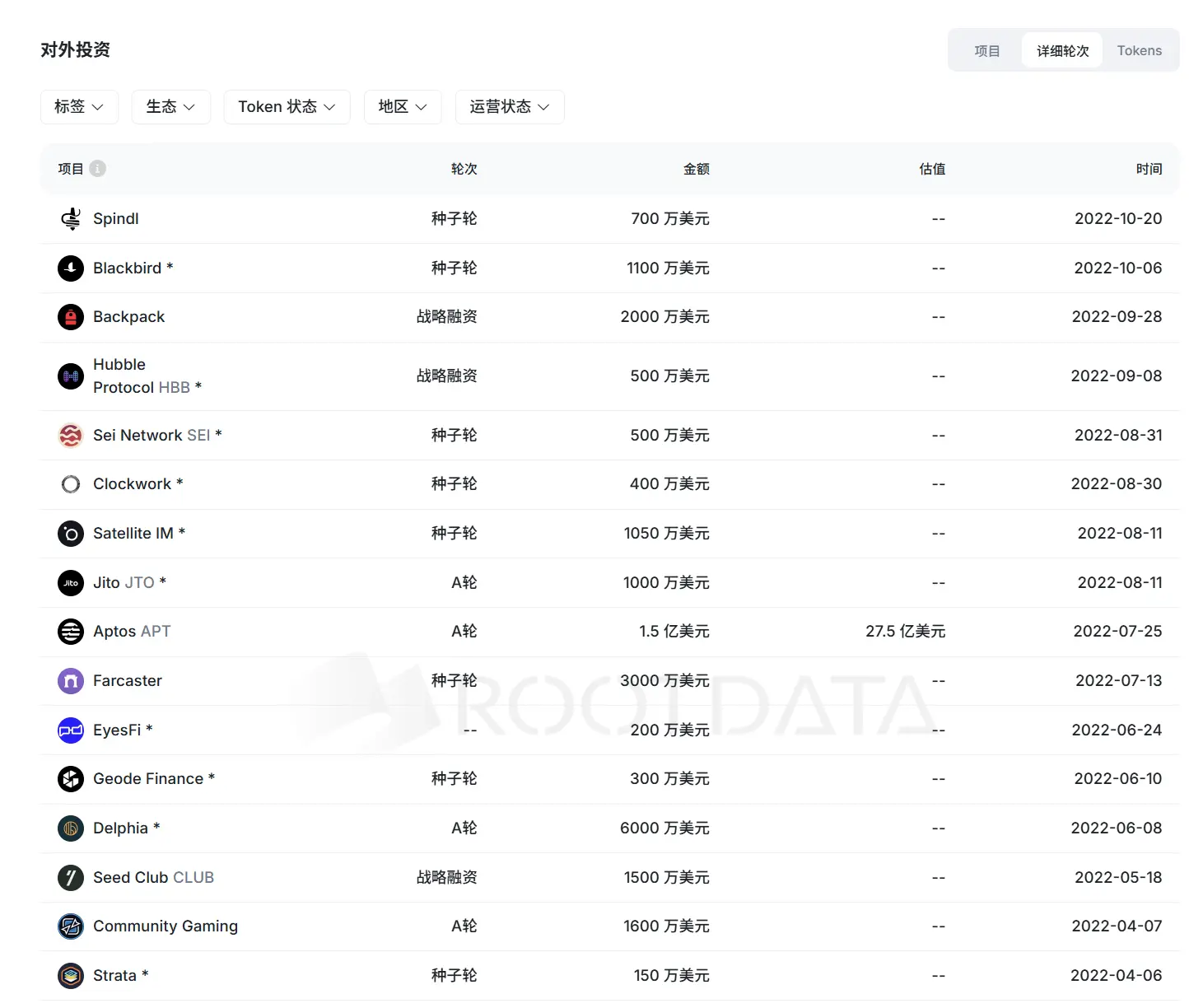
Multicoin Capital Investment Round History Source: RootData

These changes are partly due to the bleak market and performance. Among the projects Multicoin Capital heavily invested in in recent years, Wormhole, invested at a valuation of $2.5 billion (the total amount raised in this round was $225 million, second only to investment rounds in Forward Industries, FTX, and Solana), now has a token FDV of only $220 million. Pyth Network token FDV is only $480 million, and Solana's market value has fallen below $100 again.

At this point, the reason for Kyle Samani's departure is very clear: he believes the development direction of crypto has deviated from his expectations, even his values. The shattering of his ideals forced him to leave this place of disappointment and try to regain his passion in fields like AI and life sciences.

Next, Multicoin Capital will also have to face the situation after "losing its soul." Kyle Samani's exit will undoubtedly raise questions about its future direction and leadership: with the sharp slowdown in investment and organizational adjustments, will Multicoin Capital still be one of the industry's top research-oriented, conviction-driven VCs?

The Trough of Idealism

In fact, before Kyle Samani, many crypto investors and entrepreneurs have expressed similar views, resigning and choosing to temporarily leave the crypto industry. Just in January, a16z Crypto general partner Arianna Simpson announced her departure and plans to establish a new fund investing in various industries, not limited to crypto.

A more famous case is Ken Chan, former co-founder and CTO of Aevo. In an article published in November '25, he bluntly stated that he had wasted 8 years of his life on cryptocurrency and described the crypto industry as "the world's largest, most engaged super casino."

"Spending eight years in the cryptocurrency space completely destroyed my ability to discern sustainable business models. In crypto, you don't need a successful business or product to make money. The cryptocurrency industry is filled with tokens with extremely high market capitalizations but almost no users," Ken Chan believed. "This industry mentality is extremely harmful, and I believe it will lead to a long-term collapse of social mobility for the younger generation."

A series of接连出现的 cases are outlining a clearer trend: against the backdrop of a持续偏紧 macro environment, as the wealth effect of the crypto market明显减弱, the large-scale落地 of typical products is长期受阻, and the core narratives that once supported the industry's expansion are逐一证伪, the crypto industry is阶段性地 losing some of its earliest entrants and most idealistic builders and investors.

This loss does not mean a fundamental denial of crypto technology, but reflects that the patience driven by idealism is being tested by a continuously lengthening realization cycle. Before the return structure, industry order, and long-term expectations are重新建立, some core participants choose to exit阶段性地.

In past cycles, many VC investors have emphasized that high-return investments often occur when the market is "unloved," and bear markets are the best time to capture investment alpha. But now, even the "historical best investor" is choosing to turn and leave at this moment, which itself sends a signal worthy of serious consideration by the industry: the problem may no longer be just a cyclical market pullback, but the阶段性瓶颈 in the crypto industry's innovation capability, value orientation, and narrative vision is perhaps undergoing unprecedented scrutiny and re-evaluation.

Fortunately, more first-tier VCs like Coinbase Ventures, a16z, YZi Labs, and Pantera Capital remain active, with over 30 investments each in the past year. For the crypto industry in an adjustment period, the support from these VCs may not bring immediate prosperity, but it at least means that this round of re-evaluation has not yet turned into a complete exit.


Пов'язані питання

QWhy did Kyle Samani decide to step back from Multicoin Capital and the crypto industry?

AKyle Samani decided to step back because he no longer finds crypto interesting and has lost faith in the Web3 vision. He believes blockchain is primarily an asset ledger that will reshape finance but has limited applications beyond that, prompting him to explore other tech fields like AI and life sciences.

QWhat was Kyle Samani's reputation in the crypto investment community before his departure?

AKyle Samani was regarded as one of the most influential and top crypto investors, often described as a true contrarian. He was notably praised for his early investment in Solana and his steadfast belief in it during the FTX collapse, earning him recognition as one of the greatest venture capitalists in crypto history by figures like Haseeb Qureshi.

QHow has Multicoin Capital's investment activity changed recently according to the article?

AMulticoin Capital's investment activity has significantly slowed, with only 4 investment rounds since the second half of 2025 and 10 since October 2024. This pace is much slower than before and lags behind other prominent VCs, ranking outside the top 50 in investment frequency.

QWhat broader trend does Kyle Samani's exit reflect in the crypto industry?

AKyle Samani's exit reflects a broader trend of idealistic builders and investors leaving crypto due to diminished wealth effects, stalled product scalability, and disproven core narratives. It indicates a phase where patience is wearing thin, and some key participants are reassessing the industry's innovation capabilities and long-term vision.

QWhich areas does Kyle Samani still see potential in within the crypto space?

AKyle Samani still sees potential in on-chain privacy/confidentiality, specifically mentioning his belief in Zama winning that sector, and he acknowledges DePIN (Decentralized Physical Infrastructure Networks) as another notable area with promise.

Пов'язані матеріали

7 Months After the Collapse of Huiwang, Southeast Asia's Escrow Platforms Undergo a Major Reshuffle

Following the collapse of Huione Pay—dubbed the "Alipay of Southeast Asia"—seven months ago, the region's underground financial guarantee platform sector is undergoing a significant reshuffle. This power vacuum has been swiftly filled by emerging platforms such as XinBi, Tiger/Navigator, JinBei (renamed JinBo), Dali/Tiancheng, and FullyLight. These platforms, operating largely via Telegram and offering services like escrow for illicit transactions, have absorbed the vast user base and markets left behind by Huione. While positioning themselves as "trust intermediaries," their primary clientele consists of networks involved in online scams, money laundering, illegal gambling, and even human trafficking. For instance, the Tiger/Navigator platform explicitly provides "escrow" services for kidnapping-for-ransom operations ("强押车交易"). Data underscores the immense scale: Huione alone processed over $103 billion in cryptocurrency payments and facilitated over $31 billion through its escrow market before its downfall, linking it to Cambodia's notorious Prince Group. Since its collapse, competitors have seen explosive growth. For example, the XinBi platform has accumulated over $1.6 billion in total USDT revenue, while platforms like NewPay, OkPay (under Dali), and FullyLight Wallet collectively processed over $4.8 billion in USDT in a single year. This ecosystem thrives in regions like Cambodia and Myanmar, where regulatory gaps allow these platforms to act as critical financial infrastructure for sprawling cybercrime industries, from scam compounds to online casinos. The article concludes that the moniker "Southeast Asian Alipay" is a misnomer, obscuring the platforms' fundamental role in enabling serious criminal enterprises rather than representing legitimate financial innovation.

Odaily星球日报40 хв тому

7 Months After the Collapse of Huiwang, Southeast Asia's Escrow Platforms Undergo a Major Reshuffle

Odaily星球日报40 хв тому

The Changing Landscape: What Are Crypto VCs Experiencing?

Title: The Shifting Landscape of Crypto Venture Capital The era of dedicated crypto venture capital funds is undergoing a significant transformation. Once essential for navigating the sector's complexity and high risk, these specialized funds are now facing an identity crisis as the market matures. This shift mirrors historical patterns in other specialized investment classes like cleantech and SPACs, where initial information advantages dissipate as technologies become mainstream and integrated into existing industry frameworks. The article argues that crypto is reaching a critical inflection point, transitioning from a "building phase" to an "integration phase." Major players like Stripe, BlackRock, and Visa now engage with crypto not for its novel mechanics but as a foundational financial infrastructure. Their needs—regulatory compliance, banking partnerships, distribution channels—align with traditional fintech, a domain easily understood by large, generalist funds like Sequoia and Founders Fund. This evolution creates a "barbell effect" within the VC landscape. On one end are massive, diversified platforms that can incorporate crypto as one vertical among many. On the other are small, nimble funds focused on niche, experimental projects. The middle ground—medium-sized dedicated crypto funds—is being squeezed out. Their typical fund size makes it impossible to generate sufficient returns solely from early-stage crypto bets, yet they cannot compete with giants for later-stage deals. Consequently, leading crypto-native firms like Paradigm and Framework Ventures are expanding into AI, robotics, and other sectors, driven partly by LP pressure for better returns amid a broader VC DPI crisis. Others, like Dragonfly and a16z, have narrowed their crypto focus predominantly to financial infrastructure like stablecoins, reframing the sector's core narrative. For crypto entrepreneurs, this consolidation presents challenges. While generalist funds offer larger checks and broader resources, crypto projects now compete fiercely with AI for attention and capital within these firms. Furthermore, the long-term, non-commercial foundational work that built the ecosystem—funded by dedicated crypto VCs—is less likely to attract generalist capital focused on direct returns. The conclusion is that "crypto investor" as a standalone category is becoming obsolete, akin to "internet investor." Crypto is becoming a baseline infrastructure layer. The future will see a barbell structure: large-scale growth financing handled by generalist funds, while pioneering, speculative projects are funded by small, specialized vehicles. The dedicated crypto funds of the 2017-2021 boom, which incubated core infrastructure, are giving way to this new, bifurcated reality.

Foresight News57 хв тому

The Changing Landscape: What Are Crypto VCs Experiencing?

Foresight News57 хв тому

As Consensus Accelerates, What Are Young Investors Betting On?

Title: As Consensus Forms Faster, What Are Young Investors Betting On? In the rapid evolution of tech investment, a new generation of young investors is navigating a landscape where AI, robotics, commercial aerospace, and quantum computing are advancing simultaneously. Traditional investment logic based on financial models is giving way to a need for deep technical understanding and the ability to act before industry consensus forms. An analysis of trends from the "WAIC FUTURE TECH" list of young investment leaders reveals key shifts in focus. The first major trend is the movement of AI from the digital screen into the physical world. Investment is shifting from large language models and chatbots towards embodied AI, robotics, AI hardware, and edge computing. While demonstrations generate excitement, the real challenge lies in achieving scalable, reliable, and cost-effective delivery in complex real-world environments like factories and logistics. Success depends not just on algorithms but on the integration of sensors, actuators, and control systems. Second, the competitive focus for large models is moving beyond raw capability toward building an "intelligence flywheel." The goal is to create self-reinforcing systems where user interaction generates data, improving the model, which in turn enhances the user experience and attracts more engagement. Companies that successfully embed AI into workflows to create these closed-loop systems can build lasting value that isn't easily erased by the next model upgrade. Third, facing a potential bottleneck in high-quality human-generated data, investors are looking at new underlying technologies. Reinforcement learning and self-play, as demonstrated by AlphaGo Zero, offer paths for AI to generate its own experience. Scientific foundation models, which aim to build general AI capabilities for fields like life sciences and materials discovery, represent a non-consensus direction that could unlock new frontiers of knowledge and data. Finally, in deep-tech areas like quantum computing, commercial aerospace, and space-based infrastructure, patient capital is essential. These fields have long, uncertain development and validation cycles involving complex engineering, supply chains, and regulations. Investment here requires a long-term view, focusing on foundational team capabilities and the eventual emergence of market demand, even if commercial returns are distant. Collectively, these trends illustrate how young investors are adapting to a new era. They are learning to make earlier, technically-informed judgments, balance hype with real-world viability, and provide the patient capital needed to build the deep-tech foundations of the future.

marsbit1 год тому

As Consensus Accelerates, What Are Young Investors Betting On?

marsbit1 год тому

Торгівля

Спот
活动图片




