When Breakpoint Becomes a 'Festival': Why Solana Still Puts Builders Center Stage

marsbitОпубліковано о 2025-12-16Востаннє оновлено о 2025-12-16

Анотація

Breakpoint 2025 in Abu Dhabi marked a significant evolution for the Solana ecosystem—from a developer-focused gathering into a global “festival” of builders, capital, and cultural energy. Authored by Abhitej, a long-time Solana builder, the piece reflects on whether the event has retained its builder-first ethos amid rapid scaling and institutional interest. Unlike traditional conferences, Breakpoint felt open, decentralized, and intentionally designed to reduce hierarchy. It balanced the presence of developers, founders, creators, and investors without letting any group dominate. The agenda emphasized short, high-signal talks and demos, giving more people visibility. Solana’s culture stands out for rejecting elitism—anyone building something meaningful, no matter how small, gets a platform. The ecosystem embraces what works, from DeFi and infrastructure innovation to memecoins, learning from both successes and failures. Despite market turbulence, Breakpoint 2025 felt grounded in product-building, with mature discussions on scalability, cost, and real-world use cases. The energy was optimistic yet pragmatic—a celebration of creation, not extraction. While some insular “Solana-only” attitudes persist, the overall vibe was collaborative and forward-moving. Abu Dhabi’s setting contributed to the event’s inclusive, international atmosphere. Breakpoint has outgrown the conference model—it’s now a cultural festival embodying the open, builder-centric spirit of the next internet...

In December 2025, after Solana Breakpoint 2025 concluded in Abu Dhabi, Abhitej, an entrepreneur long entrenched in the Solana ecosystem, wrote this article. As a co-founder of Filament Finance and now a core builder at Bento.fun, he reflects, based on firsthand experience from multiple Breakpoints, on whether builders are still truly placed at the center as the conference has scaled.

The title may seem sharp, but it is not a negation of the grand event; rather, it's a reminder from within the ecosystem: as Breakpoint evolved from an early developer-led gathering into a global spectacle sharing the city with the F1 Grand Prix and Bitcoin MENA, with institutions, capital, and grand narratives flooding in, are the true "heads-down coders" getting diluted in the mix.

Unlike macro judgments from an external perspective, Abhitej focuses on those hard-to-quantify factors that determine the ecosystem's direction—whether the culture remains open, whether the stage still belongs to the builders, whether participation remains low-barrier. The article does not attempt to provide a standard answer, but it reminds us: Solana's vitality has never been on the stage or in the narratives, but in the developers around the globe who are persistently, quietly, yet truly building products.

Below is the original text:

I attended the first Breakpoint in Lisbon, and four years later, came to Abu Dhabi for the latest edition. In between, industry giants have fallen, the price of SOL has completed roller-coaster rides more than once, and Memecoin mania has repeatedly tested the resilience of the entire ecosystem.

But as the Solana ecosystem began preparing for Breakpoint 2025, it had already established its position:

Leading in multiple core metrics such as transaction count, application revenue, and DEX trading volume

Possessing the most culturally perceptive, user-close ecosystem atmosphere

Being the strongest, or at least one of the strongest, builder ecosystems

@joeljohn's article "Most used chain based on what?" also well pointed out Solana's dominance in multiple recent dimensions.
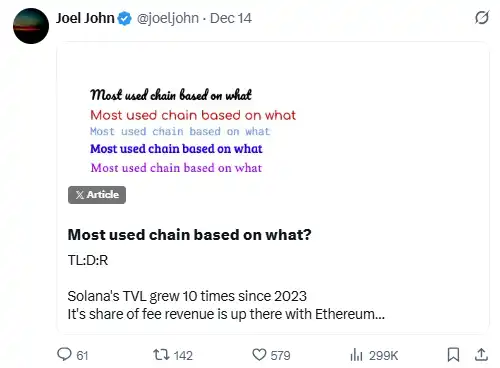
All of this has happened against the backdrop of an extremely brutal cycle for retail. Arbitrageurs have squeezed value to near its limits, altcoins have underperformed the market overall, and net developer inflow has dropped to a low. What this industry truly lacks is a spark of optimism, something that reminds people: the crypto world itself is still beautiful.

I believe Breakpoint lit that match.

When I walked into the Solana Breakpoint venue in Abu Dhabi, the first thing I felt wasn't excitement, but a movement in progress.

Not the kind of noisy, chaotic bustle. More like an undercurrent. A force in flow.

It didn't feel like entering a conference. There was no tension, no forced social pressure, no anxiety of "I must be in the right room at the right time." It felt more like a festival, a place where people weren't there to "extract value" from each other, but to genuinely celebrate "creation."

People were smiling, talking, moving around freely. Developers, creators, founders, institutions—everyone had their place, and overall, it wasn't unbalanced.

This sense of harmony was obvious from the start. No single group was overly amplified: institutions didn't dominate the narrative; creators weren't treated as mascots; founders weren't elevated to unreachable statuses. Everyone seemed approachable.

And that, in itself, is very rare.

The longer I stayed at Breakpoint, the more I felt that all this was not accidental, but deliberately designed.

The agenda wasn't like top-down information infusion: five-minute lightning talks, debates, product demos, conversations. Short, sharp, high information density. Letting more people be seen, rather than having a few repeatedly occupy the stage. You could clearly feel that this wasn't a one-time inspiration, but the result of long-term iteration.

Breakpoint wasn't achieved overnight, but gradually figured out "what really works" through years of practice.

A brief exchange I had with @paarugsethi from Superteam India was enough to make one realize how deeply the Solana ecosystem thinks about culture and the founder community.

Dissolving Elitism

But if there's one thing Solana does better than most ecosystems, it's this: it successfully dissolves elitism.

There's no invisible hierarchy here where "only a few voices matter." As long as you've genuinely built something valuable, even if it's small, you can get a platform to showcase it.

This openness changes everything: it reduces fear, invites more participation, and ultimately creates momentum. And momentum compounds.

After talking to more and more people, another characteristic became clear: within the Solana ecosystem, there is a shared sense of direction. Not a dogmatic consensus, but a state of "moving forward together." There are navigators, signal sources, and people who are seen as directional coordinates by others. Because of this, the ecosystem doesn't easily fragment.

In many ecosystems, people fight their own battles, narratives conflict, gaps keep widening, and everyone endlessly argues about "what should be," unwilling to accept "what is working."

Solana does it differently. If speculation works, it's accepted. If it fits the behavior of the new generation, it's studied, not shamed. There's no moral superiority, no whitewashing. Even memecoins, despite that phase being chaotic and predatory, were seen as an acceleration experiment, a stress test of internet capital markets.

The system crashed, some profited from it, and lessons were truly absorbed. Solana didn't pretend it never happened, but distilled the cognition as an "entire ecosystem." This acceptance, instead, made space for innovation, rather than accumulating resentment.

The most prominent feeling this year was Breakpoint's extreme builder-first nature. The market has cooled, prices are no longer狂热, the "100x overnight" crowd has noticeably decreased. But it's precisely at times like these that the real builders begin to shine.

DeFi appears more mature; infrastructure discussions return to reality: predictability of block space, latency optimization, how to make app execution cheaper and more reliable.

You can see this change in specific products: Kalshi choosing Solana as tokenization infrastructure; Phantom supporting consumer-facing interface experiences; Phoenix perps, Prop AMM, new market designs; experiments in AI, bots, privacy; hackathons, Superteam projects, those still rough but real early ideas. People come to listen to shares to learn, not to ask "how to pump this token."

This energy shift is extremely important. It makes the entire conference feel solid, honest, and product-centric.

If there's one discomfort, it's that some narrow-minded attitudes still exist in the ecosystem—"if it's not Solana-only, it's not worth attention."

This mindset isn't unique to Solana, but it shrinks the pie. The real opportunity isn't winning a public chain war, but reshaping the entire tech stack. And that can only be achieved through collaboration, not posturing.

The irony is: Solana doesn't need to proclaim loudly. Anyone walking into Breakpoint can feel it directly. This ecosystem doesn't need to mock each other online. The products, the culture, the builders, the momentum—they are loud enough.

A "Festival"

This brings me back to the initial conclusion: Solana has outgrown "holding conferences." Conferences are one-way, static, bounded. What Solana is doing now aligns more with the native form of the new generation: a festival, a celebration that exists for builders. A space where culture, capital, experimental spirit, and belief collide.

And these "festivals" will only continue to grow: more vibrant, more immersive, more diverse. Every corner adds new flavor to this internet that is taking shape.

Breakpoint 2025 is one of the best conferences I've ever attended, and it clearly shows where Solana is heading.

P.S.: In my view, choosing Abu Dhabi as the host city was an important reason why Breakpoint 2025 could be so special.


Пов'язані питання

QWhat is the main concern raised by Abhitej about the evolution of Solana Breakpoint?

AAbhitej is concerned about whether builders, the core developers who code and create, remain at the center of the event as Breakpoint has scaled up from an early developer-led gathering into a large global conference with significant institutional and capital presence.

QAccording to the article, what makes Solana's ecosystem culture different from others?

ASolana's ecosystem culture is described as open, non-elitist, and builder-first. It successfully消解 (dissolves) elitism, where anyone who builds something valuable, even on a small scale, can get a platform. It lacks a hidden hierarchy and moral superiority, accepting what works—like投机 (speculation) or memecoins—as part of its experimental nature.

QWhat key change in energy or focus was observed at Breakpoint 2025 compared to more狂热 (frenzied) market times?

AThe energy at Breakpoint 2025 was more builder-first and product-centered. With the cooling market and fewer people seeking 'overnight 100x' gains, discussions shifted to mature DeFi, realistic infrastructure improvements (like predictable block space and lower costs), and genuine learning, rather than questions about token pumps.

QHow does the author describe the overall atmosphere and structure of Breakpoint?

AThe author describes Breakpoint not as a traditional conference but more like a '节日' (festival or celebration)—a dynamic, immersive space that feels like a movement. It lacks the pressure of traditional networking, is intentionally designed to be inclusive with short, high-density talks, and allows different groups (developers, creators, founders, institutions) to coexist harmoniously without any one dominating.

QWhat is one potential weakness or狭隘 (narrow-minded) attitude the author points out within the Solana ecosystem?

AThe author points out a narrow-minded attitude where some in the ecosystem believe that 'if it's not Solana-only, it's not worth paying attention to.' This mentality can limit collaboration and the larger opportunity to reshape the entire tech stack, which requires working together rather than engaging in tribal '公链战争' (public chain wars).

Пов'язані матеріали

Anthropic and OpenAI Have Single-Handedly Severed the Logic of Pre-IPO Stock Tokenization

The pre-IPO stock token market is experiencing significant turmoil following strong statements from AI giants Anthropic and OpenAI. Both companies have updated their official policies, declaring that any transfer of their company shares—including sales, transfers, or assignments of share interests—without prior board approval is "invalid" and will not be recognized in their corporate records. This means buyers in such unauthorized transactions would not be recognized as shareholders and would have no shareholder rights. A major point of contention is the use of Special Purpose Vehicles (SPVs), which are legal entities commonly used by pre-IPO token platforms to pool investor funds and indirectly acquire shares from employees or early investors. The companies explicitly state they do not permit SPVs to acquire their shares, and any such transfer violates their restrictions. They warn that third parties selling shares through SPVs, direct sales, forward contracts, or stock tokens are likely engaged in fraud or are offering worthless investments due to these transfer limits. This stance directly threatens the core model of many pre-IPO token platforms, which rely on SPV structures. The announcement revealed additional risks within this model, such as complex "SPV-within-SPV" layering that obscures legal transparency, increases management fees, and creates a chain reaction risk of invalidation. Following the news, tokens like ANTHROPIC and OPENAI on platforms like PreStocks fell sharply (over 20%). The market reaction highlights a divergence: while asset-backed pre-IPO tokens plummeted, purely speculative pre-IPO futures contracts, which are bilateral bets on future IPO prices with no claim to actual shares, remained relatively stable as they are unaffected by the transfer restrictions. The industry is split on the implications. Some believe the fundamental logic of pre-IPO token trading is broken if leading companies reject SPV-held shares, potentially causing a domino effect. Others, like Rivet founder Nick Abouzeid, argue that buyers of such unofficial tokens always knowingly accepted the risk of non-recognition by the company. The statements serve as a stark risk warning and a corrective measure for a market where valuations for some AI-related pre-IPO tokens had soared to irrational levels, far exceeding recent funding round valuations.

marsbit7 хв тому

Anthropic and OpenAI Have Single-Handedly Severed the Logic of Pre-IPO Stock Tokenization

marsbit7 хв тому

Anthropic and OpenAI Personally Sever the Logic of Pre-IPO Crypto-Stocks

The pre-IPO token market has been rocked by strong statements from Anthropic and OpenAI. Both AI giants have updated official warnings, declaring that any sale or transfer of their company shares without explicit board approval is "invalid" and will not be recognized on their corporate records. This directly targets Special Purpose Vehicles (SPVs), the common legal structure used by pre-IPO token platforms. These platforms typically use an SPV to acquire shares from employees or early investors, then issue blockchain-based tokens representing a claim on the SPV's economic benefits. Anthropic and OpenAI's position means that if an SPV's share purchase lacked authorization, the underlying asset could be deemed worthless, nullifying the token's value. Anthropic explicitly warned that any third party selling its shares—via direct sales, forwards, or tokens—is likely fraudulent or offering a valueless investment. The crackdown highlights risks in the popular SPV model, including complex multi-layered "Russian doll" SPV structures that obscure legal ownership, add fees, and concentrate risk. If one layer is invalidated, the entire chain could collapse. Following the announcements, tokens like ANTHROPIC and OPENAI on platforms like PreStocks fell sharply (over 20%). In contrast, purely speculative pre-IPO prediction contracts remained stable, as they involve no actual share ownership. The move is seen as a corrective measure amid a market frenzy where some pre-IPO token valuations (e.g., Anthropic's token hitting a $1.4 trillion implied valuation) far exceeded recent official funding rounds. Opinions are split: some believe this undermines the core logic of pre-IPO token trading if top companies reject SPVs, while others argue buyers always assumed this legal risk when accessing unofficial channels. The statements serve as a stark warning and a potential catalyst for market de-leveraging and clearer boundaries.

Odaily星球日报10 хв тому

Anthropic and OpenAI Personally Sever the Logic of Pre-IPO Crypto-Stocks

Odaily星球日报10 хв тому

The Waged Worker Driven to Poverty by AI Subscriptions

"AI Membership: The Hidden Cost Pushing Workers Toward 'Poverty'" The widespread corporate push for AI adoption is creating a hidden financial burden for employees. Companies, from giants like Alibaba to small firms, are mandating AI use, often tying token consumption to KPIs, but frequently refuse to cover the costs. Workers are forced to pay for subscriptions out of pocket to stay competitive and avoid being replaced. Front-end developer Long Shen spends up to 2000 RMB monthly on tools like Cursor and ChatGPT Plus, seeing it as a necessary 3% salary investment to handle 90% of his coding tasks. While it boosted his performance and led to promotions, he now faces idle time at work, pretending to be busy. Designer Peng Peng navigates strict company firewalls by using personal devices and accounts for AI image generation tools like Midjourney, spending hundreds monthly without reimbursement, while her boss demands faster, more numerous revisions. The pressure creates workplace anxiety and suspicion. Programmer Li Huahua, after a friend's experience of raised KPIs following AI success, fears being branded a "traitor" for using it yet worries about falling behind if she doesn't. The dynamic allows management to demand results without understanding the tools or covering expenses, treating employees like AI "agents." While some, like entrepreneur Jin Tu, find high value in paid AI, building entire systems and winning competitions, for most, it's a trap. Free tools like Kimi and Doubao are introducing fees, closing off alternatives. The initial efficiency gains individual advantage, but as AI becomes ubiquitous, the personal edge disappears, workloads increase, and a cycle of dependency begins. Workers like Long Shen realize they cannot maintain AI-generated code without AI, making stopping harder than continuing to pay. The tool promising liberation is instead becoming a compulsory, costly chain in the modern workplace.

marsbit1 год тому

The Waged Worker Driven to Poverty by AI Subscriptions

marsbit1 год тому

SK Hynix's Trillion-Won Empire: The Successors

"SK Hynix's Trillion-Won Empire and Its Heirs" explores the unconventional succession narrative within SK Group, South Korea's second-largest conglomerate, following SK Hynix's dramatic market rise. Unlike traditional chaebol scripts prioritizing the eldest son, ownership, and political marriages, Chairman Choi Tae-won's three children from his first marriage are charting distinct paths. The eldest daughter, Choi Yun-jeong, is considered the most visible candidate. With a background in biology, consulting, and a PhD, she holds executive roles at SK Bioscience and SK Inc.'s growth strategy unit, focusing on biopharma and new businesses. Her marriage is to an AI infrastructure entrepreneur, not a traditional chaebol heir. The second daughter, Choi Min-jeong, took a unique route by voluntarily serving as a South Korean naval officer, including a tour in the Gulf of Aden. She later worked on policy and strategy for SK Hynix in Washington D.C. before co-founding an AI-driven healthcare startup in San Francisco. She married a former U.S. Marine Corps officer, connecting the family to U.S. defense and policy networks. The son, Choi In-geun, who has Type 1 diabetes, followed a more classic preparatory path with a physics degree and a stint at SK E&S but left to join McKinsey's Seoul office. He remains publicly silent and holds no SK shares, defying the traditional "crown prince" archetype. Their paths unfold against the backdrop of their parents' high-profile, contentious divorce and a record-setting asset division lawsuit. The article argues that as SK Hynix becomes a geopolitical asset in the AI era, the conventional rules of chaebol inheritance are changing. The heirs are being groomed not simply to take over, but to navigate a complex global landscape defined by AI, biotech, geopolitics, and policy, forging legitimacy through their own expertise and networks rather than birth order alone.

marsbit1 год тому

SK Hynix's Trillion-Won Empire: The Successors

marsbit1 год тому

Торгівля

Спот
Ф'ючерси

Популярні статті

Як купити CC

Ласкаво просимо до HTX.com! Ми зробили покупку CC(Canton) (CC) простою та зручною. Дотримуйтесь нашої покрокової інструкції, щоб розпочати свою криптовалютну подорож.Крок 1: Створіть обліковий запис на HTXВикористовуйте свою електронну пошту або номер телефону, щоб зареєструвати обліковий запис на HTX безплатно. Пройдіть безпроблемну реєстрацію й отримайте доступ до всіх функцій.ЗареєструватисьКрок 2: Перейдіть до розділу Купити крипту і виберіть спосіб оплатиКредитна/дебетова картка: використовуйте вашу картку Visa або Mastercard, щоб миттєво купити CC(Canton) (CC).Баланс: використовуйте кошти з балансу вашого рахунку HTX для безперешкодної торгівлі.Треті особи: ми додали популярні способи оплати, такі як Google Pay та Apple Pay, щоб підвищити зручність.P2P: Торгуйте безпосередньо з іншими користувачами на HTX.Позабіржова торгівля (OTC): ми пропонуємо індивідуальні послуги та конкурентні обмінні курси для трейдерів.Крок 3: Зберігайте свої CC(Canton) (CC)Після придбання CC(Canton) (CC) збережіть його у своєму обліковому записі на HTX. Крім того, ви можете відправити його в інше місце за допомогою блокчейн-переказу або використовувати його для торгівлі іншими криптовалютами.Крок 4: Торгівля CC(Canton) (CC)Легко торгуйте CC(Canton) (CC) на спотовому ринку HTX. Просто увійдіть до свого облікового запису, виберіть торгову пару, укладайте угоди та спостерігайте за ними в режимі реального часу. Ми пропонуємо зручний досвід як для початківців, так і для досвідчених трейдерів.

170 переглядів усьогоОпубліковано 2026.04.21Оновлено 2026.04.21

Як купити CC

Як купити BLEND

Ласкаво просимо до HTX.com! Ми зробили покупку Fluent (BLEND) простою та зручною. Дотримуйтесь нашої покрокової інструкції, щоб розпочати свою криптовалютну подорож.Крок 1: Створіть обліковий запис на HTXВикористовуйте свою електронну пошту або номер телефону, щоб зареєструвати обліковий запис на HTX безплатно. Пройдіть безпроблемну реєстрацію й отримайте доступ до всіх функцій.ЗареєструватисьКрок 2: Перейдіть до розділу Купити крипту і виберіть спосіб оплатиКредитна/дебетова картка: використовуйте вашу картку Visa або Mastercard, щоб миттєво купити Fluent (BLEND).Баланс: використовуйте кошти з балансу вашого рахунку HTX для безперешкодної торгівлі.Треті особи: ми додали популярні способи оплати, такі як Google Pay та Apple Pay, щоб підвищити зручність.P2P: Торгуйте безпосередньо з іншими користувачами на HTX.Позабіржова торгівля (OTC): ми пропонуємо індивідуальні послуги та конкурентні обмінні курси для трейдерів.Крок 3: Зберігайте свої Fluent (BLEND)Після придбання Fluent (BLEND) збережіть його у своєму обліковому записі на HTX. Крім того, ви можете відправити його в інше місце за допомогою блокчейн-переказу або використовувати його для торгівлі іншими криптовалютами.Крок 4: Торгівля Fluent (BLEND)Легко торгуйте Fluent (BLEND) на спотовому ринку HTX. Просто увійдіть до свого облікового запису, виберіть торгову пару, укладайте угоди та спостерігайте за ними в режимі реального часу. Ми пропонуємо зручний досвід як для початківців, так і для досвідчених трейдерів.

216 переглядів усьогоОпубліковано 2026.04.24Оновлено 2026.04.24

Як купити BLEND

Як купити ACN

Ласкаво просимо до HTX.com! Ми зробили покупку AITECH CLOUD NETWORK (ACN) простою та зручною. Дотримуйтесь нашої покрокової інструкції, щоб розпочати свою криптовалютну подорож.Крок 1: Створіть обліковий запис на HTXВикористовуйте свою електронну пошту або номер телефону, щоб зареєструвати обліковий запис на HTX безплатно. Пройдіть безпроблемну реєстрацію й отримайте доступ до всіх функцій.ЗареєструватисьКрок 2: Перейдіть до розділу Купити крипту і виберіть спосіб оплатиКредитна/дебетова картка: використовуйте вашу картку Visa або Mastercard, щоб миттєво купити AITECH CLOUD NETWORK (ACN).Баланс: використовуйте кошти з балансу вашого рахунку HTX для безперешкодної торгівлі.Треті особи: ми додали популярні способи оплати, такі як Google Pay та Apple Pay, щоб підвищити зручність.P2P: Торгуйте безпосередньо з іншими користувачами на HTX.Позабіржова торгівля (OTC): ми пропонуємо індивідуальні послуги та конкурентні обмінні курси для трейдерів.Крок 3: Зберігайте свої AITECH CLOUD NETWORK (ACN)Після придбання AITECH CLOUD NETWORK (ACN) збережіть його у своєму обліковому записі на HTX. Крім того, ви можете відправити його в інше місце за допомогою блокчейн-переказу або використовувати його для торгівлі іншими криптовалютами.Крок 4: Торгівля AITECH CLOUD NETWORK (ACN)Легко торгуйте AITECH CLOUD NETWORK (ACN) на спотовому ринку HTX. Просто увійдіть до свого облікового запису, виберіть торгову пару, укладайте угоди та спостерігайте за ними в режимі реального часу. Ми пропонуємо зручний досвід як для початківців, так і для досвідчених трейдерів.

53 переглядів усьогоОпубліковано 2026.04.28Оновлено 2026.04.28

Як купити ACN

Обговорення

Ласкаво просимо до спільноти HTX. Тут ви можете бути в курсі останніх подій розвитку платформи та отримати доступ до професійної ринкової інформації. Нижче представлені думки користувачів щодо ціни A (A).

活动图片













