When 500 Million People Abandon ChatGPT

marsbitОпубліковано о 2026-06-22Востаннє оновлено о 2026-06-22

Анотація

ChatGPT's Global AI Assistant Market Share Drops Below 50% Three and a half years after its groundbreaking launch, ChatGPT faces a pivotal moment. While it remains the largest AI assistant globally, its market share has fallen below 50% for the first time, reaching 46.4% as of May, according to Sensor Tower's 2026 AI landscape report. Google's Gemini (27.7%) and Anthropic's Claude (10.3%) are now its main competitors, with Grok, Perplexity, and others also gaining ground. The market has evolved from awe and initial adoption into a phase of product comparison, ecosystem integration, and commercialization. User behavior has matured significantly. Loyalty is low; users readily switch between assistants for specific tasks. Gemini benefits from deep integration within Google's ecosystem (Search, Gmail, Android), while Claude has carved a niche among productivity-focused users with strong retention, nearly matching ChatGPT's. User choice is now influenced by a complex mix of capability, ecosystem, price, use case, and even brand trust. Commercialization is accelerating. AI app downloads continue but growth is slowing, while user spending is rising. Over $4.2 billion was spent in-app during H1 2026. Claude leads in premium subscription conversion rates (13%). OpenAI is expanding its revenue streams, testing ads shown to 17% of ChatGPT users daily by May. This shift highlights the immense financial pressure of model training and inference costs. Despite revenue growth, OpenAI's c...

It has been three and a half years since ChatGPT burst onto the scene.

Back then, many people realized for the first time that a dialog box might become the next-generation internet portal. Today, it has long since become the fastest application in human history to reach 1 billion monthly active users. Yet, at the same time, it has reached a symbolic turning point:

ChatGPT's global market share has dropped below 50% for the first time.
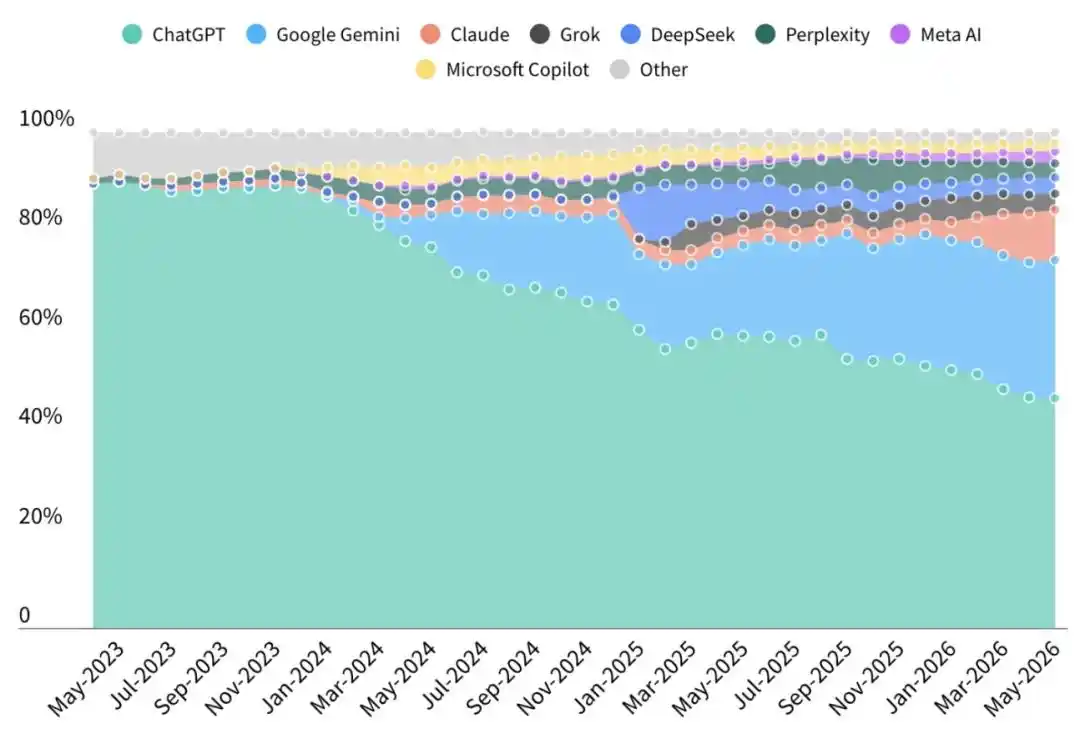
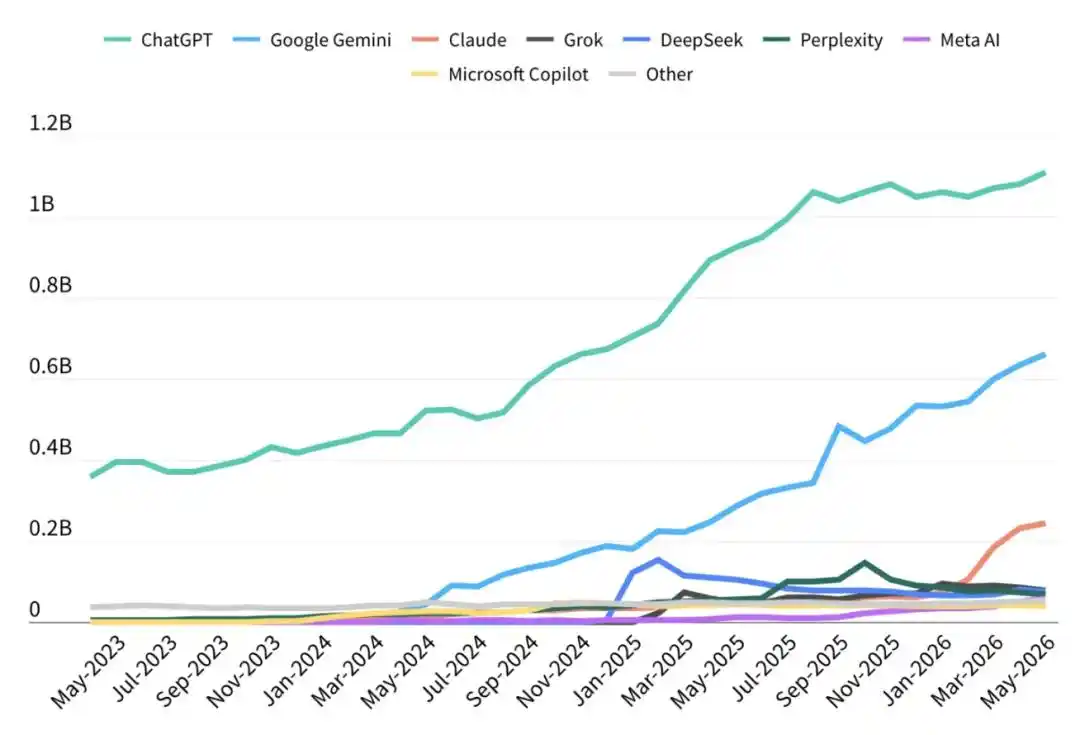
According to the analytics firm Sensor Tower in its "State of AI 2026 Report," as of the end of May this year, ChatGPT's share of the global AI assistant market fell to 46.4%. Prior to January this year, this figure was still above 50%.

ChatGPT remains the world's largest AI assistant. But leading no longer equals monopoly. The AI assistant boom ignited by OpenAI has moved from wonder, trial, and awe into the stage of product comparison, ecosystem lock-in, paid conversion, and commercialization.

Loyalty is a False Promise; Users are 'Players'

In 2023, having a ChatGPT account still carried a certain identity as an AI trendsetter. By 2026, AI assistants are increasingly becoming infrastructure in internet life, much like search, email, and office suites.

The most noteworthy change in Sensor Tower's report is not just that ChatGPT still ranks first. More importantly, users are becoming more willing to migrate. As long as another assistant is more convenient in a specific scenario, users will immediately allocate their time to that other product.

The main rivals pulling ChatGPT's share below 50% are Gemini and Claude.

As of the end of May, Gemini's global share reached 27.7%, and Claude reached 10.3%. Products like Grok, Perplexity, DeepSeek, and Meta AI each remain below 5%, but they are also continuously squeezing the remaining market.
Gemini's growth is not hard to understand.

It stands on the foundation of Google's complete ecosystem. Search, Gmail, Docs, Calendar, and Android are all natural entry points. When AI is embedded into tools users must use daily, many ordinary users don't need to specifically open another webpage to summon ChatGPT.

Especially after the release of Gemini 3.0, Google also achieved its first real major victory, officially joining the AI game table and entering the view of more mainstream users.

Claude's path is more like a victory for productivity tools.

It doesn't have a distribution system like Google's, but it has built a strong reputation in scenarios such as writing, coding, long-text processing, and complex task collaboration. Sensor Tower states that Claude is approaching ChatGPT's user retention levels. For heavy users, AI assistants have shed their toy-like attributes and are starting to genuinely impact work efficiency.
A more subtle change is that users are no longer judging AI products solely based on model capability.

As AI assistants increasingly take on personalized interactive characteristics, users are also beginning to discuss work, emotions, judgments, and decisions with them. Brand trust, value orientation, and institutional relationships may all become part of user choice.

And the slightest bit of negative publicity can trigger a wave of massive uninstalls. This is something OpenAI CEO Sam Altman has likely felt deeply over the past year.

AI companies used to believe that as long as the model was stronger, users would stay. The reality of 2026 is much more complex. Capability, ecosystem, price, scenario, and brand trust are now collectively determining whether an assistant will be used continuously.

The Free Lunch is Over; AI Apps are Starting to Talk Money

Beyond market share, another set of data from Sensor Tower's report better illustrates the stage change in the industry: AI apps are still growing, but the growth logic has changed.

Sensor Tower estimates that in the first half of 2026, global AI app downloads will approach 2.3 billion, and in-app spending will exceed $4.2 billion. In comparison, AI app in-app spending in the first half of 2025 was $1.83 billion.

Users are still downloading AI apps and are willing to pay for AI.

But the growth rates for both downloads and spending have slowed. Meanwhile, the industry has moved from a period of rapid expansion into a more realistic competitive phase. Companies can no longer just talk about user growth; they must also prove they can turn traffic into revenue.

Regional differences are also beginning to show.

Asia remains the highest market for AI app downloads, but in Q1 2026, it saw its first-ever download decline, dropping by 3.3%, mainly influenced by markets like India.
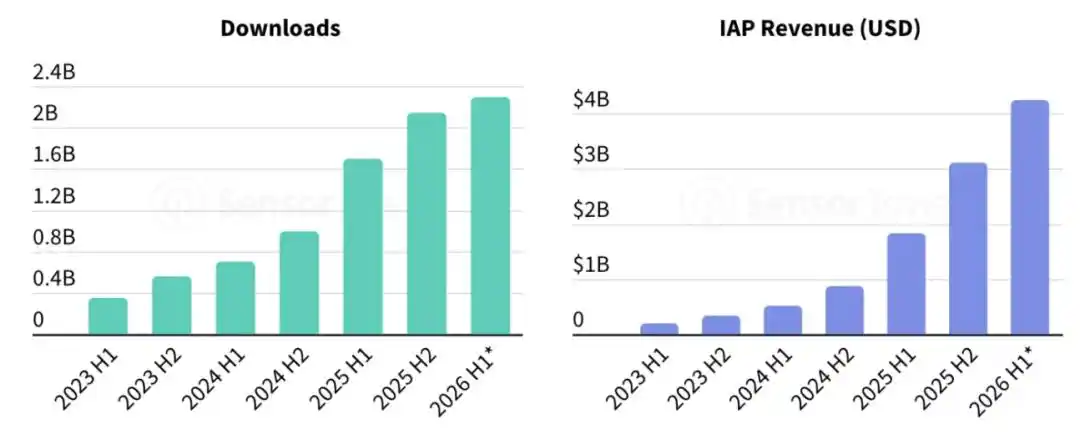
In contrast, North America and Europe are stronger in in-app consumption. For AI companies, what truly determines the business model is often the ability to pay; installation scale can only solve part of the problem.

The trend in the US market is even more pronounced.

Users are increasingly using AI assistants for productivity tasks and are more willing to pay for advanced features. Claude performs well here. Sensor Tower states that Anthropic has 13% of its users subscribing to paid plans, with a conversion rate among the highest in the industry.

A 13% subscription conversion rate explains why Claude can continue to expand its presence amidst the squeeze from giants. As long as AI helps users save time, write code, organize documents, and handle complex tasks, a subscription fee of twenty or even two hundred dollars per month is actually within an acceptable range.

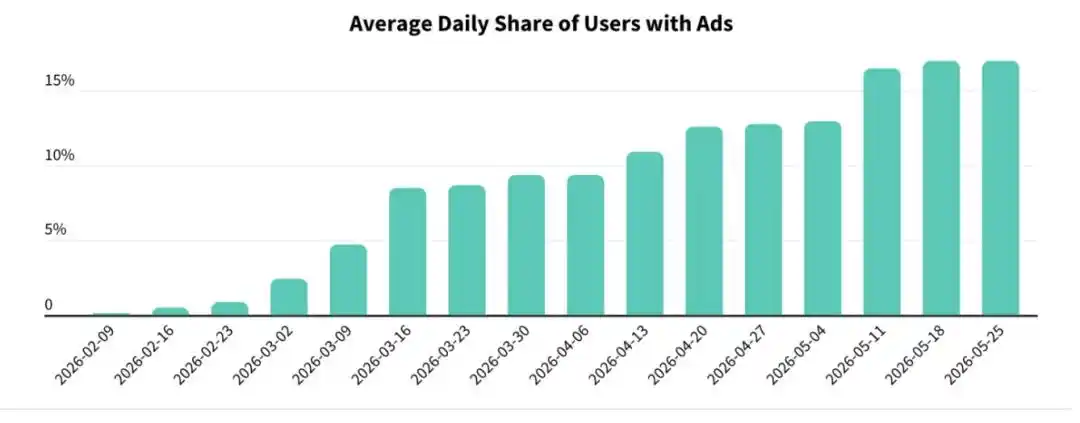
ChatGPT's commercialization path is more diverse and also more controversial. Sensor Tower states that OpenAI began testing ads in ChatGPT starting in February this year, gradually expanding ad display scale and user coverage.

By May, an average of 17% of users saw ads daily. Software and shopping are currently the largest advertiser categories, followed by media & entertainment, and food & beverage.
From subscriptions to ads, ChatGPT is moving towards a more typical internet business model. Early users were familiar with a clean dialog box, a portal imbued with the dream of Artificial General Intelligence (AGI).

Unfortunately, even the smartest AI on the planet ultimately can't escape the fate of becoming a shopping guide. For OpenAI, advertising and shopping have become experiments that must be pursued. Now, this portal is also beginning to carry ads, shopping guides, recommendations, and transaction conversions.

Model inference, training, and compute expenditures are extremely expensive; relying solely on subscription revenue can hardly cover long-term investment. Advertising and shopping are becoming the next pieces of the puzzle for ChatGPT's commercialization.

As AI begins to penetrate core scenarios like shopping, office work, and search, the imagination of AI becoming a unified super portal is also encountering increasingly realistic platform boundaries.

Sensor Tower estimates that in the first half of 2026, global AI app usage time will grow from 17.2 billion hours in the same period last year to approximately 36 billion hours. Among these, the top three AI assistants account for 89% of the total usage time of AI assistant apps.

There is still opportunity for later players, but it exists more in fragmented scenarios, such as AI companions, AI content generation, and vertical industry tools. The main battlefield for general assistants has largely been occupied by ChatGPT, Gemini, and Claude.

Farewell to the Altar; AI Moves Towards the Everyday

The decline in ChatGPT's share occurs at a somewhat paradoxical point in time: OpenAI's revenue is still growing rapidly, its user base is still expanding, and its capital reserves far exceed those of most startups.

According to a report by The Information based on documents disclosed by OpenAI to shareholders, OpenAI's cash consumption reached $3.7 billion in the first quarter, exceeding half of its $5.7 billion revenue. Both cash consumption and revenue roughly tripled year-over-year.

This is also a common challenge facing the current AI industry. Users and revenue continue to grow, yet massive capital investment is required to maintain model training, inference services, and infrastructure construction.
Furthermore, OpenAI expects its cash consumption in 2026 could reach $25 billion, rising further to $57 billion in 2027. Even though OpenAI has secretly submitted IPO filing documents, the listing timing may still be adjusted based on market conditions.

In other words, as one of the world's strongest AI brands, OpenAI still needs to answer a question: when models are getting more expensive, competition is getting fiercer, and users are becoming more willing to migrate, how high a profit margin can ChatGPT's business model ultimately generate.

However, even though ChatGPT's share has fallen below 50%, it remains the world's largest AI assistant and is still the most frequently mentioned name when people talk about AI. But this milestone is symbolic.

The AI assistant market has moved past the era where a single product defined the industry. In the past, ChatGPT was responsible for making the masses believe AI could change the internet. Now, Gemini, Claude, Grok, DeepSeek, and various vertical AI assistants are collectively dividing user time, usage scenarios, and commercial revenue.
User demands are also subtly changing.

By now, you probably are no longer satisfied with just asking AI to write a poem or tell a lame joke. Instead, you're starting to demand it writes code with fewer errors, processes documents more accurately, facilitates office collaboration more conveniently, and offers more reasonable subscription prices.

When a technology no longer elicits repeated amazement but instead begins to be scrutinized, compared, and replaced, it has truly begun to enter mainstream life.

ChatGPT has lost its dominant half of the market, but AI has truly begun to win the world. It's just that in this new world, there are no eternal kings, only us, forever ready to migrate for the sake of a more useful tool.

This article is from the WeChat public account "ifanr," author: ifanr, discovering tomorrow's products.


Трендові криптовалюти

Пов'язані питання

QAccording to the article, what is the key symbolic change in the global AI assistant market share as of May 2026?

AThe key symbolic change is that ChatGPT's global market share has dropped below 50% for the first time, to 46.4%.

QWhich two main competitors are primarily responsible for reducing ChatGPT's market share below 50%?

AGemini (27.7% share) and Claude (10.3% share) are the two main competitors responsible for this reduction.

QWhat are the two main business model paths highlighted for ChatGPT's monetization beyond subscriptions?

AThe two main paths are integrating advertising and e-commerce/shopping features into the ChatGPT platform.

QWhat does the 13% subscription conversion rate for Claude's users indicate, according to the report?

AIt indicates that users are willing to pay for AI assistants that demonstrably improve productivity, such as by saving time or handling complex tasks, making Claude's premium subscription model successful.

QWhat broader industry shift does the article suggest is represented by ChatGPT's market share decline?

AIt represents a shift from a period of awe and trial with a single dominant product to a mature, competitive phase where user choice is driven by specific features, ecosystem integration, pricing, and trust, integrating AI into everyday life.

Пов'язані матеріали

Must-Watch Events Next Week|CLARITY Act Could Face Senate Vote; SpaceX, Circle to Report Earnings (8.3-8.9)

**Summary: Key Events and Developments to Watch (August 3-9)** The upcoming week is marked by significant financial disclosures, key legislative deadlines, and notable product updates. **Major Financial Events:** Several companies are scheduled to release their Q2 2026 earnings. American Bitcoin (ABTC) will report on August 3, followed by SpaceX and Hut 8 Mining Corp. on August 4, and Circle on August 5. Notably, a significant portion of SpaceX shares (up to 12% of total shares) will be unlocked on August 6 following their earnings release. **Key Legislative Deadline:** The U.S. Senate faces an August 7 deadline to secure 60 votes for the CLARITY Act, a bipartisan bill aiming to establish a federal regulatory framework for cryptocurrencies. The Senate may hold a full vote on the bill during the week. **Economic Data:** The U.S. July Non-Farm Payrolls report will be released on August 7, providing crucial labor market data. **Technology & Product Updates:** * **Shutdowns:** DeFi portfolio tracker Zapper and wallet app Ctrl Wallet will cease operations on August 3. * **Upgrades:** LayerZero will deprecate its v1 relayers on August 3. XRP Ledger's new version 3.3.0, featuring five new functions, is expected next week. * **AI:** Elon Musk announced that the advanced Grok 4.6 AI model is set for release around August 7. * **Bitcoin:** The BIP-110 forced signaling for a potential Bitcoin network change is scheduled to begin around August 8. **Other Notable Events:** Chinese robotics firm Unitree Tech has set its preliminary price inquiry for its IPO for August 5. South Korean exchange Upbit will delist AQT and AERGO tokens on August 3.

marsbit1 год тому

Must-Watch Events Next Week|CLARITY Act Could Face Senate Vote; SpaceX, Circle to Report Earnings (8.3-8.9)

marsbit1 год тому

Stocks Are Plummeting More Sharply Than Cryptocurrencies. Where Has the Money Gone?

Stock Markets Plunge Deeper Than Cryptocurrencies: Where Did the Money Go? In late July, Seoul's Kospi index triggered circuit breakers for two consecutive days, plummeting over 40% from its June high. The collapse was led by heavyweight stocks like SK Hynix, whose record profits still disappointed investors, and devastating leveraged ETFs, with one major product losing over 83% of its value. This signaled a global, forced deleveraging targeting the most crowded trades. Interestingly, while stocks exhibited extreme volatility akin to crypto markets, Bitcoin rose nearly 15% in July after a prior steep drop. Analysis shows the money fleeing equities did not flow into Bitcoin. Instead, Bitcoin had already absorbed its sell-off in May-June, when U.S. spot Bitcoin ETFs saw historic outflows. The true safe-haven beneficiary was gold, whose price rose over 20% year-on-year, highlighting a decoupling between Bitcoin and gold as "digital gold." The sell-off was a targeted unwinding of leveraged positions in tech and semiconductors, accelerated by broker-dealer risk management and shifts in the AI narrative, including new competition from Chinese memory chipmakers. The retreat path was clear: from high-valuation tech stocks to cash and U.S. Treasuries, then to gold. For Bitcoin to attract sustained institutional inflows, conditions like eased global liquidity pressure, a "soft-landing" Fed rate cut, and U.S. regulatory clarity via legislation like the stalled CLARITY Act are needed. Currently, Bitcoin is not a safe haven but an already-cleared asset. Its low correlation with tech stocks, however, makes it a potential diversification play for institutional portfolios once the storm passes. The money isn't here yet, but the positioning is underway.

marsbit1 год тому

Stocks Are Plummeting More Sharply Than Cryptocurrencies. Where Has the Money Gone?

marsbit1 год тому

In Conversation with Ray Dalio: We Are Currently in an AI Bubble, with 1% of My Portfolio in Bitcoin

Ray Dalio, founder of Bridgewater Associates, warns in an interview that the current AI boom shows classic bubble characteristics, which could lead to significant economic downturns as seen in past cycles like 1929 or 2000. He explains that speculative enthusiasm, fueled by debt and overvaluation, often precedes a crash when rising rates or taxation force asset sales, causing widespread losses and recession. Dalio also outlines his "Big Cycle" theory, describing an approximate 80-year pattern where widening wealth gaps, massive government deficits, and shifting geopolitical power (like China's rise) create internal conflict and global instability. He emphasizes that we are in a late-cycle, transitional phase where traditional powers like the US and UK face decline. For personal wealth protection, Dalio advises diversification beyond cash into assets like stocks, bonds, real estate, and particularly gold, which he prefers over Bitcoin. While he holds about 1% of his portfolio in Bitcoin as a non-printable hard asset, he views gold as more secure from technological or governmental threats. Regarding AI's impact, Dalio believes it will disproportionately benefit capital owners, worsening inequality by replacing both physical and cognitive labor. He suggests that human intuition and emotional intelligence, combined with AI, will be key for future workers. On taxation, Dalio argues that wealth taxes are impractical and risk triggering asset sell-offs, reducing productive investment. He points to the UK as a cautionary example of debt, low productivity, and political strife. Geopolitically, Dalio foresees a more regionalized world, with the US showing weakness in prolonged conflicts like with Iran, akin to past imperial declines. The ideal outcome, he suggests, is coexisting powerful blocs (e.g., Americas, China-Asia Pacific) without major war.

marsbit5 год тому

In Conversation with Ray Dalio: We Are Currently in an AI Bubble, with 1% of My Portfolio in Bitcoin

marsbit5 год тому

Торгівля

Спот

Популярні статті

Як купити PEOPLE

Ласкаво просимо до HTX.com! Ми зробили покупку ConstitutionDAO (PEOPLE) простою та зручною. Дотримуйтесь нашої покрокової інструкції, щоб розпочати свою криптовалютну подорож.Крок 1: Створіть обліковий запис на HTXВикористовуйте свою електронну пошту або номер телефону, щоб зареєструвати обліковий запис на HTX безплатно. Пройдіть безпроблемну реєстрацію й отримайте доступ до всіх функцій.ЗареєструватисьКрок 2: Перейдіть до розділу Купити крипту і виберіть спосіб оплатиКредитна/дебетова картка: використовуйте вашу картку Visa або Mastercard, щоб миттєво купити ConstitutionDAO (PEOPLE).Баланс: використовуйте кошти з балансу вашого рахунку HTX для безперешкодної торгівлі.Треті особи: ми додали популярні способи оплати, такі як Google Pay та Apple Pay, щоб підвищити зручність.P2P: Торгуйте безпосередньо з іншими користувачами на HTX.Позабіржова торгівля (OTC): ми пропонуємо індивідуальні послуги та конкурентні обмінні курси для трейдерів.Крок 3: Зберігайте свої ConstitutionDAO (PEOPLE)Після придбання ConstitutionDAO (PEOPLE) збережіть його у своєму обліковому записі на HTX. Крім того, ви можете відправити його в інше місце за допомогою блокчейн-переказу або використовувати його для торгівлі іншими криптовалютами.Крок 4: Торгівля ConstitutionDAO (PEOPLE)Легко торгуйте ConstitutionDAO (PEOPLE) на спотовому ринку HTX. Просто увійдіть до свого облікового запису, виберіть торгову пару, укладайте угоди та спостерігайте за ними в режимі реального часу. Ми пропонуємо зручний досвід як для початківців, так і для досвідчених трейдерів.

616 переглядів усьогоОпубліковано 2024.12.12Оновлено 2026.06.02

Як купити PEOPLE

Обговорення

Ласкаво просимо до спільноти HTX. Тут ви можете бути в курсі останніх подій розвитку платформи та отримати доступ до професійної ринкової інформації. Нижче представлені думки користувачів щодо ціни PEOPLE (PEOPLE).

活动图片












