What Will End the AI Bull Market: Positioning or Narrative?

marsbitОпубліковано о 2026-05-14Востаннє оновлено о 2026-05-14

Анотація

Who Will End the AI Bull Market: Overcrowded Positions or the Narrative Itself? The US stock market's relentless rally, led by AI-themed stocks, faces a growing contradiction. Technically, positioning appears dangerously stretched: the S&P 500's six-week winning streak is historically extreme, and Goldman Sachs's Risk Appetite Indicator signals potential for a pullback. Many hot sectors are in extreme overbought territory, with mechanical fund flows suggesting the market is at or near maximum long positioning, limiting upside and creating pressure for a reset. However, shorting is difficult due to volatile exit timing and the risk of a sharp short squeeze. Fundamentally, the AI narrative remains robust, propping up sentiment. Strong corporate earnings, contained inflation concerns, and absorbed geopolitical risks provide no clear catalyst for a bear market. Yet, market performance has become excessively concentrated. Without AI contributions, broader market returns would be mediocre; semiconductors alone accounted for nearly 40% of gains since March. The market has shifted into a "greed mode," overlooking previous concerns about AI costs, energy bottlenecks, pricing wars, and security issues. The core risk is the interplay between these two factors. Nomura strategist Charlie McElligott warns that a sudden, DeepSeek-style negative catalyst could trigger a Nasdaq limit-down event, with semiconductor ETFs potentially plunging 15% in a day. The same mechanical flows that fuele...

Author: Long Yue

Source: Wall Street News

The sharper the market rallies, the harder it becomes to find reasons for a decline — but the risks have not disappeared; they are merely hidden deeper.

On May 14, Bloomberg market analyst Jon-Patrick Barnert pointed out in an article that while the current U.S. stock market rally has surged significantly, the cost and timing for shorting remain difficult to gauge. More troublingly, even the question of "what the most compelling reason to short is" has become blurry.

The core contradiction of this rally is: positioning has become extremely crowded, yet the fundamental narrative — especially AI — continues to support market sentiment. Between these two, which will crack first?

Positioning: The Market is Approaching "Max Long"

From a pure price action perspective, signals for a pullback are already quite evident.

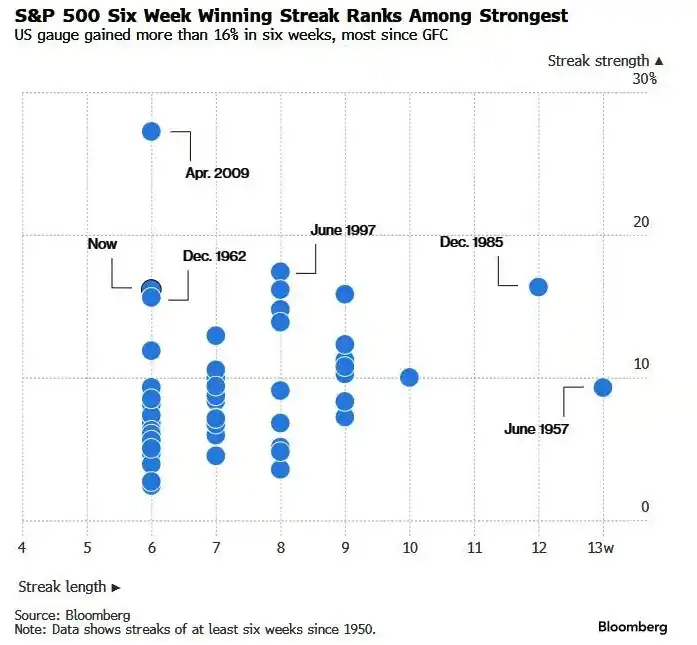
The S&P 500's six-week winning streak is not only one of the longest such runs in over 70 years, but the magnitude of gains also ranks among the strongest in history. Barnert stated that "taking a breather" would be perfectly normal for this market.
Goldman Sachs's Risk Appetite Indicator has risen back to 1, the first time since the beginning of the year. It is extremely rare for this indicator to exceed 1, and historically, it has often signaled a potential pullback. The last time it breached this threshold was in 2021, after which the market entered a bear phase.

Looking at the hottest thematic stocks, Barnert describes a market where "everything is overbought," with some of the most popular sectors reaching extreme overbought levels. Combined with mechanical fund inflows — which currently appear to be at or near maximum long positioning — the overall picture is: limited upside, and significant potential pressure from positioning resets.
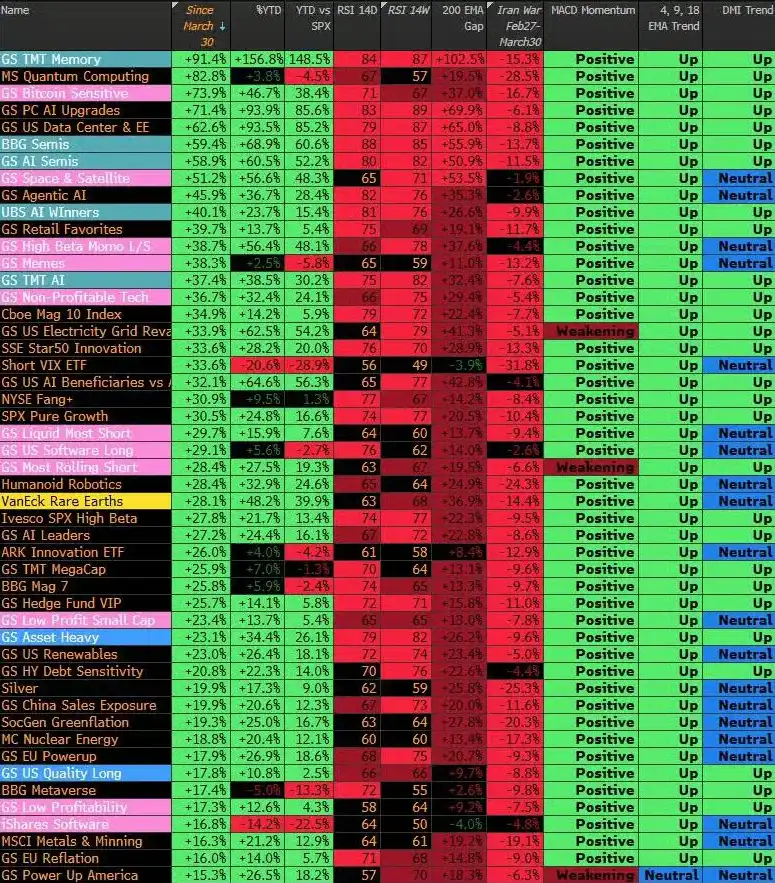
However, shorting is not easy. Barnert points out that position adjustments can be completed within a single day, making the entry and exit timing for short trades extremely difficult to manage. If the market chooses to "decline slowly," volatility positions would quietly become ineffective in a mild environment. A more likely scenario is: overall sentiment remains bullish, and if short sellers are forced to cover their positions, it could trigger another round of short squeezes, pushing prices higher and faster than anyone expected.

Fund flows in some popular ETFs have begun to show subtle shifts — leaning towards "locking in gains" rather than "chasing highs." But Barnert also admits this trend has persisted for weeks and has not yet had a material impact on market direction.

Narrative: Without AI, The Market is Nothing

If positioning is a technical vulnerability, the narrative level currently appears even more solid.

Barnert notes that there is currently a lack of clear signals triggering a fundamental bear market. Corporate earnings remain strong, inflation expectations have risen slightly but not to extreme levels. The market has digested the shocks of high oil prices and Middle East tensions, and the latest U.S. jobs data has alleviated recession fears. As for interest rate hike expectations, they are no longer a catalyst suppressing stocks.
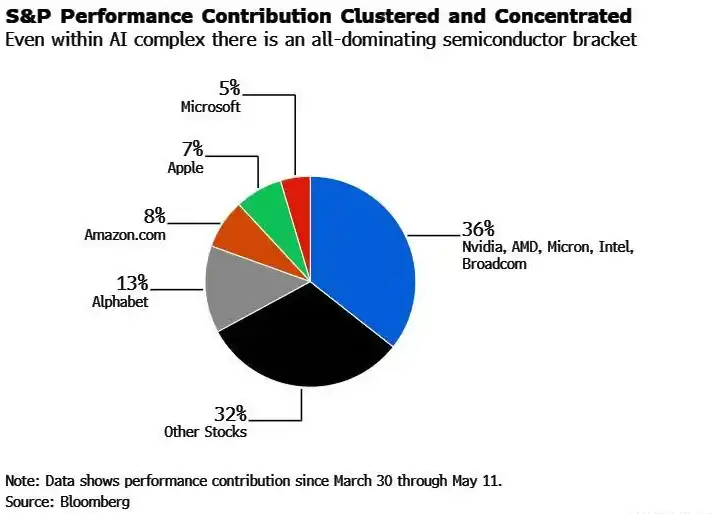
But one issue cannot be ignored: the concentration of this rally has become highly focused on "the concentration itself."

Barnert points out that whether comparing the performance of indices with and without AI, or dissecting the sources of gains since March, the conclusion points in the same direction: without AI, this market's performance can only be described as "mediocre." More notably, the semiconductor sector alone contributed nearly 40% of the gains since March.
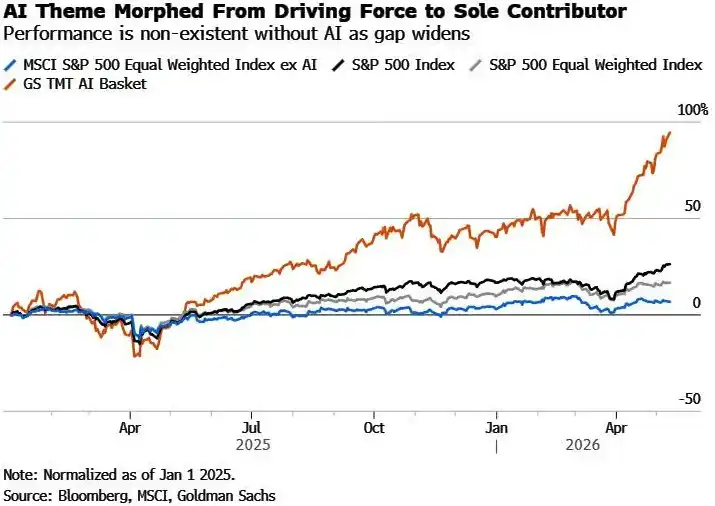
The market narrative surrounding AI has once again entered a "greed mode," a stage of pursuing unreasonable returns rather than rational, reasonable gains. The concerns widely discussed just months ago — whether AI computing costs can be offset by layoff savings, data center energy supply bottlenecks, AI pricing wars eroding profit margins, new competitors disrupting the landscape with lower costs, massive growth in capital expenditures while stock buybacks stall, AI security risks — now seem to have been collectively forgotten by the market.

The Risk of a "DeepSeek Moment" Repeat

Nomura Securities strategist Charlie McElligott issued the most direct warning on this matter.

He stated: "Given the current market structure and thematic overlap, if another fully-fledged, system-wide shock catalyst like a 'DeepSeek-style' event emerges one day, it could directly trigger a Nasdaq-level limit-down style of trade."

McElligott further noted that in such a scenario, semiconductor ETFs could easily drop 15% in a single day — because "the hypothetical reversal of reflexive, mechanical fund flows would create large-scale overshooting on the downside."

In other words, the very same mechanical fund flows (like CTA strategies, risk parity funds, etc.) that kept buying on the way up would, once triggered to reverse, become amplifiers accelerating the decline.

The AI bull market faces two major risks: one technical (overly crowded positioning), and one narrative-based (whether the AI story can hold). The former could trigger at any time; the latter, once broken, would deliver a deeper shock. Combined, they constitute the most noteworthy structural vulnerability in the current market.


Пов'язані питання

QAccording to the article, what are the two core competing factors that could end the current AI bull market?

AThe two core competing factors are: 1) Market Positioning / Overcrowded long positions, and 2) The Sustainability of the Fundamental AI Narrative.

QWhat does the Goldman Sachs Risk Appetite Indicator reading of 1, and its historical behavior, suggest about the market's near-term risk?

AThe Goldman Sachs Risk Appetite Indicator reaching 1, its highest level since the start of the year, is an extremely rare occurrence. Historically, readings above this threshold have often signaled an impending market correction. The last time it breached this level was in 2021, which preceded a bear market.

QHow does the article describe the market's dependence on AI-related stocks for its overall performance?

AThe article states that the market's performance is highly concentrated on AI. It points out that without AI, the market's performance would be 'mediocre' or 'nothing'. Specifically, the semiconductor sector alone contributed nearly 40% of the market's gains since March.

QWhat scenario does Nomura strategist Charlie McElligott warn could trigger a severe market downturn?

ACharlie McElligott warns that another widespread 'DeepSeek-style' shock catalyst could directly trigger a Nasdaq-level limit-down (trading halt) event. In such a scenario, semiconductor ETFs could easily fall 15% in a single day due to a reversal of reflexive, mechanical capital flows leading to a large-scale overshoot on the downside.

QWhy is it difficult to profit from a short-selling strategy in the current market environment, as per analyst Jon-Patrick Barnert?

AShort-selling is difficult because: 1) Position adjustments could happen within a single day, making timing entry and exit extremely hard. 2) If the market declines slowly, volatility-based short positions could quietly expire worthless. 3) The prevailing bullish sentiment means any short squeeze could trigger another rapid rally, moving faster than expected and causing losses for shorts.

Пов'язані матеріали

When AI Traffic Surpasses Humans, How Do You Prove You're Human?

As AI-generated web traffic now surpasses human activity, the internet's foundational business models—built on human attention, browsing, and advertising—face severe disruption. AI agents crawl websites at immense scale without generating ad revenue, while AI summaries divert traffic from original content sites. In response, over 2.5 million sites are blocking AI crawlers, and protections like Cloudflare's "honeypot" traps have emerged, though advanced AI can bypass these. The collapse of traditional CAPTCHAs, which assumed machines were weaker than humans, has led to a shift toward behavioral biometrics for human verification. Companies like IBM and BioCatch now analyze unique human patterns—cursor movements, typing rhythms, keystroke dynamics, and even cognitive delays like the Stroop effect—to distinguish real users from bots. These biometric signatures are difficult to fake or alter, offering a new layer of security but raising significant privacy concerns. Two competing visions for a reliable human verification system are emerging. One, exemplified by Sam Altman’s World (formerly Worldcoin), uses centralized iris scanning to generate unique credentials, though it faces bans and criticism over unauthorized data collection. The other employs cryptographic zero-knowledge proofs, allowing users to prove they are human without revealing identity or biometric data, as advocated by Vitalik Buterin. However, decentralized approaches risk exploitation through identity renting in economically unequal regions. The central dilemma is between a scalable but privacy-invasive centralized system that permanently controls users' biometric data, and a privacy-preserving cryptographic system vulnerable to real-world economic manipulation. The author expresses a preference for the cryptographic path, arguing that despite its flaws, it avoids the irreversible biometric surveillance inherent in centralized alternatives.

Foresight News2 хв тому

When AI Traffic Surpasses Humans, How Do You Prove You're Human?

Foresight News2 хв тому

Crypto Primary Market Investment and Financing Forward-Looking Weekly Report | Stablecoin Regulation Nears Implementation, ETF Funds Continue to Withdraw, Capital Begins Betting on Payment and Cash Flow

Crypto Market Weekly Report (Jun 1-7, 2026): Capital Shifts Focus to Payments & Cash Flow Market data indicates a significant divergence: while traditional institutional funds continue exiting via BTC and ETH ETFs (recording net outflows of $1.72B and $168M this week, respectively), stablecoin supply continues growing. This suggests capital is shifting from speculative asset allocation toward defensive positioning within on-chain liquidity, awaiting new, concrete opportunities. This trend is reflected in venture capital focus. Weekly fundraising fell 27% to $302M, with investments concentrating on infrastructure with tangible revenue potential: 1. **Stablecoin Infrastructure (28% of funding):** Projects like M0 Protocol ($35M raise) are gaining attention as regulatory clarity (e.g., the GENIUS Act) nears, shifting the focus from legitimacy to building payment and settlement networks. 2. **AI Agent Infrastructure (26%):** Investments are moving from conceptual AI Agents towards the execution and economic layers required for a functional "Agent economy." Key raises include OpenRouter ($40M) and Halliday ($20M). 3. **Real World Assets (RWA) (18%):** The search for on-chain yield and cash flow drives continued interest in RWA platforms like Ondo Finance. Security threats are evolving from smart contract exploits toward key management failures, permission control issues, and regulatory execution risks (e.g., court-ordered asset freezes). **Key Takeaways:** The investment thesis is shifting from narrative-driven bets to revenue and cash-flow-generating protocols. Future attention should be on the progression of stablecoin regulations, the commercial validation of AI Agent economies, and the performance of high-revenue protocols like derivatives platforms.

marsbit9 хв тому

Crypto Primary Market Investment and Financing Forward-Looking Weekly Report | Stablecoin Regulation Nears Implementation, ETF Funds Continue to Withdraw, Capital Begins Betting on Payment and Cash Flow

marsbit9 хв тому

Buy an NFT First to Get a Ticket? The Largest World Cup Ticket Slump in History

"Ticketing Woes for 2026 World Cup: NFT 'Right-to-Buy' and High Prices Dampen Sales" Despite anticipation for the 2026 FIFA World Cup, with 48 teams and 104 matches across North America, the tournament faces significant unsold tickets, with approximately 180,000 group-stage tickets still available for resale just before kick-off. This unexpected shortfall is attributed to FIFA's controversial new ticketing strategy, which includes an NFT-based "Right-to-Buy" (RTB) system and opaque, dynamic pricing. FIFA introduced RTBs as digital collectibles (NFTs) sold on its FIFA Collect platform. An RTB grants the holder only the right to purchase a ticket for a specific match later, not the ticket itself. This two-step process, criticized for selling "scarcity" first, saw RTBs priced from tens to hundreds of dollars, generating millions in revenue for FIFA. With many tickets remaining available on official channels, the value of these prepaid purchase rights is now being questioned. Compounding the issue are ticket prices, reported to be 2 to 4 times higher than the 2022 Qatar World Cup, and up to 7 times more for marquee matches. FIFA employed dynamic pricing, common in U.S. sports, but lacked transparency on seat availability and exact locations during sales, frustrating global fans facing high travel costs. This has drawn scrutiny from regulators in New York and New Jersey. FIFA's official resale platform also drew criticism for imposing high fees—roughly 10% on sellers and 17% on buyers, allowing FIFA to profit further from secondary market transactions. While FIFA President Gianni Infantino states over 6 million tickets have been sold, the situation highlights a potential disconnect between fan enthusiasm and willingness to pay under an aggressive commercial model.

marsbit17 хв тому

Buy an NFT First to Get a Ticket? The Largest World Cup Ticket Slump in History

marsbit17 хв тому

Торгівля

Спот
Ф'ючерси
活动图片




