What Kind of People Is Anthropic Actually Hiring? Insights from 1,680 Resumes Provide the Answer

marsbitОпубліковано о 2026-06-15Востаннє оновлено о 2026-06-15

Анотація

Contrary to the common perception of Anthropic as a PhD-heavy AI research lab, an analysis of 1,680 engineer profiles reveals its core talent is experienced "builders." The engineering team, largely assembled in the past 18 months (median tenure 10 months), hires senior engineers with a median of 12.2 years of prior experience. They primarily come from major engineering-focused companies like Google, Meta, Amazon, Microsoft, Stripe, Databricks, Snowflake, and Palantir, not primarily from other AI labs. Their backgrounds are infrastructure-heavy (40%), focusing on backend, distributed systems, databases, and security, with skills like Python, Java, C++, and AWS being common. Only 13.7% hold PhDs. The dominant job title is "Member of Technical Staff." For early-career hires (<6 years experience), entry is not based on standard work history but on prestigious signals: top internships (e.g., at FAANG or quant trading firms), competition rankings, research publications, or AI safety fellowship experience. The key insight for applicants is to present as infrastructure builders, highlighting experience with large-scale systems, not as pure researchers, reflecting Anthropic's identity as a highly engineered infrastructure company.

Editor's Note: Anthropic is often imagined by outsiders as an AI lab composed of PhDs, researchers, and frontier model experts. However, this analysis of 1,680 engineer profiles offers a more realistic answer: the core of Anthropic is not just "research," but "building."


By analyzing 5,306 LinkedIn profiles listing Anthropic as the current employer and further filtering down to 1,680 engineer profiles, this article reaches a counter-intuitive conclusion: the most core talent profile at Anthropic is not the "researcher" imagined by the outside world, but a group of experienced "builders" (people who can truly set up, run, and scale large-scale systems).

Data shows that Anthropic's engineering team was largely formed rapidly in the past 18 months: over half of current engineers joined less than a year ago. However, the new hires are generally very senior, with a median of 12.2 years of work experience before joining. A significant number came from companies renowned for engineering prowess and infrastructure, such as Google, Meta, Amazon, Microsoft, Stripe, Databricks, Snowflake, and Palantir.

This also explains the real focus of Anthropic's engineering organization: compared to the model research that outsiders focus on, it operates more like a highly engineered infrastructure company. Its engineers' backgrounds are concentrated in areas like infrastructure, backend, distributed systems, databases, and security. Only 13.7% hold PhDs; the majority are senior engineers with bachelor's or master's degrees.

Opportunities for early-career talent are not nonexistent, but the bar is equally high: top tech company internships, competition achievements, publications, or experience in AI safety/alignment projects often serve as screening signals in place of years of experience.

The author's final advice is straightforward: if you want to join Anthropic, don't write your resume as if applying to a research lab. Instead, highlight the large-scale systems you have actually built, scaled, and maintained. At its foundation, the competition in frontier AI is increasingly becoming a competition of engineering capability and infrastructure capability.

The original text is below:

Builders, Not Researchers

I scraped all LinkedIn profiles listing Anthropic as the current employer, totaling 5,306 people. I then filtered for the 1,680 individuals in genuine engineering roles and further examined the 7,986 records in their past job descriptions to analyze what they were doing before joining Anthropic.

Here are the results.

The Organization Was Scaled Up Almost Overnight
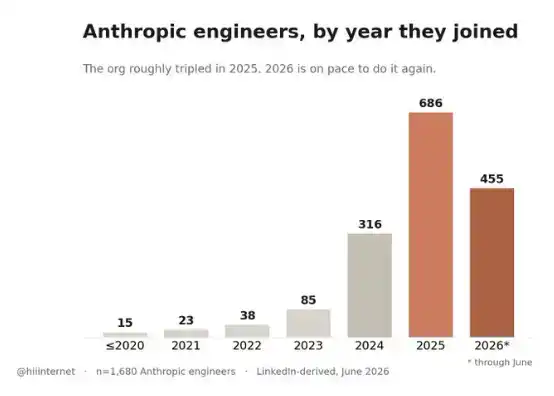
Only 15 engineers who joined Anthropic before 2021 are still employed there today. In 2025, this organization's engineering team nearly tripled in size, adding 686 engineers that year; the hiring pace for 2026 is projected to be similar, with 455 added by June.

Currently, half of the engineering team has been at Anthropic for less than a year. 53% joined within the past 12 months. Median tenure: 10 months.

This is a large-scale organization that was essentially built up in about 18 months.

They Almost Exclusively Hire Senior Engineers
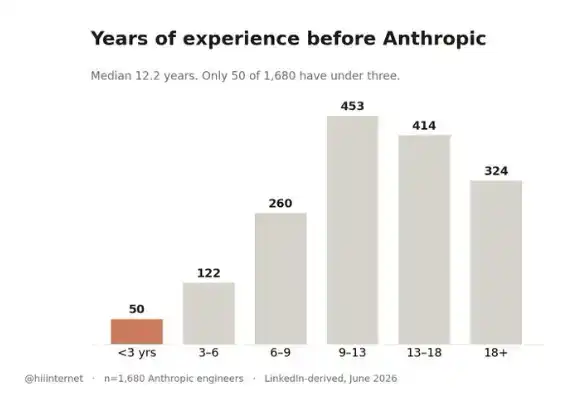
The median years of work experience before joining Anthropic is 12.2 years. The middle 50% have between 8.8 and 16.5 years of experience. Among these 1,680 people, only 50 have less than 3 years of experience. 44% have 13 or more years of experience. New graduate hiring is virtually nonexistent.

In other words, the typical new hire at Anthropic is an engineer with 12 years of experience who has only been at Anthropic for 10 months.

Clear Bias Towards Infrastructure Over Traditional Research
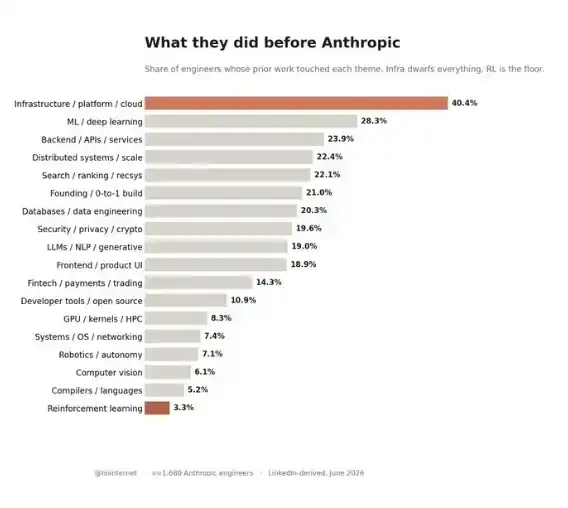
Infrastructure background appears in 40% of the engineers' profiles. Backend, distributed systems, databases, and security each appear in about 20% of profiles. Reinforcement learning, the "RL" in RLHF, appears in only 3.3%.

The typical Anthropic engineer spent the past decade building large-scale production systems at either a hyperscale cloud provider or an infrastructure-heavy startup.

Their self-listed skills tell the same story: Python (585 people), Java (566), C++ (443), JavaScript (376), SQL (302), Linux (230), Distributed Systems (189), AWS (154). The more "sexy"-sounding model training work certainly exists, but it's a low percentage.

The Largest Talent Source Is Not a Lab, It's Google
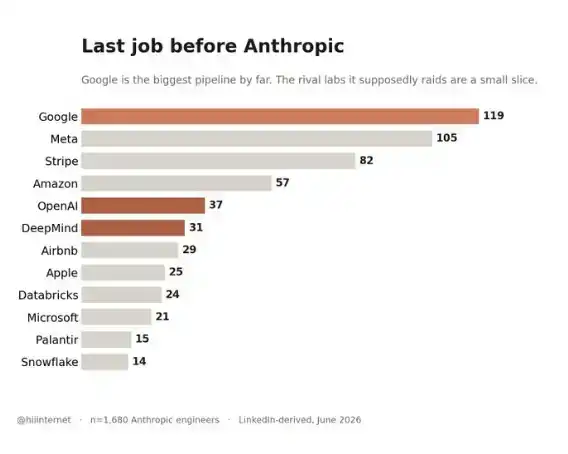
Everyone thinks Anthropic mainly hires from OpenAI and DeepMind. But its largest talent pipeline, by far, is Google. Those competitor labs are just two small bars in the middle of the chart.

Anthropic clearly prefers companies known for engineering rigor: Stripe, Databricks, Snowflake, Palantir, Airbnb.

Looking at where these engineers have worked historically, the ranking is: Google (405 people), Meta (273), Amazon (197), Microsoft (171), Stripe (124), Apple (87), Stanford (68), DeepMind (62), Airbnb (51), OpenAI (48). Half of the current engineering team, 50%, have at least one FAANG company in their career history.

Of course, they also hire from other AI labs. OpenAI is a top-five direct source, and DeepMind is a top-six direct source. About 94 engineers moved directly from other frontier AI labs to Anthropic.

The Myth of the PhD
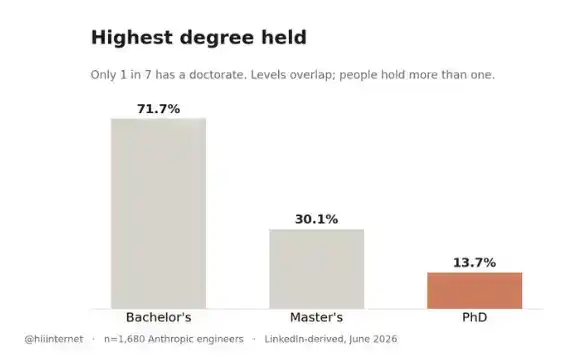
Only 13.7% hold a doctoral degree. That's roughly one in seven people.

The typical Anthropic recruitment target is not a research scientist, but a senior engineer with a bachelor's or master's degree. The image of a "lab full of PhDs" is largely incorrect at the engineering team level.

The distribution of academic majors also perfectly fits the profile of a "building organization": Computer Science (819 people), followed by Mathematics (78), Physics (70), Computer Engineering (69). Philosophy also makes the top 20, with 13 people, likely related to safety.

Stanford Is Clearly the Leading Source by University
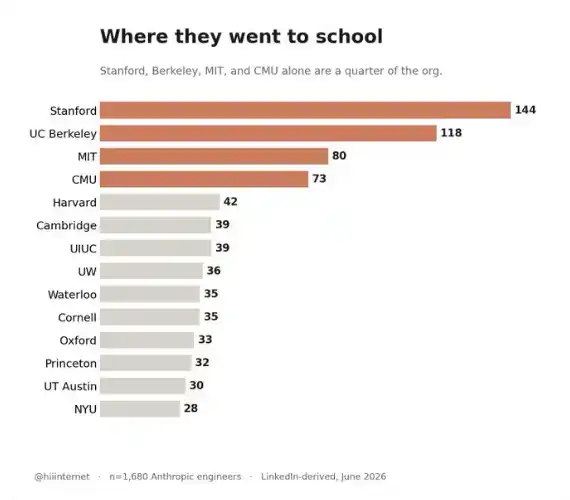
Looking at universities, the historical cumulative ranking is: Stanford (144 people), Berkeley (118), MIT (80), CMU (73), Harvard (42), Cambridge (39), UW (36), Waterloo and Cornell (35 each), Oxford (33), Princeton (32). The top four schools combined account for a quarter of the entire engineering team.

80% of people share the same job title.

"Member of Technical Staff."

A former Instagram CTO, a few former Adept founders, and Stanford faculty at Anthropic all share the title "MoTS." This flattening of job titles is clearly intentional. Seniority and specific function are, by design, hidden.

Where is the One Entry Point for Early-Career People into Anthropic?
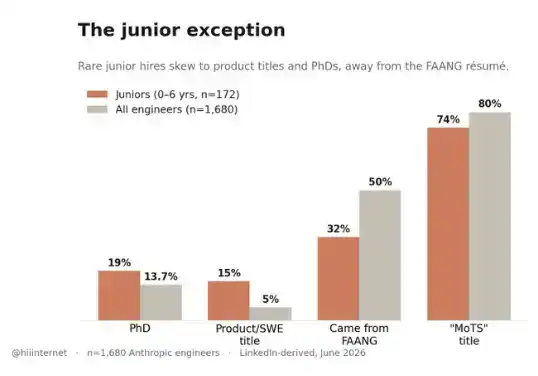
There are 172 engineers with less than 6 years of experience, and 50 of them have less than 3 years. But they are not typical new graduates. They roughly fall into two categories, with almost no ordinary mid-level engineers in between.

Compared to the entire engineering team, they show distinctly different characteristics: a higher PhD rate of 19% vs. 13.7% overall; product/SWE titles are three times more common, at 15% vs. 5% overall; they are also far less likely to have FAANG experience, only 32% vs. 50% overall.

In place of years of experience, they possess a different form of prestige capital:

The Internship Pipeline. 50% of them list internships at these companies: Meta (16 people), Google (10), DeepMind (6), Microsoft (5), Amazon (5), plus Jane Street, Two Sigma, HRT, Optiver, Nvidia.

From Quant Trading to AI Labs. 9% had stints at top trading firms, including Jane Street, Two Sigma, Five Rings, HRT, Optiver, Citadel. This is a group of young math/coding competition talent entering AI labs via the high-frequency trading industry.

Alignment Fellowships. 6% had exposure to MATS, SERI, Redwood, or ARC. This is an entry point that is almost exclusively for early-career talent and virtually absent among the senior cohort.

A very clear profile emerges: MIT, IOI Silver Medalist, Codeforces rating 2900+, entered reinforcement learning and safety directly after four years of work. Their screening criteria aren't years of experience, but competition rankings and publications.

These young engineers are also more international than their senior counterparts. School sources for low-seniority engineers include: Berkeley (15), Stanford (14), Cambridge (10), MIT (7), Tsinghua (7), Oxford (6), plus Imperial, NUS, Shanghai Jiao Tong University, ETH Zürich.

So, How Should You Interpret This?

If you want to join Anthropic as an engineer, don't write your resume as if applying to a research lab. Write it as if applying to an infrastructure company. Show the systems you've actually built and scaled. That's the resume getting hired.

The early-career stage is the only exception. At this stage, the barrier isn't regular work experience, but top internships, competition rankings, or publications.

If you're competing with Anthropic for talent, your target isn't "PhDs" or "lab background" per se, but those senior Builders from hyperscale cloud providers or companies with stellar engineering reputations: they have about 12 years of experience, likely from Stripe, Databricks, Snowflake, Palantir. Anthropic is already fishing heavily in this talent pool.


Трендові криптовалюти

Пов'язані питання

QWhat is the core talent profile that Anthropic primarily hires for, according to the analysis of engineer resumes?

AThe core talent profile at Anthropic is not 'researchers,' but rather experienced 'builders'—engineers who can build, scale, and maintain large-scale production systems. The majority are senior engineers with a background in infrastructure, backend, distributed systems, databases, and security, not necessarily AI model research.

QWhat does the data say about the experience level of a typical new engineer joining Anthropic?

AThe median prior work experience for engineers joining Anthropic is 12.2 years. The middle 50% have between 8.8 and 16.5 years of experience. New hires are predominantly senior engineers, with nearly zero recent graduate hiring.

QWhich company is the largest direct source of engineering talent for Anthropic, and what does this indicate about their hiring preference?

AGoogle is by far the largest direct source of engineering talent for Anthropic. This indicates a strong preference for candidates from companies renowned for engineering rigor and infrastructure capabilities (like Meta, Amazon, Microsoft, Stripe, Databricks), rather than exclusively from AI research labs like OpenAI or DeepMind.

QWhat is the percentage of engineers at Anthropic with a PhD, and what is the most common educational background?

AOnly 13.7% of the engineers analyzed hold a PhD. The most common educational background is a Bachelor's or Master's degree in Computer Science (819 people), which aligns with the profile of a 'builder' organization focused on engineering and infrastructure.

QFor early-career individuals with limited work experience, what are the primary pathways to secure an engineering role at Anthropic?

AEarly-career individuals primarily gain entry through alternative prestige signals: top-tier internship experiences (e.g., at Meta, Google, DeepMind), exceptional competition rankings (e.g., IOI medals, high Codeforces scores), research publications, or participation in specialized AI safety/alignment fellowships (e.g., MATS, SERI).

Пов'язані матеріали

The Most Difficult Thing to Predict on Polymarket Is... When the POLY Airdrop Will Happen

During the recent World Cup, Polymarket saw record-breaking activity, with its "World Cup winner" market reaching $4.32 billion in volume, making it the platform's highest-volume single prediction event ever. Over the six-week tournament, football markets amassed $85 billion in nominal trading volume, cementing sports as a major growth driver. Capitalizing on this surge in traffic, Polymarket quietly increased fees for its sports markets in early July. The taker fee multiplier was raised from 0.03 to 0.05, effectively raising maximum costs per trade by nearly 70% and moving sports out of its lowest fee tier. This follows a broader trend of the platform gradually expanding fee structures across various market categories since the start of the year to boost revenue. However, community focus is increasingly shifting from trading volumes to the long-awaited POLY token airdrop. Despite a senior executive confirming in late 2025 that a token and airdrop were planned for after U.S. market re-entry, no timeline has been provided. Recent actions, like an affiliated account deleting a potentially suggestive tweet and official help pages stating "no airdrop or token generation event has been announced," have fueled speculation and frustration. The community is divided on the reasons for the delay. Some believe Polymarket is waiting for a more favorable regulatory window in the U.S., while others speculate that the platform's strong organic growth and rising fee revenue have reduced the urgency to issue a token, potentially following a path similar to OpenSea. The prolonged uncertainty has led users to question not the *if*, but the *when*, of the POLY airdrop, turning it into one of the platform's most unpredictable events.

Odaily星球日报1 хв тому

The Most Difficult Thing to Predict on Polymarket Is... When the POLY Airdrop Will Happen

Odaily星球日报1 хв тому

After Investing in Changxin, Hefei State Capital Makes Another Move

Two events unfolded within the same week. On July 13th, the Hefei Industrial Investment Xinzhi Xinyu Equity Investment Partnership with a pledged scale of 5 billion RMB was established. Three days later, ChangXin Technology launched its online and offline public offering at a price of 8.66 RMB per share, aiming to raise approximately 57.9 billion RMB. The link between these events is the Hefei Industrial Investment Group (Hefei ChanTou). Hefei ChanTou directly holds shares in ChangXin Technology through its wholly-owned subsidiary, ChangXin Integration, and is also behind the newly established 5 billion RMB fund. This highlights a strategic move: as ChangXin approaches its IPO, Hefei ChanTou establishes a new fund to prepare for the next round of industrial investment. Founded in 2015, Hefei ChanTou is a state-owned capital investment platform focused on industrial financing and innovation. Beyond direct equity holdings in major projects like ChangXin's 12-inch memory wafer manufacturing base, it manages various provincial and municipal government-guided funds. Its self-managed fund scale exceeds 100 billion RMB. ChangXin Technology, now China's leading DRAM manufacturer, exemplifies the classic "Hefei model." A decade ago, when founder Zhu Yiming sought entry into the capital-intensive DRAM sector, Hefei's state capital provided the crucial long-term support. Pre-IPO, entities within the Hefei ChanTou system hold significant direct and indirect stakes, with a theoretical combined value of roughly 116.2 billion RMB based on the IPO price. However, this long-cycle, concentrated investment model brings financial pressure. Hefei ChanTou's financials show significant liabilities, net outflows from investing activities, and reliance on investment income. The focus is now shifting alongside Hefei's broader "654X" industrial system, which encompasses six dominant industries, five emerging industries (like AI and biopharma), and four future industries (including quantum tech and nuclear fusion). The narrative is one of transition. As the ChangXin project reaches a major milestone with its IPO, the new 5 billion RMB fund symbolizes the beginning of the next investment chapter—targeting a more diverse and early-stage array of sectors within Hefei's expanded industrial vision.

marsbit10 хв тому

After Investing in Changxin, Hefei State Capital Makes Another Move

marsbit10 хв тому

Should Developers Build on Corporate Blockchains Like Base and Robinhood?

Should developers build on enterprise-backed public chains like Base, Robinhood, or Stripe's Tempo? While these chains offer enticing benefits—primarily access to the platform's existing user base for accelerated growth—they come with significant, well-documented risks stemming from the inherent conflict of interest when a company controls both the underlying chain and major on-chain applications. The core promise is traffic distribution: projects gain exposure through platforms like the Coinbase wallet or app. However, this model creates five major risks: 1. **Direct Competition**: The platform can leverage its data and position to launch and prioritize its own competing products, similar to Amazon creating private-label goods or Microsoft bundling Internet Explorer. 2. **Wallet Agnosticism**: Companion wallets (e.g., Coinbase Wallet) must support multiple chains and integrate top applications across the ecosystem to remain competitive, diluting the promised exclusive traffic advantage for the enterprise chain. 3. **Competitor Exclusion**: Rival platforms (e.g., Coinbase vs. Robinhood) have no incentive to promote applications built on a competitor's chain. 4. **Profit Extraction**: The party controlling end-users holds disproportionate bargaining power and can capture most of the value, squeezing protocol profits down to marginal cost. 5. **Unfulfilled Promises**: Promised traffic support can be deprioritized or withdrawn based on shifting corporate strategies. In contrast, neutral chains like Ethereum or Solana avoid these platform risks entirely. For developers considering enterprise chains, risk mitigation strategies include: evaluating substantial onboarding grants, seeking (though often weak) contractual guarantees, and, most crucially, pursuing a multi-chain strategy while building independent user acquisition channels. Enterprise chains may be useful for initial cold-start growth, but the ultimate goal should be cultivating a dedicated user base rather than long-term dependence on a single, conflicted platform.

marsbit11 хв тому

Should Developers Build on Corporate Blockchains Like Base and Robinhood?

marsbit11 хв тому

The Jacobian Conjecture that plagued Yitang Zhang for 7 years was overturned and disproven by Fable 5 overnight

**Summary:** The mathematical community was shocked when the longstanding **Jacobi Conjecture**—a core problem in polynomial mapping that had remained open for 87 years—was reportedly **disproven** by **Fable 5** (an AI model from Anthropic). The conjecture, first posed in 1939, asks whether a polynomial map with a constant, non-zero Jacobian determinant must have a polynomial inverse. Despite seeming intuitive, it had resisted numerous proof attempts by leading mathematicians. The breakthrough came when a researcher, Levent Alpoge, shared a succinct counterexample generated by Fable 5: a specific polynomial map from ℂ³ to ℂ³ whose Jacobian is the constant -2, yet which is not injective (mapping three distinct points to the same image). This elegantly falsifies the conjecture in its general form for dimensions ≥3. The counterexample is simple enough to be verified by hand or with tools like Wolfram Alpha. The event sparked intense discussion, with other AI models like GPT-5.6 quickly analyzing the result and even proposing a refined conjecture. It demonstrated AI's emerging capacity for genuine mathematical creativity, not just pattern matching. The story carries a poignant human dimension: renowned mathematician **Yitang Zhang** had devoted seven years of his early career to this problem under his PhD advisor, using a flawed lemma provided by the advisor. This setback contributed to Zhang leaving academia for years, including a period working at Subway, before his later breakthrough on the Twin Prime Conjecture. The AI's swift resolution underscores the tragic waste of his early effort on a conjecture now shown to be false in higher dimensions. It's important to note the disproof specifically targets the generalized (n-dimensional, n≥3) conjecture. The 2-dimensional case, which Zhang worked on, remains open and is considered mathematically distinct and even more challenging. Nonetheless, the event marks a significant moment, prompting reflections on AI's future role in mathematical discovery.

marsbit37 хв тому

The Jacobian Conjecture that plagued Yitang Zhang for 7 years was overturned and disproven by Fable 5 overnight

marsbit37 хв тому

Торгівля

Спот

Популярні статті

Як купити PEOPLE

Ласкаво просимо до HTX.com! Ми зробили покупку ConstitutionDAO (PEOPLE) простою та зручною. Дотримуйтесь нашої покрокової інструкції, щоб розпочати свою криптовалютну подорож.Крок 1: Створіть обліковий запис на HTXВикористовуйте свою електронну пошту або номер телефону, щоб зареєструвати обліковий запис на HTX безплатно. Пройдіть безпроблемну реєстрацію й отримайте доступ до всіх функцій.ЗареєструватисьКрок 2: Перейдіть до розділу Купити крипту і виберіть спосіб оплатиКредитна/дебетова картка: використовуйте вашу картку Visa або Mastercard, щоб миттєво купити ConstitutionDAO (PEOPLE).Баланс: використовуйте кошти з балансу вашого рахунку HTX для безперешкодної торгівлі.Треті особи: ми додали популярні способи оплати, такі як Google Pay та Apple Pay, щоб підвищити зручність.P2P: Торгуйте безпосередньо з іншими користувачами на HTX.Позабіржова торгівля (OTC): ми пропонуємо індивідуальні послуги та конкурентні обмінні курси для трейдерів.Крок 3: Зберігайте свої ConstitutionDAO (PEOPLE)Після придбання ConstitutionDAO (PEOPLE) збережіть його у своєму обліковому записі на HTX. Крім того, ви можете відправити його в інше місце за допомогою блокчейн-переказу або використовувати його для торгівлі іншими криптовалютами.Крок 4: Торгівля ConstitutionDAO (PEOPLE)Легко торгуйте ConstitutionDAO (PEOPLE) на спотовому ринку HTX. Просто увійдіть до свого облікового запису, виберіть торгову пару, укладайте угоди та спостерігайте за ними в режимі реального часу. Ми пропонуємо зручний досвід як для початківців, так і для досвідчених трейдерів.

540 переглядів усьогоОпубліковано 2024.12.12Оновлено 2026.06.02

Як купити PEOPLE

Обговорення

Ласкаво просимо до спільноти HTX. Тут ви можете бути в курсі останніх подій розвитку платформи та отримати доступ до професійної ринкової інформації. Нижче представлені думки користувачів щодо ціни PEOPLE (PEOPLE).

活动图片