What happened in crypto today: Hormuz tensions, oil prices impact the market

ambcryptoОпубліковано о 2026-03-23Востаннє оновлено о 2026-03-23

Анотація

Trump’s 48-hour ultimatum over the Strait of Hormuz triggered a crypto market downturn, reinforcing Bitcoin’s role as a macro stress outlet. BTC swung between $68,265 and $71,051 before settling near $69,195, down 2.2%, with over $123 million in liquidations. Ethereum fell 2.1%, and the Fear and Greed Index dropped to 9, indicating rising fear. The sell-off spread to altcoins like XRP and SOL, with total market cap falling to $2.37 trillion. Bitcoin dominance rose to 58.2%, showing a defensive shift into BTC rather than altcoins. Spot Bitcoin ETFs saw $163 million in outflows on March 18, reversing prior inflows, though cumulative inflows remain above $56 billion. The market appears reactive, with fragile liquidity and no significant new capital entering.

Trump’s 48-hour ultimatum over the Strait of Hormuz quickly spilled into crypto, reinforcing Bitcoin’s [BTC] role as the first macro stress outlet. Within hours, BTC swung between $68,265 and $71,051 before settling near $69,195, down 2.2%.

In fact, this sharp range expansion signals rapid repricing rather than stable demand. At the same time, liquidations surged to over $300 million, an 80% increase, with over $123 million from BTC, indicating that forced unwinds dominated price action.
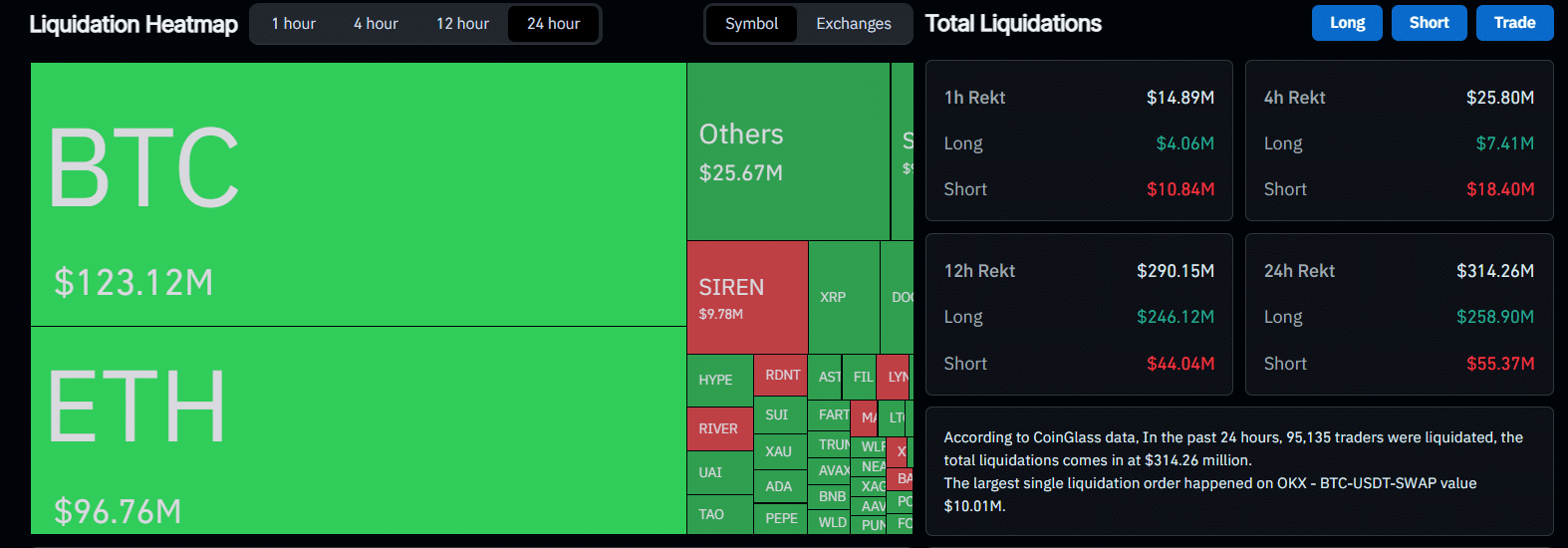
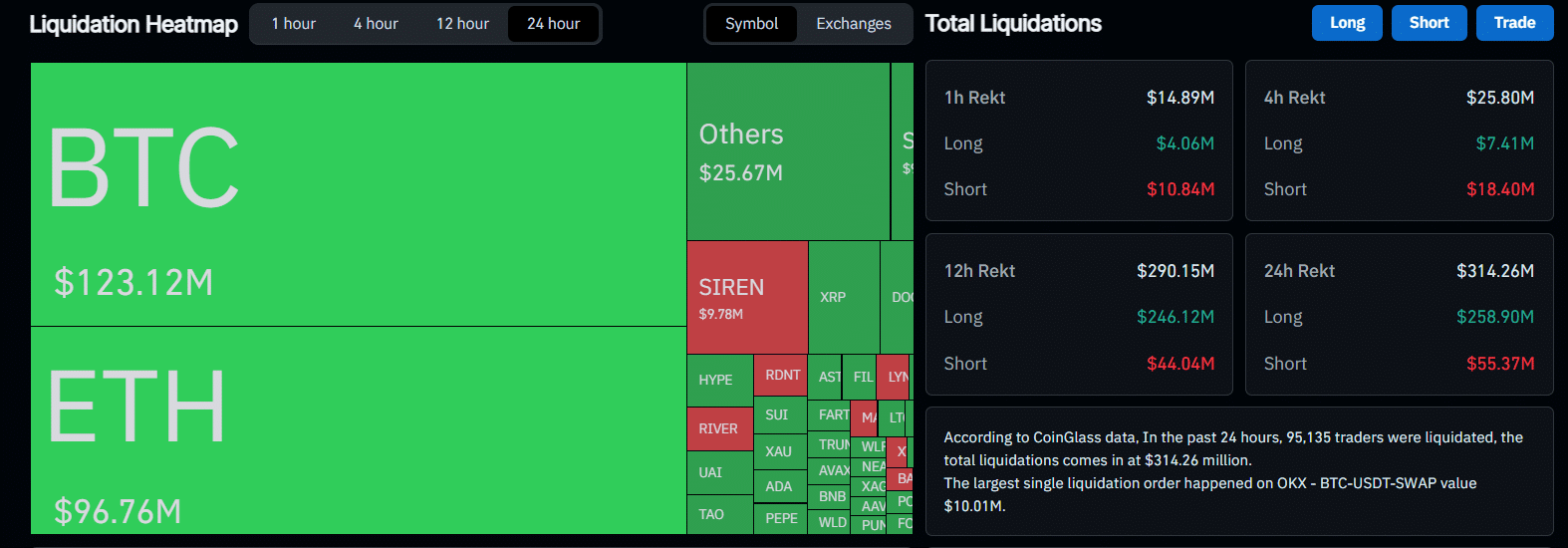
Source: CoinGlass

Meanwhile, Ethereum [ETH] fell 2.1%, confirming broad risk sensitivity. As volatility increased, the Fear and Greed Index dropped to 9, while shorts rose to 51.7%.

This setup implies that traders are shifting toward protection rather than accumulation, which suggests fragile liquidity and a market driven more by reaction than conviction.

Market-wide correction unfolds in tandem

Bitcoin’s drop set off a broader reaction, as altcoins moved lower in tandem but with varying intensity. Ethereum fell 3.01% to $2,091, while Ripple [XRP] dropped 3.04% and Solana [SOL] declined 2.86%, showing coordinated but uneven pressure.

In fact, this spread highlights how altcoins amplify downside when liquidity tightens, yet still track Bitcoin’s direction closely. Meanwhile, total market cap slipped to $2.37 trillion, signaling capital outflows, although not a full breakdown in structure.

At the same time, the CoinMarketCap 20 Index fell 2.5%, confirming broad weakness across large caps. This setup implies risk appetite is softening, while capital becomes more selective, meaning altcoins remain vulnerable but can stabilize quickly if Bitcoin regains momentum.

Bitcoin reflects macro stress amid oil-driven risks

As Hormuz tensions intensified, Bitcoin remained aligned with risk assets, not a safe-haven shift. Bitcoin dominance rose to 58.2%, up 0.27%, signaling rotation into BTC over altcoins rather than broad inflows.

This reflects defensive positioning within crypto, not renewed risk appetite. Meanwhile, ETF flows reflected shifting conviction across the market. On the 17th of March, Spot Bitcoin ETFs recorded $199 million in net inflows.

However, this trend quickly reversed. On the 18th of March, flows flipped to $163 million in outflows, signaling short-term uncertainty.

Even so, cumulative inflows still exceed $56 billion. As a result, underlying institutional interest continues to persist despite recent fluctuations.

As the price holds near $68,700–$69,000, stability appears conditional rather than strong. At the same time, stablecoin supply shows no sharp expansion, indicating limited fresh liquidity entering the market.


Пов'язані питання

QWhat was the immediate impact of Trump's 48-hour ultimatum over the Strait of Hormuz on the cryptocurrency market?

AThe news caused Bitcoin's price to swing between $68,265 and $71,051, ultimately settling near $69,195 with a 2.2% drop, and triggered over $300 million in liquidations.

QHow did the broader altcoin market react to Bitcoin's price drop?

AAltcoins moved lower in tandem, with Ethereum falling 3.01%, Ripple (XRP) dropping 3.04%, and Solana (SOL) declining 2.86%, showing coordinated but uneven pressure.

QWhat did the rise in Bitcoin dominance to 58.2% signify about market sentiment?

AIt signaled a defensive rotation of capital into Bitcoin over altcoins, reflecting risk-off positioning within crypto rather than a broad shift into crypto as a safe-haven or renewed overall risk appetite.

QWhat was the trend in Spot Bitcoin ETF flows around March 17th and 18th?

ANet inflows of $199 million were recorded on March 17th, but this quickly reversed to $163 million in outflows on March 18th, indicating short-term uncertainty among investors.

QWhat does the lack of a sharp expansion in stablecoin supply indicate about the market?

AIt suggests that there is limited fresh liquidity entering the cryptocurrency market, meaning recent price action is more driven by existing capital repositioning than by new money flowing in.

Пов'язані матеріали

Within Strategy's Framework, STRC's Dividend Yield Remains at 12% as Share Price Stays Below Par Value

Michael Saylor, Executive Chairman of Strategy (MSTR), confirmed that the dividend rate for its STRC perpetual preferred shares will remain at 12.00% through August 2026. The rate has increased from 9% at its July 2025 launch to the current high via a "ratchet" mechanism, which permanently raises the rate by 0.5% whenever the share price falls below $95. This mechanism is intended to push the price back toward its $100 par value and support Strategy's "at-the-market" (ATM) program for issuing new shares to fund Bitcoin purchases. However, the mechanism has not worked as intended. STRC shares closed at $89.46 on July 31, remaining about 10-11% below par value despite the record-high dividend. Competition from rival Strive's higher-yielding SATA securities has pressured demand. The persistent discount has forced Strategy to suspend new STRC issuances via its ATM program, limiting this funding channel for Bitcoin acquisitions. STRC's struggles reflect Bitcoin's own volatility, as the preferred shares historically move in tandem. Analysts have warned the ratchet structure carries long-term, one-way risk. A law firm is investigating Strategy's ability to maintain dividend payments if Bitcoin's price stays low. Retail investors own roughly 83% of outstanding STRC shares, a group seen as prone to panic selling during downturns. In response, Strategy has established financial reserves, including a liquidity cushion covering about 26 months of dividend/interest obligations, and a $2 billion share buyback program alongside a Bitcoin monetization framework, though the company emphasized it is not obligated to sell any Bitcoin.

cryptonews.ru31 хв тому

Within Strategy's Framework, STRC's Dividend Yield Remains at 12% as Share Price Stays Below Par Value

cryptonews.ru31 хв тому

Analyst: Bitcoin's Price Will Drop to $60k in August, Then Rebound to $70k

Financial analyst Andrey Poroshin has provided a new forecast for Bitcoin's price dynamics in August. Poroshin, an analyst at the Bitbanker exchange, expects the cryptocurrency market to experience a downturn this month, with prices retesting the $60,000 level due to a lack of supportive macroeconomic catalysts. He noted that the recent US Federal Reserve decision to hold interest rates did not significantly impact the market, while inflation remains above the 2% target. Poroshin stated that Bitcoin is ending July under pressure from moderate volatility and a lack of new macroeconomic stimuli, leading to continued market caution. According to his base scenario, Bitcoin will drop to a range of $60,000 to $62,000 before recovering to $70,000. He pointed out that even $70,000 remains below the cost of mining in the US, which has prompted some miners to shift towards AI data center operations. Poroshin cited the winding down of BitMEX's operations as a potential catalyst for a price rebound, suggesting the exit of weaker players often coincides with market reversals and reduced short-term selling pressure. He believes Bitcoin is currently less susceptible to geopolitical shocks, such as the Iran-US conflict, and does not expect significant market changes in August related to the pending CLARITY Act. Looking ahead, Poroshin forecasts that September will bring more active price fluctuations driven by potential Fed rate decisions and possible discussions or approval of the CLARITY Act.

cryptonews.ru31 хв тому

Analyst: Bitcoin's Price Will Drop to $60k in August, Then Rebound to $70k

cryptonews.ru31 хв тому

Торгівля

Спот
活动图片




