Welcome to the New Crypto World: Only This Time, The Place Where You Lose Money Is Called the Stock Market

marsbitОпубліковано о 2026-07-30Востаннє оновлено о 2026-07-30

Анотація

Welcome to the New Crypto World: Only This Time, the Place to Lose Money is Called the Stock Market. The article depicts a future (2026) where global stock markets, particularly tech stocks, are exhibiting behaviors and risks reminiscent of the cryptocurrency world. The narrative centers on a sharp crash in South Korea's KOSPI index and leading stocks like SK Hynix, highlighting widespread retail losses, leverage-induced liquidations, and extreme volatility. It argues that a significant shift in market dynamics is underway: pricing is increasingly driven by narratives (like the AI boom) over fundamental valuation, amplified by high leverage and the rapid, emotion-fueled consensus formed on social media. Former crypto traders, seeking new opportunities, brought their high-risk strategies—chasing narratives, using leverage—into equity markets, focusing on sectors like AI and semiconductors. Ironically, data suggests some major tech stocks have recently shown greater volatility and faster crashes than Bitcoin, which is becoming relatively more stable and "stock-like" through institutional adoption. The piece details how leveraged ETFs in Korea, particularly those tied to single stocks, created a vicious cycle of forced selling that exacerbated the market plunge. It concludes that while stocks retain underlying fundamentals, the *trading* of them has undergone a "de-rationalization": markets now prioritize themes, social media sentiment, and leveraged bets over traditional ana...

Author: Dou Wanle

July 13, 2026, Seoul.

South Korea's benchmark KOSPI index plummeted 8.95% in a single day, triggering its 7th circuit breaker of the year. SK Hynix, the 'national destiny stock' in the eyes of Koreans, plunged 15.37%, a decline not seen in nearly two decades. Samsung Electronics also fell over 10%.

Margin calls were issued for over 1.2 million leveraged accounts. Brokerage systems automatically liquidated between 320,000 and 460,000 accounts. More heartbreaking is that 62% of those liquidated were young people aged 20 to 30. Some lost their down payment for a wedding apartment, others were trading on margin...

A young man in his 20s in Busan, who lost money following a recommendation from a stock YouTuber, went and stabbed the influencer.

In the past, these phrases would most likely have been used to describe scenes after a crypto market crash. Today, they are recurring in the South Korean, American, and Japanese markets as the tech stock tide recedes.

Sharp rallies and sell-offs are just the surface. What's truly changed is the method of valuation—narrative outweighs fundamentals, leverage amplifies emotions, and social media drives consensus to extremes with unprecedented speed.

Global stock markets, especially tech stocks, are becoming increasingly like the crypto world.

Returning to the Family Home

"Welcome back to the family home."

After the crash, crypto traders who had switched to stocks shared numerous loss stories online. Comments like the one above were ubiquitous.
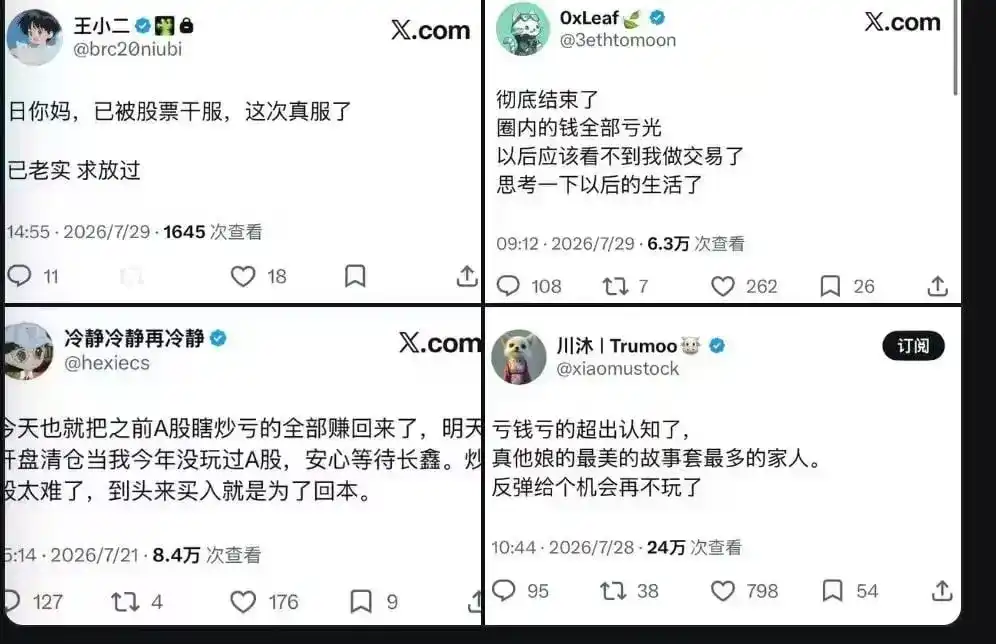
The so-called "family home" refers to the cryptocurrency world. From the second half of 2025 to early 2026, a major drama of "leaving the family home" unfolded in the crypto space.

A number of KOLs and veteran players who had been in the cryptocurrency market for years began to lose faith. Bitcoin was range-bound with tepid trading volume, meme coins kept getting shaved. Many felt "this circle is boring" and started turning their attention to US stocks.

This choice seemed very reasonable.

Stocks have revenue, profits, financial reports, and SEC oversight. Compared to crypto projects lacking cash flow and priced purely on consensus, US stocks at least appeared to be more mature and safer assets.

The crypto traders didn't just take their liquidity; they brought their trading methods along too.

In the crypto market, they were accustomed to chasing new narratives, hunting for high-volatility targets, using leverage, and swiftly switching positions based on social media sentiment. Upon entering the stock market, this approach barely changed—only the trading objects shifted from tokens to AI, memory chips, and leveraged ETFs, repeatedly achieving significant gains.

Memory stocks soon became the new collective consensus.

The logic was not complicated: AI servers require more high-bandwidth memory (HBM), leading to supply shortages and rising memory prices. Micron, Samsung Electronics, and SK Hynix naturally became the most direct 'shovel sellers.' The phrase "you can never have enough memory" became deeply ingrained.
Numerous crypto KOLs reinvented themselves, starting to talk about US stocks, memory cycles, and AI capital expenditure. Products like the 2x leveraged SK Hynix ETF were also regarded as more 'efficient' betting tools than regular stocks.

Until the market reversed in July.

Bitcoin Becomes the "Low Volatility Asset"

How long does it take to fall from the peak?

Bitcoin took 268 days to halve its value, and silver took 169 days for a similar magnitude of retracement.

In contrast, SanDisk took only 36 days to fall about 55%, and SK Hynix took only 34 days to drop about 53%.

While both experienced a 'halving,' Bitcoin took nearly nine months, while memory stocks took just over one month.
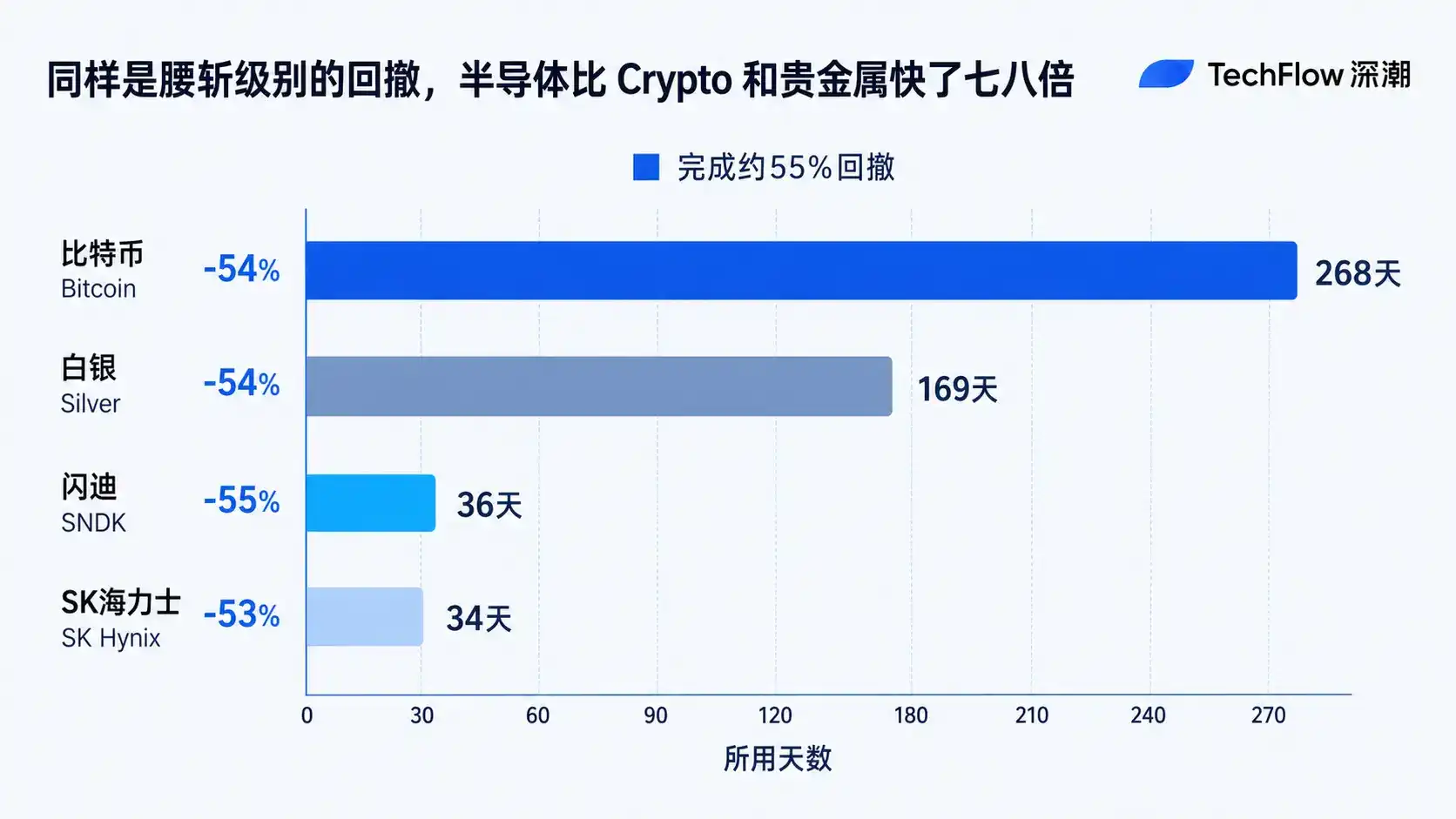
This is the ironic twist of this round of market movements. In the past, investors worried Bitcoin could surge or crash within days, while stocks adjusted slowly based on earnings and valuations. Now, some tech stocks are completing an entire bubble burst in a shorter time frame than cryptocurrencies.

It's very counter-intuitive. Compared to some tech stocks, Bitcoin is becoming relatively stable.

According to Schwab statistics, Bitcoin's historical volatility in 2025 was about 42%, with a maximum drawdown of around 32%. During the same period, Tesla's volatility was about 63% with a max drawdown of 48%, and Nvidia's volatility was about 50% with a max drawdown of 37%.

Bitcoin remains a high-risk asset, but the volatility of some major tech stocks is even greater.

Bitwise even predicted in its 2026 outlook that Bitcoin's overall volatility might continue to be lower than Nvidia's.

So the current situation is quite absurd: Bitcoin is becoming more like tech stocks, while tech stocks are becoming more like Bitcoin.

When Narrative Becomes the Valuation Anchor

There's an old saying in crypto: trading crypto is trading narratives.

In 2026, global tech stocks are turning this saying into reality.

AI is certainly not vaporware. Nvidia, Microsoft, Google, and large cloud computing companies have real revenue and are investing real capital to build data centers.

But there's a long road between "AI will indeed create value" and "any company touching AI is worth buying at any price."

At the height of the frenzy, the market simply skipped that road.

AI servers, optical modules, memory chips, data centers, power equipment, even nuclear energy companies—as long as they could be placed within the AI industrial chain, their stock prices could surge. Businesses were still in the planning stage, orders not yet secured, but the market would price them based on the best possible outcome years in advance.

The story in South Korea was "AI semiconductors are tied to national destiny." As KOSPI kept hitting new highs, more and more families began opening stock accounts for their underage children, gifting popular stocks like Samsung Electronics and SK Hynix as long-term presents.

A similar concentration occurred in the A-share market. In the first half of 2026, the TMT sector's market cap reached 41.78 trillion yuan, accounting for about 31.45% of the total A-share market value. On some trading days, turnover in the tech sector approached half of the entire market's.

The US market has long been priced around a handful of large tech companies. As index gains relied increasingly on just a few firms, and as funds, options, and retail investors flooded into the same stocks, seemingly diversified portfolios were essentially betting on the same AI story.

This is reminiscent of the old crypto world. Dogecoin's surge in 2021 wasn't due to a technological breakthrough, but because Elon Musk tweeted. The surge in tech stocks in 2026 wasn't because all companies experienced explosive earnings growth, but because ChatGPT convinced everyone that "AI will rewrite everything."

That narratives could dominate the market so rapidly is also inseparable from changes in dissemination methods.

In the past, stock information primarily came from financial reports, research notes, and institutional roadshows. Today, more and more people's investment decisions come from YouTube, X, short videos, and paid communities.

Complex company research is compressed into a few sentences: Time will prove compute and optical modules, AI compute will always be insufficient...

Social media algorithms don't reward caution either. Overnight riches are always the traffic magnet: someone doubled their money overnight with options, an office worker achieved financial freedom by heavily investing in memory stocks, someone used leveraged ETFs to earn years' worth of salary in a few months.

Charts are the best advertisement. A large number of housewives and middle-aged women began investing their private savings, and some even sold properties to buy stocks, reminiscent of students dropping out of school to all-in on Web3 a few years ago...

The Leverage Carnival

The scariest thing in crypto isn't volatility; it's the lethal combination of leverage and volatility. In 2026, global stock markets are perfectly replicating it.

On May 27, 2026, the Korea Exchange approved the listing of 16 single-stock leveraged ETFs with 2x leverage, tracking stocks like Samsung Electronics and SK Hynix.

Retail investors went wild. From approval to mid-July, Korean retail investors accumulated a net purchase of 14 trillion won (approx. 64 billion RMB) worth of single-stock leveraged ETFs. During the same period, foreign investors bought only about 2 trillion won.

These ETFs had several fatal design flaws.

These products rebalance their positions daily. The more severe the volatility, the more significant the decay in net asset value. Assume a stock falls 10%, then rises 11.1%—it returns to its original price. The corresponding 2x leveraged product would first fall 20%, then rise 22.2%, ultimately still losing about 2.2%.

The problem is even worse during rapid declines.

To maintain target leverage, the products need to passively reduce risk exposure after a decline. Selling further depresses the underlying price, triggering more position reductions, stop-losses, and margin pressure.

Goldman Sachs later pointed out that the "rapid deleveraging" of these products was the main cause of abnormal intraday volatility in KOSPI, with 62% of institutional net selling stemming from ETF-related liquidations.

Two months later, South Korean regulators urgently halted all new listings of single-stock leveraged ETFs. The minimum margin requirement was drastically raised from 10 million won to 30 million won, and only cash was recognized.

But it was too late. 2.3 trillion won in forced liquidation amounts, and the wealth of hundreds of thousands of families vanished into thin air.

Even the US stock market, the deepest in the world, is experiencing the backlash of leverage.

JPMorgan analysts recently noted that US stocks still have "deleveraging room," needing three months to return to pre-April levels.

The ratio of memory chip stock leveraged ETF assets to underlying market cap is three times the average for all stock ETFs. Even for broad leveraged stock index ETFs, the ratio is high relative to its own history.

A Regression

"Stock markets becoming like crypto" doesn't mean stocks have become completely identical to cryptocurrencies.

Stocks still have companies, assets, revenue, and cash flow behind them. They also have financial disclosures, audits, and regulation. Even when market sentiment fades, a truly profitable company still possesses a calculable value.

What's truly changed is at the trading layer.

In the past, people bought a company's future profits. Now, more and more people are trading the heat of a theme.

The crypto-fication of stock markets is essentially a revolution of de-rationalization.

Traditional stock markets look at P/E, cash flow; crypto-fied markets look at narratives, imagination. Traditional stock markets consider 20% volatility high; crypto-fied markets see individual stocks fluctuating 10-15% daily as the norm.

Traditional markets use leverage via margin trading; crypto-fied markets use ETFs, derivatives, quantitative strategies. Traditional market info comes from research reports, financial statements; crypto-fied market info comes from Twitter, YouTubers, online communities. Traditional markets have institutions rationally pricing; crypto-fied markets have institutions becoming retail-like, quant funds chasing momentum...

What's even more laughable is, now Bitcoin is striving to become like a stock, gaining mainstream financial acceptance through ETFs, institutionalization, and declining volatility.

This is an absurd point of intersection.

Those who transitioned from crypto to stocks ultimately found they hadn't left the "family home." It's the same repeating mechanism: grand narratives, crowded positions, easily accessible leverage, and everyone believing they can exit before everyone else.

The words written by a Korean retail investor on a trading forum are worth everyone remembering: I want to go back to the days before I traded stocks, and get my money back.

But the market never issues refunds.

Трендові криптовалюти

Пов'язані питання

QAccording to the article, why are global stock markets, especially tech stocks, becoming more like the cryptocurrency market?

AThe article argues that stock markets, particularly tech stocks, are becoming more like the cryptocurrency market due to several converging factors. Firstly, pricing is increasingly driven by narrative and hype (like AI) rather than traditional valuation metrics like earnings. Secondly, the widespread use of leverage, especially through products like single-stock leveraged ETFs, magnifies volatility and emotions, similar to crypto trading. Finally, social media and online influencers rapidly form and spread consensus, pushing market sentiment to extremes and encouraging herd behavior among retail investors.

QWhat role did single-stock leveraged ETFs play in the South Korean market crash described in the article?

AIn South Korea, the approval of single-stock 2x leveraged ETFs (tracking stocks like Samsung and SK Hynix) in May 2026 played a catastrophic role. A massive influx of retail money into these products created concentrated, highly leveraged positions. Their daily rebalancing mechanism caused significant 'volatility decay' during swings. Most critically, during the sharp July decline, these ETFs were forced to automatically sell underlying stocks to maintain their target leverage. This created a vicious cycle of forced selling, further driving down stock prices, triggering more margin calls, and leading to a market crash. High estimated that 62% of institutional net selling during the crash was related to ETF liquidations.

QWhat paradoxical comparison does the article make between Bitcoin and certain technology stocks in 2026?

AThe article presents a paradoxical and counterintuitive comparison: while Bitcoin is notorious for its volatility, data from 2025 showed that its historical volatility (~42%) and maximum drawdown (~32%) were actually lower than those of major tech stocks like Tesla (~63% volatility, ~48% drawdown) and Nvidia (~50% volatility, ~37% drawdown). Furthermore, it took stocks like SK Hynix only about 34 days to fall roughly 53% from their peak, whereas a similar 'halving' for Bitcoin historically took about 268 days. Thus, compared to some hyper-volatile tech stocks, Bitcoin was ironically becoming a relatively 'low-volatility asset'.

QHow does the article characterize the change in information sources and decision-making for stock investors?

AThe article characterizes a fundamental shift in how stock investment information is sourced and decisions are made. Traditionally, investors relied on financial reports, analyst research, and institutional roadshows. Now, decisions are increasingly influenced by content from social media platforms like YouTube, X (Twitter), short video apps, and paid online communities. Complex company analysis is reduced to simple, viral slogans or narratives (e.g., 'AI compute will always be scarce'). Social media algorithms favor sensational, get-rich-quick stories over cautious analysis, accelerating the spread of consensus and FOMO (fear of missing out) among retail investors.

QWhat is the core irony or 'crossroads' highlighted at the end of the article regarding Bitcoin and stocks?

AThe article highlights a profound irony at the current crossroads of finance. On one hand, Bitcoin and the crypto market, originally the 'wild west' of finance, are striving to become more like traditional stocks—seeking legitimacy through ETFs, institutional adoption, and reduced volatility to gain mainstream acceptance. On the other hand, segments of the traditional stock market, especially tech stocks, are regressing to behave more like the speculative, narrative-driven, high-leverage crypto market of the past. The 'crypto natives' who moved to stocks found they never left their '原生家庭' (native home)—the same mechanisms of hype, leverage, and the greater fool theory were now dominant in equities.

Пов'язані матеріали

In Conversation with Ray Dalio: We Are Currently in an AI Bubble, with 1% of My Portfolio in Bitcoin

Ray Dalio, founder of Bridgewater Associates, warns in an interview that the current AI boom shows classic bubble characteristics, which could lead to significant economic downturns as seen in past cycles like 1929 or 2000. He explains that speculative enthusiasm, fueled by debt and overvaluation, often precedes a crash when rising rates or taxation force asset sales, causing widespread losses and recession. Dalio also outlines his "Big Cycle" theory, describing an approximate 80-year pattern where widening wealth gaps, massive government deficits, and shifting geopolitical power (like China's rise) create internal conflict and global instability. He emphasizes that we are in a late-cycle, transitional phase where traditional powers like the US and UK face decline. For personal wealth protection, Dalio advises diversification beyond cash into assets like stocks, bonds, real estate, and particularly gold, which he prefers over Bitcoin. While he holds about 1% of his portfolio in Bitcoin as a non-printable hard asset, he views gold as more secure from technological or governmental threats. Regarding AI's impact, Dalio believes it will disproportionately benefit capital owners, worsening inequality by replacing both physical and cognitive labor. He suggests that human intuition and emotional intelligence, combined with AI, will be key for future workers. On taxation, Dalio argues that wealth taxes are impractical and risk triggering asset sell-offs, reducing productive investment. He points to the UK as a cautionary example of debt, low productivity, and political strife. Geopolitically, Dalio foresees a more regionalized world, with the US showing weakness in prolonged conflicts like with Iran, akin to past imperial declines. The ideal outcome, he suggests, is coexisting powerful blocs (e.g., Americas, China-Asia Pacific) without major war.

marsbit2 год тому

In Conversation with Ray Dalio: We Are Currently in an AI Bubble, with 1% of My Portfolio in Bitcoin

marsbit2 год тому

Daily 7.2 Trillion KRW: Foreign Capital's Record Net Buying on Friday! Wall Street Says Headwinds for Korean Stock Fund Flows Have Subsided

South Korean stock market sees a dramatic shift in fund flows. On July 31, foreign investors made a record net purchase of approximately KRW 7.2 trillion in KOSPI stocks, marking a fundamental reversal from the persistent large-scale net outflows seen in previous months. This contributed to a significant narrowing of foreign net selling in July to KRW 9.8 trillion, down sharply from KRW 48.4 trillion in June and KRW 44.5 trillion in May. Simultaneously, domestic institutional pressure eased. South Korean pension funds and asset managers turned to a net buying position in July, purchasing KRW 1.0 trillion worth of KOSPI shares, contrasting with net sales in May and June. Market volatility is expected to be dampened by new financial regulations. Effective July 31, the Financial Services Commission tightened access for retail investors to single-stock leveraged ETFs by raising the minimum cash deposit requirement. Trading volumes for these products subsequently dropped to about 50% of their monthly average. Citigroup Research maintains its year-end KOSPI target of 10,000 points. The firm cites several supportive factors: the substantial easing of headwinds from capital outflows, a robust fundamental outlook for the semiconductor sector, historically low market valuations, strong economic fundamentals, and the potential for policy support from financial authorities if needed.

marsbit2 год тому

Daily 7.2 Trillion KRW: Foreign Capital's Record Net Buying on Friday! Wall Street Says Headwinds for Korean Stock Fund Flows Have Subsided

marsbit2 год тому

Thanks to Dice Rolls, Bitcoin Keys Are Stored Offline, But Not Everyone Will Do It

The article discusses using dice rolls to generate secure Bitcoin wallet seeds, providing entropy independent of potentially flawed hardware random number generators. It explains that each fair dice roll offers about 2.585 bits of entropy, with around 50 rolls needed for a standard 12-word seed phrase and 99+ recommended for higher security. This method gained attention after a vulnerability was revealed in some Coldcard hardware wallets, where a faulty firmware RNG (dating back to 2021) compromised generated keys. The analysis notes that while a dice-generated main seed was safe from this specific flaw, other Coldcard functions (like creating paper wallets, backup keys, or passwords) could still be vulnerable if they used the defective RNG. The piece argues that while dice-based entropy is technically robust, the manual process is error-prone, tedious, and unrealistic for most new users, who might make mistakes in recording or inputting rolls. It concludes that while manual entropy generation should remain an option for advanced users, the long-term goal is to develop reliable, user-friendly hardware and software that securely generates randomness without requiring specialized knowledge. Coldcard users are advised to check their firmware version and replace any secondary secrets (like paper wallet keys) created with vulnerable devices, while also considering multi-signature setups with devices from different manufacturers for added security.

cryptonews.ru7 год тому

Thanks to Dice Rolls, Bitcoin Keys Are Stored Offline, But Not Everyone Will Do It

cryptonews.ru7 год тому

Торгівля

Спот

Популярні статті

Що таке $S$

Розуміння SPERO: Комплексний огляд Вступ до SPERO Оскільки ландшафт інновацій продовжує еволюціонувати, виникнення технологій web3 та криптовалютних проектів відіграє ключову роль у формуванні цифрового майбутнього. Один з проектів, який привернув увагу в цій динамічній сфері, — це SPERO, позначений як SPERO,$$s$. Ця стаття має на меті зібрати та представити детальну інформацію про SPERO, щоб допомогти ентузіастам та інвесторам зрозуміти його основи, цілі та інновації в рамках web3 та крипто-сектору. Що таке SPERO,$$s$? SPERO,$$s$ — це унікальний проект у криптопросторі, який прагне використати принципи децентралізації та технології блокчейн для створення екосистеми, що сприяє залученню, корисності та фінансовій інклюзії. Проект розроблений для полегшення взаємодії між користувачами новими способами, надаючи їм інноваційні фінансові рішення та послуги. У своїй основі SPERO,$$s$ прагне надати можливості індивідам, забезпечуючи інструменти та платформи, які покращують користувацький досвід у криптовалютному просторі. Це включає в себе можливість більш гнучких методів транзакцій, сприяння ініціативам, що підтримуються спільнотою, та створення шляхів для фінансових можливостей через децентралізовані додатки (dApps). Основна концепція SPERO,$$s$ обертається навколо інклюзивності, прагнучи зменшити розриви в традиційній фінансовій системі, використовуючи переваги технології блокчейн. Хто є творцем SPERO,$$s$? Особистість творця SPERO,$$s$ залишається дещо невідомою, оскільки є обмежені публічно доступні ресурси, що надають детальну інформацію про його засновників. Ця відсутність прозорості може бути наслідком зобов'язання проекту до децентралізації — етики, яку багато проектів web3 поділяють, ставлячи колективні внески вище за індивідуальне визнання. Зосереджуючи обговорення навколо спільноти та її колективних цілей, SPERO,$$s$ втілює суть наділення без виділення конкретних осіб. Таким чином, розуміння етики та місії SPERO є більш важливим, ніж ідентифікація єдиного творця. Хто є інвесторами SPERO,$$s$? SPERO,$$s$ підтримується різноманітними інвесторами, починаючи від венчурних капіталістів до ангельських інвесторів, які прагнуть сприяти інноваціям у крипто-секторі. Зосередження цих інвесторів зазвичай узгоджується з місією SPERO — пріоритет надається проектам, які обіцяють технологічний прогрес у суспільстві, фінансову інклюзію та децентралізоване управління. Ці інвесторські фонди зазвичай зацікавлені в проектах, які не лише пропонують інноваційні продукти, але й позитивно впливають на спільноту блокчейн та її екосистеми. Підтримка з боку цих інвесторів підкріплює SPERO,$$s$ як значного конкурента в швидко змінюваній сфері крипто-проектів. Як працює SPERO,$$s$? SPERO,$$s$ використовує багатогранну структуру, яка відрізняє його від традиційних криптовалютних проектів. Ось деякі ключові особливості, які підкреслюють його унікальність та інноваційність: Децентралізоване управління: SPERO,$$s$ інтегрує моделі децентралізованого управління, надаючи користувачам можливість активно брати участь у процесах прийняття рішень щодо майбутнього проекту. Цей підхід сприяє відчуттю власності та відповідальності серед членів спільноти. Корисність токена: SPERO,$$s$ використовує свій власний криптовалютний токен, розроблений для виконання різних функцій в екосистемі. Ці токени дозволяють здійснювати транзакції, отримувати винагороди та полегшувати послуги, що пропонуються на платформі, підвищуючи загальну залученість та корисність. Шарова архітектура: Технічна архітектура SPERO,$$s$ підтримує модульність та масштабованість, що дозволяє безперешкодно інтегрувати додаткові функції та додатки в міру розвитку проекту. Ця адаптивність є надзвичайно важливою для збереження актуальності в постійно змінюваному крипто-ландшафті. Залучення спільноти: Проект підкреслює ініціативи, що підтримуються спільнотою, використовуючи механізми, які стимулюють співпрацю та зворотний зв'язок. Підтримуючи сильну спільноту, SPERO,$$s$ може краще задовольняти потреби користувачів та адаптуватися до ринкових тенденцій. Фокус на інклюзію: Пропонуючи низькі комісії за транзакції та зручні інтерфейси, SPERO,$$s$ прагне залучити різноманітну базу користувачів, включаючи осіб, які раніше не брали участі в крипто-просторі. Це зобов'язання до інклюзії узгоджується з його загальною місією наділення через доступність. Хронологія SPERO,$$s$ Розуміння історії проекту надає важливі уявлення про його розвиток та етапи. Нижче наведено пропоновану хронологію, що відображає значні події в еволюції SPERO,$$s$: Етап концептуалізації та ідеації: Початкові ідеї, що стали основою SPERO,$$s$, були сформовані, тісно пов'язані з принципами децентралізації та фокусом на спільноті в індустрії блокчейн. Запуск білого паперу проекту: Після концептуального етапу був випущений комплексний білий папір, що детально описує бачення, цілі та технологічну інфраструктуру SPERO,$$s$, щоб залучити інтерес та зворотний зв'язок від спільноти. Створення спільноти та ранні залучення: Активні зусилля були спрямовані на створення спільноти ранніх прихильників та потенційних інвесторів, що полегшило обговорення цілей проекту та отримання підтримки. Подія генерації токенів: SPERO,$$s$ провів подію генерації токенів (TGE) для розподілу своїх рідних токенів серед ранніх прихильників та встановлення початкової ліквідності в екосистемі. Запуск початкового dApp: Перший децентралізований додаток (dApp), пов'язаний з SPERO,$$s$, став доступним, дозволяючи користувачам взаємодіяти з основними функціями платформи. Постійний розвиток та партнерства: Безперервні оновлення та вдосконалення пропозицій проекту, включаючи стратегічні партнерства з іншими учасниками блокчейн-простору, сформували SPERO,$$s$ у конкурентоспроможного та еволюціонуючого гравця на крипто-ринку. Висновок SPERO,$$s$ є свідченням потенціалу web3 та криптовалют для революціонізації фінансових систем та наділення індивідів. Завдяки зобов'язанню до децентралізованого управління, залучення спільноти та інноваційно спроектованих функцій, він прокладає шлях до більш інклюзивного фінансового ландшафту. Як і з будь-якими інвестиціями в швидко змінюваному крипто-просторі, потенційним інвесторам та користувачам рекомендується ретельно досліджувати та обдумано взаємодіяти з поточними подіями в SPERO,$$s$. Проект демонструє інноваційний дух крипто-індустрії, запрошуючи до подальшого дослідження його численних можливостей. Хоча подорож SPERO,$$s$ ще триває, його основні принципи можуть справді вплинути на майбутнє того, як ми взаємодіємо з технологією, фінансами та один з одним у взаємопов'язаних цифрових екосистемах.

196 переглядів усьогоОпубліковано 2024.12.17Оновлено 2024.12.17

Що таке $S$

Що таке AGENT S

Агент S: Майбутнє автономної взаємодії в Web3 Вступ У постійно змінюваному ландшафті Web3 та криптовалюти інновації постійно переосмислюють, як люди взаємодіють з цифровими платформами. Один з таких новаторських проектів, Агент S, обіцяє революціонізувати взаємодію людини з комп'ютером через свою відкриту агентну структуру. Прокладаючи шлях для автономних взаємодій, Агент S прагне спростити складні завдання, пропонуючи трансформаційні застосування в штучному інтелекті (ШІ). Це детальне дослідження заглиблюється в складності проекту, його унікальні особливості та наслідки для сфери криптовалюти. Що таке Агент S? Агент S є революційною відкритою агентною структурою, спеціально розробленою для вирішення трьох основних викликів в автоматизації комп'ютерних завдань: Набуття специфічних знань у галузі: Структура інтелектуально навчається з різних зовнішніх джерел знань та внутрішнього досвіду. Цей подвійний підхід дозволяє їй створити багатий репозиторій специфічних знань у галузі, покращуючи її продуктивність у виконанні завдань. Планування на довгих горизонтах завдань: Агент S використовує планування з підкріпленням досвіду, стратегічний підхід, який полегшує ефективний розподіл та виконання складних завдань. Ця функція значно підвищує її здатність ефективно та результативно управляти кількома підзавданнями. Обробка динамічних, неоднорідних інтерфейсів: Проект представляє Інтерфейс Агент-Комп'ютер (ACI), інноваційне рішення, яке покращує взаємодію між агентами та користувачами. Використовуючи багатомодальні великі мовні моделі (MLLMs), Агент S може безперешкодно орієнтуватися та маніпулювати різноманітними графічними інтерфейсами користувача. Завдяки цим новаторським функціям Агент S надає надійну структуру, яка вирішує складнощі, пов'язані з автоматизацією людської взаємодії з машинами, прокладаючи шлях для численних застосувань у ШІ та за його межами. Хто є творцем Агент S? Хоча концепція Агент S є фундаментально новаторською, конкретна інформація про його творця залишається невідомою. Творець наразі невідомий, що підкреслює або початкову стадію проекту, або стратегічний вибір зберегти засновників у таємниці. Незважаючи на анонімність, акцент залишається на можливостях та потенціалі структури. Хто є інвесторами Агент S? Оскільки Агент S є відносно новим у криптографічній екосистемі, детальна інформація про його інвесторів та фінансових спонсорів не задокументована. Відсутність публічно доступних відомостей про інвестиційні фонди або організації, що підтримують проект, викликає питання щодо його фінансової структури та дорожньої карти розвитку. Розуміння підтримки є критично важливим для оцінки стійкості проекту та потенційного впливу на ринок. Як працює Агент S? В основі Агент S лежить передова технологія, яка дозволяє йому ефективно функціонувати в різних умовах. Його операційна модель побудована навколо кількох ключових функцій: Взаємодія з комп'ютером, подібна до людської: Структура пропонує розширене планування ШІ, прагнучи зробити взаємодії з комп'ютерами більш інтуїтивними. Імітуючи людську поведінку при виконанні завдань, вона обіцяє підвищити досвід користувачів. Наративна пам'ять: Використовується для використання високорівневого досвіду, Агент S використовує наративну пам'ять для відстеження історій завдань, тим самим покращуючи свої процеси прийняття рішень. Епізодична пам'ять: Ця функція надає користувачам покрокові інструкції, дозволяючи структурі пропонувати контекстуальну підтримку в міру виконання завдань. Підтримка OpenACI: Завдяки можливості працювати локально, Агент S дозволяє користувачам зберігати контроль над своїми взаємодіями та робочими процесами, узгоджуючи з децентралізованою етикою Web3. Легка інтеграція з зовнішніми API: Його універсальність і сумісність з різними платформами ШІ забезпечують те, що Агент S може безперешкодно вписатися в існуючі технологічні екосистеми, роблячи його привабливим вибором для розробників та організацій. Ці функціональні можливості колективно сприяють унікальному положенню Агент S у крипто-просторі, оскільки він автоматизує складні, багатоступеневі завдання з мінімальним втручанням людини. У міру розвитку проекту його потенційні застосування в Web3 можуть переосмислити, як відбуваються цифрові взаємодії. Хронологія Агент S Розробка та етапи Агент S можуть бути узагальнені в хронології, яка підкреслює його значні події: 27 вересня 2024 року: Концепція Агент S була представлена в комплексній науковій статті під назвою “Відкрита агентна структура, яка використовує комп'ютери як людина”, що демонструє основи проекту. 10 жовтня 2024 року: Наукова стаття була опублікована на arXiv, пропонуючи детальне дослідження структури та її оцінки продуктивності на основі бенчмарку OSWorld. 12 жовтня 2024 року: Було випущено відеопрезентацію, що надає візуальне уявлення про можливості та особливості Агент S, ще більше залучаючи потенційних користувачів та інвесторів. Ці маркери в хронології не лише ілюструють прогрес Агент S, але й вказують на його прихильність до прозорості та залучення громади. Ключові моменти про Агент S У міру розвитку структури Агент S кілька ключових характеристик виділяються, підкреслюючи її новаторський характер та потенціал: Інноваційна структура: Розроблена для забезпечення інтуїтивного використання комп'ютерів, подібного до людської взаємодії, Агент S пропонує новий підхід до автоматизації завдань. Автономна взаємодія: Здатність автономно взаємодіяти з комп'ютерами через GUI означає стрибок до більш інтелектуальних та ефективних обчислювальних рішень. Автоматизація складних завдань: Завдяки своїй надійній методології він може автоматизувати складні, багатоступеневі завдання, роблячи процеси швидшими та менш схильними до помилок. Безперервне вдосконалення: Механізми навчання дозволяють Агенту S покращуватися на основі минулого досвіду, постійно підвищуючи свою продуктивність та ефективність. Універсальність: Його адаптивність до різних операційних середовищ, таких як OSWorld та WindowsAgentArena, забезпечує його здатність служити широкому спектру застосувань. Оскільки Агент S займає своє місце в ландшафті Web3 та криптовалюти, його потенціал покращити можливості взаємодії та автоматизувати процеси означає значний прогрес у технологіях ШІ. Завдяки своїй інноваційній структурі Агент S є прикладом майбутнього цифрових взаємодій, обіцяючи більш безперешкодний та ефективний досвід для користувачів у різних галузях. Висновок Агент S представляє собою сміливий крок вперед у поєднанні ШІ та Web3, з можливістю переосмислити, як ми взаємодіємо з технологією. Хоча проект все ще на ранніх стадіях, можливості для його застосування є величезними та переконливими. Завдяки своїй комплексній структурі, що вирішує критичні виклики, Агент S прагне вивести автономні взаємодії на передній план цифрового досвіду. У міру того, як ми заглиблюємося в сфери криптовалюти та децентралізації, проекти, подібні до Агент S, безсумнівно, відіграватимуть ключову роль у формуванні майбутнього технологій та співпраці людини з комп'ютером.

817 переглядів усьогоОпубліковано 2025.01.14Оновлено 2025.01.14

Що таке AGENT S

Як купити S

Ласкаво просимо до HTX.com! Ми зробили покупку Sonic (S) простою та зручною. Дотримуйтесь нашої покрокової інструкції, щоб розпочати свою криптовалютну подорож.Крок 1: Створіть обліковий запис на HTXВикористовуйте свою електронну пошту або номер телефону, щоб зареєструвати обліковий запис на HTX безплатно. Пройдіть безпроблемну реєстрацію й отримайте доступ до всіх функцій.ЗареєструватисьКрок 2: Перейдіть до розділу Купити крипту і виберіть спосіб оплатиКредитна/дебетова картка: використовуйте вашу картку Visa або Mastercard, щоб миттєво купити Sonic (S).Баланс: використовуйте кошти з балансу вашого рахунку HTX для безперешкодної торгівлі.Треті особи: ми додали популярні способи оплати, такі як Google Pay та Apple Pay, щоб підвищити зручність.P2P: Торгуйте безпосередньо з іншими користувачами на HTX.Позабіржова торгівля (OTC): ми пропонуємо індивідуальні послуги та конкурентні обмінні курси для трейдерів.Крок 3: Зберігайте свої Sonic (S)Після придбання Sonic (S) збережіть його у своєму обліковому записі на HTX. Крім того, ви можете відправити його в інше місце за допомогою блокчейн-переказу або використовувати його для торгівлі іншими криптовалютами.Крок 4: Торгівля Sonic (S)Легко торгуйте Sonic (S) на спотовому ринку HTX. Просто увійдіть до свого облікового запису, виберіть торгову пару, укладайте угоди та спостерігайте за ними в режимі реального часу. Ми пропонуємо зручний досвід як для початківців, так і для досвідчених трейдерів.

1.8k переглядів усьогоОпубліковано 2025.01.15Оновлено 2026.06.02

Як купити S

Обговорення

Ласкаво просимо до спільноти HTX. Тут ви можете бути в курсі останніх подій розвитку платформи та отримати доступ до професійної ринкової інформації. Нижче представлені думки користувачів щодо ціни S (S).

活动图片














