In mid-July 2026, the global AI industry reached a subtle yet pivotal turning point: the allocation power of computing resources began shifting from "cloud giants" to "computing power owners," and the value anchor of AI officially settled from a "parameter race" to "penetration into the real industrial sector."
With the global governance consensus reached at the World Artificial Intelligence Conference (WAIC), and social media giants like Meta entering the cloud computing arena with their computing power, the AI industry has completely moved beyond the "cottage industry" style of model development and officially entered an era of "full-chain integration" driven by heavy assets and hardcore technology.
Seismic Shift in the Computing Power Landscape: Social Giants' "Dimensionality Reduction Strike"
The most critical commercial development this week was Meta's plan to launch its "MetaCompute" cloud business.
• Logic Restructuring: This signifies that giants owning massive GPU clusters are no longer satisfied with merely providing model APIs, but are directly challenging traditional cloud computing vendors like AWS and Azure.
• Impact Assessment: This integrated "computing power + model + data" one-stop service will significantly compress the living space for small and medium-sized computing power rental providers. For enterprise users, this means that when choosing a cloud computing platform in the future, criteria will extend beyond "storage and bandwidth" to also consider the "large model ecosystem" it is tied to.
Domestic Models' "Wall-Breaking" Action: The Extreme Squeeze of Open Source and Cost
The intensive launch and open-sourcing of domestic foundational large models (like DeepSeek-V4 and Tencent's Hunyuan Hy-3) this week revealed that competition among domestic large models has entered a stage of "public utility."
• Strategic Signal: Model capabilities aligning with global top-tier standards have become the norm. The current core competitiveness lies in "extreme cost-effectiveness" and "scenario adaptability." Through Mixture-of-Experts (MoE) architecture optimization and time-based billing strategies, domestic vendors are systematically lowering the barrier to AI adoption for government & enterprise and education sectors.
• Commercial Significance: As large models become cheaper, enterprises no longer need to train foundational models themselves, but can focus resources entirely on "private deployment" and "deep business integration," clearing the cost obstacle for the large-scale validation of native AI business models.
Embodied AI: From "Cool Videos" to "Factory Battlefield"
Driven by intensive policies, humanoid robots have left the lab and entered the "real-world training" phase.
• Policy Lever: The so-called "ten-thousand-unit-scale deployment" and "adaptation for industrial AI computing centers" focus on directly connecting the AI "brain" to "limbs," requiring these limbs to perform industrial-grade tasks on real logistics, warehousing, and automotive manufacturing assembly lines.
• Value Return: Capital's focus is shifting from "which robot has the best dance moves" to "who can provide the most stable industrial simulation data" and "whose robot can first complete a real factory hour bill."
Global Governance: From "Academic Debate" to "Operational Guidelines"
With the convening of WAIC and ITU summits, the global governance mechanism has evolved from hollow ethical appeals to practical frameworks for sovereign AI.
• Sovereign Consensus: "Sovereign AI" is no longer a slogan, but the justification for nations to build data fortresses and localized computing centers. This implies that the global expansion of AI will face higher geopolitical compliance barriers.
• Governance Pressure: For developers and enterprises, this means "compliance" has become a prerequisite for product release. Future AI models must, from the outset of design, integrate underlying architectures that are "auditable, governable, and data-sovereignty-friendly."
Summary of Key Variables This Week
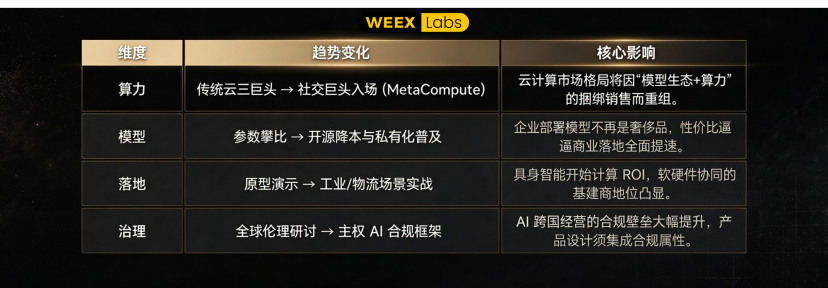
WEEX Labs Deep Insights
The industry shifts in July 2026 indicate: AI's prosperity is piercing through the screens of the virtual world, deeply embedding itself into the fabric of global manufacturing.
For current enterprise strategy, we propose three recommendations:
1. Embrace "Open Source Privatization": Leverage the current open-source benefits of domestic models like DeepSeek to prioritize building enterprise-specific knowledge bases in private environments. Avoid excessive data reliance on external APIs; this is the baseline for coping with future regulatory and cost fluctuations.
2. Beware of "Computing Power Lock-in": The entry of social platforms into the cloud market is a complex signal. When planning digital infrastructure, enterprises should maintain diversity among cloud providers to avoid losing future bargaining power due to model ecosystem lock-in.
Seek Opportunities in "Embodied Infrastructure": In the field of humanoid robots, the opportunity may lie not in making the robots themselves, but in being the "service provider" for data collection, industrial simulation software, or providing AI computing power adaptation solutions for factories.