WEEX Completes $2 Million WXT Buyback, Rewarding User Support for 'Futures Mining'

marsbitОпубліковано о 2025-12-16Востаннє оновлено о 2025-12-16

Анотація

Global cryptocurrency exchange WEEX has completed a $2 million buyback of its native token WXT, repurchasing 72,571,028 WXT tokens. The move is part of the platform’s effort to reward users for their participation in the "Futures Mining" campaign, which offers up to 30% trading fee rebates in WXT. The campaign, originally scheduled to end on December 15, has been extended by 10 days to December 25 due to high user demand. Participants receive real-time WXT rewards for each futures trade, with higher trading volumes unlocking greater rebate tiers, ranging from Bronze to King Miner levels. To prevent inflation and support token value, WEEX used its own funds for the buyback, maintaining WXT’s scarcity. Since its launch in July 2024, WXT has seen significant growth, with year-to-date gains of around 70%, making it one of the top-performing exchange tokens. WEEX has conducted four buybacks to date, burning 41.24% of WXT’s total supply. Additional token utility includes fee discounts, airdrops, and membership benefits, offering holders an estimated annualized return of 660.61%.

On December 16, globally leading cryptocurrency trading platform WEEX announced the completion of a new round of WXT buyback worth $2 million, totaling 72,571,028 WXT tokens repurchased.

This WXT buyback aims to reward global users for their support of WEEX's 'Futures Mining' campaign. The event offers up to 30% trading fee rebate rewards for users participating in futures trading, with rewards distributed in real-time via WXT tokens.

In other words, 'Futures Mining' transforms users' daily futures trading into a novel, fully trading volume-driven 'mining' model—the higher the trading volume, the higher the fee rebate ratio, with all WXT rewards credited instantly.

'Futures Mining' Continues to Boom, Event Extended by 10 Days

WEEX 'Futures Mining' aims to return platform growth dividends to users through the innovative incentive model of 'trading is mining'. During the event, users receive real-time WXT-based fee rebates for each futures open/close order, with rebates up to 30%.

Since its launch on November 26, the event has attracted active participation from global users, with trading heat continuously rising. According to WEEX official data, as of 18:00 on December 16 (UTC+8), the top 100 users on the 'Futures Mining' leaderboard have accumulated a total futures trading volume of $9.172 billion, with total mining rewards of 3,015,047.7 WXT (data updating in real-time).
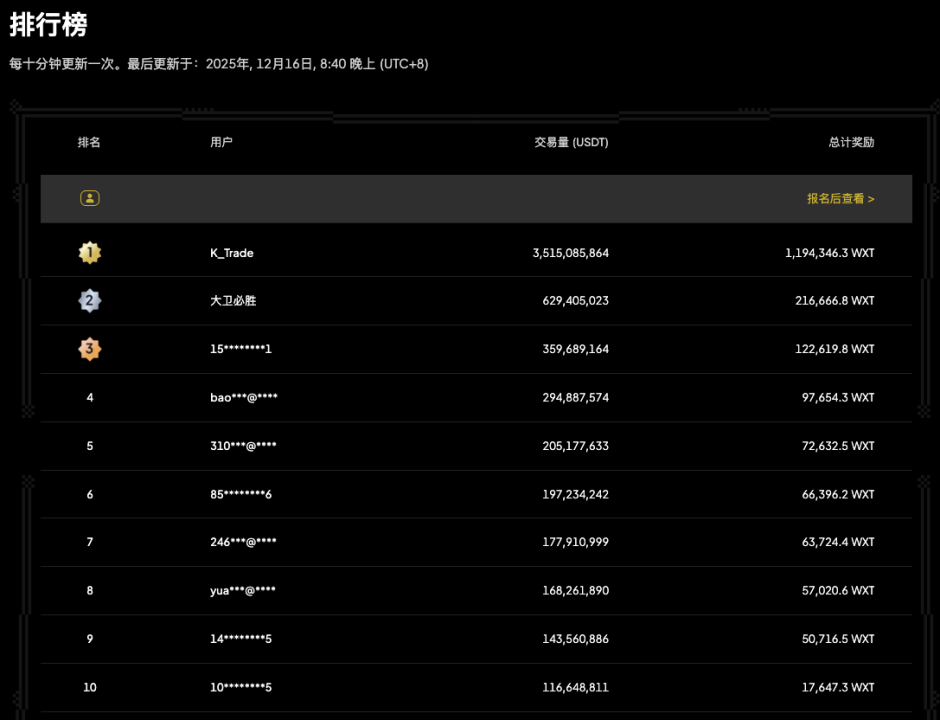
Due to the novel mechanism, generous rewards, and support for second-level settlement with instant rewards, the event has seen daily new participants and trading volumes repeatedly hit record highs after launch, with many users requesting an extension. Therefore, WEEX has extended the event by 10 days, moving the deadline from the original December 15 to December 25, allowing more users sufficient time to participate and continue enjoying mining rebate benefits.

This adjustment only extends the event duration; the rules remain unchanged: users click to register and participate in futures trading to receive WXT-based fee rebates, with WXT rewards credited in real-time after each open/close order.

Based on the miner tier mechanism of the 'Futures Mining' event, users start at the 'Copper Miner' tier. After trading begins, they can unlock Copper, Silver, Gold, Platinum, Diamond, and King tiers sequentially based on cumulative trading volume. The higher the trading volume, the higher the miner tier and fee rebate ratio, up to 30%. After the extension, users' unlocked miner tiers and rebate ratios remain effective. Trading fees generated during the extension will still be rebated in real-time at the corresponding ratio. Users can check their reward amounts and status in real-time via the WEEX App or official website.

72.57 Million WXT Buyback Completed, Ensuring Deflationary Effect

Unlike the token inflation issues faced by trading mining launched by other CEXs or liquidity mining on DeFi platforms, WEEX 'Futures Mining' not only maintains WXT's deflation but also genuinely demonstrates 'user rewards' sincerity through the $2 million WXT buyback supporting mechanism.

As previously announced, WEEX used platform funds to conduct a WXT buyback on the open market on December 16. By 17:00 (UTC) on December 16, the buyback plan was completed as scheduled, totaling 72,571,028 WXT repurchased at an average price of 0.027559 USDT/WXT.

Thus, the circulating supply of WXT will not increase due to the 'Futures Mining' event, maintaining WXT's scarcity and value stability, ensuring users' mining收益. Long-term, as WEEX's user base and trading volume continue to grow, the platform can invest more resources to further empower the WXT ecosystem, enhancing WXT's long-term appreciation potential.

Since its launch in July 2024, WXT has seen a maximum increase of over 358%, with a cumulative increase of over 180% to date. According to CMC data, WXT has risen about 70% year-to-date, ranking among the top 5 CEX platform tokens for yearly gains.

This outstanding performance is attributed to WEEX's long-term empowerment of the WXT ecosystem. To date, WEEX has completed 4 WXT buybacks via open market operations, cumulatively repurchasing 4,196,774,851 WXT tokens. The first three buybacks have been burned, with the burned amount accounting for 41.24% of WXT's total issuance, fully demonstrating WEEX's long-term support and confidence in the WXT token ecosystem.

In addition to buyback and burn, WEEX continues to empower WXT through various mechanisms such as WE-Launch new token listing airdrops, trading fee discounts, and trader权益 upgrades, resulting in a comprehensive annualized yield of up to 660.61% for WXT holders.

As the core of the WEEX ecosystem, WXT is dedicated to incentivizing partners, contributors, and active users of the exchange community. Through the 'Futures Mining' event and WXT buyback mechanism, WEEX not only creates more profit opportunities for users but also further consolidates WXT's market position.

Join WEEX now to experience the new 'Futures Mining' model and easily unlock more profits: https://www.weex.com/zh-CN/events/futures-trading/trade-to-earn


Пов'язані питання

QWhat is the total amount and value of WXT tokens repurchased by WEEX in this round?

AWEEX repurchased a total of 72,571,028 WXT tokens, valued at $2 million.

QWhat is the main purpose of the 'Futures Mining' event launched by WEEX?

AThe main purpose of the 'Futures Mining' event is to reward users for their contract trading by providing up to 30% fee rebates, distributed in real-time with WXT tokens.

QHow does the miner ranking system work in the 'Futures Mining' event?

AUsers start as 'Copper Miners' and can unlock higher ranks (Silver, Gold, Platinum, Diamond, King) based on their cumulative trading volume. A higher rank grants a higher fee rebate percentage, up to 30%.

QHow does WEEX ensure the WXT token remains deflationary despite the mining rewards?

AWEEX uses its own funds to repurchase WXT tokens from the open market, which offsets the new tokens issued as mining incentives, thus maintaining the token's scarcity and deflationary nature.

QWhat is the cumulative amount of WXT tokens that WEEX has repurchased and burned to date?

AWEEX has repurchased a cumulative total of 4,196,774,851 WXT tokens, with the first three batches already burned, accounting for 41.24% of the total WXT issuance.

Пов'язані матеріали

Ethereum Q1 2026 Report: Fees Decline, Users and Transaction Volume Hit New Highs

Ethereum Q1 2026 Report: Fees Down, Users & Transactions Hit New Highs Token Terminal's Q1 2026 report on Ethereum presents a pivotal development: the network achieved record highs in monthly active users (13.2M, +85.9% YoY), total transactions (200.4M, +81.5% YoY), and throughput (25.78 TPS), while transaction fees on the mainnet plummeted by 47.9% quarter-over-quarter. This shift is attributed to the network's strategic move into a "low fees for scale" phase, exemplified by the Fusaka upgrade which increased data capacity and lowered block space costs, releasing pent-up demand (a manifestation of Jevons's Paradox). The report highlights a core narrative shift for Ethereum: from a DeFi-centric blockchain to a global financial settlement layer. It maintains a dominant position in tokenized assets, holding majority market shares among top chains in stablecoins (61.8%), tokenized funds (73.0%), and tokenized commodities (84.0%). Growth in tokenized funds (+73.1% YoY) and commodities (+325.9% YoY) was particularly strong, driven by institutions like BlackRock and JPMorgan entering the space. Contrasting these usage gains, several USD-denominated value metrics declined in Q1: fully diluted market cap fell 30.3% QoQ, total value locked (TVL) dropped 11.0%, and ecosystem transaction volume decreased 24.0%. The report interprets this as Ethereum prioritizing long-term network expansion and cementing its role as the default settlement layer for finance over short-term fee capture. The commentary from Etherealize argues that, much like the early internet, Ethereum's open, permissionless model is poised to win over closed alternatives as institutional tokenization accelerates.

marsbit19 хв тому

Ethereum Q1 2026 Report: Fees Decline, Users and Transaction Volume Hit New Highs

marsbit19 хв тому

He Just Raised 2.7 Billion, and Li Fei-Fei Also Invested

Pete Florence, a former senior research scientist at Google DeepMind and a key contributor to the Vision-Language-Action (VLA) model architecture, is deliberately distancing his startup, Generalist AI, from the trendy "world model" label. He argues that the industry should prioritize concrete goals over buzzwords. His goal is to create robots that can perform a vast range of unseen tasks with high speed and success rates, without needing task-specific training data. Recently, his company raised $400 million (¥2.7 billion) at a $2 billion valuation. Notable investors include NVIDIA's NVentures, Bezos Expeditions, NFDG, as well as Xiaomi co-founder Lin Bin, Zoom founder Eric Yuan, and renowned AI scientist Fei-Fei Li. Florence's approach stems from his academic background at MIT under Professor Russ Tedrake, focusing on understanding the physical world. After joining DeepMind, he developed models like Transporter Network and co-created the VLA framework. He left in 2025 to found Generalist AI. The company has launched two models: GEN-0, which demonstrated that scaling laws apply to physical motion, and GEN-1. GEN-1 was trained on over 500,000 hours of physical interaction data collected via a specialized wearable device. It achieves a 99% success rate on precise mechanical tasks like folding boxes and maintains performance three times faster than its predecessor. Florence believes GEN-1 is reaching a commercial utility threshold similar to the GPT-3 inflection point. The substantial funding round, following GEN-1's release, signifies strong investor confidence in Generalist AI's practical, goal-driven path to creating versatile, useful robots, regardless of the "world model" terminology.

marsbit25 хв тому

He Just Raised 2.7 Billion, and Li Fei-Fei Also Invested

marsbit25 хв тому

Two Legends Lost in Three Days: Is Google's AI Talent Dam Cracking?

In three days, Google lost two AI legends. On June 18, Noam Shazeer, co-author of the seminal "Attention is All You Need" paper and Gemini co-lead, left for OpenAI. Just 48 hours later, John Jumper, 2024 Nobel laureate and AlphaFold lead, departed DeepMind for Anthropic. This follows Andrej Karpathy joining Anthropic in May. These moves highlight a structural trend: top AI talent is concentrating at mission-driven, pre-IPO firms like OpenAI and Anthropic, while Google becomes a primary source. The exodus stems from a core mission mismatch. Google's ad-centric model often subordinates AI research to product and revenue goals, creating friction for pioneers like Shazeer, who returned in 2024 only to leave again. In contrast, OpenAI and Anthropic offer singular focus on pushing AI boundaries, whether towards AGI or safety-aligned models, which deeply appeals to top researchers like Jumper. Financial incentives amplify the pull. With both OpenAI and Anthropic nearing IPO, employees stand to gain immensely from equity, an upside Google's mature stock cannot match. Furthermore, the 2023 merger of Google Brain and DeepMind, intended to consolidate strength, has instead created cultural tension and slowed the path from research to product, as evidenced by Gemini's pace. This talent redistribution is reshaping the AI landscape. While Google retains vast data and compute resources, its true crisis is the quiet, continuous loss of the people who define the field's future. The real moat in AI is not infrastructure, but the concentration of brilliant minds—a battle Google is currently losing.

marsbit2 год тому

Two Legends Lost in Three Days: Is Google's AI Talent Dam Cracking?

marsbit2 год тому

Behind the AI Report Card, Lies a Chinese 'Exam Setter'

Beyond the familiar performance charts like MMLU-Pro and MMMU, which major AI models strive to ace, stands a key "examiner": Chinese-Canadian researcher Wenhu Chen. An assistant professor at the University of Waterloo and founder of TIGERLab, Chen addresses the crucial need for more rigorous AI evaluation. As models like GPT-4 began scoring near-perfect results on older benchmarks like MMLU, it became difficult to distinguish their true capabilities. In response, Chen introduced MMLU-Pro in 2024, featuring harder, more reasoning-focused questions with more answer choices, successfully reintroducing meaningful performance gaps. His work extends to multi-modal evaluation with MMMU and its enhanced version, MMMU-Pro. These benchmarks test a model's ability to understand and reason with complex information from images, charts, and text across diverse academic subjects, exposing the significant challenges even top models face in genuine comprehension. Chen's background in complex QA, table reasoning, and his experience at Google DeepMind on projects like Gemini inform his approach. He understands that effective benchmarks must anticipate how models might "cheat" by memorizing data or avoiding visual analysis. His lab also actively researches video understanding and generation models (e.g., UniVideo, Vamba), ensuring his evaluation work is grounded in practical model-building challenges. Now at Meta's Super Intelligence Lab, Chen continues his focus on multi-modal data and evaluation, representing the deep yet often unseen contributions of Chinese talent in shaping the fundamental tools of the AI industry.

marsbit2 год тому

Behind the AI Report Card, Lies a Chinese 'Exam Setter'

marsbit2 год тому

Торгівля

Спот
Ф'ючерси
活动图片