Weekly Token Unlocks: EIGEN Unlocks 7.5% of Circulating Supply Tokens

marsbitОпубліковано о 2026-03-29Востаннє оновлено о 2026-03-29

Анотація

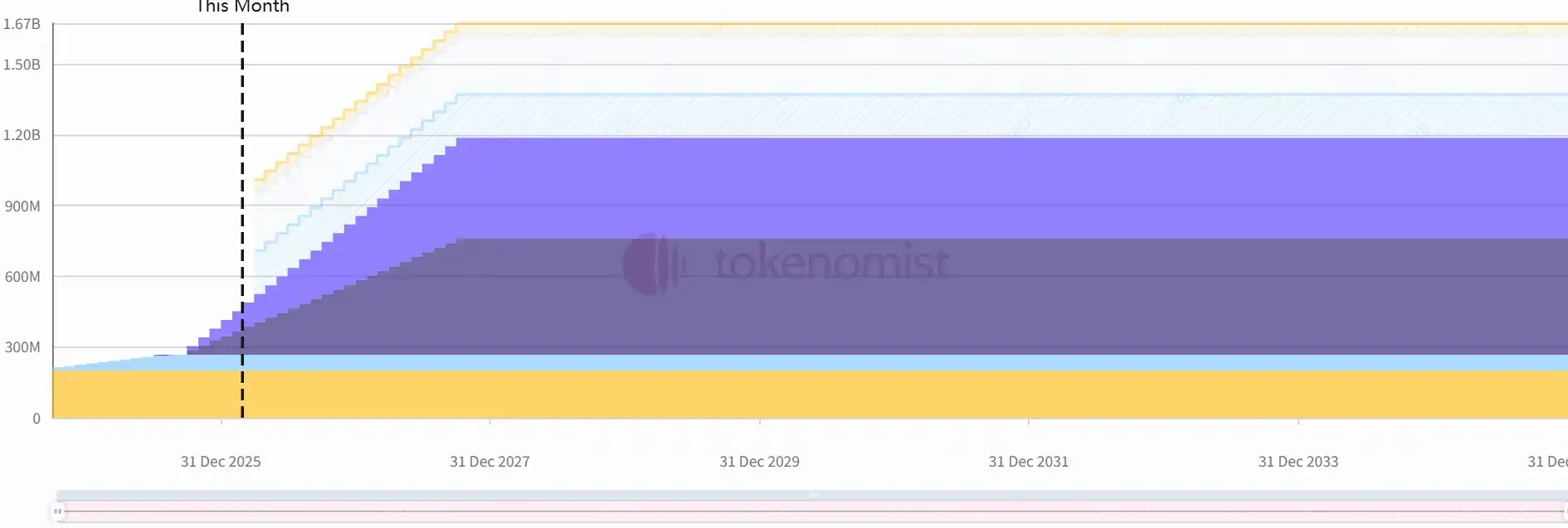
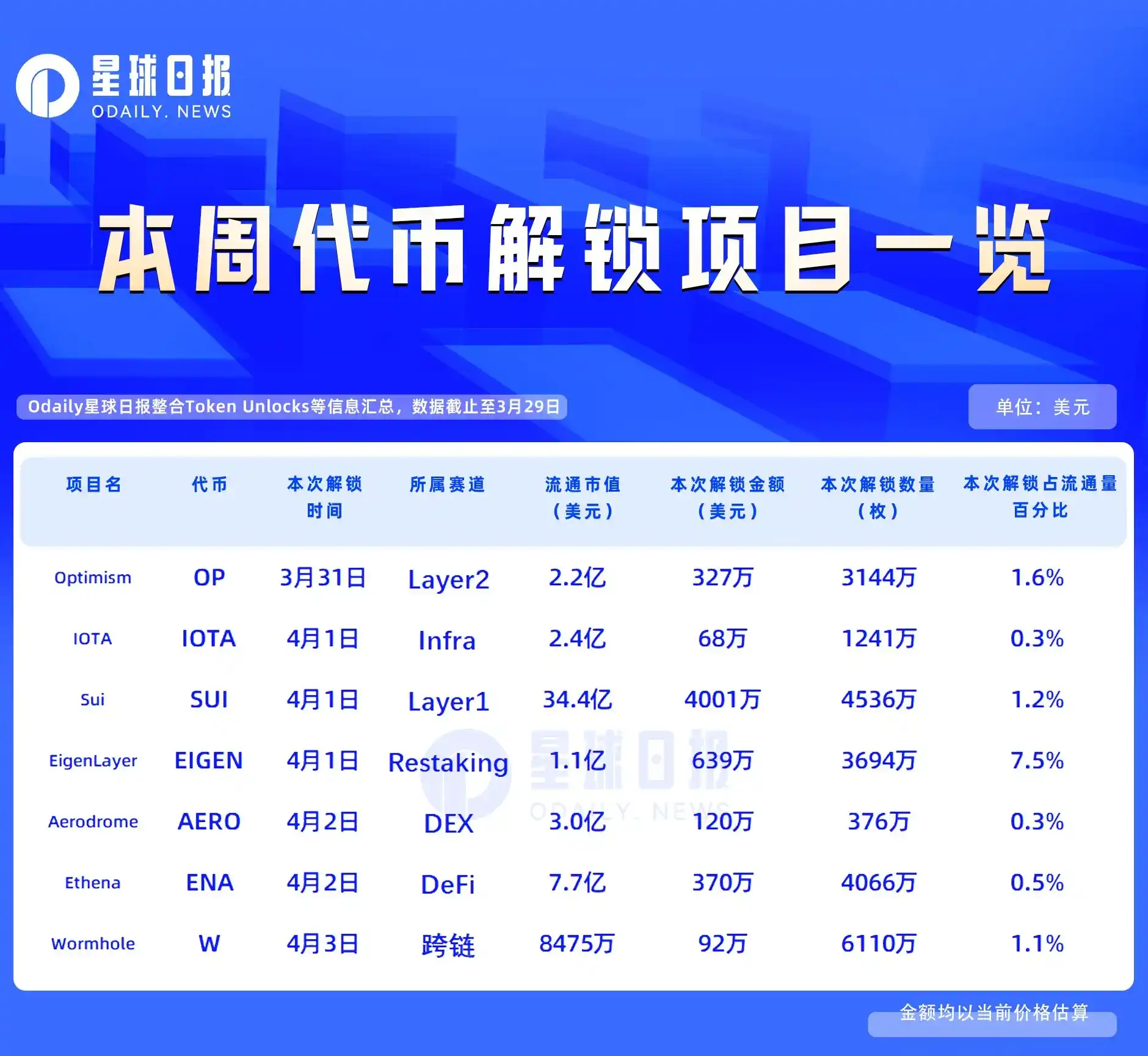
This week's major token unlocks feature significant releases from EigenLayer and Optimism. EigenLayer unlocks 36.94 million EIGEN tokens, valued at approximately $6.39 million. This release represents about 7.5% of its circulating supply. EigenLayer is a protocol built on Ethereum that introduces restaking, a new primitive in cryptoeconomic security, allowing users to restake their ETH and extend its security to other applications on the network. Additionally, Optimism unlocks 31.44 million OP tokens, worth roughly $3.27 million. Optimism is a Layer 2 scaling solution that uses Optimistic Rollup technology to scale the Ethereum network, enabling high transaction throughput while maintaining Ethereum's security. The provided images detail each project's specific release schedules.

EigenLayer

Project Twitter: https://x.com/eigenlayer

Project Website: https://www.eigenlayer.xyz/

This Unlock Amount: 36.94 million tokens

This Unlock Value: Approximately $6.39 million

EigenLayer is a protocol built on Ethereum that introduces the concept of restaking, a new primitive in cryptoeconomic security. This primitive allows for the restaking of ETH at the consensus layer. Users who stake ETH can opt into EigenLayer smart contracts to restake their ETH and extend cryptoeconomic security to other applications on the network.

The specific release curve is as follows:

Optimism

Project Twitter: https://twitter.com/Optimism

Project Website: https://app.optimism.io/governance

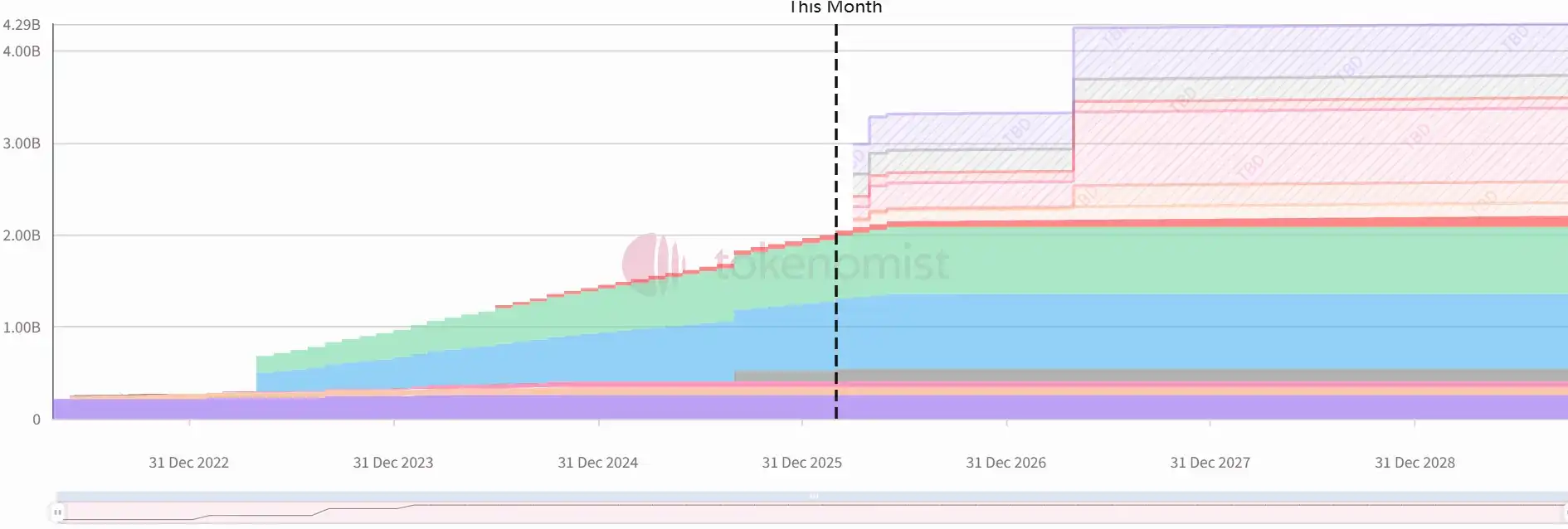
This Unlock Amount: 31.44 million tokens

This Unlock Value: Approximately $3.27 million

Optimism is a Layer 2 scaling solution that uses the Optimistic Rollup approach to achieve the goal of scaling the Ethereum network. It can handle transactions on a large scale while maintaining Ethereum's security, allowing Ethereum developers to efficiently use all the tools on Ethereum without making changes.

The specific release curve is as follows:

Трендові криптовалюти

Пов'язані питання

QWhat is the amount of EIGEN tokens being unlocked this week and what percentage of the circulating supply does it represent?

A36.94 million EIGEN tokens are being unlocked this week, representing 7.5% of the circulating supply.

QWhat is the estimated USD value of the EIGEN token unlock?

AThe estimated value of the EIGEN token unlock is approximately $6.39 million.

QWhat core concept does EigenLayer introduce to cryptoeconomic security?

AEigenLayer introduces the concept of restaking, a new primitive in cryptoeconomic security that allows for the restaking of ETH at the consensus layer.

QHow many OP tokens is Optimism unlocking and what is their approximate value?

AOptimism is unlocking 31.44 million OP tokens, with an approximate value of $3.27 million.

QWhat scaling solution does Optimism use to achieve its goal of scaling the Ethereum network?

AOptimism uses an Optimistic Rollup solution to scale the Ethereum network, enabling it to process transactions at scale while maintaining Ethereum's security.

Пов'язані матеріали

Dialogue with Jia Hang | Looking Back at Two Decades of Chinese Payment Going Global

**Summary: A Conversation with Jia Hang on Two Decades of China's Payment Globalization** Jia Hang, a veteran with over twenty years in payments, reflects on China's attempts to build a global payment network through three key phases: UnionPay (card networks), Alipay+ (digital wallets), and now, stablecoins. His journey began at UnionPay International, aiming to establish China's card network abroad. While successful in following Chinese tourists ("where Chinese go, UnionPay goes"), it struggled to achieve true global scale. The core lesson: card networks like Visa/Mastercard's unassailable advantage isn't just technical standards, but their deeply entrenched **governance and profit-sharing models** that create powerful network effects. Competing as the "same species" is nearly impossible. At Ant Group, he led Alipay+, a strategy to bypass card networks by interconnecting local e-wallets worldwide. While innovative, it faced a similar ceiling. Mobile QR payments and card swipes were essentially **the same species competing for the same pie**, lacking a disruptive value proposition for users or a sustainable new incentive model to replace the card networks' established flywheel. Today, at Singapore's DCS, Jia focuses on stablecoin-based payments. He argues stablecoins represent a fundamental shift. They are not competing with Visa for consumer payments but challenging the **traditional banking and account system for value movement**. Products like "U Cards" (stablecoin-linked payment cards) are transitional, leveraging existing card networks for acceptance while building new rails. The real potential lies in stablecoins enabling seamless, low-cost global value transfer, potentially reorganizing the financial infrastructure around **accounts rather than cards**. Jia believes stablecoin adoption for local retail payments, cross-border transactions, and as high-yield savings vehicles is becoming irreversible. This could gradually reduce reliance on traditional fiat channels, especially in regions with weak currencies or capital controls. The quest for the "next global payment network" continues, now centered on whether stablecoins can successfully bridge Web2 and Web3, establish new governance, and create compelling user value beyond mere cost reduction.

marsbit8 хв тому
Dialogue with Jia Hang | Looking Back at Two Decades of Chinese Payment Going Global

marsbit8 хв тому

Circle's Stock Price Plunges 76%, Hong Kong Dollar Stablecoin Set to Launch Within Two Weeks

Circle's stock price has plunged approximately 76% from its 2023 peak, reflecting a major market revaluation. Despite this, Circle President Heath Tarbert emphasized the company's focus on long-term execution and its dominant position with USDC's $73 billion circulation across 34 blockchains. The competitive landscape is intensifying. A new consortium-backed stablecoin, Open USD, is attempting to challenge incumbents by sharing reserve yields with partners. More significantly, Visa's new stablecoin platform, initially supporting Open USD while also being compatible with USDC, could erode Circle's network effects. In response, Circle is expanding into real-world payments through partnerships like the one with Japan's JCB. Separately, Tether (USDT) faces a two-year compliance window under new U.S. regulations, requiring it to adjust its reserve composition away from assets like Bitcoin and loans towards cash and U.S. Treasuries. Meanwhile, in Hong Kong, Standard Chartered-backed fintech firm Dian Dian is poised to launch a licensed HKD-pegged stablecoin (HKDAP), moving the industry into a phase where the real test is integrating licensed stablecoins into actual payment flows and corporate treasury systems. The sharp decline in Circle's stock underscores a broader shift: the stablecoin market is moving from a winner-takes-all dynamic to a multi-player competitive arena where execution, compliance, and real-world utility are becoming paramount.

marsbit8 хв тому
Circle's Stock Price Plunges 76%, Hong Kong Dollar Stablecoin Set to Launch Within Two Weeks

marsbit8 хв тому

Amidst Capital's Encirclement, Decentralization is the Sole Defense for Public Blockchains

In a landscape dominated by power and profit motives, the author argues that decentralization is not merely one desirable feature among many in blockchain design—it is the singular, non-negotiable defense against corporate and capital capture. The article adopts a Machiavellian, realist perspective on human institutions, positing that businesses will inevitably attempt to co-opt any valuable network to protect their profits and dominance. While external attacks like 51% forks are often discussed, the greater existential risk is internal capture—the gradual erosion of a protocol’s neutrality by vested interests, as seen historically with platforms like Visa and Google. The piece critiques permissioned chains, highly centralized “permissionless” layer-1s, and layer-2s without sufficient decentralization (e.g., single sequencers) as inherently vulnerable. These compromised systems, promoted by established financial players, are framed as delaying tactics to stifle truly open networks that threaten existing high-fee, inefficient business models. Real-world examples, such as closed enterprise consortiums that exclude competitors, illustrate how such systems cement oligopolies rather than foster innovation. The author concludes that while decentralized protocols like Ethereum are imperfect and costly to operate, they represent the only viable long-term equilibrium. In a market where value naturally flows to the most secure and neutral settlement layer, only maximally decentralized public blockchains can resist being subsumed by capital and powerful incumbents.

Foresight News19 хв тому

Amidst Capital's Encirclement, Decentralization is the Sole Defense for Public Blockchains

Foresight News19 хв тому

Who Decides the Rules of Bitcoin? BIP-110 Ignites Governance Debate

Bitcoin's governance is once again at the center of a heated debate, this time ignited by BIP-110, the "Reduced Data Temporary Softfork." This proposal aims to curb non-monetary data (like inscriptions and Runes) by introducing seven new consensus-layer restrictions over a year, such as limiting new output scripts to 34 bytes and restoring the OP_RETURN cap to 83 bytes. The controversy stems from BIP-110's fundamental shift: it moves the battle against "spam" from node relay and miner policies to the consensus layer, rendering currently valid transactions invalid. Supporters, arguing that default policy governance has failed (highlighted by Bitcoin Core v30's relaxation of OP_RETURN limits), see this as necessary to protect node resources and Bitcoin's monetary focus. Opponents, led by figures like Michael Saylor and Adam Back, warn it dangerously centralizes governance. Saylor listed 110 reasons against it, criticizing its low 55% miner activation threshold and potential for chain splits. Back emphasized Bitcoin's "permissionless" ethos, arguing no single group should impose value judgments via consensus rules. Further complicating matters, technical critiques suggest BIP-110 may be technically circumventable, and a "BlockSlop" vulnerability in its upgrade path poses a consensus risk. The debate has drawn in diverse stakeholders: miners (with pools like Ocean signaling support and Foundry polling clients), node operators (like Bitcoin Knots), and new players like corporate treasury holder MicroStrategy (Saylor), whose market influence adds a novel dimension. Ultimately, BIP-110 acts as a governance stress test, exposing the unresolved question: who decides Bitcoin's rules? It pits the authority of miners, node operators, developers, and capital holders against each other, with each side claiming to defend Bitcoin's core principles of neutrality and security.

marsbit35 хв тому

Who Decides the Rules of Bitcoin? BIP-110 Ignites Governance Debate

marsbit35 хв тому

Торгівля

Спот

Популярні статті

Як купити EIGEN

Ласкаво просимо до HTX.com! Ми зробили покупку EigenLayer (EIGEN) простою та зручною. Дотримуйтесь нашої покрокової інструкції, щоб розпочати свою криптовалютну подорож.Крок 1: Створіть обліковий запис на HTXВикористовуйте свою електронну пошту або номер телефону, щоб зареєструвати обліковий запис на HTX безплатно. Пройдіть безпроблемну реєстрацію й отримайте доступ до всіх функцій.ЗареєструватисьКрок 2: Перейдіть до розділу Купити крипту і виберіть спосіб оплатиКредитна/дебетова картка: використовуйте вашу картку Visa або Mastercard, щоб миттєво купити EigenLayer (EIGEN).Баланс: використовуйте кошти з балансу вашого рахунку HTX для безперешкодної торгівлі.Треті особи: ми додали популярні способи оплати, такі як Google Pay та Apple Pay, щоб підвищити зручність.P2P: Торгуйте безпосередньо з іншими користувачами на HTX.Позабіржова торгівля (OTC): ми пропонуємо індивідуальні послуги та конкурентні обмінні курси для трейдерів.Крок 3: Зберігайте свої EigenLayer (EIGEN)Після придбання EigenLayer (EIGEN) збережіть його у своєму обліковому записі на HTX. Крім того, ви можете відправити його в інше місце за допомогою блокчейн-переказу або використовувати його для торгівлі іншими криптовалютами.Крок 4: Торгівля EigenLayer (EIGEN)Легко торгуйте EigenLayer (EIGEN) на спотовому ринку HTX. Просто увійдіть до свого облікового запису, виберіть торгову пару, укладайте угоди та спостерігайте за ними в режимі реального часу. Ми пропонуємо зручний досвід як для початківців, так і для досвідчених трейдерів.

334 переглядів усьогоОпубліковано 2024.12.12Оновлено 2026.06.02

Як купити EIGEN

Обговорення

Ласкаво просимо до спільноти HTX. Тут ви можете бути в курсі останніх подій розвитку платформи та отримати доступ до професійної ринкової інформації. Нижче представлені думки користувачів щодо ціни EIGEN (EIGEN).

活动图片