Web3 Teams, Stop Wasting Your Marketing Budget on Platform X

marsbitОпубліковано о 2026-03-12Востаннє оновлено о 2026-03-12

Анотація

Web3 marketing teams are wasting budgets on ineffective X platform campaigns, as traditional promotion strategies have become obsolete. The classic model—announcement, followed by coordinated KOL posts, and then community discussion—no longer works due to X's new partnership disclosure rules, which make paid promotions obvious to users. This triggers ad avoidance instead of organic engagement. X rewards drama, memes, and debates, not formal announcements. Using Starknet's recent strkBTC campaign as a case study, the author notes that their promotional efforts resulted in low organic mentions and engagement. The solution is to flip the strategy: start by creating narrative tension through debates and comparisons (e.g., "Ethereum L2 vs. Bitcoin L2"), encourage community-generated content, and only then release the official announcement. The goal is to dominate conversations, not just broadcast messages. For developer outreach, building ecosystem prestige and showcasing success stories is more effective than announcement-led campaigns. The key takeaway: marketing must prioritize sparking discussion rather than controlling the message.

Original Author / Stacy Muur

Compiled by / Odaily Planet Daily Golem(@web 3_golem)

Every month, Green Dots conducts research on KOL promotional campaigns on Platform X to understand the strategies of other Web3 marketing teams and track which strategies and post styles are truly effective. However, due to the new paid partnership policy introduced by X, which has changed the marketing landscape on Platform X(Related reading: Musk casually overturns the rice bowl of crypto KOLs), most Web3 projects' promotional strategies are no longer suitable. Stacy Muur reveals in this article the common problems in many recent Web3 promotional activities, using Starknet as the case study for this analysis.

Author's statement: This is not targeting Starknet; their technical strength remains strong. Despite the many doubts and suspicions from the outside world after the airdrop and TGE, the team continues to release and develop products, which deserves respect. But this article focuses only on one aspect: marketing strategy. Starknet's recent new product promotion is just a typical example.

How did Starknet conduct its advertising promotion?

Starknet recently launched strkBTC [₿] and invited some content creators on Platform X to promote this event. They adopted a very classic promotion model:

  1. First, release an announcement with a promotional video;
  2. Within 12-48 hours of the announcement, KOLs will post collaborative promotional posts;
  3. Subsequently, publish articles to specifically explain the advantages of the product.

Even though this promotion was conducted in late February, to comply with Platform X's paid partnership policy, some creators included the paid partnership label when posting related content. But the focus of this article is not on the disclosure of payments, but on the effectiveness of this promotion strategy itself.

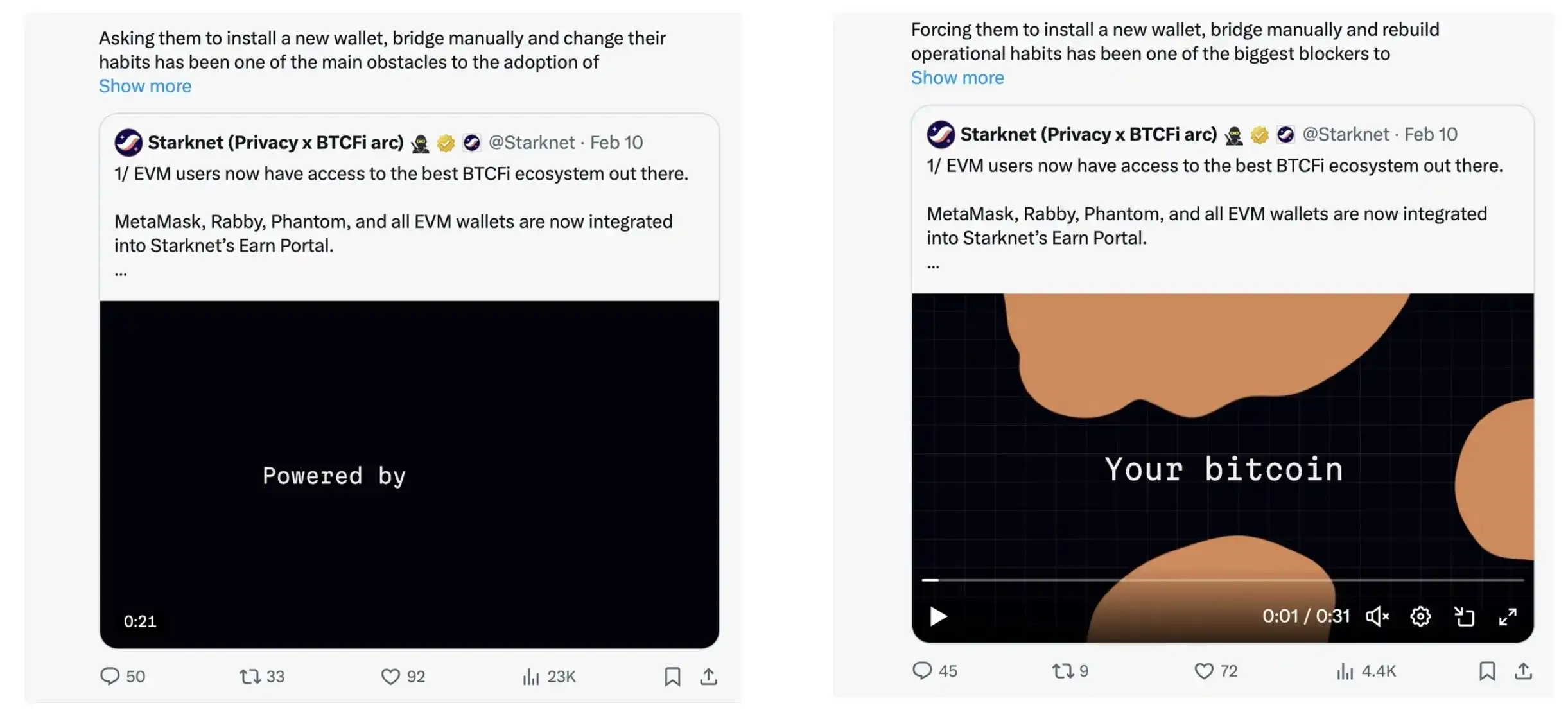
On February 10th, around another announcement released by Starknet, their marketing team conducted another KOL promotion. Exactly the same routine: first release a video announcement, then promote it through KOLs.
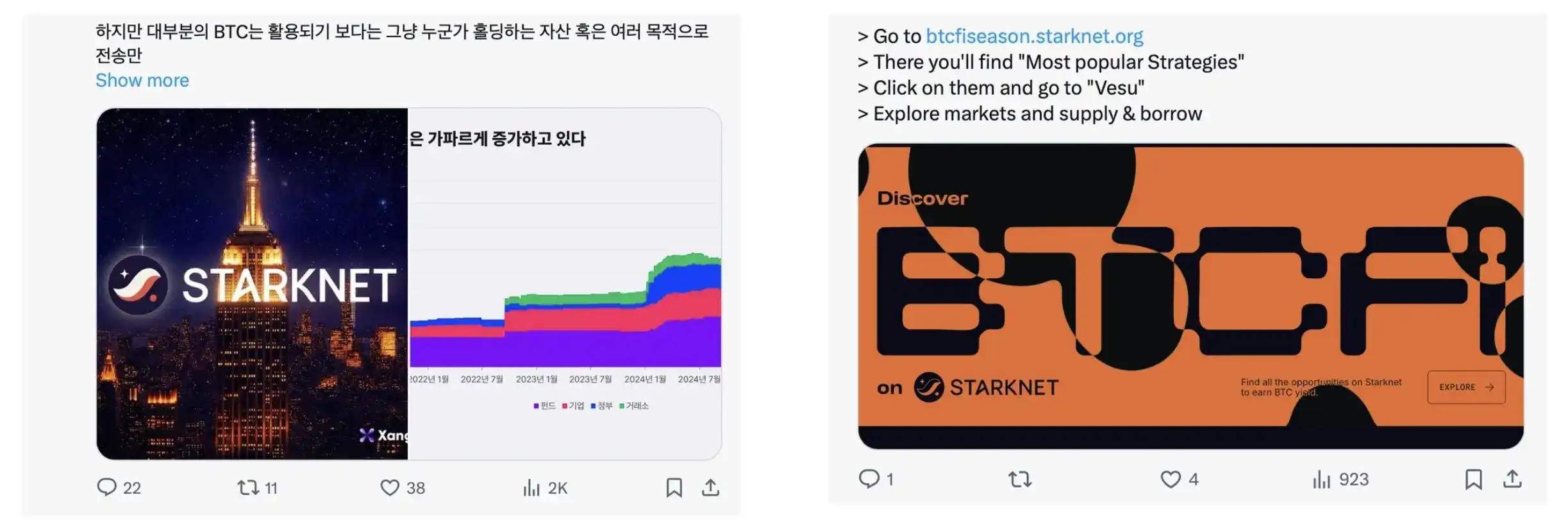
Of course, Starknet also has other promotional methods, such as publishing several long articles and conducting some promotional activities in the Korean language region.
For the record, I don't know who was responsible for managing this campaign, nor whether any agency was involved. I am merely providing some thoughts from an outsider's perspective, from a marketer's point of view.

One problem is obvious throughout the promotion: the screening of creators participating in the promotion is weak.

X is essentially a perception layer. Ideally, creator promotions on X should bring:

  • More discussion about the brand
  • Trigger more voluntary posts from independent creators
  • Drive the production of more community content
  • Stronger ecosystem activation

But is that what we see? Not really.

If you use simple filtering conditions on X to view popular posts mentioning Starknet in February, the results are obvious.
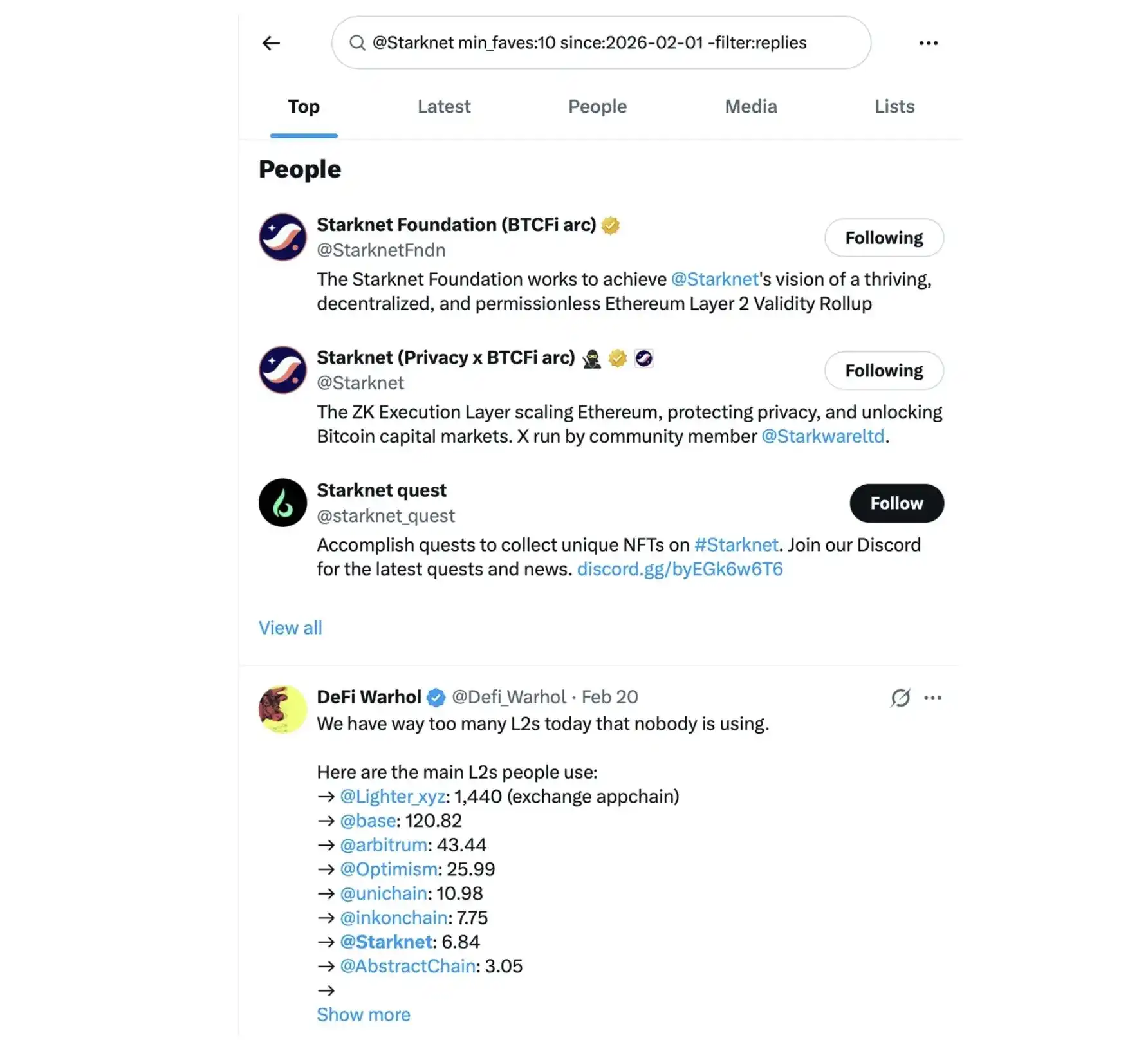
The most mentioned post was actually from Warhol. Overall, in February, only a little over 100 independent posts mentioning Starknet received more than 10 likes. For a well-known L2 ecosystem, this number is not high.

Some popular organic mentions of Starknet included:

  • Mookie's post about token unlocks (approx. 10k views)
  • Warhol's post about the best internship brands in the crypto industry (approx. 16k views)
  • Warhol's L2 rating list (approx. 30k views)
  • santiment's post ranking L2s by developer activity (approx. 50k views)
  • mztacat's post about the "Big Four companies" (approx. 82k views)

The above roughly constitutes Starknet's mention volume on Platform X in February. This leads to a more important question, not just concerning Starknet, but concerning the fact that the classic Web3 marketing strategy is gradually failing on Platform X.

Why is the classic Web3 advertising strategy failing?

For years, the default mode of Web3 marketing has been this: Announcement -> KOL promotion -> Community discussion.

This classic model worked when X's timeline was less crowded, narratives were strong, and most promotions were not easily identifiable as paid promotions. But it started failing after the following changes occurred.

Paid disclosure kills implicit virality

Once creators started adding paid disclosure information, this promotion model became obvious to followers.

First, users see an announcement, then within the next 24 hours, 5-10 similar promotional posts appear, all with largely identical content. Users can immediately recognize this structure. It doesn't trigger community discussion; instead, it sends a signal that "this is an ad campaign."

In the environment of Crypto Twitter, ads rarely spark community discussion; they are usually just scrolled past.

KOL behavior is now very easy to identify

Crypto Twitter has matured; people understand how KOL marketing works.

When the same group of creators quotes the same announcement with slightly different wording, it's easily interpreted as a coordinated promotion. And once KOL content is clearly identified as a promotion, user engagement drops because the audience switches from curiosity mode to ad-filtering mode.

X rewards buzz, not announcements

X is not a distribution channel; it's a narrative space. Unless a Web3 project's announcement can trigger the following, they rarely become trending topics:

  • Arguments and debates
  • Meme coins
  • Hot takes
  • Competition between KOLs

Without these dynamic factors, dissemination can only bring brief user reach but cannot truly win users' minds. Therefore, to truly gain buzz, Web3 projects should change the sequence of their marketing campaigns.

The old promotion flow was: Announcement -> KOL promotion -> Community discussion. The new promotion structure should be: First build the topic -> Spark creator debate -> Generate community content -> Finally announce, so the announcement becomes the final confirmation moment, not the starting point.

If the project skips the narrative stage, promotion has nothing to build on.

How to redesign a promotion campaign for Starknet

Let's get back to reality. Starknet carries heavy baggage. The previous airdrop phase triggered a lot of fear, uncertainty, and doubt. Explanations and promotional videos alone cannot solve this problem; the project needs to control the conversation to resolve it. Different goals also require different marketing strategies.

If the goal is to win mindshare

The strategy should be to actively engage in controversy. Don't try to suppress critics; design topics that can spark debate.

For example:

  • "Which L2 is better for developing BTCFi?"
  • "Ethereum L2 vs Bitcoin L2"
  • "Top 5 ecosystems for BTCFi developers"

Then sponsor posts related to ranking lists, posts comparing Starknet with other projects, and posts with debates. Maybe half the timeline will support Starknet, and the other half will attack Starknet, but both sides increase exposure. Creating drama is not bad marketing; marketing that goes unnoticed is bad.

If the goal is to dominate the narrative

Then stop publishing lengthy PR articles; few people read them. Instead, publish visual infographics, ecosystem maps, competitor comparisons, and short frameworks that KOLs can reuse. Giving creators space to remix content is far more powerful than content they can only quote.

The goal of dominating the narrative is not one good article, but dozens of derivative articles. This is how narratives spread.

If the goal is to attract developers

Then remember that developer acquisition is a B2B model. Posting announcements on X is not effective for developer onboarding. What projects should do is:

  • Build topic momentum
  • Build ecosystem prestige
  • Showcase developers who have already found success there

Once this trend forms, onboarding developers becomes much easier. Because developers also chase hotspots.

Conclusion

The traditional Web3 promotion model (Announcement -> KOL promotion) is dying on X. The new model is more like: Design the topic -> Spark creator interest -> Trigger discussion -> Let the community run with it.

The project's announcement is still important, but it should no longer be the beginning of the promotion campaign; it should be the end point.

Пов'язані питання

QAccording to the article, why is the classic Web3 marketing strategy of 'announcement → KOL promotion' no longer effective on platform X?

AThe strategy is no longer effective due to several key changes: paid disclosure labels make the promotional nature obvious to users, the coordinated posting by KOLs is easily recognized as a campaign, and the X platform's algorithm rewards engaging topics and drama rather than simple announcements.

QWhat does the author suggest is the new, more effective structure for a marketing campaign on X?

AThe author suggests the new structure should be: design a debatable topic → spark creator debate → generate community content → and finally, publish the official announcement as the confirmation point, not the starting point.

QWhat was identified as a major problem with Starknet's recent promotional campaign on X?

AA major problem was the weak vetting of the creators involved in the promotion, which failed to generate significant independent discussion, community content, or ecosystem activation.

QWhat specific type of content does the author recommend creating to dominate public opinion, instead of long PR articles?

AThe author recommends creating visual infographics, ecosystem maps, competitor comparisons, and short, reusable frameworks that creators can easily remix and build upon, leading to dozens of derivative posts.

QFor the goal of attracting developers, what does the article say is more effective than making announcements on X?

AFor attracting developers, it is more effective to build topic momentum, create ecosystem prestige, and showcase developers who have already found success on the platform, as developer acquisition is a B2B process that follows trends.

Пов'язані матеріали

$292 Million KelpDAO Cross-Chain Bridge Hack: Who Should Foot the Bill?

On April 18, 2026, an attacker stole 116,500 rsETH (worth ~$292M) from KelpDAO’s cross-chain bridge in 46 minutes—the largest DeFi exploit of 2026. The stolen assets were deposited into Aave V3 as collateral, causing $177–200M in bad debt and triggering a cascade of losses across nine DeFi protocols. Aave’s TVL dropped by ~$6B overnight. This legal analysis argues that KelpDAO and LayerZero Labs share concurrent liability, with fault apportioned 60%/40%. KelpDAO negligently configured its bridge with a 1-of-1 decentralized verifier network (DVN)—a single point of failure—despite LayerZero’s explicit recommendation of a 2-of-3 setup. LayerZero, which operated the compromised DVN, failed to secure its RPC infrastructure against a known poisoning attack vector. Both protocols’ terms of service cap liability at $200 (KelpDAO) or $50 (LayerZero), but these limits are likely unenforceable due to unconscionability, gross negligence exceptions, and potential securities law invalidation (if rsETH is deemed a security under the Howey test). Aave’s governance also faces fiduciary duty claims for raising rsETH’s loan-to-value ratio to 93%—far above competitors’ 72–75%—without adequately assessing bridge risks, amplifying the systemic fallout. Practical recovery targets include LayerZero Labs (a registered Canadian entity), KelpDAO’s founders, auditors, and identifiable Aave governance delegates. The incident underscores escalating legal risks for DeFi protocols, infrastructure providers, and governance participants.

marsbit4 хв тому

$292 Million KelpDAO Cross-Chain Bridge Hack: Who Should Foot the Bill?

marsbit4 хв тому

Insider Trading in War: 5 People Involved, the Highest Earner Was Arrested

On April 24, the U.S. Department of Justice arrested U.S. Army Special Forces Staff Sergeant Gannon Ken Van Dyke for insider trading related to the capture of Venezuelan President Nicolás Maduro on January 3. Van Dyke allegedly profited over $400,000 by placing bets on a prediction market, Polymarket, using insider knowledge of the covert operation. According to the indictment, Van Dyke registered an account (0x31a5) on December 26 and made a series of bets predicting Maduro’s capture and U.S. military involvement in Venezuela. He withdrew most of his funds on the day of the operation and attempted to obscure his tracks by transferring assets through crypto and brokerage accounts. This case marks the first time the DOJ has prosecuted insider trading on Polymarket. PolyBeats had previously identified five suspicious accounts, including Van Dyke’s—the highest earner—in January. The other accounts, with profits ranging from $34,000 to $145,000, remain under unofficial scrutiny but have not been charged. Their lower profits, indirect access to information, and unclear legal boundaries may complicate prosecution. Polymarket has since strengthened its market integrity rules, explicitly prohibiting trading based on confidential or insider information. Van Dyke’s arrest, nearly four months after his trades, signals increased regulatory attention and the persistent traceability of blockchain-based transactions.

marsbit6 хв тому

Insider Trading in War: 5 People Involved, the Highest Earner Was Arrested

marsbit6 хв тому

Bitwise: Bullish on Bitcoin's Performance in the Second Half of the Year, AI and Regulation Will Spark a New Altcoin Season

Bitwise CIO Matt Hougan and Research Lead Ryan Rasmussen express strong bullish sentiment on Bitcoin's long-term prospects, suggesting that its $1 million price target may be too conservative. They argue Bitcoin serves a dual role: as digital gold and a potential global settlement asset, especially amid declining trust in traditional monetary systems. Despite a weak Q1 2026 where nearly all crypto assets and prices saw double-digit declines, the analysts remain optimistic due to strong forward-looking catalysts, including institutional adoption via Bitcoin ETFs from major firms like Morgan Stanley and Goldman Sachs. Geopolitical instability, such as Iran’s mention of using Bitcoin for international payments, increases the value of Bitcoin’s “out-of-the-money call option” as a non-political, global settlement currency. This enhances its appeal beyond a mere store of value. . Additionally, Hougan highlights that a clearer regulatory token framework under current SEC leadership, combined with AI efficiency gains and high-performance blockchains, could fuel a new “altseason” by late 2026. This may lead to a wave of legitimate, value-capturing token projects, unlike the earlier ICO boom. . Bitwise also announced an Avalanche ETF, citing its unique architecture and rapid growth in real-world asset (RWA) tokenization, which has surged 10x to nearly $30 billion in two years. The firm believes Layer 1 blockchains are still early in their growth cycle, with significant potential ahead.

marsbit52 хв тому

Bitwise: Bullish on Bitcoin's Performance in the Second Half of the Year, AI and Regulation Will Spark a New Altcoin Season

marsbit52 хв тому

Торгівля

Спот
Ф'ючерси
活动图片