Web3 and DApps in 2026: A utility-driven year ahead for crypto

cointelegraphОпубліковано о 2025-12-24Востаннє оновлено о 2025-12-24

Анотація

By 2026, the crypto industry is shifting from speculative hype toward a utility-driven focus. Decentralized applications (DApps) are increasingly built for real-world use, with developers prioritizing polished user experience, interoperability, and sustainable monetization rather than short-term gains. Key improvements include account abstraction, gas sponsorships, and faster blockchain performance, narrowing the gap with Web2 applications. Ecosystems like Ethereum, Solana, and TON are competing not just on scalability but also on distribution and practical relevance. The emergence of super-apps and AI agents may further simplify user interaction. The year will test whether DApps can retain users without speculative incentives—making actual utility the defining metric for success.

As the crypto space headed into the last month of 2025, the mood was different from previous cycles. The year didn’t bring another decentralized finance (DeFi) summer or non-fungible token (NFT) euphoria, but instead ushered in a slow and sober pivot toward utility.

Decentralized applications (DApps) are software programs that run on blockchain networks, rather than centralized servers. By using smart contracts, DApps allow users to interact directly with apps for payments, finance, gaming or social media while retaining greater control over identities and assets.

Active builders held steady in 2025 but shifted their priorities to a longer-term outlook. According to Electric Capital’s Developer Report, the number of full-time crypto developers — defined as contributors committing code at least 10 days per month — rose 5% year-on-year, even as total developer counts dipped slightly.

The divergence suggests that speculative “tourist” participation has waned, while more builders are pursuing crypto as a full-time profession. In practice, that points to a smaller but more committed developer base, with sustained development effort increasingly concentrated among long-term teams rather than short-term projects.
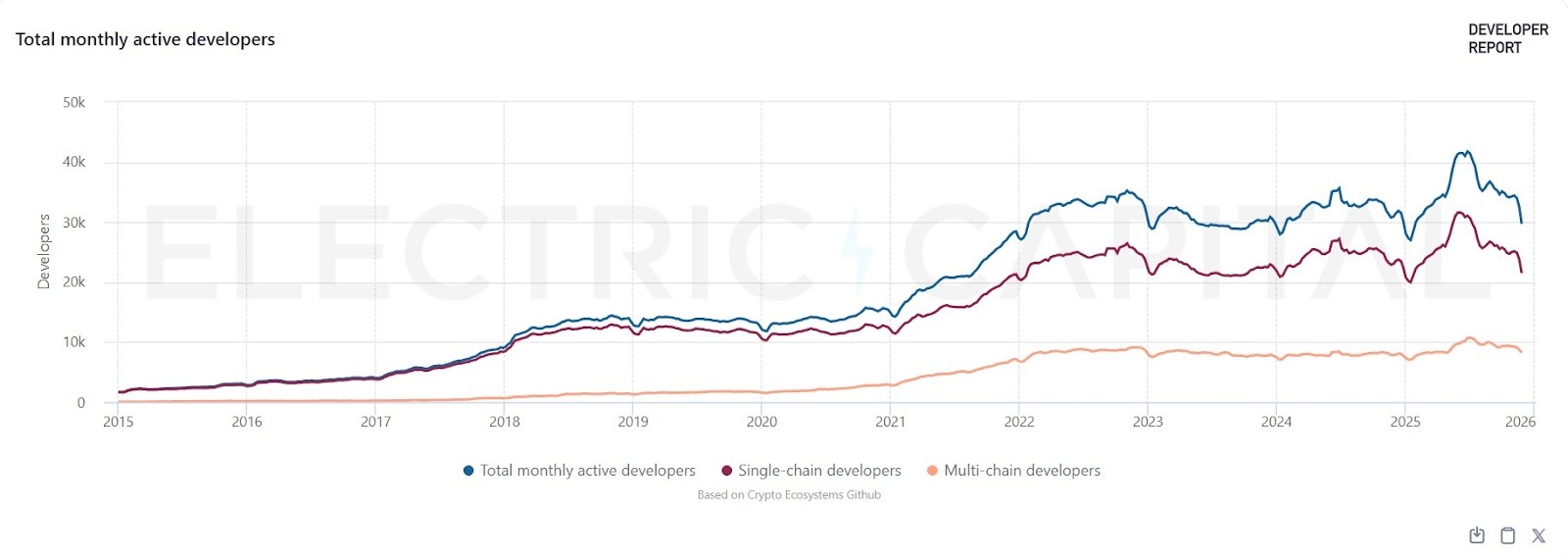
Total monthly active developers. Source: Electric Capital

Web3 gaming developers are also identifying different drivers of success for gaming DApps. According to a survey by the Blockchain Gaming Alliance (BGA), Web3 game developers are tying success to polished gameplay, sustainable monetization and infrastructure that supports spending.

This means that builders are depending less on external forces like traditional gaming giants coming into Web3 and instead focusing on controllable factors such as implementing interoperability, integrating artificial intelligence and creating player-driven economies.
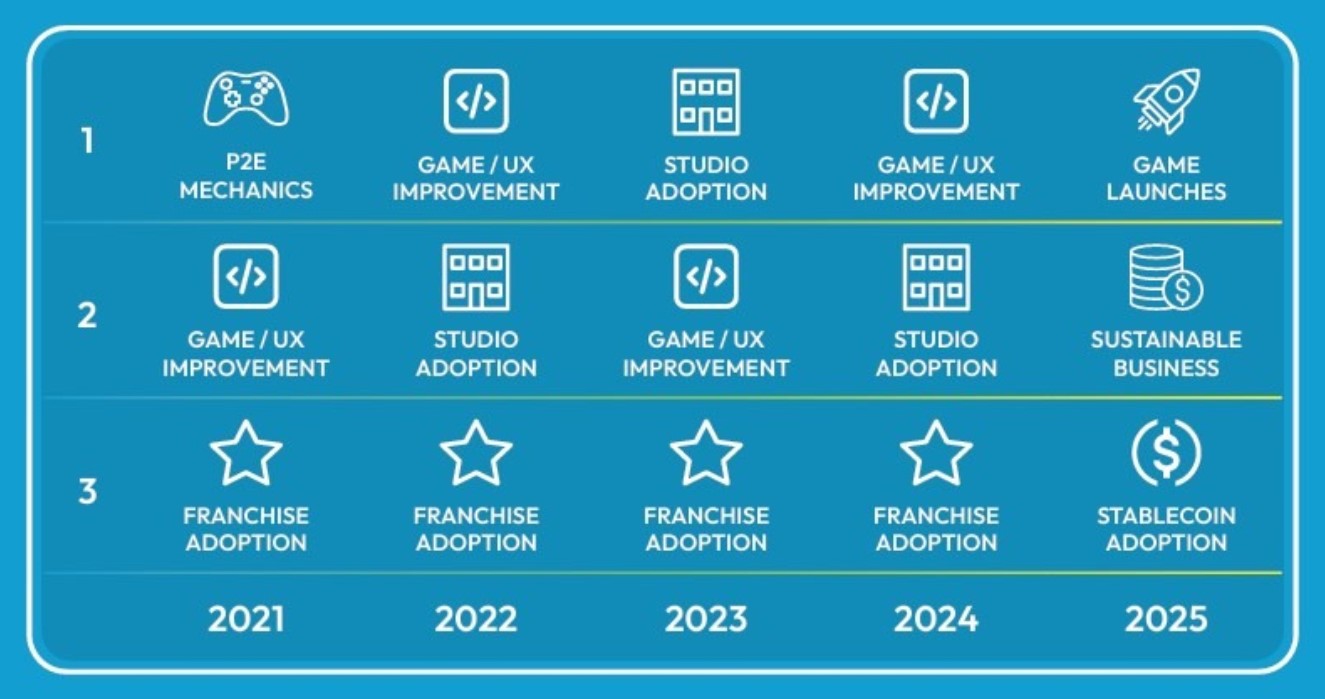
Key factors that are perceived to drive the growth of the blockchain gaming industry. Source: BGA Survey

If 2024 was defined by layer-2 scaling paths, 2025 became a year of preparation. Builders focused on making crypto usable, pushing account abstraction into production, tightening wallet UX and building mobile distribution channels through ecosystems like Solana’s Saga and The Open Network’s deep integration with Telegram.

At the same time, regulators across major jurisdictions like the United States, Europe and Asia have drawn clearer boundaries around stablecoins, custody and reporting, giving developers a framework to build within. The result was a year spent building the groundwork instead of chasing breakout apps.

The groundwork now sets up 2026 as a decisive test of relevance. With tooling largely in place and compliance streamlined, DApps will need to address the challenging question of whether they can attract and retain users without relying on speculative incentives.

The industry spent much of 2025 talking about a pivot to utility, but 2026 is where this claim would have to meet reality. If everyday users don’t stay once yields fade and rewards disappear, the problem will no longer be the technology, but the applications themselves.

How DApps can compete with Web2 in 2026

While DApps focused on competing with each other for user attention in previous years, 2026 may become the year when they must stand against Web2 applications and their scale.

For DApps to stand a chance, they must erase barriers that historically caused friction for mainstream users — and the shift is already underway. Account abstraction is moving closer to becoming the default experience across major ecosystems, enabling smart accounts that behave more like familiar log-in mechanisms than cryptographic tooling.

Gas sponsorships, where apps pay gas on behalf of users, reduced one of the biggest pain points, while social logins and MPC wallets removed the need for seed phrases. Moreover, sub-second finality on high-performance blockchains like Solana and modular rollups on Ethereum have narrowed the latency gap.

The emerging layer of AI agents capable of interacting with smart contracts could make DApp usage feel less like managing a wallet and more like a regular application.

Related: Tether deepens AI bet, backs Italian firm’s humanoid robots

This highlights the stark contrast between 2025 and 2026. This year showed fragmentation fatigue, where thousands of isolated DApps, each with separate accounts, assets and user journeys, created a high cognitive load for new users.

Because of this, the next leap for the sector may come from modular, interoperable super apps that bundle multiple needs in one interface, similar to how WeChat and Grab built dominance in the Web2 space.

Payments, savings and stablecoin rails could sit alongside NFT creator tools, gaming assets, loyalty tokens and social identity, allowing users to move across experiences inside a single ecosystem.

If 2025 was the year protocols built the foundation, 2026 may be the year to test whether these actually work in daily use.
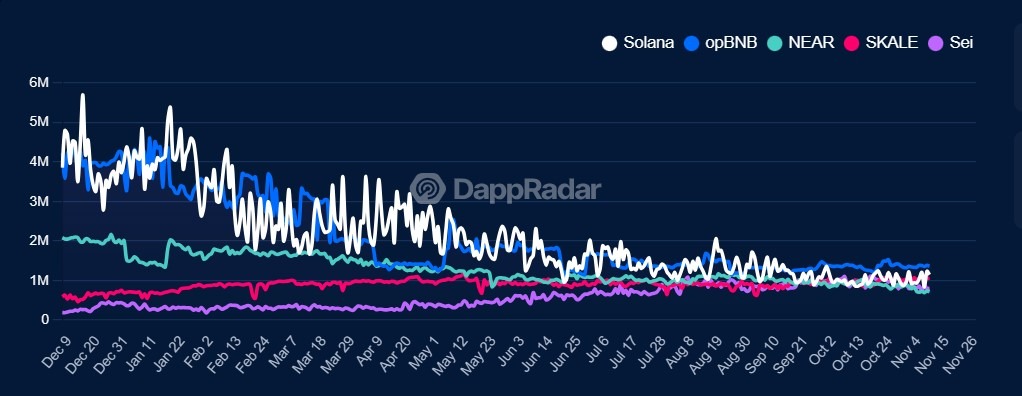
Solana and opBNB dominate in unique active wallets in 2025. Source: DappRadar

Related: Web3 gaming, DeFi lead sector activity in October despite market decline: Report

Which ecosystems are positioned to win in 2026?

Several ecosystems enter 2026 with distinct advantages, not only in throughput or developer tools, but also in distribution, user funnels and real-world relevance.

Ethereum remains the center of smart contract development, but its 2025 upgrades were incremental in nature. Improvements tied to the Fusaka upgrade focused on advancing Ethereum's data availability and zero-knowledge roadmap.

It includes early steps toward more efficient proof systems and shared sequencing concepts rather than immediate fee reductions on the mainnet. Together with the continued maturation of rollups, these changes position Ethereum to support cheaper and faster settlement over time, without compromising its security model.

Related: Vitalik Buterin pitches ZK-proofs to audit X algorithm and rankings

Solana continues to carve out the consumer lane, powering sub-second transactions for payments, in-app micro-purchases and mobile-native experiences that feel more Web2 than Web3.

On the other hand, TON stands out with arguably the strongest user funnel in the crypto space. Telegram's massive user base, Mini Apps and seamless wallet integrations created a distribution channel that would be difficult to replicate.
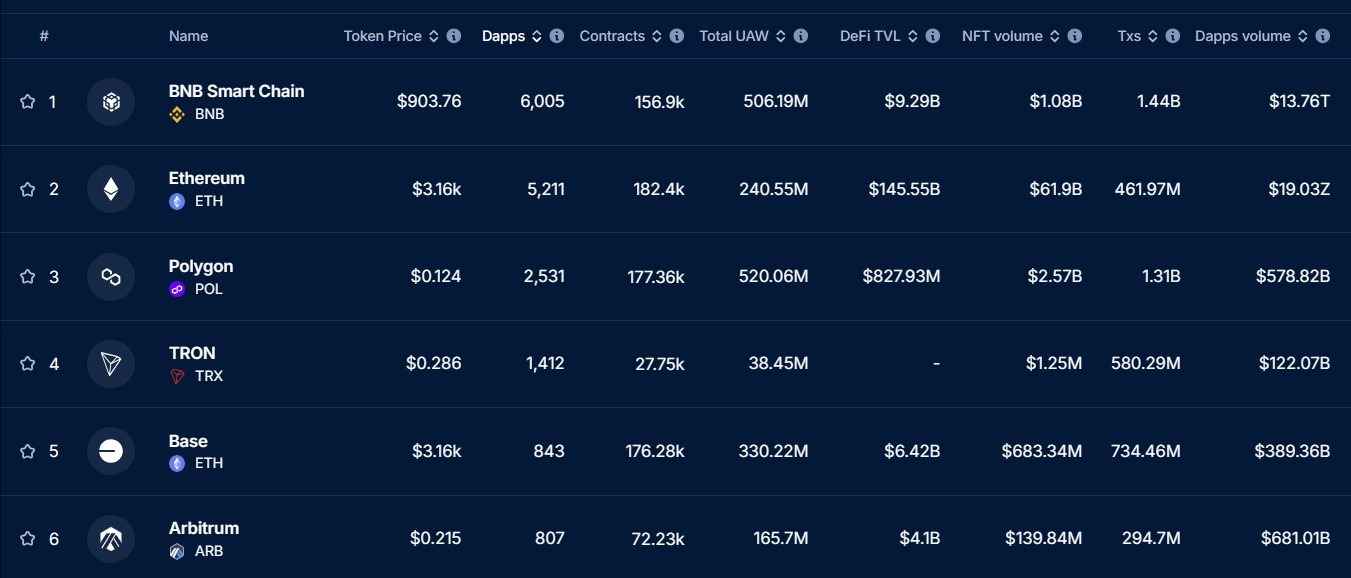
DappRadar integrated data showed that BNB Chain has over 6,000 DApps. Source: DappRadar

Beyond chains, thematic sectors could also define what could dominate the sector in 2026. Decentralized physical infrastructure networks (DePIN) gained traction in 2025 by anchoring crypto to real-world workflows like bandwidth, compute markets, mobility networks and energy credits.

These provided revenue paths that are not dependent on yield farming. In June, a World Economic Forum (WEF) report predicted that the sector could grow to $3.5 trillion by 2028, driven by the adoption of blockchain and artificial intelligence.

Meanwhile, creator-focused DApps are also maturing beyond NFTs and speculation toward micro-IP ownership, music royalties and fan-powered monetization models.

If these trends hold, the ecosystems best placed to succeed in 2026 will likely be the ones that combine distribution, scalability and clearer everyday use cases — not just the fastest network, but the one with the most active users.

2026 will be a turning point for utility

Crypto has already spent years building, scaling networks, tightening security, refining user experiences and building regulatory foundations to support its developments.

With infrastructure reaching consumer-grade readiness, the next phase may be less about which chain processes transactions faster and more about which products we are willing to return to without the usual token incentives.

If 2025 was a year spent in construction, 2026 is shaping up to be a year to evaluate — one where DApps must deliver practical value and not just promises. The winners will be those that feel similar to everyday applications, with simple onboarding, invisible gas and stable cost structures.

Magazine: Ethereum’s Fusaka fork explained for dummies: What the hell is PeerDAS?

Пов'язані питання

QWhat was the main shift in the crypto space during 2025 according to the article?

AThe main shift in 2025 was a slow and sober pivot toward utility, moving away from speculative trends like DeFi summers and NFT euphoria, with builders focusing on long-term development and making crypto usable.

QHow did the developer landscape change in 2025 based on Electric Capital's Developer Report?

AAccording to Electric Capital's Developer Report, the number of full-time crypto developers (those committing code at least 10 days per month) rose 5% year-on-year, while total developer counts dipped slightly, indicating a smaller but more committed developer base focused on long-term projects.

QWhat are the key factors that Web3 game developers believe drive success for gaming DApps, as per the Blockchain Gaming Alliance survey?

AWeb3 game developers tie success to polished gameplay, sustainable monetization, and infrastructure that supports spending, focusing on controllable factors like interoperability, AI integration, and player-driven economies rather than relying on external forces like traditional gaming giants.

QWhat technological and UX improvements are helping DApps compete with Web2 applications in 2026?

AImprovements include account abstraction becoming the default experience, gas sponsorships where apps pay gas fees for users, social logins, MPC wallets eliminating seed phrases, sub-second finality on high-performance blockchains, and AI agents that make DApp usage feel like regular applications, all reducing friction for mainstream users.

QWhich ecosystems are positioned to win in 2026, and what advantages do they have?

AEthereum remains the center of smart contract development with incremental upgrades focused on data availability and zero-knowledge proofs. Solana excels in consumer applications with sub-second transactions for payments and mobile-native experiences. TON has a strong user funnel through Telegram's massive user base and seamless wallet features. Additionally, ecosystems supporting DePIN and creator-focused DApps with real-world utility are well-positioned.

Пов'язані матеріали

Google and Amazon Simultaneously Invest Heavily in a Competitor: The Most Absurd Business Logic of the AI Era Is Becoming Reality

In a span of four days, Amazon announced an additional $25 billion investment, and Google pledged up to $40 billion—both direct competitors pouring over $65 billion into the same AI startup, Anthropic. Rather than a typical venture capital move, this signals the latest escalation in the cloud wars. The core of the deal is not equity but compute pre-orders: Anthropic must spend the majority of these funds on AWS and Google Cloud services and chips, effectively locking in massive future compute consumption. This reflects a shift in cloud market dynamics—enterprises now choose cloud providers based on which hosts the best AI models, not just price or stability. With OpenAI deeply tied to Microsoft, Anthropic’s Claude has become the only viable strategic asset for Google and Amazon to remain competitive. Anthropic’s annualized revenue has surged to $30 billion, and it is expanding into verticals like biotech, positioning itself as a cross-industry AI infrastructure layer. However, this funding comes with constraints: Anthropic’s independence is challenged as it balances two rival investors, its safety-first narrative faces pressure from regulatory scrutiny, and its path to IPO introduces new financial pressures. Globally, this accelerates a "tri-polar" closed-loop structure in AI infrastructure, with Microsoft-OpenAI, Google-Anthropic, and Amazon-Anthropic forming exclusive model-cloud alliances. In contrast, China’s landscape differs—investments like Alibaba and Tencent backing open-source model firm DeepSeek reflect a more decoupled approach, though closed-source models from major cloud providers still dominate. The $65 billion bet is ultimately about securing a seat at the table in an AI-defined future—where missing the model layer means losing the cloud war.

marsbit1 год тому

Google and Amazon Simultaneously Invest Heavily in a Competitor: The Most Absurd Business Logic of the AI Era Is Becoming Reality

marsbit1 год тому

Computing Power Constrained, Why Did DeepSeek-V4 Open Source?

DeepSeek-V4 has been released as a preview open-source model, featuring 1 million tokens of context length as a baseline capability—previously a premium feature locked behind enterprise paywalls by major overseas AI firms. The official announcement, however, openly acknowledges computational constraints, particularly limited service throughput for the high-end DeepSeek-V4-Pro version due to restricted high-end computing power. Rather than competing on pure scale, DeepSeek adopts a pragmatic approach that balances algorithmic innovation with hardware realities in China’s AI ecosystem. The V4-Pro model uses a highly sparse architecture with 1.6T total parameters but only activates 49B during inference. It performs strongly in agentic coding, knowledge-intensive tasks, and STEM reasoning, competing closely with top-tier closed models like Gemini Pro 3.1 and Claude Opus 4.6 in certain scenarios. A key strategic product is the Flash edition, with 284B total parameters but only 13B activated—making it cost-effective and accessible for mid- and low-tier hardware, including domestic AI chips from Huawei (Ascend), Cambricon, and Hygon. This design supports broader adoption across developers and SMEs while stimulating China's domestic semiconductor ecosystem. Despite facing talent outflow and intense competition in user traffic—with rivals like Doubao and Qianwen leading in monthly active users—DeepSeek has maintained technical momentum. The release also comes amid reports of a new funding round targeting a valuation exceeding $10 billion, potentially setting a new record in China’s LLM sector. Ultimately, DeepSeek-V4 represents a shift toward open yet realistic infrastructure development in the constrained compute landscape of Chinese AI, emphasizing engineering efficiency and domestic hardware compatibility over pure model scale.

marsbit1 год тому

Computing Power Constrained, Why Did DeepSeek-V4 Open Source?

marsbit1 год тому

Торгівля

Спот
Ф'ючерси

Популярні статті

Що таке WL

I. Вступ до проектуWorldLand - це L2 або бічний ланцюг Ethereum, розроблений як рішення знизу вгору для покращення екосистеми Ethereum.II. Інформація про токен1) Основна інформаціяНазва токена: WL (WorldLand)III. Пов'язані посиланняВебсайт:https://worldland.foundation/Експлорери:https://bscscan.com/address/0x8aaB31fbc69C92fa53f600910Cf0f215531F8239Соціальні мережі:https://x.com/WorldLand_space Примітка: Вступ до проекту взято з матеріалів, опублікованих або наданих офіційною командою проекту, які є лише для довідки і не є інвестиційною порадою. HTX не несе відповідальності за будь-які прямі або непрямі збитки, що виникають внаслідок цього.

228 переглядів усьогоОпубліковано 2026.03.28Оновлено 2026.03.28

Що таке WL

Як купити WL

Ласкаво просимо до HTX.com! Ми зробили покупку WorldLand (WL) простою та зручною. Дотримуйтесь нашої покрокової інструкції, щоб розпочати свою криптовалютну подорож.Крок 1: Створіть обліковий запис на HTXВикористовуйте свою електронну пошту або номер телефону, щоб зареєструвати обліковий запис на HTX безплатно. Пройдіть безпроблемну реєстрацію й отримайте доступ до всіх функцій.ЗареєструватисьКрок 2: Перейдіть до розділу Купити крипту і виберіть спосіб оплатиКредитна/дебетова картка: використовуйте вашу картку Visa або Mastercard, щоб миттєво купити WorldLand (WL).Баланс: використовуйте кошти з балансу вашого рахунку HTX для безперешкодної торгівлі.Треті особи: ми додали популярні способи оплати, такі як Google Pay та Apple Pay, щоб підвищити зручність.P2P: Торгуйте безпосередньо з іншими користувачами на HTX.Позабіржова торгівля (OTC): ми пропонуємо індивідуальні послуги та конкурентні обмінні курси для трейдерів.Крок 3: Зберігайте свої WorldLand (WL)Після придбання WorldLand (WL) збережіть його у своєму обліковому записі на HTX. Крім того, ви можете відправити його в інше місце за допомогою блокчейн-переказу або використовувати його для торгівлі іншими криптовалютами.Крок 4: Торгівля WorldLand (WL)Легко торгуйте WorldLand (WL) на спотовому ринку HTX. Просто увійдіть до свого облікового запису, виберіть торгову пару, укладайте угоди та спостерігайте за ними в режимі реального часу. Ми пропонуємо зручний досвід як для початківців, так і для досвідчених трейдерів.

285 переглядів усьогоОпубліковано 2026.03.28Оновлено 2026.03.28

Як купити WL

Як купити BASED

Ласкаво просимо до HTX.com! Ми зробили покупку Based (BASED) простою та зручною. Дотримуйтесь нашої покрокової інструкції, щоб розпочати свою криптовалютну подорож.Крок 1: Створіть обліковий запис на HTXВикористовуйте свою електронну пошту або номер телефону, щоб зареєструвати обліковий запис на HTX безплатно. Пройдіть безпроблемну реєстрацію й отримайте доступ до всіх функцій.ЗареєструватисьКрок 2: Перейдіть до розділу Купити крипту і виберіть спосіб оплатиКредитна/дебетова картка: використовуйте вашу картку Visa або Mastercard, щоб миттєво купити Based (BASED).Баланс: використовуйте кошти з балансу вашого рахунку HTX для безперешкодної торгівлі.Треті особи: ми додали популярні способи оплати, такі як Google Pay та Apple Pay, щоб підвищити зручність.P2P: Торгуйте безпосередньо з іншими користувачами на HTX.Позабіржова торгівля (OTC): ми пропонуємо індивідуальні послуги та конкурентні обмінні курси для трейдерів.Крок 3: Зберігайте свої Based (BASED)Після придбання Based (BASED) збережіть його у своєму обліковому записі на HTX. Крім того, ви можете відправити його в інше місце за допомогою блокчейн-переказу або використовувати його для торгівлі іншими криптовалютами.Крок 4: Торгівля Based (BASED)Легко торгуйте Based (BASED) на спотовому ринку HTX. Просто увійдіть до свого облікового запису, виберіть торгову пару, укладайте угоди та спостерігайте за ними в режимі реального часу. Ми пропонуємо зручний досвід як для початківців, так і для досвідчених трейдерів.

249 переглядів усьогоОпубліковано 2026.03.30Оновлено 2026.03.30

Як купити BASED

Обговорення

Ласкаво просимо до спільноти HTX. Тут ви можете бути в курсі останніх подій розвитку платформи та отримати доступ до професійної ринкової інформації. Нижче представлені думки користувачів щодо ціни A (A).

活动图片