Web3 and DApps in 2026: A utility-driven year ahead for crypto

cointelegraphОпубліковано о 2025-12-24Востаннє оновлено о 2025-12-24

Анотація

By 2026, the crypto industry is shifting from speculative hype toward a utility-driven focus. Decentralized applications (DApps) are increasingly built for real-world use, with developers prioritizing polished user experience, interoperability, and sustainable monetization rather than short-term gains. Key improvements include account abstraction, gas sponsorships, and faster blockchain performance, narrowing the gap with Web2 applications. Ecosystems like Ethereum, Solana, and TON are competing not just on scalability but also on distribution and practical relevance. The emergence of super-apps and AI agents may further simplify user interaction. The year will test whether DApps can retain users without speculative incentives—making actual utility the defining metric for success.

As the crypto space headed into the last month of 2025, the mood was different from previous cycles. The year didn’t bring another decentralized finance (DeFi) summer or non-fungible token (NFT) euphoria, but instead ushered in a slow and sober pivot toward utility.

Decentralized applications (DApps) are software programs that run on blockchain networks, rather than centralized servers. By using smart contracts, DApps allow users to interact directly with apps for payments, finance, gaming or social media while retaining greater control over identities and assets.

Active builders held steady in 2025 but shifted their priorities to a longer-term outlook. According to Electric Capital’s Developer Report, the number of full-time crypto developers — defined as contributors committing code at least 10 days per month — rose 5% year-on-year, even as total developer counts dipped slightly.

The divergence suggests that speculative “tourist” participation has waned, while more builders are pursuing crypto as a full-time profession. In practice, that points to a smaller but more committed developer base, with sustained development effort increasingly concentrated among long-term teams rather than short-term projects.
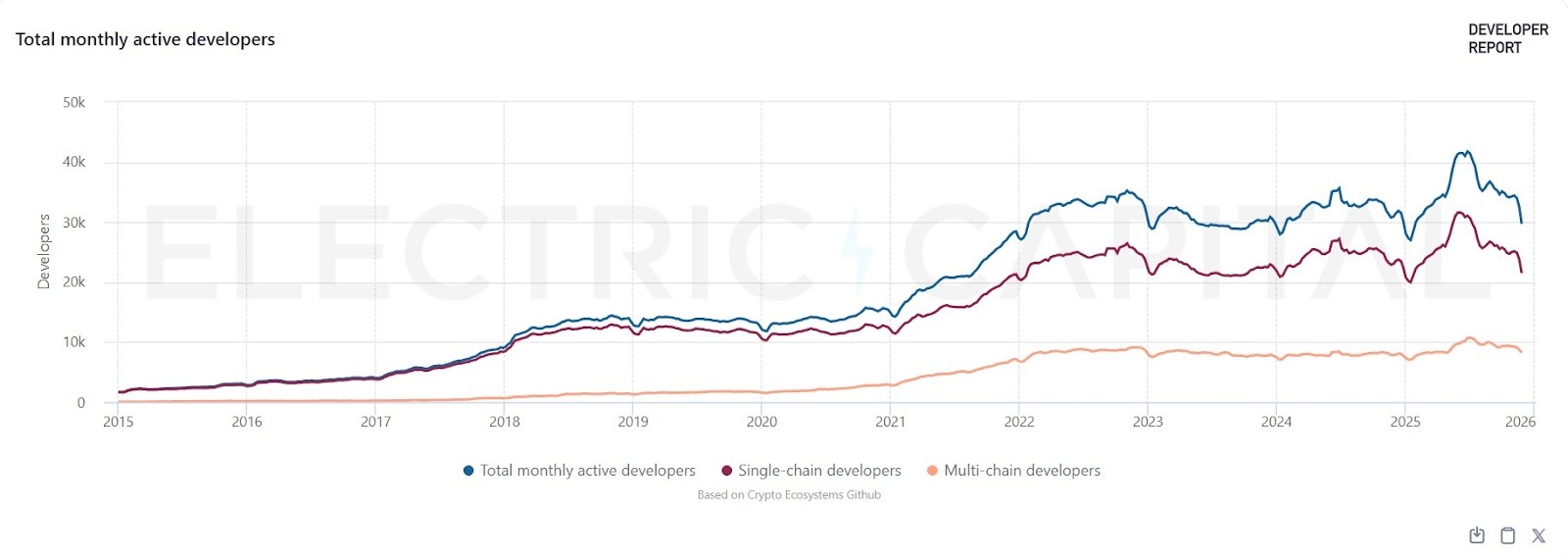
Total monthly active developers. Source: Electric Capital

Web3 gaming developers are also identifying different drivers of success for gaming DApps. According to a survey by the Blockchain Gaming Alliance (BGA), Web3 game developers are tying success to polished gameplay, sustainable monetization and infrastructure that supports spending.

This means that builders are depending less on external forces like traditional gaming giants coming into Web3 and instead focusing on controllable factors such as implementing interoperability, integrating artificial intelligence and creating player-driven economies.
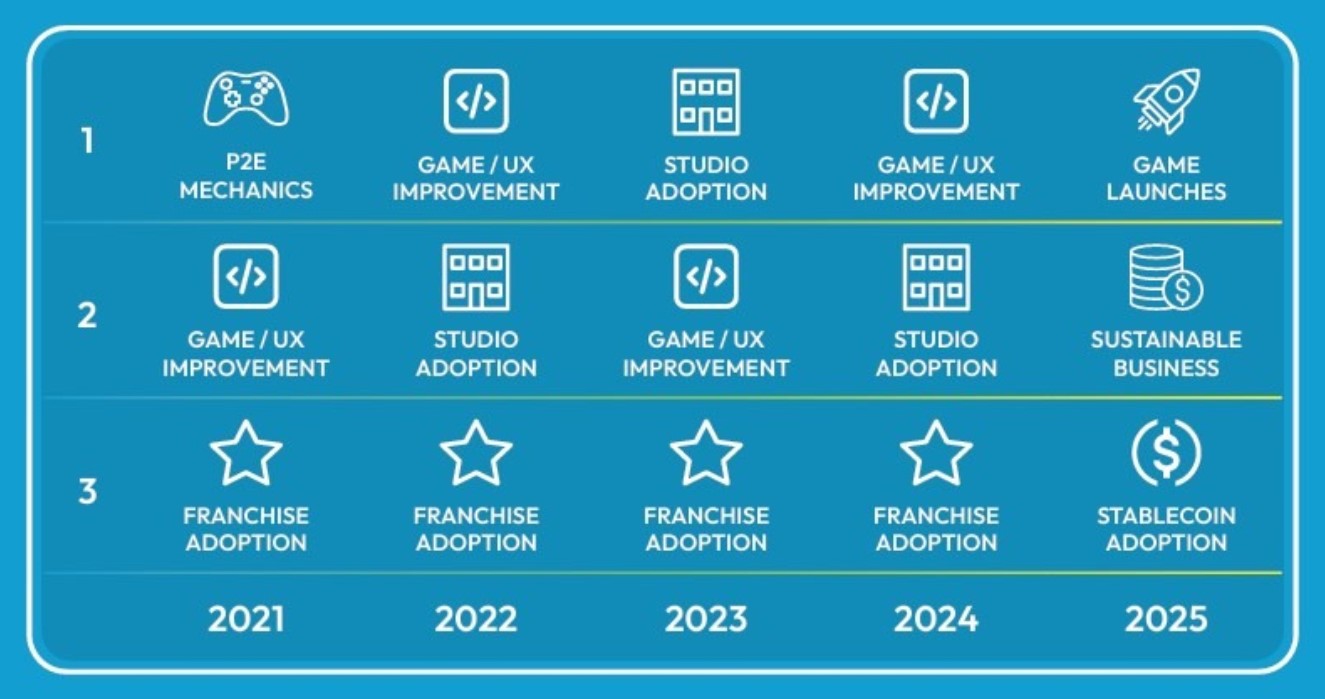
Key factors that are perceived to drive the growth of the blockchain gaming industry. Source: BGA Survey

If 2024 was defined by layer-2 scaling paths, 2025 became a year of preparation. Builders focused on making crypto usable, pushing account abstraction into production, tightening wallet UX and building mobile distribution channels through ecosystems like Solana’s Saga and The Open Network’s deep integration with Telegram.

At the same time, regulators across major jurisdictions like the United States, Europe and Asia have drawn clearer boundaries around stablecoins, custody and reporting, giving developers a framework to build within. The result was a year spent building the groundwork instead of chasing breakout apps.

The groundwork now sets up 2026 as a decisive test of relevance. With tooling largely in place and compliance streamlined, DApps will need to address the challenging question of whether they can attract and retain users without relying on speculative incentives.

The industry spent much of 2025 talking about a pivot to utility, but 2026 is where this claim would have to meet reality. If everyday users don’t stay once yields fade and rewards disappear, the problem will no longer be the technology, but the applications themselves.

How DApps can compete with Web2 in 2026

While DApps focused on competing with each other for user attention in previous years, 2026 may become the year when they must stand against Web2 applications and their scale.

For DApps to stand a chance, they must erase barriers that historically caused friction for mainstream users — and the shift is already underway. Account abstraction is moving closer to becoming the default experience across major ecosystems, enabling smart accounts that behave more like familiar log-in mechanisms than cryptographic tooling.

Gas sponsorships, where apps pay gas on behalf of users, reduced one of the biggest pain points, while social logins and MPC wallets removed the need for seed phrases. Moreover, sub-second finality on high-performance blockchains like Solana and modular rollups on Ethereum have narrowed the latency gap.

The emerging layer of AI agents capable of interacting with smart contracts could make DApp usage feel less like managing a wallet and more like a regular application.

Related: Tether deepens AI bet, backs Italian firm’s humanoid robots

This highlights the stark contrast between 2025 and 2026. This year showed fragmentation fatigue, where thousands of isolated DApps, each with separate accounts, assets and user journeys, created a high cognitive load for new users.

Because of this, the next leap for the sector may come from modular, interoperable super apps that bundle multiple needs in one interface, similar to how WeChat and Grab built dominance in the Web2 space.

Payments, savings and stablecoin rails could sit alongside NFT creator tools, gaming assets, loyalty tokens and social identity, allowing users to move across experiences inside a single ecosystem.

If 2025 was the year protocols built the foundation, 2026 may be the year to test whether these actually work in daily use.
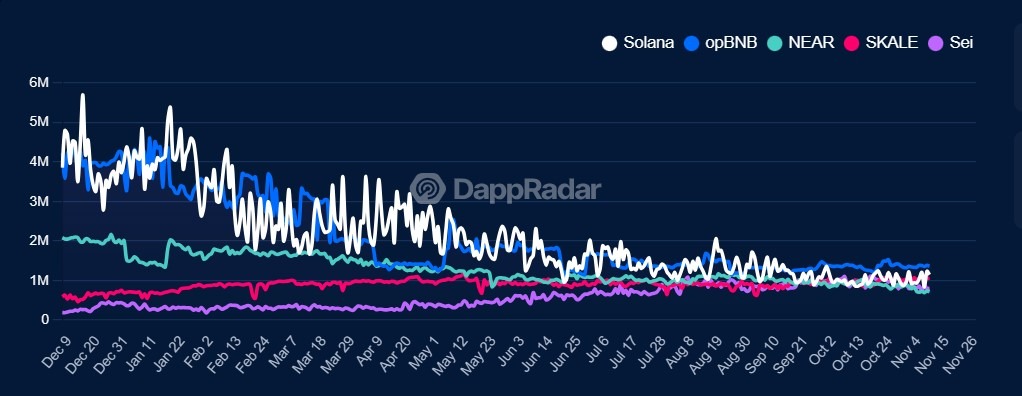
Solana and opBNB dominate in unique active wallets in 2025. Source: DappRadar

Related: Web3 gaming, DeFi lead sector activity in October despite market decline: Report

Which ecosystems are positioned to win in 2026?

Several ecosystems enter 2026 with distinct advantages, not only in throughput or developer tools, but also in distribution, user funnels and real-world relevance.

Ethereum remains the center of smart contract development, but its 2025 upgrades were incremental in nature. Improvements tied to the Fusaka upgrade focused on advancing Ethereum's data availability and zero-knowledge roadmap.

It includes early steps toward more efficient proof systems and shared sequencing concepts rather than immediate fee reductions on the mainnet. Together with the continued maturation of rollups, these changes position Ethereum to support cheaper and faster settlement over time, without compromising its security model.

Related: Vitalik Buterin pitches ZK-proofs to audit X algorithm and rankings

Solana continues to carve out the consumer lane, powering sub-second transactions for payments, in-app micro-purchases and mobile-native experiences that feel more Web2 than Web3.

On the other hand, TON stands out with arguably the strongest user funnel in the crypto space. Telegram's massive user base, Mini Apps and seamless wallet integrations created a distribution channel that would be difficult to replicate.
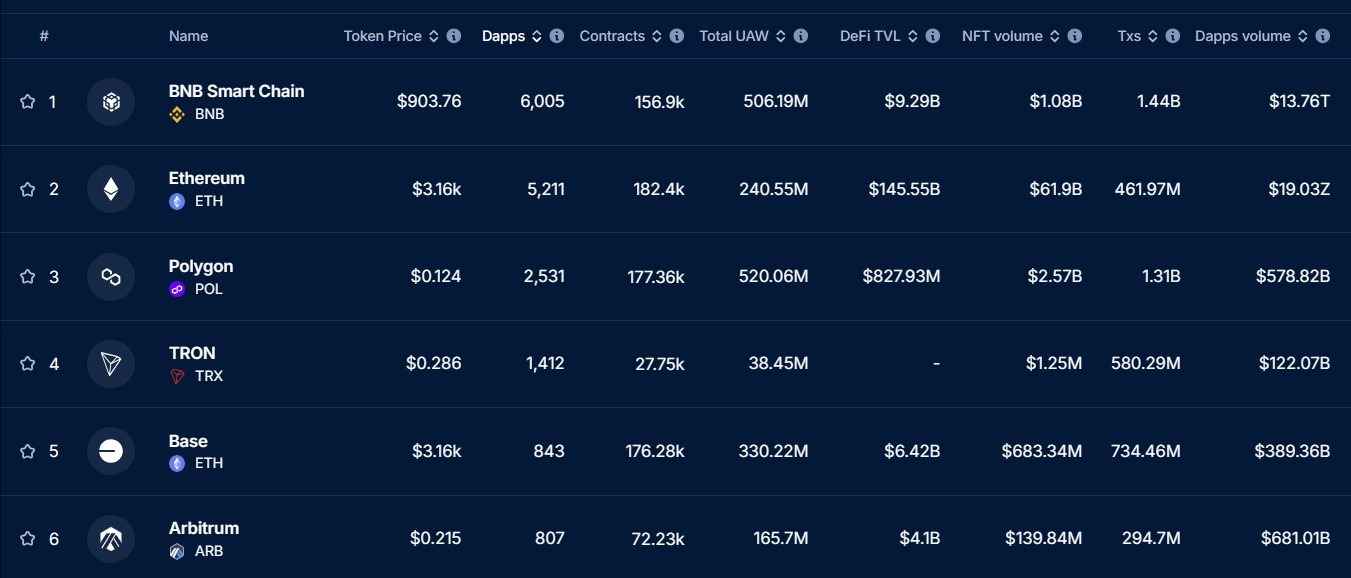
DappRadar integrated data showed that BNB Chain has over 6,000 DApps. Source: DappRadar

Beyond chains, thematic sectors could also define what could dominate the sector in 2026. Decentralized physical infrastructure networks (DePIN) gained traction in 2025 by anchoring crypto to real-world workflows like bandwidth, compute markets, mobility networks and energy credits.

These provided revenue paths that are not dependent on yield farming. In June, a World Economic Forum (WEF) report predicted that the sector could grow to $3.5 trillion by 2028, driven by the adoption of blockchain and artificial intelligence.

Meanwhile, creator-focused DApps are also maturing beyond NFTs and speculation toward micro-IP ownership, music royalties and fan-powered monetization models.

If these trends hold, the ecosystems best placed to succeed in 2026 will likely be the ones that combine distribution, scalability and clearer everyday use cases — not just the fastest network, but the one with the most active users.

2026 will be a turning point for utility

Crypto has already spent years building, scaling networks, tightening security, refining user experiences and building regulatory foundations to support its developments.

With infrastructure reaching consumer-grade readiness, the next phase may be less about which chain processes transactions faster and more about which products we are willing to return to without the usual token incentives.

If 2025 was a year spent in construction, 2026 is shaping up to be a year to evaluate — one where DApps must deliver practical value and not just promises. The winners will be those that feel similar to everyday applications, with simple onboarding, invisible gas and stable cost structures.

Magazine: Ethereum’s Fusaka fork explained for dummies: What the hell is PeerDAS?

Трендові криптовалюти

Пов'язані питання

QWhat was the main shift in the crypto space during 2025 according to the article?

AThe main shift in 2025 was a slow and sober pivot toward utility, moving away from speculative trends like DeFi summers and NFT euphoria, with builders focusing on long-term development and making crypto usable.

QHow did the developer landscape change in 2025 based on Electric Capital's Developer Report?

AAccording to Electric Capital's Developer Report, the number of full-time crypto developers (those committing code at least 10 days per month) rose 5% year-on-year, while total developer counts dipped slightly, indicating a smaller but more committed developer base focused on long-term projects.

QWhat are the key factors that Web3 game developers believe drive success for gaming DApps, as per the Blockchain Gaming Alliance survey?

AWeb3 game developers tie success to polished gameplay, sustainable monetization, and infrastructure that supports spending, focusing on controllable factors like interoperability, AI integration, and player-driven economies rather than relying on external forces like traditional gaming giants.

QWhat technological and UX improvements are helping DApps compete with Web2 applications in 2026?

AImprovements include account abstraction becoming the default experience, gas sponsorships where apps pay gas fees for users, social logins, MPC wallets eliminating seed phrases, sub-second finality on high-performance blockchains, and AI agents that make DApp usage feel like regular applications, all reducing friction for mainstream users.

QWhich ecosystems are positioned to win in 2026, and what advantages do they have?

AEthereum remains the center of smart contract development with incremental upgrades focused on data availability and zero-knowledge proofs. Solana excels in consumer applications with sub-second transactions for payments and mobile-native experiences. TON has a strong user funnel through Telegram's massive user base and seamless wallet features. Additionally, ecosystems supporting DePIN and creator-focused DApps with real-world utility are well-positioned.

Пов'язані матеріали

In the Age of Artificial Intelligence, We Need 'Magicians,' Not 'Managers'

In the AI era, leadership must shift from management to magic. As knowledge rapidly expires, value shifts from what leaders know to what they can facilitate. Traditional "inside-out" management, driven by internal experience, is giving way to "outside-in" thinking focused on external opportunities, customer needs, and disruptive change. The core challenge is fostering new ideas that may invalidate existing knowledge. While technologies like steam, electricity, and AI provide the "skeleton" for innovation, it is human vision—connecting technology to customer dreams—that creates magic. Historical figures like Richard Arkwright and Eldridge R. Johnson succeeded not by inventing core technologies, but by reimagining work and business models from the outside in. Leaders must transition from controllers to "architects of flourishing." Their role is to design environments where empowerment, creativity, and adaptive learning thrive. This involves granting autonomy, fostering partnerships, and building resilient systems that scale innovation. Critical leadership qualities now include judgment, creativity, and the ability to learn continuously rather than relying on static expertise. Therefore, cultivating future leaders requires a focus on timeless fundamentals, humanities for broader perspective, and social acuity, rather than over-specialization in quickly outdated technical skills. The future rewards those who respond to the unseen and create conditions for better answers to emerge. Leadership in the AI age is less about having all the answers and more about enabling others to discover them—creating organizations where people explore, imagine, and thrive.

marsbit18 хв тому

In the Age of Artificial Intelligence, We Need 'Magicians,' Not 'Managers'

marsbit18 хв тому

Platform Token Soars 15x in Half a Month, Pons Tops Robinhood Chain Charts for Both Token Launches and Trading

In just half a month, the Pons platform token (PONS) surged over 15x in value as Pons solidified its position as the leading token launch and trading platform on Robinhood Chain, capturing both the highest daily token creation volume and transaction volume. Following the exit of previous leader NOXA, competition initially favored Flap before Pons emerged dominant around mid-July. By July 26th, Pons accounted for 77.1% of total trading volume across all Robinhood Chain launchpads. Pons's success is attributed to its streamlined, one-transaction process for deploying a token contract and its corresponding Uniswap V3 liquidity pool simultaneously, eliminating the need for bonding curves or complex migrations. This simplicity, combined with low creation costs and immediate tradability, attracted significant creation activity and speculative trading. The meteoric rise of its native token, PONS, further fueled platform growth. A tokenomics model directing 80% of protocol fees to buy back and burn PONS created a reinforcing cycle: platform usage boosted PONS value, which in turn attracted more users. Looking ahead, Pons V2 aims to expand beyond meme tokens by integrating support for paying fees in stablecoins (USDG) and RWA assets, aligning with Robinhood Chain's broader focus on on-chain finance and stock tokens.

Odaily星球日报1 год тому

Platform Token Soars 15x in Half a Month, Pons Tops Robinhood Chain Charts for Both Token Launches and Trading

Odaily星球日报1 год тому

Торгівля

Спот

Популярні статті

Як купити O

Ласкаво просимо до HTX.com! Ми зробили покупку O1 exchange (O) простою та зручною. Дотримуйтесь нашої покрокової інструкції, щоб розпочати свою криптовалютну подорож.Крок 1: Створіть обліковий запис на HTXВикористовуйте свою електронну пошту або номер телефону, щоб зареєструвати обліковий запис на HTX безплатно. Пройдіть безпроблемну реєстрацію й отримайте доступ до всіх функцій.ЗареєструватисьКрок 2: Перейдіть до розділу Купити крипту і виберіть спосіб оплатиКредитна/дебетова картка: використовуйте вашу картку Visa або Mastercard, щоб миттєво купити O1 exchange (O).Баланс: використовуйте кошти з балансу вашого рахунку HTX для безперешкодної торгівлі.Треті особи: ми додали популярні способи оплати, такі як Google Pay та Apple Pay, щоб підвищити зручність.P2P: Торгуйте безпосередньо з іншими користувачами на HTX.Позабіржова торгівля (OTC): ми пропонуємо індивідуальні послуги та конкурентні обмінні курси для трейдерів.Крок 3: Зберігайте свої O1 exchange (O)Після придбання O1 exchange (O) збережіть його у своєму обліковому записі на HTX. Крім того, ви можете відправити його в інше місце за допомогою блокчейн-переказу або використовувати його для торгівлі іншими криптовалютами.Крок 4: Торгівля O1 exchange (O)Легко торгуйте O1 exchange (O) на спотовому ринку HTX. Просто увійдіть до свого облікового запису, виберіть торгову пару, укладайте угоди та спостерігайте за ними в режимі реального часу. Ми пропонуємо зручний досвід як для початківців, так і для досвідчених трейдерів.

396 переглядів усьогоОпубліковано 2026.06.19Оновлено 2026.06.19

Як купити O

Як купити PROS

Ласкаво просимо до HTX.com! Ми зробили покупку Pharos (PROS) простою та зручною. Дотримуйтесь нашої покрокової інструкції, щоб розпочати свою криптовалютну подорож.Крок 1: Створіть обліковий запис на HTXВикористовуйте свою електронну пошту або номер телефону, щоб зареєструвати обліковий запис на HTX безплатно. Пройдіть безпроблемну реєстрацію й отримайте доступ до всіх функцій.ЗареєструватисьКрок 2: Перейдіть до розділу Купити крипту і виберіть спосіб оплатиКредитна/дебетова картка: використовуйте вашу картку Visa або Mastercard, щоб миттєво купити Pharos (PROS).Баланс: використовуйте кошти з балансу вашого рахунку HTX для безперешкодної торгівлі.Треті особи: ми додали популярні способи оплати, такі як Google Pay та Apple Pay, щоб підвищити зручність.P2P: Торгуйте безпосередньо з іншими користувачами на HTX.Позабіржова торгівля (OTC): ми пропонуємо індивідуальні послуги та конкурентні обмінні курси для трейдерів.Крок 3: Зберігайте свої Pharos (PROS)Після придбання Pharos (PROS) збережіть його у своєму обліковому записі на HTX. Крім того, ви можете відправити його в інше місце за допомогою блокчейн-переказу або використовувати його для торгівлі іншими криптовалютами.Крок 4: Торгівля Pharos (PROS)Легко торгуйте Pharos (PROS) на спотовому ринку HTX. Просто увійдіть до свого облікового запису, виберіть торгову пару, укладайте угоди та спостерігайте за ними в режимі реального часу. Ми пропонуємо зручний досвід як для початківців, так і для досвідчених трейдерів.

460 переглядів усьогоОпубліковано 2026.06.22Оновлено 2026.06.22

Як купити PROS

Що таке VERONA

I. Вступ до проекту VERONA - це блокчейн, створений для всіх, скрізь, через абстракцію ланцюга. Використовуючи свій загальний шар абстракції, VERONA вирізняється інтеграцією складних функцій блокчейну, таких як рахунки, підписи та взаємодія, безпосередньо на рівні протоколу. Цей підхід дозволяє взаємодіяти з блокчейн-додатками без необхідності розуміти основні технології.1) Основна інформація Назва: VERONA (VERONA)III. Пов'язані посилання Офіційне посилання на сайт: https://xion.burnt.com/ Біла книга: https://xion.burnt.com/whitepaper.pdf Експлорери: https://explorer.burnt.com/ Соціальні мережі: https://x.com/burnt_xion Примітка: Вступ до проекту взято з матеріалів, опублікованих або наданих офіційною командою проекту, які є лише для довідки і не є інвестиційною порадою. HTX не несе відповідальності за будь-які прямі або непрямі збитки, що виникають внаслідок цього.

328 переглядів усьогоОпубліковано 2026.06.22Оновлено 2026.06.22

Що таке VERONA

Обговорення

Ласкаво просимо до спільноти HTX. Тут ви можете бути в курсі останніх подій розвитку платформи та отримати доступ до професійної ринкової інформації. Нижче представлені думки користувачів щодо ціни A (A).

活动图片