Was the Prediction Market the Biggest Winner of This Year's Super Bowl?

比推Опубліковано о 2026-02-10Востаннє оновлено о 2026-02-10

Анотація

This year's Super Bowl marked a potential turning point, with prediction markets emerging as a serious competitor to traditional sports betting. Platforms Kalshi and Polymarket offered markets on the game, halftime show, and ads. While the American Gaming Association projected a record $1.76 billion in traditional sports bets, an analyst estimated prediction markets could capture 80% of the year-over-year growth, with a forecast of $630 million in volume for the event. However, available data suggests prediction markets fell short of this forecast. Kalshi's top Super Bowl-specific markets saw a combined volume of approximately $233 million. Its season-long "Who will win the Super Bowl" contract accumulated over $500 million in volume, but this was spread over the entire NFL season. Kalshi's significant growth is aided by its CFTC regulatory status, allowing a US mobile app, leading to 1.9 million downloads in January alone. Polymarket, lacking direct US app access for most users, saw about $76 million in volume across its top three Super Bowl markets. Its strength was demonstrated in information discovery, as its market accurately predicted Lady Gaga's surprise halftime show appearance days in advance. The activity occurs amidst an unresolved regulatory conflict, with Kalshi operating under federal CFTC oversight while state gaming regulators challenge it in court. Although prediction markets did not meet the $630 million hype for the Super Bowl weekend, their rapid user g...

Source: Bankless

Author: David Christopher

Original Title: Did Prediction Markets Win the Super Bowl?

Compiled and Edited by: BitpushNews


This year's Super Bowl—Seattle Seahawks vs. New England Patriots—though lacking the star power of last year's Chiefs vs. Eagles matchup with Taylor Swift's presence, marked a turning point: prediction markets were explicitly recognized as genuine competitors to traditional sports betting for the first time.

Two major prediction market platforms, Kalshi and Polymarket, both set up markets around the game, the halftime show, advertisements, and more. Preliminary data paints an interesting and complex picture.

A quick note before we begin: Sportsbooks have not yet aggregated and reported their total betting volume—this will take a few days. Therefore, this analysis is based on predicted data from the sports betting side versus the trading volume on prediction markets.

Sports Betting Predictions: Another Record High, But Growth Slows

The American Gaming Association estimates that U.S. sportsbooks will handle approximately $1.76 billion in bets on Super Bowl LX, setting a new record and representing a year-over-year increase of about 27%. Although specific figures vary slightly depending on the source, most predictions point in the same direction: another record high, continuing the eight-year growth trend since the Supreme Court allowed states to legalize sports betting in 2018.

But the growth rate is clearly slowing. Sports betting is now legal in 39 states and Washington D.C., with only Missouri joining this cycle as a new market—meaning the explosive growth driven by market expansion in previous years is giving way to incremental growth. Against this backdrop, prediction markets have become another factor curbing growth. Ed Birkin of H2 Gambling Capital told Fortune that he estimates prediction markets will account for 80% of the year-on-year increase in betting activity, predicting that trading volume on prediction markets during the entire event will reach $630 million.

Based on currently available data, the performance of prediction markets seems far below that figure.
Kalshi

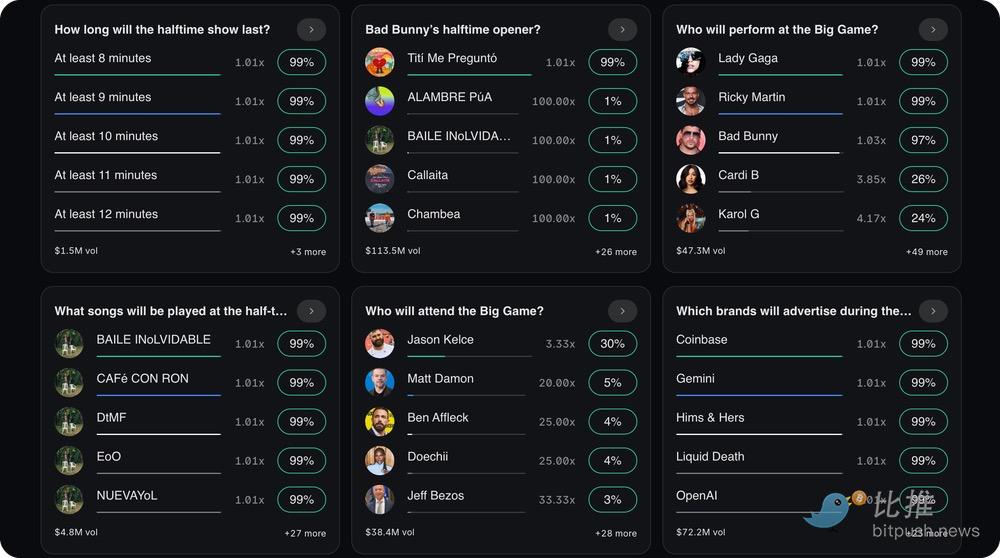
Kalshi's markets specifically created for the Super Bowl (i.e., contracts directly tied to the game, halftime show, and broadcast) generated significant, but not predicted, trading volume:

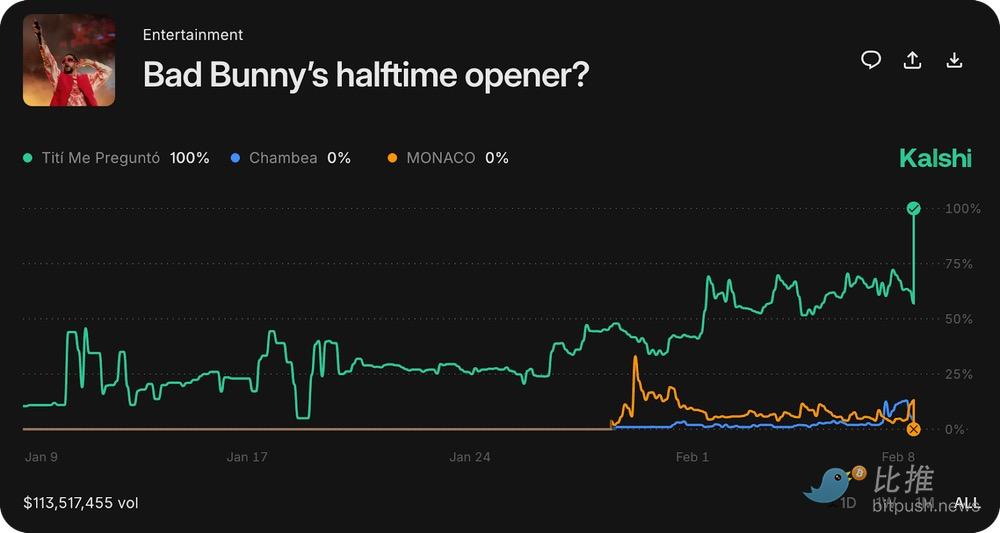
  • Bad Bunny Halftime Show Opening Song: $113.5 million

  • Which Company Will Air the First Commercial: $72.2 million

  • Who Will Perform at the Game: $47.3 million

Just these top few markets saw a combined trading volume of approximately $233 million, far below the $630 million prediction analysts had for the entire prediction market.

Furthermore, Kalshi's flagship NFL market—a "Who Will Win the Super Bowl" contract open for months throughout the season—saw total trading volume exceed $500 million. But this figure reflects the cumulative trading volume over the entire NFL season, not just Super Bowl weekend. Even so, this is less than a third of the amount sportsbooks are predicted to handle for the Super Bowl alone.

For months, sports betting has constituted the vast majority (over 90%) of Kalshi's total trading volume, thanks to its promotional channels which are on par with, if not better than, those of sportsbooks.

First, Kalshi's federal regulation through the CFTC means U.S. users can access it directly via its mobile app, just like a sports betting app. Coupled with a strong venture capital-backed advertising budget and a partnership with Robinhood, Kalshi stands out. This foundation is paying off: In January alone, Kalshi saw 1.9 million downloads, while DraftKings and FanDuel's new prediction market apps, launched in December, saw combined downloads of less than 100,000 (these apps were launched in states where their traditional sports betting apps are not permitted, but response has been tepid so far). Additionally, DraftKings partnered with Crypto.com last Friday to expand its event contract offerings, indicating that established giants are taking this threat seriously.
Polymarket

Polymarket's similar season-long NFL market saw trading volume of about $700 million—higher than Kalshi's—but the situation is different for its Super Bowl-specific markets. Polymarket's top three Super Bowl markets saw a combined trading volume of approximately $76 million:

  • Main Game Market: $55.26 million

  • Super Bowl MVP: $12 million

  • Who Will Perform the Halftime Show: $9 million

Polymarket lacks Kalshi's regulatory approval in the U.S., meaning American users cannot access it directly through a mobile app. Technically, Polymarket now has a U.S. app after acquiring a CFTC-registered exchange last year, but it is currently rolling out gradually through a waitlist, and its Super Bowl offerings were limited. As of the week before the game, the app didn't even list any sports markets; the full suite of Super Bowl features was only available on its global website.

Therefore, most U.S. users still need to access it via the website, using VPNs, etc. For casual sports bettors, this is not on the same playing field as downloading Kalshi from the App Store.

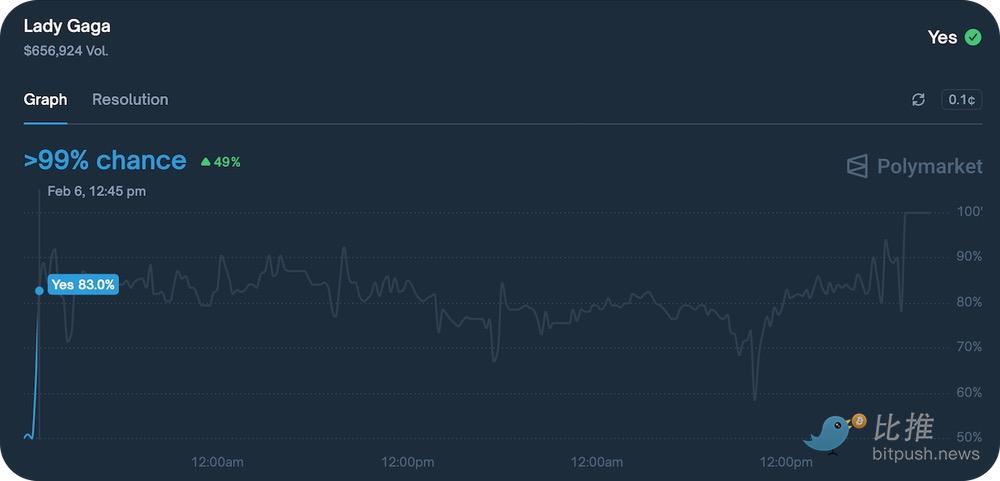
However, where Polymarket truly shines is its primary use case—information discovery. In its halftime show performer market, Lady Gaga's probability remained stable at around 80% in the days leading up to the game—well before her surprise appearance at the halftime show, which Billboard magazine had not reported on and genuinely surprised everyone I watched with.
Regulatory Progress

All of this is happening against the backdrop of unresolved regulatory conflicts.

Kalshi operates as a federally regulated exchange under the CFTC, which allows its sports contracts to proceed—especially after new CFTC Chairman Michael Selig stated he would not block or cede regulatory authority to the states. State gaming regulators, who oversee sportsbooks, continue to pursue legal challenges against Kalshi and its peers, and many analysts expect these cases to eventually reach the Supreme Court.

For now, prediction markets operate in a gray area, allowing them to cover the nation without needing state-by-state approval—a structural advantage that sportsbooks cannot easily replicate.

Summary

So, did prediction markets live up to the hype for Super Bowl LX? Relative to the $630 million prediction, not quite.

The combined trading volume on the visible top Super Bowl-specific markets across the two leading platforms was approximately $310 million—about half the predicted value. The season-long NFL markets on both platforms achieved huge trading volumes, but that was cumulative over months of football games, not a single-week explosion during Super Bowl weekend.

Context is also important. The 1.9 million downloads Kalshi garnered in January dwarf the combined total of DraftKings and FanDuel's prediction market apps. This pressure is already visibly reflected in stock prices—as observed by Fortune, shares of FanDuel parent Flutter Entertainment have fallen for eight consecutive weeks, their longest losing streak in twenty-three years; DraftKings' stock price is hovering near its lows since 2023, down more than 60% from its all-time high. Bloomberg data shows that over the past three months, market expectations for Flutter's Q4 earnings have been sharply cut by nearly 49%, and DraftKings' expectations have also fallen by 29%. Imagine if someone had bet on Polymarket that "DraftKings will underperform," they might have quietly profited by now.

Prediction markets may not have conquered the Super Bowl overnight, but they have certainly arrived—and for traditional sports betting platforms, the trajectory of this trend is alarming enough.


Twitter:https://twitter.com/BitpushNewsCN

Bitpush TG Discussion Group:https://t.me/BitPushCommunity

Bitpush TG Subscription: https://t.me/bitpush

Original link:https://www.bitpush.news/articles/7610501

Пов'язані питання

QWhat was the estimated total betting volume for Super Bowl LX by the American Gaming Association?

AThe American Gaming Association estimated that U.S. sportsbooks would handle approximately $1.76 billion in bets for Super Bowl LX.

QWhich two prediction market platforms were highlighted as major players for the Super Bowl markets?

AThe two major prediction market platforms highlighted were Kalshi and Polymarket.

QWhat was the combined trading volume of Kalshi's top three Super Bowl-specific markets?

AThe combined trading volume of Kalshi's top three Super Bowl-specific markets was approximately $233 million.

QWhat key regulatory advantage does Kalshi have over Polymarket in the United States?

AKalshi operates as a federally regulated exchange by the CFTC, which allows U.S. users direct access through its mobile app, unlike Polymarket which lacks this approval and requires most U.S. users to access via its global website, often using a VPN.

QAccording to the article, what was one significant way that Polymarket demonstrated its strength in 'information discovery'?

APolymarket's market on the halftime show performer correctly showed Lady Gaga's probability at around 80% days before the game, well ahead of her surprise appearance which was not reported by Billboard, showcasing its predictive information discovery capability.

Пов'язані матеріали

Understanding Hash in One Article: The "Browser Miner" on Ethereum

Hash is an Ethereum-based ERC-20 token described as a "browser-minable post-quantum token." Its key features include enabling browser-based GPU mining without specialized hardware, a fixed supply cap of 21 million tokens, immutable and permissionless smart contracts with no team allocation or pre-mining, and an emphasis on post-quantum security using Keccak256 hashing. The mining mechanism is a simplified on-chain proof-of-work where miners solve unique challenges tied to their wallet address. Key design elements prevent answer theft, with epochs resetting every 100 blocks (~20 minutes) and a per-block minting limit. Emission follows a Bitcoin-like halving schedule every 100,000 mints, starting at 100 tokens per mint. Projections suggest all tokens could be mined within approximately 294 days if a target rate of one mint per minute is sustained. Hash emphasizes "post-quantum" security by leveraging hash-based primitives like Keccak256, which are considered more resistant to quantum attacks compared to elliptic-curve cryptography. While not a fully post-quantum asset, it aligns with Ethereum's broader post-quantum research narrative. The project completed its Genesis sale at $0.03 and began trading on Uniswap, with its price reaching around $0.19. The initial circulating supply is small, with 5% sold in Genesis and 5% allocated to liquidity. The majority (47.6% of total supply) is allocated to early-stage mining, leading to a front-loaded emission schedule. This structure, combined with low initial liquidity, makes Hash a high-volatility, high-risk project dependent on sustained miner participation and market demand to absorb new supply.

marsbit3 хв тому

Understanding Hash in One Article: The "Browser Miner" on Ethereum

marsbit3 хв тому

OpenAI's Largest Internal Wealth Creation: 600 People Cash Out a Total of $6.6 Billion, 75 Take Home the Maximum $30 Million Each

A Wall Street Journal report reveals OpenAI's unprecedented pre-IPO wealth creation. In a single employee stock sale last October, over 600 current and former employees sold shares, collectively cashing out approximately $6.6 billion. Due to high investor demand, the company tripled the individual sale cap to $30 million, with about 75 employees selling the maximum amount. This event represents the largest such transaction in tech industry history for a private company. OpenAI's valuation was $500 billion for this tender offer. Employees with over two years of tenure were eligible, allowing many post-ChatGPT hires their first liquidity event. The company's stock has reportedly grown over 100-fold in seven years. Following a restructuring, employees collectively hold about 26% of OpenAI. The scale of executive wealth is also staggering. In court testimony related to Elon Musk's lawsuit, President and co-founder Greg Brockman confirmed his OpenAI stake is worth around $30 billion. Analysis indicates about 165 current and former employees hold a combined ~$164.9 billion in equity, averaging nearly $1 billion per person in paper wealth. OpenAI's per-employee stock-based compensation is estimated to be 34 times the average of major tech firms before their IPOs. OpenAI continues its rapid ascent, closing a $122 billion funding round at an $852 billion valuation in March. With monthly revenue hitting $2 billion, over 900 million weekly ChatGPT users, and plans for a potential trillion-dollar IPO in late 2026, this wealth-creation engine shows no signs of stopping.

链捕手25 хв тому

OpenAI's Largest Internal Wealth Creation: 600 People Cash Out a Total of $6.6 Billion, 75 Take Home the Maximum $30 Million Each

链捕手25 хв тому

Understanding CPO (Co-Packaged Optics) in One Article: Why Nvidia Is Willing to Spend $3.2 Billion on a Fiber?

NVIDIA and Corning announced a multi-year strategic partnership on May 6, 2026, with NVIDIA committing up to $3.2 billion to support Corning's U.S. expansion. This investment will triple Corning's manufacturing plants and significantly boost its optical fiber and communications production capacity. The core driver behind this massive investment is the fundamental shift from copper to optical interconnect technology within AI data centers. As GPU clusters scale, copper wires face critical limitations: severe signal attenuation over distance, high energy consumption for signal integrity, and excessive heat generation. Optical fiber, transmitting light instead of electrical signals, solves these issues with minimal loss, near-light speed, and lower power needs. The article outlines a three-stage evolution of data center interconnect: 1. **Traditional Copper Interconnects:** The mainstream solution of the 2010s, now being phased out due to scaling bottlenecks. 2. **Pluggable Optical Modules:** The current mainstream, where modules convert electrical signals to light externally. This process still introduces energy loss and latency. 3. **CPO (Co-Packaged Optics):** The next-generation technology where the optical engine is integrated directly with the GPU chip package. This drastically reduces the electrical signal travel distance to mere millimeters, slashing power consumption and latency while boosting data density. NVIDIA CEO Jensen Huang has identified CPO as an essential core technology for AI infrastructure. NVIDIA's investment signifies a strategic shift from being a buyer to actively controlling its supply chain for critical components. With demand for specialized optical fiber far outstripping supply—evidenced by soaring prices—securing long-term manufacturing capacity has become a competitive necessity. While Corning's expansion may pressure some suppliers, a projected global fiber supply gap of 5-15% over the next few years creates a significant opportunity window, particularly for Chinese manufacturers competitive in optical preforms, chips, and modules. Ultimately, NVIDIA's move is not about chasing a trend but an engineering imperative. The transition to light-based interconnects like CPO is driven by the physical limits of copper, marking a definitive step in the ongoing AI computing revolution.

marsbit50 хв тому

Understanding CPO (Co-Packaged Optics) in One Article: Why Nvidia Is Willing to Spend $3.2 Billion on a Fiber?

marsbit50 хв тому

Торгівля

Спот
Ф'ючерси
活动图片





