Was the Prediction Market the Biggest Winner of This Year's Super Bowl?

比推Опубліковано о 2026-02-10Востаннє оновлено о 2026-02-10

Анотація

This year's Super Bowl marked a potential turning point, with prediction markets emerging as a serious competitor to traditional sports betting. Platforms Kalshi and Polymarket offered markets on the game, halftime show, and ads. While the American Gaming Association projected a record $1.76 billion in traditional sports bets, an analyst estimated prediction markets could capture 80% of the year-over-year growth, with a forecast of $630 million in volume for the event. However, available data suggests prediction markets fell short of this forecast. Kalshi's top Super Bowl-specific markets saw a combined volume of approximately $233 million. Its season-long "Who will win the Super Bowl" contract accumulated over $500 million in volume, but this was spread over the entire NFL season. Kalshi's significant growth is aided by its CFTC regulatory status, allowing a US mobile app, leading to 1.9 million downloads in January alone. Polymarket, lacking direct US app access for most users, saw about $76 million in volume across its top three Super Bowl markets. Its strength was demonstrated in information discovery, as its market accurately predicted Lady Gaga's surprise halftime show appearance days in advance. The activity occurs amidst an unresolved regulatory conflict, with Kalshi operating under federal CFTC oversight while state gaming regulators challenge it in court. Although prediction markets did not meet the $630 million hype for the Super Bowl weekend, their rapid user g...

Source: Bankless

Author: David Christopher

Original Title: Did Prediction Markets Win the Super Bowl?

Compiled and Edited by: BitpushNews


This year's Super Bowl—Seattle Seahawks vs. New England Patriots—though lacking the star power of last year's Chiefs vs. Eagles matchup with Taylor Swift's presence, marked a turning point: prediction markets were explicitly recognized as genuine competitors to traditional sports betting for the first time.

Two major prediction market platforms, Kalshi and Polymarket, both set up markets around the game, the halftime show, advertisements, and more. Preliminary data paints an interesting and complex picture.

A quick note before we begin: Sportsbooks have not yet aggregated and reported their total betting volume—this will take a few days. Therefore, this analysis is based on predicted data from the sports betting side versus the trading volume on prediction markets.

Sports Betting Predictions: Another Record High, But Growth Slows

The American Gaming Association estimates that U.S. sportsbooks will handle approximately $1.76 billion in bets on Super Bowl LX, setting a new record and representing a year-over-year increase of about 27%. Although specific figures vary slightly depending on the source, most predictions point in the same direction: another record high, continuing the eight-year growth trend since the Supreme Court allowed states to legalize sports betting in 2018.

But the growth rate is clearly slowing. Sports betting is now legal in 39 states and Washington D.C., with only Missouri joining this cycle as a new market—meaning the explosive growth driven by market expansion in previous years is giving way to incremental growth. Against this backdrop, prediction markets have become another factor curbing growth. Ed Birkin of H2 Gambling Capital told Fortune that he estimates prediction markets will account for 80% of the year-on-year increase in betting activity, predicting that trading volume on prediction markets during the entire event will reach $630 million.

Based on currently available data, the performance of prediction markets seems far below that figure.
Kalshi

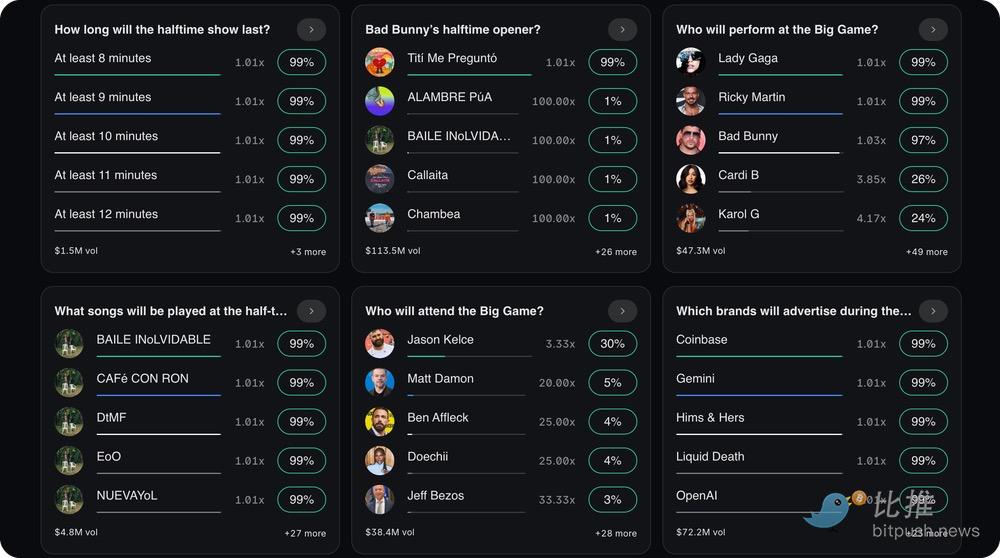
Kalshi's markets specifically created for the Super Bowl (i.e., contracts directly tied to the game, halftime show, and broadcast) generated significant, but not predicted, trading volume:

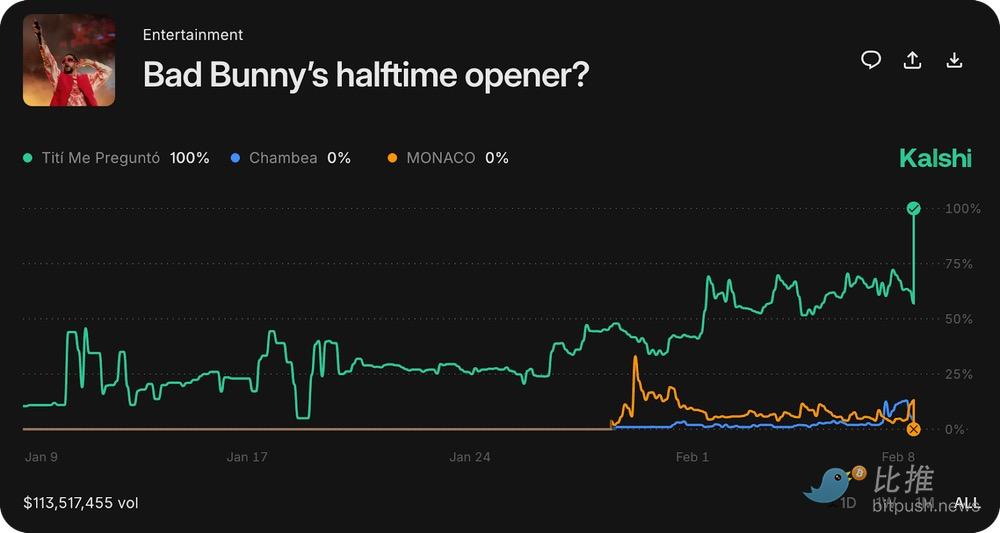
  • Bad Bunny Halftime Show Opening Song: $113.5 million

  • Which Company Will Air the First Commercial: $72.2 million

  • Who Will Perform at the Game: $47.3 million

Just these top few markets saw a combined trading volume of approximately $233 million, far below the $630 million prediction analysts had for the entire prediction market.

Furthermore, Kalshi's flagship NFL market—a "Who Will Win the Super Bowl" contract open for months throughout the season—saw total trading volume exceed $500 million. But this figure reflects the cumulative trading volume over the entire NFL season, not just Super Bowl weekend. Even so, this is less than a third of the amount sportsbooks are predicted to handle for the Super Bowl alone.

For months, sports betting has constituted the vast majority (over 90%) of Kalshi's total trading volume, thanks to its promotional channels which are on par with, if not better than, those of sportsbooks.

First, Kalshi's federal regulation through the CFTC means U.S. users can access it directly via its mobile app, just like a sports betting app. Coupled with a strong venture capital-backed advertising budget and a partnership with Robinhood, Kalshi stands out. This foundation is paying off: In January alone, Kalshi saw 1.9 million downloads, while DraftKings and FanDuel's new prediction market apps, launched in December, saw combined downloads of less than 100,000 (these apps were launched in states where their traditional sports betting apps are not permitted, but response has been tepid so far). Additionally, DraftKings partnered with Crypto.com last Friday to expand its event contract offerings, indicating that established giants are taking this threat seriously.
Polymarket

Polymarket's similar season-long NFL market saw trading volume of about $700 million—higher than Kalshi's—but the situation is different for its Super Bowl-specific markets. Polymarket's top three Super Bowl markets saw a combined trading volume of approximately $76 million:

  • Main Game Market: $55.26 million

  • Super Bowl MVP: $12 million

  • Who Will Perform the Halftime Show: $9 million

Polymarket lacks Kalshi's regulatory approval in the U.S., meaning American users cannot access it directly through a mobile app. Technically, Polymarket now has a U.S. app after acquiring a CFTC-registered exchange last year, but it is currently rolling out gradually through a waitlist, and its Super Bowl offerings were limited. As of the week before the game, the app didn't even list any sports markets; the full suite of Super Bowl features was only available on its global website.

Therefore, most U.S. users still need to access it via the website, using VPNs, etc. For casual sports bettors, this is not on the same playing field as downloading Kalshi from the App Store.

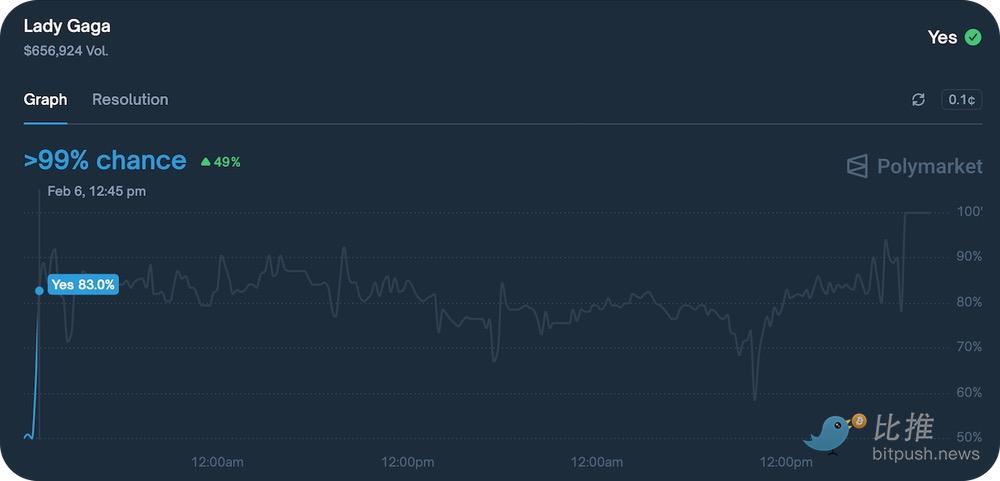
However, where Polymarket truly shines is its primary use case—information discovery. In its halftime show performer market, Lady Gaga's probability remained stable at around 80% in the days leading up to the game—well before her surprise appearance at the halftime show, which Billboard magazine had not reported on and genuinely surprised everyone I watched with.
Regulatory Progress

All of this is happening against the backdrop of unresolved regulatory conflicts.

Kalshi operates as a federally regulated exchange under the CFTC, which allows its sports contracts to proceed—especially after new CFTC Chairman Michael Selig stated he would not block or cede regulatory authority to the states. State gaming regulators, who oversee sportsbooks, continue to pursue legal challenges against Kalshi and its peers, and many analysts expect these cases to eventually reach the Supreme Court.

For now, prediction markets operate in a gray area, allowing them to cover the nation without needing state-by-state approval—a structural advantage that sportsbooks cannot easily replicate.

Summary

So, did prediction markets live up to the hype for Super Bowl LX? Relative to the $630 million prediction, not quite.

The combined trading volume on the visible top Super Bowl-specific markets across the two leading platforms was approximately $310 million—about half the predicted value. The season-long NFL markets on both platforms achieved huge trading volumes, but that was cumulative over months of football games, not a single-week explosion during Super Bowl weekend.

Context is also important. The 1.9 million downloads Kalshi garnered in January dwarf the combined total of DraftKings and FanDuel's prediction market apps. This pressure is already visibly reflected in stock prices—as observed by Fortune, shares of FanDuel parent Flutter Entertainment have fallen for eight consecutive weeks, their longest losing streak in twenty-three years; DraftKings' stock price is hovering near its lows since 2023, down more than 60% from its all-time high. Bloomberg data shows that over the past three months, market expectations for Flutter's Q4 earnings have been sharply cut by nearly 49%, and DraftKings' expectations have also fallen by 29%. Imagine if someone had bet on Polymarket that "DraftKings will underperform," they might have quietly profited by now.

Prediction markets may not have conquered the Super Bowl overnight, but they have certainly arrived—and for traditional sports betting platforms, the trajectory of this trend is alarming enough.


Twitter:https://twitter.com/BitpushNewsCN

Bitpush TG Discussion Group:https://t.me/BitPushCommunity

Bitpush TG Subscription: https://t.me/bitpush

Original link:https://www.bitpush.news/articles/7610501

Пов'язані питання

QWhat was the estimated total betting volume for Super Bowl LX by the American Gaming Association?

AThe American Gaming Association estimated that U.S. sportsbooks would handle approximately $1.76 billion in bets for Super Bowl LX.

QWhich two prediction market platforms were highlighted as major players for the Super Bowl markets?

AThe two major prediction market platforms highlighted were Kalshi and Polymarket.

QWhat was the combined trading volume of Kalshi's top three Super Bowl-specific markets?

AThe combined trading volume of Kalshi's top three Super Bowl-specific markets was approximately $233 million.

QWhat key regulatory advantage does Kalshi have over Polymarket in the United States?

AKalshi operates as a federally regulated exchange by the CFTC, which allows U.S. users direct access through its mobile app, unlike Polymarket which lacks this approval and requires most U.S. users to access via its global website, often using a VPN.

QAccording to the article, what was one significant way that Polymarket demonstrated its strength in 'information discovery'?

APolymarket's market on the halftime show performer correctly showed Lady Gaga's probability at around 80% days before the game, well ahead of her surprise appearance which was not reported by Billboard, showcasing its predictive information discovery capability.

Пов'язані матеріали

Annual Salary of Millions Competing for Electricians, Meta Rushes to Open Its Own Technical School

The AI boom is facing an unexpected bottleneck: a severe shortage of skilled construction workers and electricians. As tech giants like Meta, OpenAI, and Alphabet race to build massive data centers—such as OpenAI's $16 billion "Stargate" project—they are hitting a critical labor wall. The U.S. needs an estimated 130,000 more electricians, 240,000 construction workers, and 150,000 supervisors by 2030 for AI infrastructure alone, but tens of thousands of electrician jobs go unfilled each year. While AI companies offer high premiums, with electricians earning up to $280,000 annually, worker scarcity still causes massive losses—delays on a single project can cost $14.2 million per month. The complexity of building AI data centers, which require immense power (equivalent to powering hundreds of thousands of homes), sophisticated electrical systems, and advanced liquid cooling solutions, demands highly skilled technicians who are in short supply. To combat this, companies are investing heavily in training. Meta has committed $115 million to a free training school offering tuition, housing, and stipends, targeting 5,000 new workers. OpenAI is partnering with unions to secure skilled labor. These efforts are paying off, with a significant rise in Gen Z interest in trade schools over college. However, the power demands are staggering. AI data centers are driving a rapid surge in electricity consumption, projected to account for up to 12% of U.S. power use by 2028 and raising costs for consumers. Furthermore, the construction boom is project-based, leading to a potential future glut of trained workers once building peaks, which could depress wages industry-wide. The race for AI supremacy now depends as much on skilled hands as on advanced chips.

marsbit25 хв тому

Annual Salary of Millions Competing for Electricians, Meta Rushes to Open Its Own Technical School

marsbit25 хв тому

OpenAI No Longer Sells Its Most Expensive Model for Profit

OpenAI is shifting its business strategy away from promoting its most expensive, flagship models for every task. Recent price cuts—80% for GPT-5.6 Luna and 20% for Terra—signal a deeper change: the company now actively advises users that many tasks don't require the most powerful model. Instead, OpenAI recommends a tiered approach: use the high-end GPT-5.6 Sol for complex planning and analysis, then delegate execution to cheaper models like Luna. This mirrors moves by Anthropic, which recently launched Claude Opus 5 at half the price of its top model, Fable 5. Both companies are de-emphasizing flagship models as primary revenue drivers, using them instead for brand prestige and technological showcases. The industry is entering a "mass-market" phase, similar to automotive, where high-volume, cost-effective models handle daily operations and drive scale. OpenAI's price reductions are partly enabled by AI models themselves optimizing underlying code and infrastructure, creating a self-reinforcing cycle of efficiency gains and cost reduction. Competition is shifting from "who is smartest" to "who offers the best value." The goal is no longer selling individual models but fostering widespread API adoption and ecosystem lock-in. By making AI calls cheap and ubiquitous, companies like OpenAI aim to become the indispensable, utility-like infrastructure powering automated workflows—the "water and electricity" of software, quietly embedded everywhere.

marsbit25 хв тому

OpenAI No Longer Sells Its Most Expensive Model for Profit

marsbit25 хв тому

Will the Fed Definitely Raise Interest Rates in September? How Will Crypto and U.S. Stocks Withstand the Pressure?

The market's expectation for a September Fed rate hike surged dramatically in early August, jumping from under 50% to over 80% within a week. This shift followed a contentious July FOMC meeting, where a 9-3 vote to hold rates revealed growing dissent from hawkish members advocating for an immediate hike to combat persistent inflation. The primary catalyst for this repricing is rising oil prices, driven by renewed geopolitical tensions around the Strait of Hormuz, which threaten global supply. Energy costs directly influence inflation metrics, making the upcoming July CPI report (due August 12th) a critical data point. If it shows inflation reaccelerating, the probability of a September hike will solidify. For Bitcoin and crypto assets, this is typically bearish news. Bitcoin continues to behave as a high-beta, liquidity-sensitive risk asset. A rate hike raises the opportunity cost of holding non-yielding assets and could drive capital toward money markets, pressuring crypto prices in the short term. However, historical patterns suggest that if a hike is perceived as the end of a tightening cycle rather than the start, any negative price impact may be brief. U.S. stocks, particularly crypto-linked equities like Coinbase and growth-oriented tech stocks, are also vulnerable. Higher rates increase discount rates in valuation models, putting pressure on high-multiple companies. This coincides with a pivotal tech earnings season where investor focus has shifted from massive AI capital expenditure to tangible revenue and cash flow generation. Companies with negative cash flow and weak growth narratives could face heightened volatility if borrowing costs rise in September. In summary, a September Fed hike has evolved into a mainstream market scenario. Key factors to watch are oil prices, the July CPI report, and Fed communications, which will determine the final decision and its impact on volatile crypto and equity markets.

marsbit36 хв тому

Will the Fed Definitely Raise Interest Rates in September? How Will Crypto and U.S. Stocks Withstand the Pressure?

marsbit36 хв тому

Торгівля

Спот
活动图片





