Warsh Ends the 'Dollar Devaluation Trade'? Crypto Market Continues Plunge Over Weekend, Bitcoin Breaks Below $80,000 Mark

华尔街日报Опубліковано о 2026-02-01Востаннє оновлено о 2026-02-01

Анотація

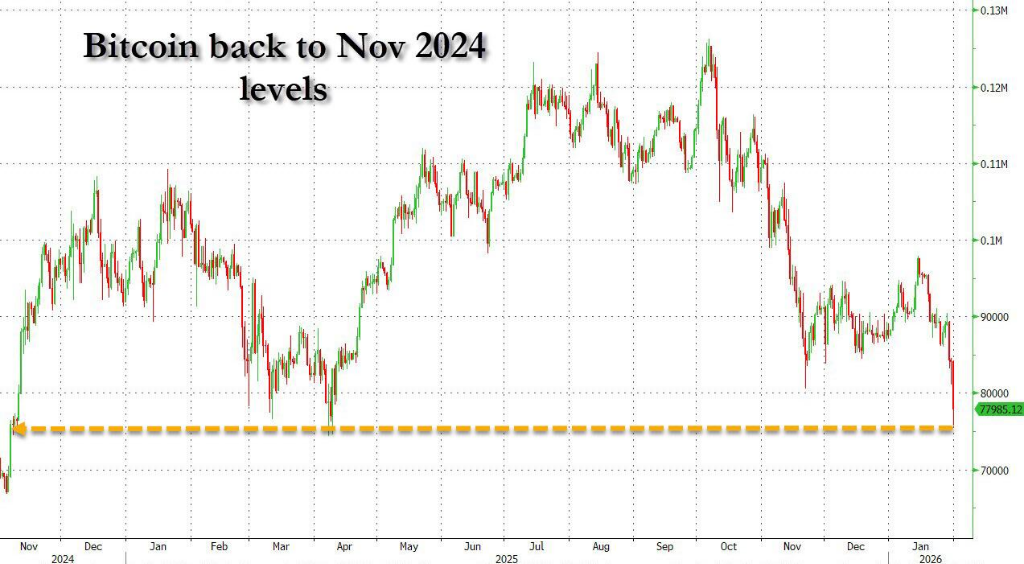
The cryptocurrency market experienced a significant sell-off over the weekend, with Bitcoin falling below the $80,000 mark to its lowest level since April of last year. The decline, which extended a month-long downward trend, was partly triggered by former President Trump’s nomination of Kevin Warsh as the next Federal Reserve Chair. Analysts suggest that Warsh’s expected hawkish stance on inflation may reduce the appeal of “sell America” trades, including bets against the U.S. dollar. During the sell-off, Bitcoin dropped as much as 10% to around $75,710, while Ethereum and Solana saw even steeper declines of over 17%. Approximately $1.6 billion in long and short positions were liquidated within 24 hours, with outflows from spot ETFs further indicating weak investor interest. Market observers noted particularly low retail engagement, with trading volumes expected to remain subdued in the near term. Notably, Bitcoin failed to attract safe-haven demand despite heightened geopolitical tensions between Israel and Iran, as well as a surge in gold and silver prices. Instead, traditional assets like precious metals and cash continued to be preferred shelters for investors concerned about fiat currency risks. Regulatory uncertainty in the U.S., including delays in crypto market structure legislation, also contributed to the negative sentiment. Warsh nomination appears to have reversed earlier strong rallies in cryptocurrencies, gold, and silver, as markets anticipate a less interv...

The cryptocurrency market experienced a new round of sell-offs over the weekend, with Bitcoin falling below the $80,000 mark to its lowest level since April of last year, extending a month-long downward trend. This selling wave, which began after Trump nominated Warsh as Fed Chair, has not only hit cryptocurrencies hard but also reversed the gains in gold and silver, as market bets on dollar devaluation are unraveling.

Amid thin liquidity and limited buying interest, Bitcoin's decline reached 10% at one point on Saturday, touching a low of $75,709.88. Other major tokens like Ethereum and Solana saw even steeper drops, falling by 17% and over 17% respectively. According to CoinGecko data, the total market value of cryptocurrencies evaporated by approximately $111 billion in the past 24 hours.
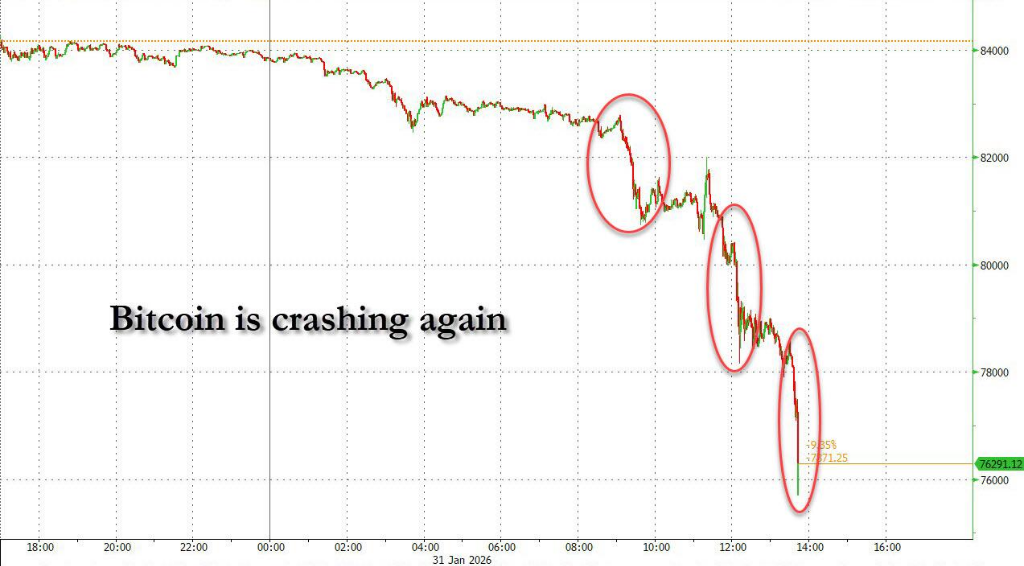
This decline occurred against a backdrop of thin liquidity and limited buying interest, amplifying the drop of the world's largest cryptocurrency to over 30%. Data from market tracker Coinglass showed that about $1.6 billion in long and short positions were liquidated during the same period, with most occurring in the last four hours, primarily concentrated in Bitcoin and Ethereum.

The news of President Trump nominating Warsh to serve as the next Chair of the Federal Reserve seemed to exacerbate the cryptocurrency decline. As previously reported by Wall Street Insights, former Goldman Sachs executive Gavyn Davies stated that choosing Warsh reduces the risk of a crisis triggered by the "Sell America" trade, as he is expected to be resolute in guarding against inflation.

Liquidation Scale Expands, Retail Interest Remains Low

According to data from market tracker Coinglass, approximately $1.6 billion in long and short positions were liquidated in the past 24 hours, with most occurring in the last four hours, primarily concentrated in Bitcoin and Ethereum.

After closing at $83,817 on Friday, Bitcoin fell to $78,092 by Saturday evening, a drop of 7%. This decline brings it back to levels seen after April '25, continuing weeks of macro-level disappointment.
Needham analyst John Todaro said, "The current levels indicate extremely low interest from retail investors," adding that trading volume could remain low for "the next one or two quarters." Continued outflows from spot ETFs further confirm the waning investor interest.

Safe-Haven Attribute Fails, Gold and Silver Become Preferred

Davies, the former chief economist and partner at Goldman Sachs Group, stated that Warsh's policy mix might be welcomed by market participants, though he wishes to reduce the Fed's role in the markets, meaning he may be less willing to intervene during stock market turbulence. "Many market observers would like this combination—a smaller balance sheet alongside more deregulation of the banking system."

Gavyn Davies, Co-founder and Chairman of Fulcrum Asset Management and head of the London office, said in a video posted on the company's website:

"The market, including the dollar, will breathe a significant sigh of relief. Choosing Warsh reduces the risk of that truly crisis-inducing 'Sell America' trade."

Despite the dollar weakening for most of January and growing investor wariness towards the policy risks of the Trump administration, this change failed to boost cryptocurrency market sentiment. Similarly, when gold prices surged to record highs, Bitcoin failed to respond meaningfully.

Louis Navellier of Navellier & Associates said, "Silver and gold have become the tools for investors worried about fiat currency." After gold and silver experienced significant pullbacks on Friday, Bitcoin still failed to attract inflows. Traditional safe-haven funds remain concentrated in metals and cash.

This absence of buying highlights the dilemma of Bitcoin's role in a broader investment portfolio. Geopolitical risks have failed to spark demand, and Bitcoin's dual positioning as both a momentum trade and a hedge against currency devaluation is now in trouble.

Geopolitical Tensions and Regulatory Uncertainty

Bitcoin prices could also be affected by escalating tensions between Israel and Iran. According to Xinhua News Agency, Trump stated that the US and Iran are negotiating, and an advisor to Iran's Supreme Leader said a "negotiation framework" is taking shape. Earlier on January 31st, social media was flooded with rumors about the assassination of the commander of Iran's Islamic Revolutionary Guard Corps Navy, drone attacks on naval bases, and explosions in multiple locations. Iranian media debunked these rumors one by one, stating that the claims were untrue.

Furthermore, delays in new market structure regulations for the US cryptocurrency industry have dampened interest in digital assets. The market had anticipated that regulatory clarity would boost confidence, but the Senate committee's shift in focus to housing issues has led to a postponement of cryptocurrency legislation.

It is worth noting that although Warsh has called Bitcoin a "good asset" and a "good cop on the beat for policy," his nomination news seems to have reversed the strong rally in gold, silver, and cryptocurrencies. The market expects that Warsh may wish to reduce the Fed's role in the markets, meaning he might be less willing to intervene during periods of stock market turbulence.

Пов'язані питання

QWhat triggered the latest sell-off in the cryptocurrency market according to the article?

AThe sell-off was triggered by former President Trump's nomination of Kevin Warsh as the next Federal Reserve Chair, which led to a reversal of the 'dollar贬值交易' (dollar devaluation trade) as markets expect Warsh to be tough on inflation.

QHow much did Bitcoin's price drop to during the weekend sell-off, and what was the percentage decline?

ABitcoin's price dropped to $75,709.88 during the sell-off, representing a decline of 10% at its lowest point, and it fell below the $80,000 mark.

QWhat was the total value erased from the cryptocurrency market in the past 24 hours, as per CoinGecko data?

AApproximately $111 billion was erased from the total cryptocurrency market value in the past 24 hours, according to CoinGecko data.

QWhy did the article mention that Bitcoin's 'safe-haven'属性失效 (safe-haven attribute failed)?

ABitcoin's safe-haven attribute failed because it did not attract meaningful inflows even as gold and silver reached record highs or during geopolitical tensions, with traditional safe-haven funds remaining concentrated in metals and cash.

QWhat impact did Kevin Warsh's nomination have on market expectations regarding the Federal Reserve's role?

AKevin Warsh's nomination led markets to expect that he would want to reduce the Federal Reserve's role in markets, meaning he might be less willing to intervene during stock market turbulence, and he is anticipated to focus on a smaller balance sheet and banking deregulation.

Пов'язані матеріали

The Niche Consensus Among Elites: Has College Become an Expensive Waste?

**Summary:** A growing "anti-college" movement is gaining traction among elite circles in Silicon Valley, challenging the traditional value of a four-year university degree. Proponents argue that college has become an expensive, slow, and increasingly irrelevant waste of time, especially in the fast-paced tech world where opportunities pass by quickly. The movement is led by figures like billionaire Peter Thiel, who criticizes universities for high costs, ideological indoctrination, and stifling true innovation. His "Thiel Fellowship" pays young people to drop out and pursue ventures. Companies like Palantir Technologies (co-founded by Thiel) fuel this trend with programs like the "Meritocracy Fellowship," which offers high school graduates paid internships as an alternative to immediate college enrollment, promising a practical "Palantir Degree." Key drivers include: 1. **Economics:** Skyrocketing student debt versus the allure of immediate, high-paying tech jobs or startup funding. 2. **Technology:** AI and online tools lowering barriers to self-education and product development, making formal instruction seem inefficient. 3. **Culture:** A backlash against perceived "woke" ideology and DEI policies in universities, coupled with a belief that these institutions suppress meritocracy and masculine drive. The movement is notably male-dominated. Critics, like economist David Deming, warn against overgeneralizing from dropout success stories (survivorship bias). He emphasizes that genuine autodidacts are rare, corporate training is narrowly focused, and the "college wage premium" remains high for most people. University liberal arts education, he argues, builds adaptable problem-solving skills and broad perspectives. The debate highlights a deeper crisis in education. The core model of the modern university appears increasingly mismatched with the speed of the information age. The movement signals a shift in the locus of learning from institutional "education" to personal, active "learning" powered by the internet and AI. Ultimately, this may not mean the end of university, but rather a painful evolution. The future likely holds more hybrid, personalized, and lifelong learning pathways. The central question becomes: in a world changing faster than any curriculum, how do we best learn?

marsbit3 хв тому

The Niche Consensus Among Elites: Has College Become an Expensive Waste?

marsbit3 хв тому

From Subsidies to Token-Based Pricing to Price Cuts: Is OpenAI Sparking a Price War? Is the Inflection Point for Token Economics Nearing?

The commercialization of generative AI is facing a critical inflection point as a potential price war looms. According to The Wall Street Journal, OpenAI is considering a significant cut to its token fees to compete with rival Anthropic, signaling a shift from a growth-at-all-costs model focused on token consumption. This move comes as both companies, reportedly losing billions on compute, prepare for IPOs, and as enterprise customers face "bill shock" from switching to usage-based token billing. Reports indicate poor ROI, with one analysis finding only 18 cents of every dollar spent on AI tokens generates user-facing value. The industry's initial phases—from flat-rate subscriptions to aggressive subsidies—have given way to a reckoning with real costs. Analysts debate the future: some predict a bifurcation between premium, high-cost models for complex tasks and cheaper alternatives for routine work, while others believe overall spending will still rise as agentic AI increases tokens per task. Notably, Chinese model DeepSeek's low-cost API is gaining traction with U.S. enterprises, adding competitive pressure. The core challenge is redefining value beyond token volume ("tokenmaxxing") toward measurable productivity ("valuemaxxing"), as the entire AI value chain, from cloud providers to chipmakers, feels the ripple effects of unsustainable pricing.

marsbit7 хв тому

From Subsidies to Token-Based Pricing to Price Cuts: Is OpenAI Sparking a Price War? Is the Inflection Point for Token Economics Nearing?

marsbit7 хв тому

Торгівля

Спот
Ф'ючерси
活动图片