Warmonger Trump Has Forgotten the Americans Waiting in Airport Lines for Hours

marsbitОпубліковано о 2026-04-03Востаннє оновлено о 2026-04-03

Анотація

A government shutdown at the Department of Homeland Security (DHS), which began on February 14, 2025, continues to cause severe disruptions across the United States. Over 100,000 DHS employees are unpaid, and nearly 11% of TSA workers are absent, leading to massive airport delays—some lines stretching into parking lots. Elon Musk offered to pay TSA salaries but was declined by the White House due to legal and conflict-of-interest concerns. In response, President Trump deployed Immigration and Customs Enforcement (ICE) agents to assist at airports. However, these agents lacked proper TSA skills, instead focusing on immigration enforcement, and delays persisted. Prediction markets like Polymarket indicate a 44% chance the shutdown ends between April 5–8, after Congress reconvenes. If missed, the stalemate may prolong. Another market suggests a 31% probability Republicans use the "nuclear option"—a procedural maneuver to bypass the 60-vote Senate threshold—to pass funding, though it carries political risks. Amid ongoing Iran tensions, the shutdown highlights domestic dysfunction, with essential services strained and political resolution uncertain.

Recently, international news has been dominated by the Iran situation and Trump's erratic stance on the war's direction.

Yet one event, which dominated headlines in 2025, is now rarely mentioned by mainstream media—on February 14, due to a deadlock between Democrats and Republicans over the Department of Homeland Security (DHS) funding bill, a partial shutdown of the DHS officially began.

As of now, the shutdown has not ended.

During this nearly two-month shutdown, over 100,000 DHS employees have been unable to receive their salaries, and nearly 11% of Transportation Security Administration (TSA) employees have been absent. In New Orleans, passengers waiting for security checks have formed lines winding from inside the terminal to the outdoors, even looping seven times in the parking lot before reaching the entrance.
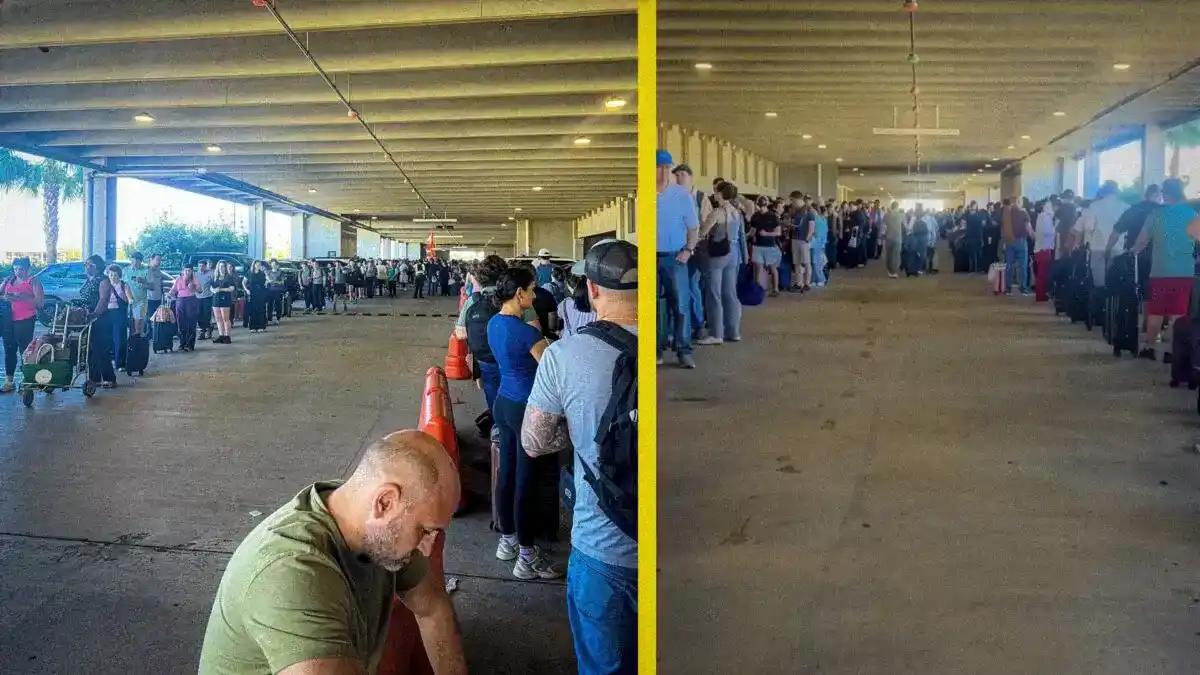
For the United States, which has almost no high-speed rail network and relies heavily on air travel, disruptions to the civil aviation system are crippling. Even Elon Musk publicly offered to pay the salaries of affected TSA employees out of his own pocket.

Also starting in March, the prediction market Polymarket launched a weekly updated prediction event for "number of U.S. flight delays this week"—traders can bet on how many flights will be delayed each week; predicting correctly earns money, while predicting wrong results in a total loss.
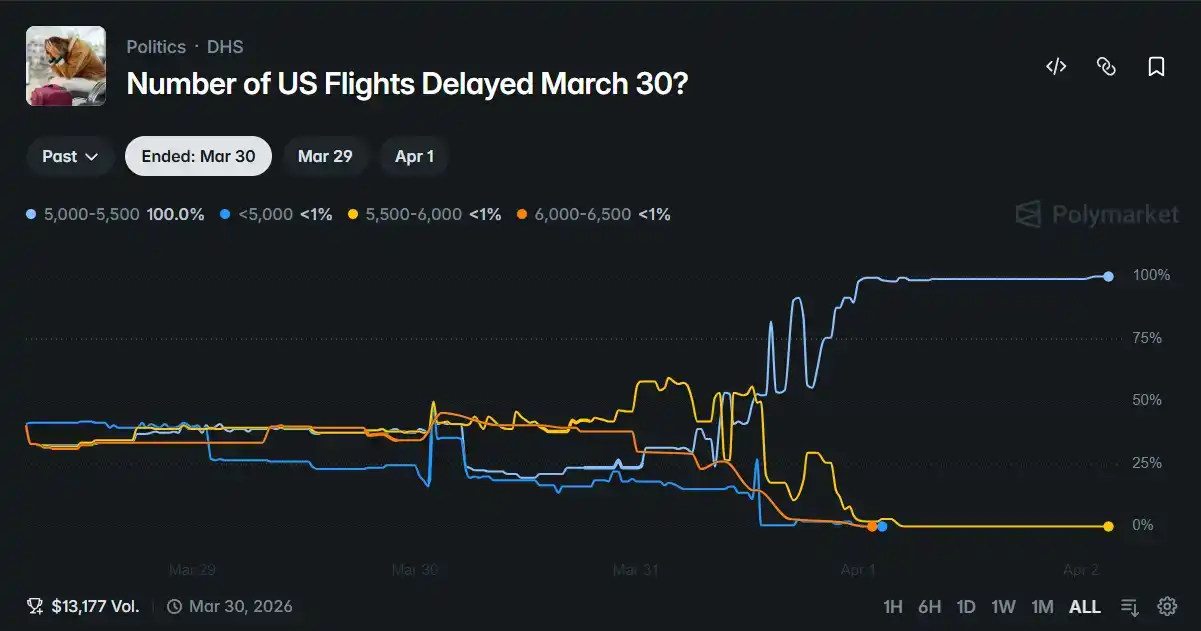
Beyond such purely entertainment-focused events, Polymarket has also listed several topics with considerable reference value. Through the probabilities reflected by these topics, we can attempt to interpret the true current state of the government shutdown and even U.S. domestic affairs.

The Shutdown Game Between the Two Parties

The duration of this shutdown has already broken the previous record of 35 days set by Trump. Amid the widespread flight delays and the near-collapse of the security screening system, when the shutdown will end is the most pressing question for those affected within the United States.

Polymarket currently has a related event: "DHS shutdown will end by ___." As of the time of writing, the probability of the shutdown ending between April 5 and 8 is 44%, while the probability that it will not end in April is 14%.
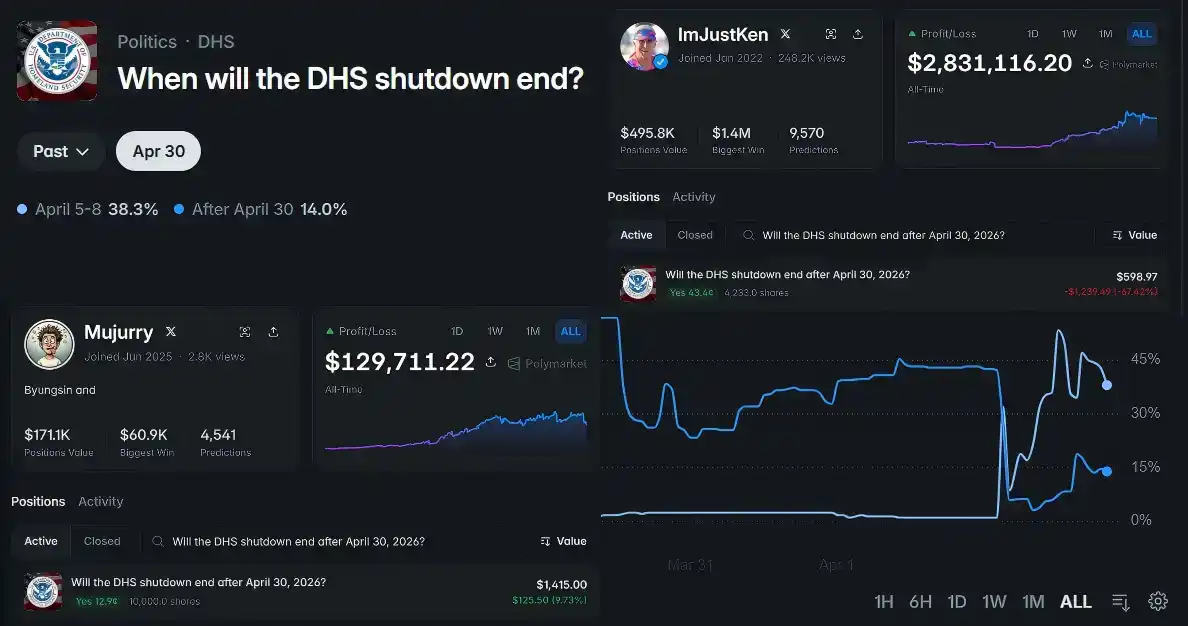
Betting on these two time nodes are many "smart money" traders—seasoned participants with high past prediction accuracy and strong profitability in the political sector. Behind such trading profiles lies a clear logic: if the shutdown does not end during the window of April 5 to 8, the likelihood of reaching an agreement within the month will significantly decrease.

April 5 to 8 coincides with Congress returning from recess, when both parties will once again place the funding bill on the table. If an agreement can be reached within a few days after returning, and the bill passes both the House and Senate before being signed, the shutdown will end.

However, if this window is missed again, the House and Senate will subsequently become engrossed in other agenda items. Without strong political pressure, the motivation for the two parties to return to the negotiating table will greatly diminish.

Musk's "Offer to Pay" and ICE's "Filling In"

Due to continuous TSA employee resignations causing severe delays at major airports, Elon Musk stated on March 21 that he was willing to pay TSA personnel's salaries, which led to the Polymarket trading event "Will Musk pay TSA employees' salaries?".
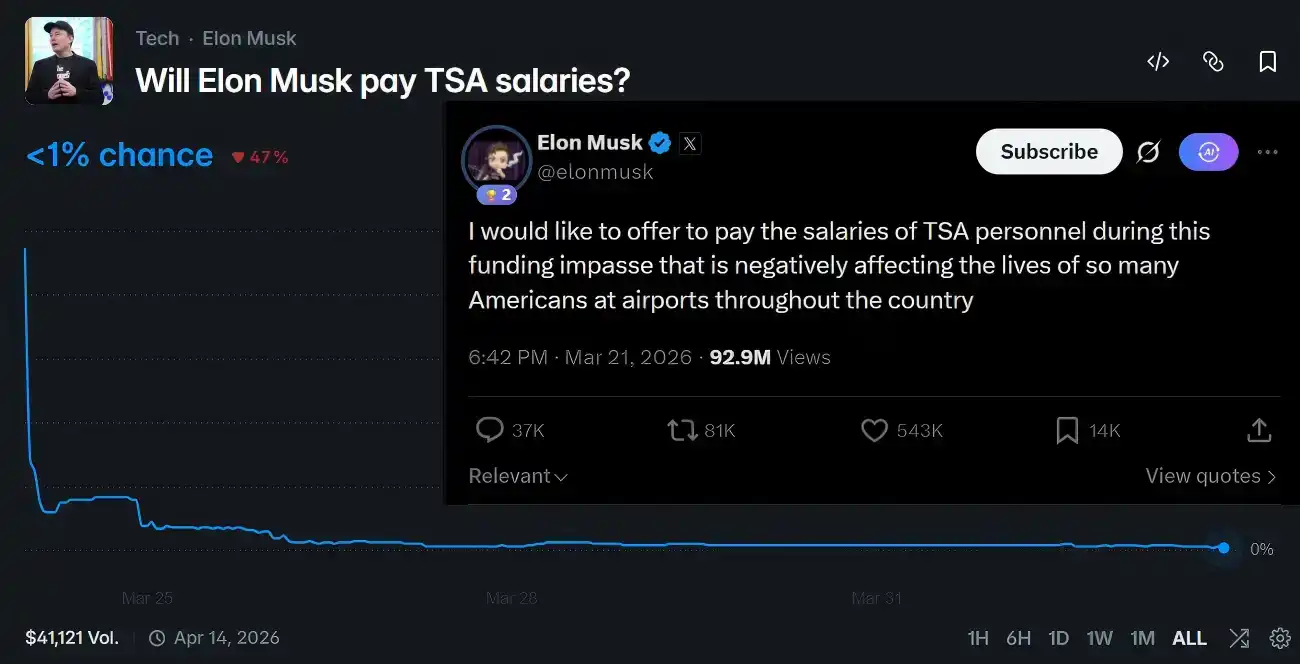
However, shortly after Musk's post, the White House declined the offer citing legal compliance and conflict of interest concerns: according to U.S. federal law, government employees cannot accept external compensation related to their official duties;加之 Musk's deep involvement in federal government contracts, direct payment of salaries faces serious conflict of interest challenges.

Although the refusal was legally justified, ordinary people still need to make a living. To minimize the impact of the aviation system's paralysis on the midterm elections, Trump ordered the deployment of Immigration and Customs Enforcement (ICE) agents to airports in March to replace TSA employees who had left due to unpaid salaries.

But the scene that unfolded once these ICE agents entered the airports made the entire shutdown event seem even more absurd.

After Trump took office, ICE, to meet the goal of "arresting 3,000 people daily and deporting a million people annually," has been drastically compressing recruitment and training processes—planning to hire ten thousand additional law enforcement officers and shortening the originally scheduled 16 weeks of in-person training to 8 weeks.

In short, the professional competence of these ICE agents themselves is already questionable.

TSA security work requires systematic training, covering core skills such as X-ray machine operation and explosive detection, for which ICE agents simply lack the qualifications.

Thus, a historic scene unfolded: TSA employees, while working unpaid, had to demonstrate security procedures to ICE agents and teach them how to maintain order. Most ICE agents did not actually conduct security checks but instead patrolled the terminals, using their law enforcement status to question and deport suspected illegal immigrants.

Data confirms the outcome of this farce: after ICE's deployment to airports, flight delay conditions did not significantly improve. By the end of March, the U.S. aviation system still experienced thousands of daily flight delays, with Atlanta Airport's TSA absenteeism rate nearing 40% and single-day flight delays exceeding 350. These numbers indicate that these ICE agents, who were supposed to act as a buffer for the shutdown, did not serve any expected purpose.

The "Nuclear Option" to Break the Deadlock

Another trading event related to this government shutdown is "Will Republicans use the 'nuclear option' to break the filibuster before December 31, 2026?", with a current probability of 31%.
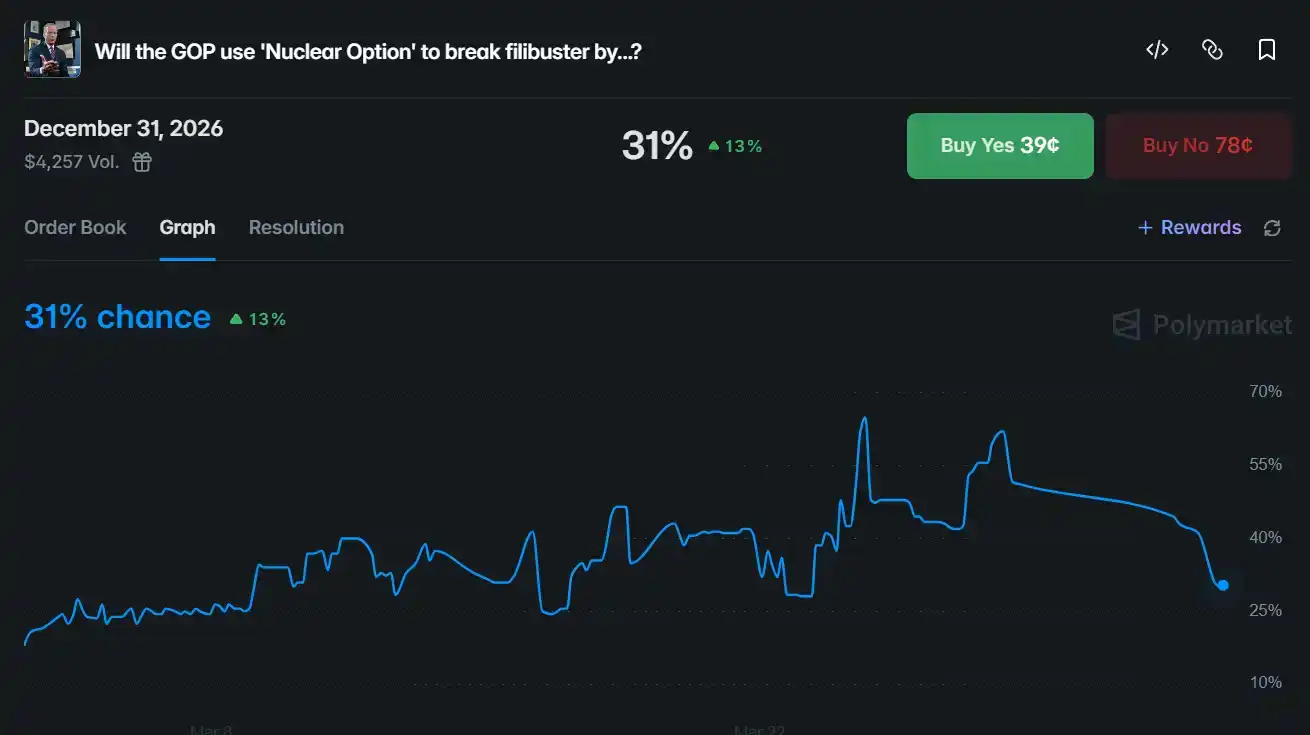
At first glance, the term "nuclear option" sounds intimidating; but in U.S. politics, it is not a literal nuclear weapon but rather one of the few yet highly destructive procedural trump cards available to Republicans.

In the U.S. legislative system, the House of Representatives is responsible for proposing and drafting appropriations bills, while the Senate is responsible for deliberation and voting. Typically, ending debate and proceeding to a vote in the Senate requires 60 votes—this means the minority party needs only 41 votes to block any bill by indefinitely prolonging debate through a filibuster.

The "nuclear option" provides a path to bypass this threshold: a senator raises a procedural appeal, and a simple majority (51 votes) overrules the presiding officer's decision, thereby forcibly lowering the vote threshold required to end debate from 60 votes.

Currently, Senate Republicans hold 53 seats; once the nuclear option is triggered, the Democrats' ability to obstruct will be nearly zero.

But the reason the "nuclear option" is called "nuclear" lies in the high cost it imposes on the user:破坏 Senate rules会被选民视为滥用权力; more crucially,一旦共和党未来失去多数席位, the same rules could be used by Democrats for retaliation.

The pit dug today might be filled by oneself tomorrow. The 31% probability is the market's true pricing of this dilemma.

Even as this shutdown deadlock remains unresolved, Trump must simultaneously deal with the escalating situation with Iran.

On one side is the high-pressure game of diplomacy and military action, on the other are airport lines, unpaid wages, and partisan bickering—the troubles this U.S. administration needs to manage simultaneously are far greater than what headlines suggest. Crises in domestic and foreign affairs never wait for the other to be resolved first.

Amid such turmoil, the rich array of political and current events prediction events on prediction markets will continue to serve as an objective mirror, helping us capture the true trajectory of these narratives.


Пов'язані питання

QWhat is the main reason for the ongoing DHS shutdown mentioned in the article?

AThe shutdown is due to a stalemate between Democrats and Republicans over the Department of Homeland Security (DHS) funding bill.

QHow has the DHS shutdown affected airport operations in the United States?

AThe shutdown has caused significant disruptions, with over 10,000 DHS employees unpaid, nearly 11% of TSA staff absent, and passengers facing extremely long security lines, such as in New Orleans where queues extended to the parking lot.

QWhat was Elon Musk's proposed solution to the TSA payment issue, and why was it rejected?

AElon Musk offered to pay TSA employees' salaries, but the White House declined due to legal compliance issues and potential conflicts of interest, as federal law prohibits government workers from accepting external payments related to their duties.

QWhat is the 'nuclear option' in the context of U.S. Senate procedures, and what is its current probability of being used according to Polymarket?

AThe 'nuclear option' is a procedural tactic to bypass the 60-vote threshold for ending debate in the Senate, allowing legislation to pass with a simple majority. Polymarket estimates a 31% probability that Republicans will use it by December 31, 2026.

QHow effective was the deployment of ICE agents to replace TSA workers during the shutdown?

AThe deployment was largely ineffective. ICE agents lacked proper training for TSA duties, such as operating X-ray machines, and instead focused on patrolling and immigration enforcement. Flight delays remained high, with no significant improvement in airport operations.

Пов'язані матеріали

$30 Billion DeFi Capital Exodus: LayerZero Stumbles, Chainlink Feasts

Following the major DeFi security incident involving Kelp DAO, a significant migration of funds is underway from the cross-chain protocol LayerZero to Chainlink's CCIP (Cross-Chain Interoperability Protocol). Over $30 billion in Total Value Locked (TVL) from protocols like Kelp DAO, Solv Protocol, Re, and Tydro has moved to Chainlink in the past week, driven by security concerns. LayerZero is facing a severe trust crisis after the attack. Initially denying responsibility, LayerZero Labs has now issued a public apology, acknowledging management oversights. These include a vulnerable "1/1" single-node configuration for its Decentralized Verification Network (DVN) and past misuse of a multi-signature wallet by a team member. The protocol's weekly bridge volume has slumped to near-historic lows of around $470 million. In contrast, Chainlink is experiencing a surge in adoption and activity. Its independent active addresses recently hit multi-month highs, and whales have been accumulating LINK tokens. Beyond DeFi, Chainlink is securing partnerships with traditional finance giants like DTCC, European stock exchange operator SIX Group, and asset manager Amundi. While LayerZero has announced security upgrades—such as migrating to stronger multi-signature configurations and developing a second DVN client—and contributed to a rescue fund, the event underscores that security is becoming a decisive competitive factor as DeFi matures.

marsbit4 хв тому

$30 Billion DeFi Capital Exodus: LayerZero Stumbles, Chainlink Feasts

marsbit4 хв тому

The $13 Trillion Repo Market Is Quietly Being Rewritten by Blockchain

The $13 trillion repurchase agreement (repo) market, a crucial artery for global short-term funding, is experiencing a significant transformation through blockchain technology. After years of limited impact in finance, blockchain is finding substantial adoption in repo transactions. Major institutions like JPMorgan Chase, HSBC, and Broadridge are deploying tokenized repo platforms, with daily volumes already reaching tens of billions of dollars. Traditional repo markets operate with fixed hours, rely on intermediaries, and involve manual, time-consuming processes. Tokenized repos, by contrast, use blockchain to create digital tokens representing cash and securities collateral. This enables near-instantaneous settlement, 24/7 trading, automated execution, and enhanced auditability. The key drivers for adoption include maturing technology, more receptive regulators, and growing client recognition of tangible benefits like reduced operational friction and capital efficiency. Analyses, such as one from Broadridge, indicate that moving a portion of repo activity onto blockchain can significantly reduce a bank's required liquidity buffers, potentially freeing up billions in capital. The infrastructure is also seen as foundational for a future of round-the-clock trading for traditional assets. Challenges remain, including the existence of fragmented blockchain networks, the need for stress testing under extreme market conditions, and the loss of operational flexibility compared to manual processes. However, the industry consensus is that these are implementation hurdles. Tokenized repo has moved beyond pilot stages to become one of blockchain's most concrete and impactful applications in traditional finance, marking a pivotal shift in how a core market functions.

marsbit4 хв тому

The $13 Trillion Repo Market Is Quietly Being Rewritten by Blockchain

marsbit4 хв тому

From Gas Limit to 'Keyed Nonces', How to Understand the Next Step in Ethereum Scalability?

Ethereum’s scalability efforts are shifting toward a user-centric approach—focusing not only on higher TPS, but on translating technical upgrades into lower costs, smoother operations, and better wallet experiences. Two recent developments highlight this direction: - **Raising the Gas Limit to 200 million**: Following the Fusaka upgrade that increased it to 60 million, a consensus has formed around a potential future increase to 200 million. This would boost Ethereum’s execution capacity, but it is planned alongside other upgrades—such as ePBS, Block-Level Access Lists (BAL), and EIP-8037—to manage state growth and keep node operation viable for average participants. - **Keyed Nonces (EIP-8250)**: This proposal aims to improve how transactions are queued. Instead of a single linear nonce per account, it introduces multiple independent nonce domains. This prevents different types of transactions—such as private payments, session keys, or batch operations—from blocking each other. Vitalik Buterin views this as a foundational step toward better privacy support and more flexible state scalability. Together, these upgrades are part of a broader move to push complexity from wallets, DApps, and relays back into the protocol layer. For everyday users, this means future Ethereum interactions could become less congested, more intuitive, and safer—especially as core improvements in account abstraction, cross-L2 interoperability, and node decentralization continue to progress. Ultimately, Ethereum is evolving to handle not just more transactions, but more varied and complex on-chain use cases while preserving its decentralized foundation.

marsbit27 хв тому

From Gas Limit to 'Keyed Nonces', How to Understand the Next Step in Ethereum Scalability?

marsbit27 хв тому

Leaving OpenAI, How Much Has Their Net Worth Increased?

Former OpenAI employees have collectively accrued near-trillion dollar valuations through ventures and investments, charting AI's future. The article highlights two main paths: founding high-value companies like Anthropic and Perplexity, or applying insider insights as investors. Leopold Aschenbrenner exemplifies the investor path. After being fired from OpenAI, he leveraged firsthand knowledge of AI's massive energy demands to make hugely successful public market bets on nuclear and fuel cell companies, practicing "cross-industry cognitive arbitrage." Other alumni, like the Zero Shot VC fund founders, use their technical foresight for early-stage investing. Their key advantage lies not just in picking winners, but in knowing which technical approaches are likely dead ends—a "veto list" derived from internal OpenAI experience. Angel investing within the network, as seen with Mira Murati and Sam Altman, operates on deep, pre-existing understanding of a founder's capabilities, reducing due diligence to near zero. This creates an ecosystem bound by a shared belief in AGI's imminent arrival, differing from networks like the "PayPal Mafia" which were built on shared past struggles. The shift of these builders to investors signals a profound conviction: their situational awareness of the AI landscape is now so clear that deploying capital based on that judgment is more efficient than building themselves. They are allocating bets on the future they helped shape from the inside.

marsbit38 хв тому

Leaving OpenAI, How Much Has Their Net Worth Increased?

marsbit38 хв тому

Торгівля

Спот
Ф'ючерси
活动图片