Warmonger Trump Has Forgotten the Americans Waiting in Airport Lines for Hours

marsbitОпубліковано о 2026-04-03Востаннє оновлено о 2026-04-03

Анотація

A government shutdown at the Department of Homeland Security (DHS), which began on February 14, 2025, continues to cause severe disruptions across the United States. Over 100,000 DHS employees are unpaid, and nearly 11% of TSA workers are absent, leading to massive airport delays—some lines stretching into parking lots. Elon Musk offered to pay TSA salaries but was declined by the White House due to legal and conflict-of-interest concerns. In response, President Trump deployed Immigration and Customs Enforcement (ICE) agents to assist at airports. However, these agents lacked proper TSA skills, instead focusing on immigration enforcement, and delays persisted. Prediction markets like Polymarket indicate a 44% chance the shutdown ends between April 5–8, after Congress reconvenes. If missed, the stalemate may prolong. Another market suggests a 31% probability Republicans use the "nuclear option"—a procedural maneuver to bypass the 60-vote Senate threshold—to pass funding, though it carries political risks. Amid ongoing Iran tensions, the shutdown highlights domestic dysfunction, with essential services strained and political resolution uncertain.

Recently, international news has been dominated by the Iran situation and Trump's erratic stance on the war's direction.

Yet one event, which dominated headlines in 2025, is now rarely mentioned by mainstream media—on February 14, due to a deadlock between Democrats and Republicans over the Department of Homeland Security (DHS) funding bill, a partial shutdown of the DHS officially began.

As of now, the shutdown has not ended.

During this nearly two-month shutdown, over 100,000 DHS employees have been unable to receive their salaries, and nearly 11% of Transportation Security Administration (TSA) employees have been absent. In New Orleans, passengers waiting for security checks have formed lines winding from inside the terminal to the outdoors, even looping seven times in the parking lot before reaching the entrance.
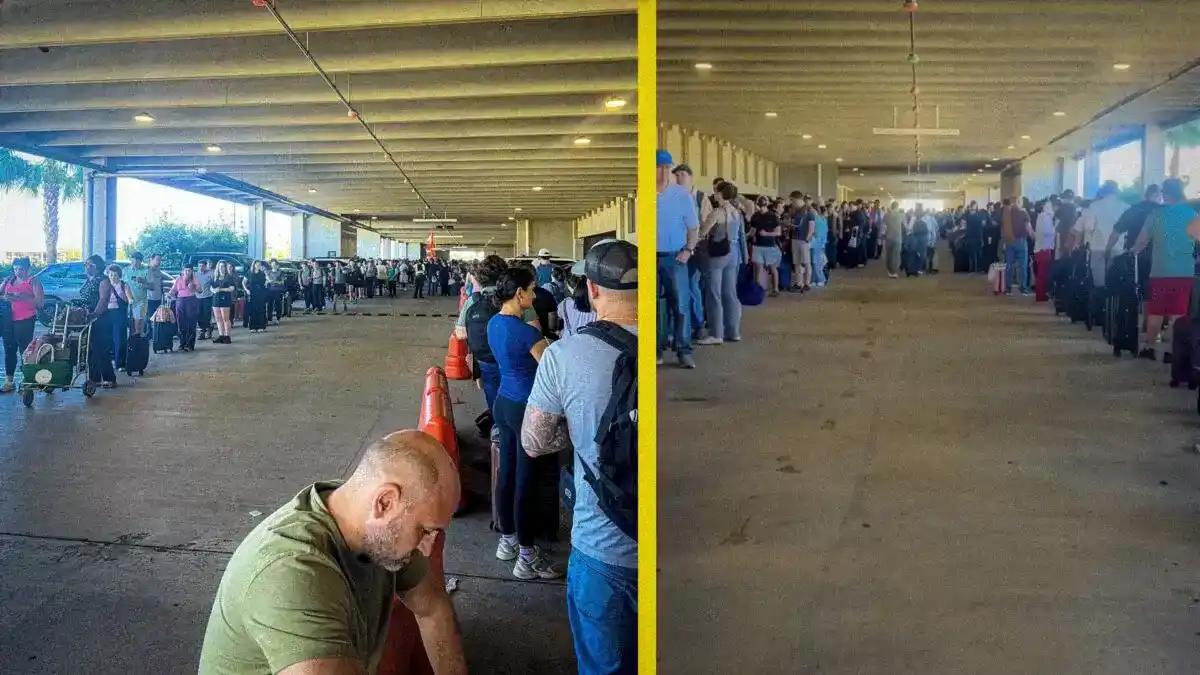
For the United States, which has almost no high-speed rail network and relies heavily on air travel, disruptions to the civil aviation system are crippling. Even Elon Musk publicly offered to pay the salaries of affected TSA employees out of his own pocket.

Also starting in March, the prediction market Polymarket launched a weekly updated prediction event for "number of U.S. flight delays this week"—traders can bet on how many flights will be delayed each week; predicting correctly earns money, while predicting wrong results in a total loss.
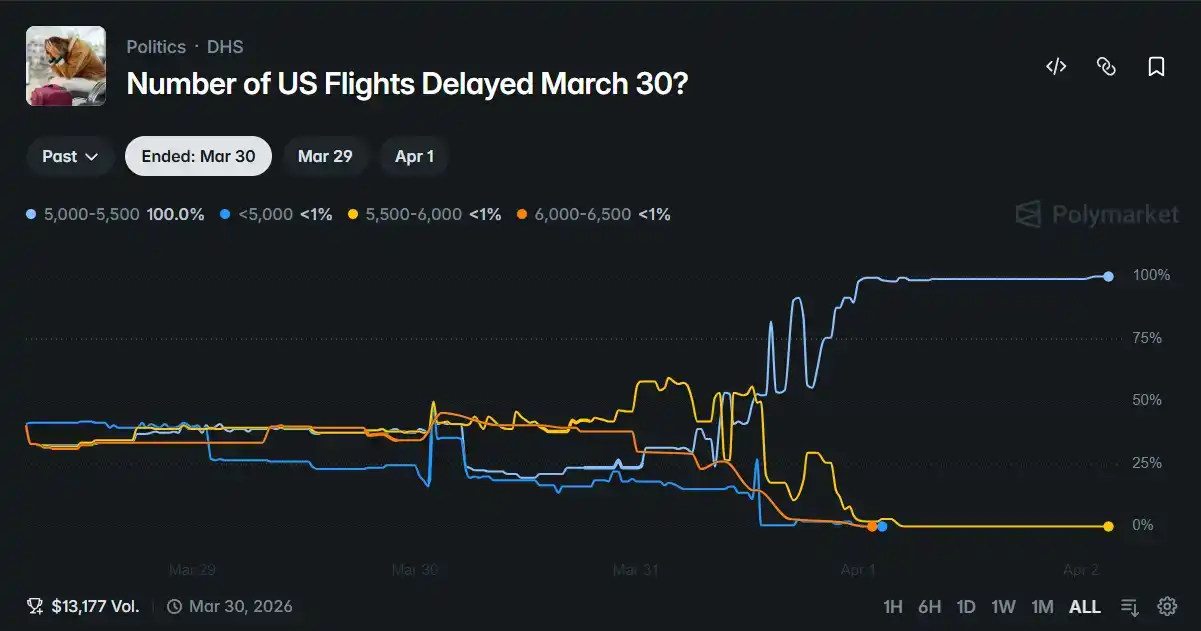
Beyond such purely entertainment-focused events, Polymarket has also listed several topics with considerable reference value. Through the probabilities reflected by these topics, we can attempt to interpret the true current state of the government shutdown and even U.S. domestic affairs.

The Shutdown Game Between the Two Parties

The duration of this shutdown has already broken the previous record of 35 days set by Trump. Amid the widespread flight delays and the near-collapse of the security screening system, when the shutdown will end is the most pressing question for those affected within the United States.

Polymarket currently has a related event: "DHS shutdown will end by ___." As of the time of writing, the probability of the shutdown ending between April 5 and 8 is 44%, while the probability that it will not end in April is 14%.
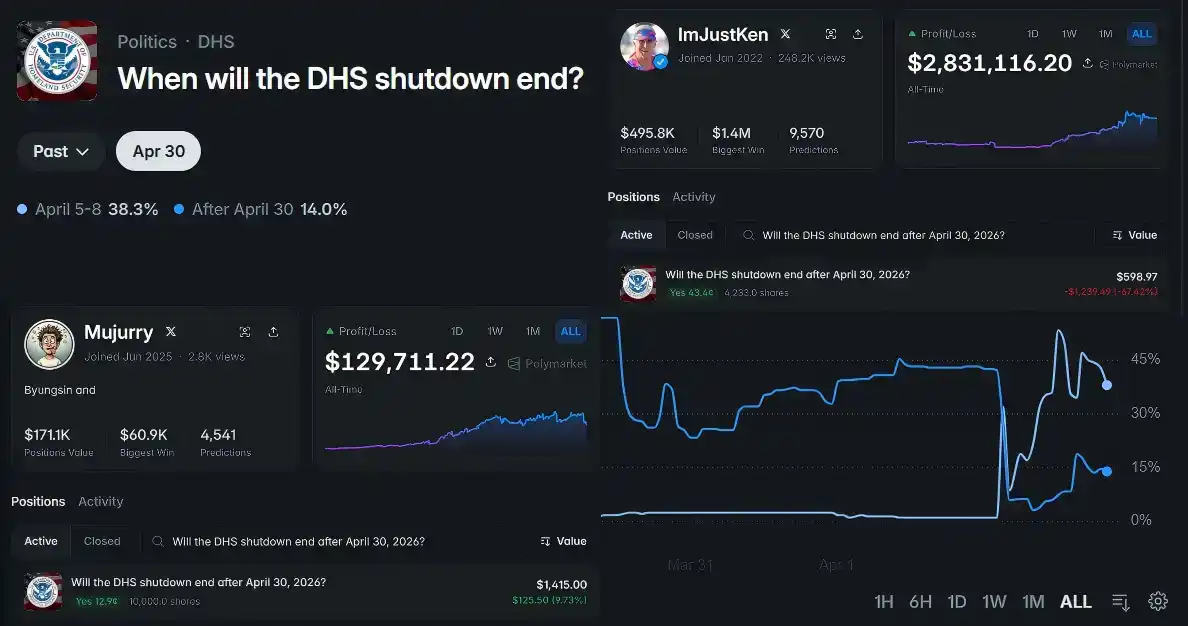
Betting on these two time nodes are many "smart money" traders—seasoned participants with high past prediction accuracy and strong profitability in the political sector. Behind such trading profiles lies a clear logic: if the shutdown does not end during the window of April 5 to 8, the likelihood of reaching an agreement within the month will significantly decrease.

April 5 to 8 coincides with Congress returning from recess, when both parties will once again place the funding bill on the table. If an agreement can be reached within a few days after returning, and the bill passes both the House and Senate before being signed, the shutdown will end.

However, if this window is missed again, the House and Senate will subsequently become engrossed in other agenda items. Without strong political pressure, the motivation for the two parties to return to the negotiating table will greatly diminish.

Musk's "Offer to Pay" and ICE's "Filling In"

Due to continuous TSA employee resignations causing severe delays at major airports, Elon Musk stated on March 21 that he was willing to pay TSA personnel's salaries, which led to the Polymarket trading event "Will Musk pay TSA employees' salaries?".
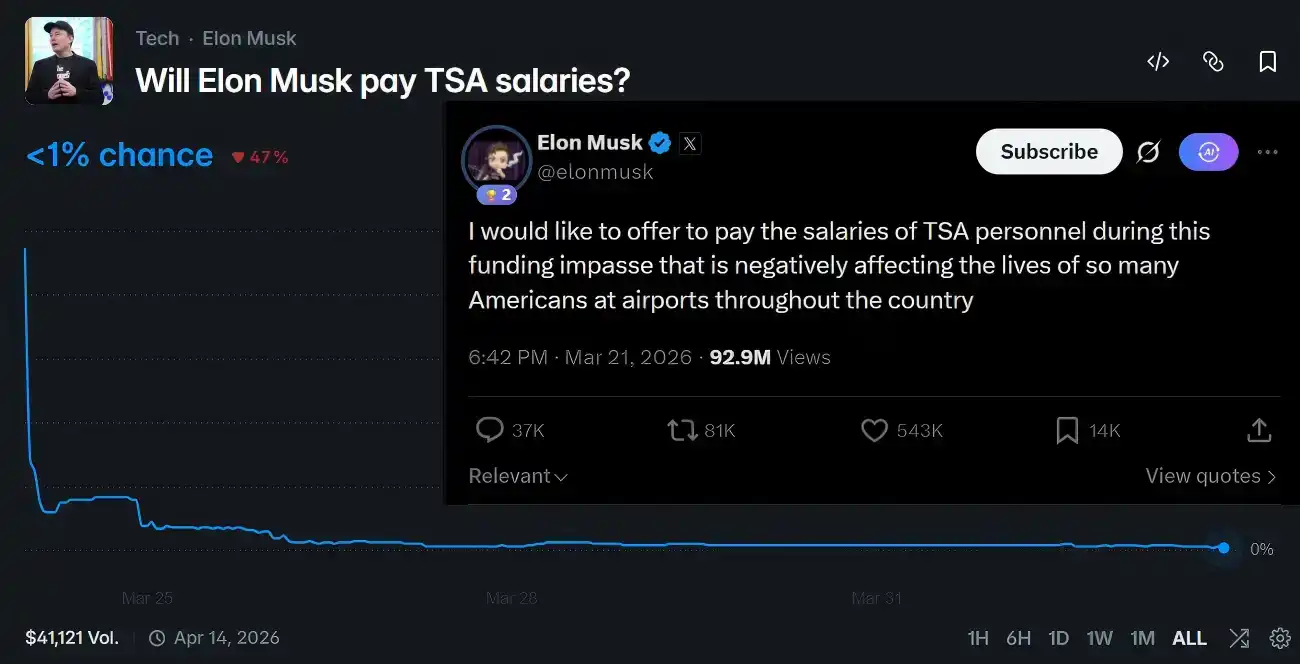
However, shortly after Musk's post, the White House declined the offer citing legal compliance and conflict of interest concerns: according to U.S. federal law, government employees cannot accept external compensation related to their official duties;加之 Musk's deep involvement in federal government contracts, direct payment of salaries faces serious conflict of interest challenges.

Although the refusal was legally justified, ordinary people still need to make a living. To minimize the impact of the aviation system's paralysis on the midterm elections, Trump ordered the deployment of Immigration and Customs Enforcement (ICE) agents to airports in March to replace TSA employees who had left due to unpaid salaries.

But the scene that unfolded once these ICE agents entered the airports made the entire shutdown event seem even more absurd.

After Trump took office, ICE, to meet the goal of "arresting 3,000 people daily and deporting a million people annually," has been drastically compressing recruitment and training processes—planning to hire ten thousand additional law enforcement officers and shortening the originally scheduled 16 weeks of in-person training to 8 weeks.

In short, the professional competence of these ICE agents themselves is already questionable.

TSA security work requires systematic training, covering core skills such as X-ray machine operation and explosive detection, for which ICE agents simply lack the qualifications.

Thus, a historic scene unfolded: TSA employees, while working unpaid, had to demonstrate security procedures to ICE agents and teach them how to maintain order. Most ICE agents did not actually conduct security checks but instead patrolled the terminals, using their law enforcement status to question and deport suspected illegal immigrants.

Data confirms the outcome of this farce: after ICE's deployment to airports, flight delay conditions did not significantly improve. By the end of March, the U.S. aviation system still experienced thousands of daily flight delays, with Atlanta Airport's TSA absenteeism rate nearing 40% and single-day flight delays exceeding 350. These numbers indicate that these ICE agents, who were supposed to act as a buffer for the shutdown, did not serve any expected purpose.

The "Nuclear Option" to Break the Deadlock

Another trading event related to this government shutdown is "Will Republicans use the 'nuclear option' to break the filibuster before December 31, 2026?", with a current probability of 31%.
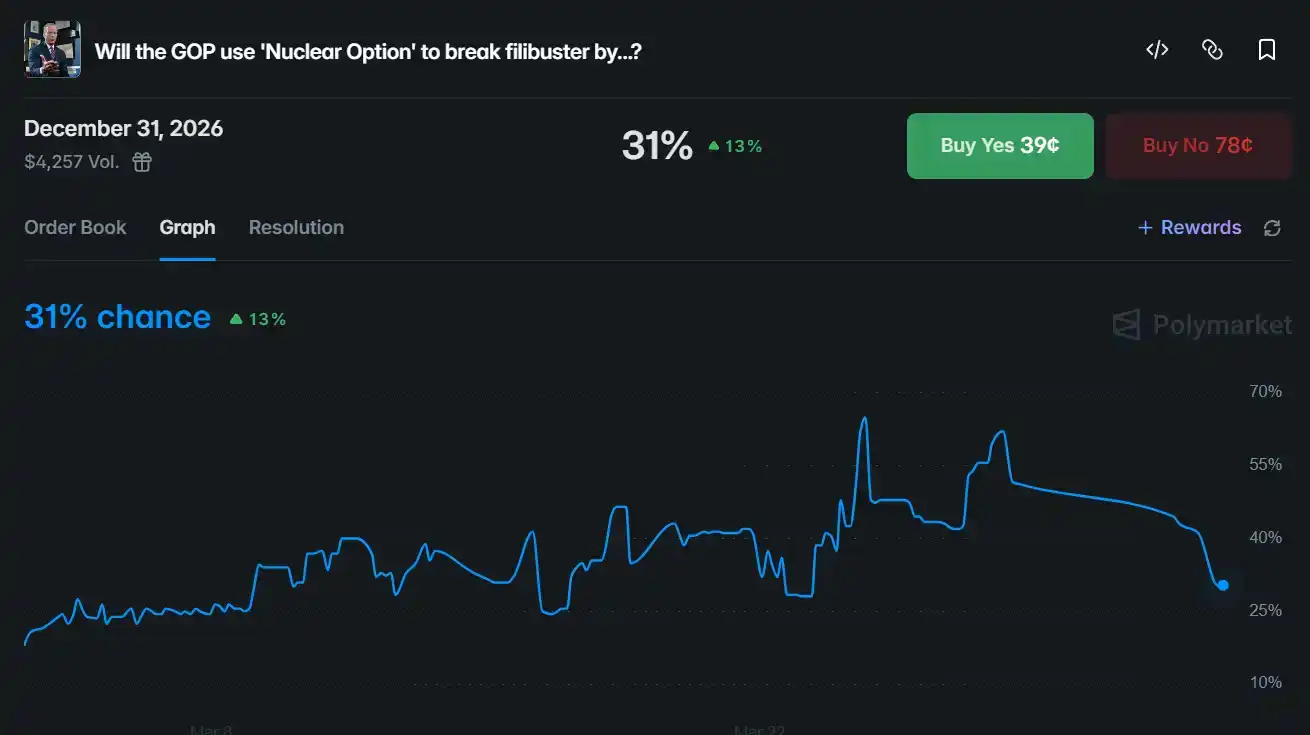
At first glance, the term "nuclear option" sounds intimidating; but in U.S. politics, it is not a literal nuclear weapon but rather one of the few yet highly destructive procedural trump cards available to Republicans.

In the U.S. legislative system, the House of Representatives is responsible for proposing and drafting appropriations bills, while the Senate is responsible for deliberation and voting. Typically, ending debate and proceeding to a vote in the Senate requires 60 votes—this means the minority party needs only 41 votes to block any bill by indefinitely prolonging debate through a filibuster.

The "nuclear option" provides a path to bypass this threshold: a senator raises a procedural appeal, and a simple majority (51 votes) overrules the presiding officer's decision, thereby forcibly lowering the vote threshold required to end debate from 60 votes.

Currently, Senate Republicans hold 53 seats; once the nuclear option is triggered, the Democrats' ability to obstruct will be nearly zero.

But the reason the "nuclear option" is called "nuclear" lies in the high cost it imposes on the user:破坏 Senate rules会被选民视为滥用权力; more crucially,一旦共和党未来失去多数席位, the same rules could be used by Democrats for retaliation.

The pit dug today might be filled by oneself tomorrow. The 31% probability is the market's true pricing of this dilemma.

Even as this shutdown deadlock remains unresolved, Trump must simultaneously deal with the escalating situation with Iran.

On one side is the high-pressure game of diplomacy and military action, on the other are airport lines, unpaid wages, and partisan bickering—the troubles this U.S. administration needs to manage simultaneously are far greater than what headlines suggest. Crises in domestic and foreign affairs never wait for the other to be resolved first.

Amid such turmoil, the rich array of political and current events prediction events on prediction markets will continue to serve as an objective mirror, helping us capture the true trajectory of these narratives.


Пов'язані питання

QWhat is the main reason for the ongoing DHS shutdown mentioned in the article?

AThe shutdown is due to a stalemate between Democrats and Republicans over the Department of Homeland Security (DHS) funding bill.

QHow has the DHS shutdown affected airport operations in the United States?

AThe shutdown has caused significant disruptions, with over 10,000 DHS employees unpaid, nearly 11% of TSA staff absent, and passengers facing extremely long security lines, such as in New Orleans where queues extended to the parking lot.

QWhat was Elon Musk's proposed solution to the TSA payment issue, and why was it rejected?

AElon Musk offered to pay TSA employees' salaries, but the White House declined due to legal compliance issues and potential conflicts of interest, as federal law prohibits government workers from accepting external payments related to their duties.

QWhat is the 'nuclear option' in the context of U.S. Senate procedures, and what is its current probability of being used according to Polymarket?

AThe 'nuclear option' is a procedural tactic to bypass the 60-vote threshold for ending debate in the Senate, allowing legislation to pass with a simple majority. Polymarket estimates a 31% probability that Republicans will use it by December 31, 2026.

QHow effective was the deployment of ICE agents to replace TSA workers during the shutdown?

AThe deployment was largely ineffective. ICE agents lacked proper training for TSA duties, such as operating X-ray machines, and instead focused on patrolling and immigration enforcement. Flight delays remained high, with no significant improvement in airport operations.

Пов'язані матеріали

Will the Next Crypto Bull Run Start with On-Chain Trading of SpaceX?

This article presents a scenario-based forecast for the crypto industry from 2026 to 2029, arguing that the next major cycle will be driven not by technological narratives but by legal access to real-world assets. The author predicts that by mid-2026, pre-IPO perpetual contracts for top private companies like SpaceX, OpenAI, and Anthropic on platforms like Hyperliquid will become the primary gateway for accessing quality assets, as most crypto-native tokens fail to capture real value. The much-hyped AI x Crypto intersection largely fails except for prediction markets, which thrive on betting on AI model supremacy. By 2027, public blockchain foundations are forced to choose between catering to retail speculation or building compliant infrastructure for institutions, with many opting for the latter. Growth in stablecoins and tokenized private credit/equity hits a "triple ceiling" due to regulatory and political uncertainty rather than market demand. The pivotal shift is forecast for 2028. A major liquidation event in pre-IPO perpetuals exposes the structural flaw of synthetic markets lacking a real underlying asset anchor. In response, regulatory changes finally allow the public solicitation of private securities resales to verified accredited investors. This creates a legitimate secondary market for real company equity, which then becomes the core asset class of the new bull market, relegating synthetic perps to a niche role. By 2029, the industry becomes "boring" but foundational. Tokens without claims on real cash flows or assets cease trading. Stablecoin growth is steady but politically capped. Crypto infrastructure fades from view as it gets absorbed into traditional finance backends. The article's central thesis is that the key bottleneck for crypto's next phase is legal and regulatory channels for real asset ownership, not technology.

marsbit1 год тому

Will the Next Crypto Bull Run Start with On-Chain Trading of SpaceX?

marsbit1 год тому

The Value Distribution of Stablecoins

**Summary: The Value Distribution of Stablecoins** The article argues that stablecoins are evolving from mere trading tools into broader channels for dollar access. It divides the stablecoin ecosystem into four layers to analyze how value is distributed: 1. **Issuance Layer:** Mints stablecoins, holds reserve assets, and captures the spread between reserve yield and user costs (e.g., Tether, Circle). This layer currently earns the largest profit margin. 2. **Infrastructure Layer:** Connects stablecoins to the traditional financial system, handling fiat on/off-ramps, banking integration, compliance (KYC/AML), and asset management (e.g., Bridge, BVNK). This is the "unglamorous" but critical work, building the essential bridges between crypto and real-world finance. 3. **Acquiring/Distribution Layer:** Integrates stablecoins into merchant systems, manages payment flows, and provides enterprise financial software (e.g., Stripe, Coinbase). They act as the access point for businesses. 4. **Application Layer:** The end-users and businesses that ultimately use stablecoins for payments, settlements, or as a store of value. They benefit from convenience but have little pricing power. The core thesis is that while the issuance layer currently dominates profits, the often-overlooked **infrastructure layer holds significant long-term potential**. The real challenge and barrier to mass adoption is not the on-chain transfer of stablecoins (which is simple), but the complex "last mile" integration into existing business workflows, banking systems, and regulatory frameworks across different countries. Companies in this layer are currently in a "land grab" phase, investing heavily to build networks, secure bank partnerships, and establish compliance pathways. While their position is currently pressured by the profitable issuers above and distribution platforms below, the article suggests that if stablecoins become a default financial rail for businesses, the infrastructure providers who have done the hard work of integration will ultimately gain strong pricing power and become entrenched, essential players.

marsbit8 год тому

The Value Distribution of Stablecoins

marsbit8 год тому

The Value Distribution of Stablecoins

The Value Distribution of Stablecoins The article argues that stablecoins are evolving from a mere trading tool into a broad "dollar channel." It analyzes the industry's value chain through four layers: 1. **Issuance Layer (e.g., Tether, Circle):** The top layer that mints stablecoins, holds reserve assets, and captures the thickest interest rate spread. 2. **Infrastructure Layer (e.g., Bridge, BVNK):** Connects stablecoins to the traditional financial system, handling critical but complex "dirty work" like fiat on/off-ramps, banking integration, compliance (KYC/AML), and cross-border settlement. 3. **Acquiring/Distribution Layer (e.g., Stripe, Coinbase):** Embeds stablecoins into merchant systems, manages payment flows, and integrates with enterprise software. 4. **Application Layer:** End-users and businesses that ultimately use stablecoins for payments, settlement, or storing value. The author posits that while the issuance layer currently captures the most profit, the most overlooked and potentially critical layer is infrastructure. The core challenge for stablecoin adoption isn't the on-chain transfer (which is simple), but bridging the gap between blockchain and the real-world financial system. This involves solving practical problems for businesses: fiat conversion, reconciliation, tax handling, and user onboarding. Infrastructure companies are currently in a difficult "land-grab" phase—building networks, securing banking relationships, and achieving compliance country-by-country. They face pressure from both the profitable issuance layer above and distribution platforms below. However, the author suggests this layer is building a crucial moat. Once stablecoins become a default business rail, the infrastructure players who have done the hard work of integration may gain significant, durable value and pricing power.

链捕手8 год тому

The Value Distribution of Stablecoins

链捕手8 год тому

Торгівля

Спот
Ф'ючерси
活动图片




