Want to Follow SpaceX? Data Shows 30 Star U.S. IPO Stocks Mostly Halve in First Year

marsbitОпубліковано о 2026-06-11Востаннє оновлено о 2026-06-11

Анотація

"SpaceX is set for a historic IPO on June 12 under ticker SPCX, pricing at $135 per share to raise $75 billion at a valuation of about $1.75 trillion. However, data from Motley Fool on 30 high-profile tech IPOs since 2012 reveals a challenging pattern for new investors. Median returns were -9% after six and twelve months, with a median maximum drawdown of 54% in the first year. No company avoided a significant decline, including later successes like Meta and Palantir. Morningstar estimates SpaceX's fair value at only around $780 billion, less than half its IPO valuation. Despite SpaceX's dominant market share in U.S. rocket launches and a profitable Starlink subscriber base, its financials show a $4.9 billion net loss in 2025 and a trailing twelve-month revenue of $18.7 billion, resulting in a price-to-sales ratio exceeding 90. Analysts caution that while the IPO may see initial gains, historical trends suggest a high probability of substantial price declines and volatility in the following year."

Author: Curry, Chaoxiang Research

Synopsis: SpaceX is set to price after market close on June 11 and list on Nasdaq on the 12th under ticker SPCX, with an offering price of $135 per share, a valuation of approximately $1.75 trillion, raising $75 billion, making it the largest IPO in history.

However, historical data from 30 star tech IPOs compiled by Motley Fool shows: the median returns 6 months and 12 months post-listing were both -9%, with a median maximum drawdown of 54% in the first year, and none escaped unscathed. Morningstar's fair value estimate is only about $780 billion, less than half the offering valuation.
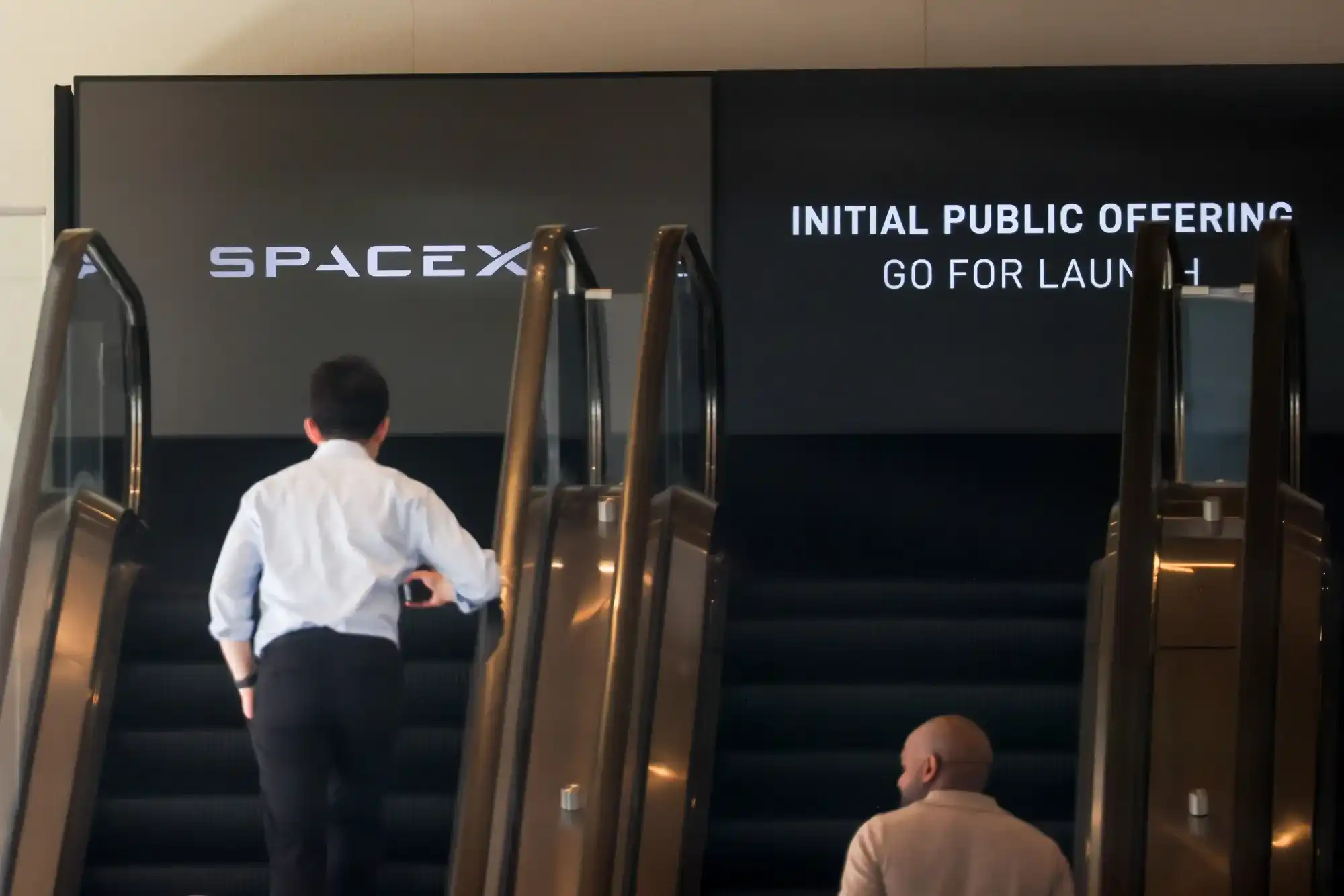
This Friday (June 12), SpaceX will list on Nasdaq under the ticker SPCX. According to a Reuters report on June 3, the offering price was set at $135 per share, issuing about 5.56 billion shares to raise $75 billion, corresponding to a valuation of about $1.75 trillion (some sources calculate it as $1.77 trillion based on post-offering shares). By either measure, this is the largest IPO in stock market history, with Goldman Sachs leading a syndicate of 21 underwriters. The final pricing will be determined after the U.S. market close on June 11.

The hype is undeniable. SpaceX stated in its S-1 filing that the company has "identified the largest executable total addressable market in human history," quantified at $28.5 trillion. The retail allocation was set at about 30% of the float, roughly three times the usual level for large IPOs.

The problem is, for ordinary investors rushing in on the first day, the answer provided by historical data is quite grim.

The Median Ledger: Small Gains in the First Three Months, Collective Losses After Six

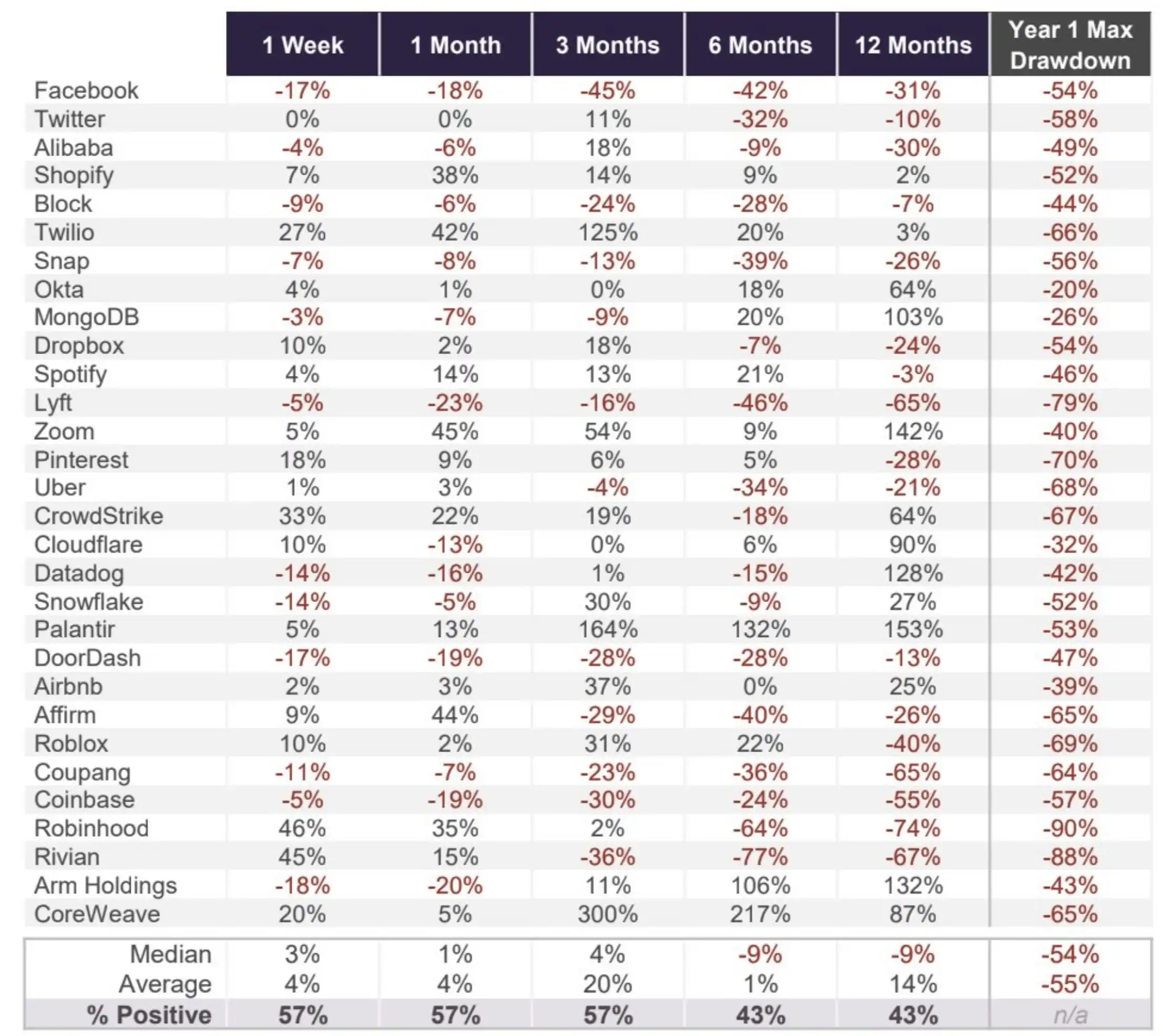
In an article published on June 9, Motley Fool analyst Ryan Vanzo analyzed the post-listing performance of 30 star technology companies since 2012, with a sample ranging from Facebook and Twitter to Coinbase, Robinhood, Rivian, Arm, and CoreWeave.

The shape of the median curve is telling: median returns were +3% after 1 week, +1% after 1 month, and +4% after 3 months—all passable up to this point. But extending to 6 months, the median becomes -9%; at 12 months, it remains -9%. The proportion of companies with positive returns also collapses in sync, dropping from 57% maintained in the first three months to 43% at both the 6-month and 12-month marks. In other words, holding for a full year results in losses for most momentum buyers.

Individual stock divergence is extreme. CoreWeave soared 300% three months after listing, Palantir gained 164% in three months, and Zoom rose 142% in twelve months. But negative cases are equally dense: Lyft fell 65% in twelve months, Robinhood dropped 74%, Rivian fell 67%, and Coupang declined 65%. There is no stable relationship between star power and post-IPO returns.
Median Maximum First-Year Drawdown 54%, Robinhood and Coinbase Both Halved

More striking than returns are the drawdown figures. The median maximum drawdown within the first year of listing for the 30 companies was 54%, with an average of 55%. Okta had the smallest drawdown at 20%, and none avoided it.
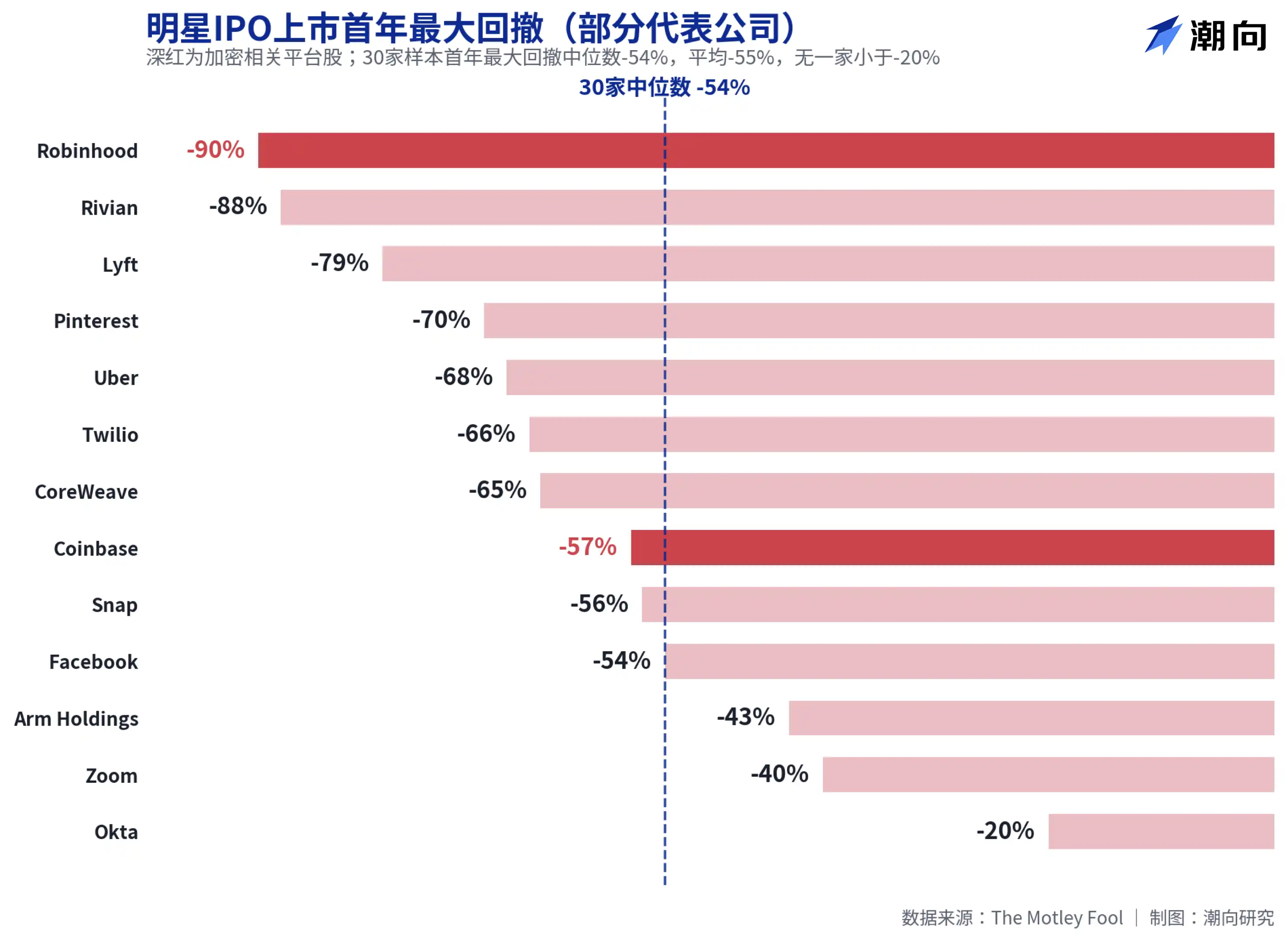
Two platforms familiar to crypto users are in the hardest-hit areas. Robinhood's maximum drawdown in its first year was 90%, the highest among the 30; Coinbase saw a 57% drawdown. Even companies later proven to be big winners were not exempt: CoreWeave had a 65% first-year drawdown, Palantir 53%, and Meta (then Facebook) 54%. This data points to a simple conclusion: even if you pick the right company, buying at the opening price will likely subject you to floating losses at the halving level first.

Academic research paints a similar picture. Jay Ritter, Director of the IPO Research Program at the University of Florida, tracked 1,479 IPOs from 2012 to 2021, finding an average first-day return as high as 23.6%, but the average total return over the subsequent three years was only 10.6%. The Wall Street Journal cited Ritter's data stating that investors who bought on the first day and held for three years underperformed a market-cap-weighted index by about 21%. The excitement of the first day largely borrowed future gains.

SpaceX's Ledger: $18.7 Billion in Revenue Supporting a $1.75 Trillion Valuation

Returning to SpaceX itself, the valuation debate is more concrete than historical patterns.

According to financial data cited by The Motley Fool, SpaceX's 2025 revenue was $18.7 billion, a 33% year-over-year increase, but it reported a net loss of $4.9 billion, reversing a profit of about $790 million in 2024. S-1 data compiled by BitMEX shows a single-quarter net loss of $4.28 billion in Q1 2026, with cumulative losses reaching $41.3 billion, of which the AI business (post-merger with xAI) burns about $2.5 billion per quarter. Calculated at a $1.75 trillion valuation, the price-to-sales ratio exceeds 90 times.

Morningstar's stance is the most direct. Analysts at the firm called SpaceX "severely overvalued," suggesting long-term investors will have opportunities to buy at better margins of safety after the IPO, and set the fair value estimate at approximately $780 billion, less than half the offering valuation. A reference point: SpaceX's over-the-counter tender offer in December 2025 corresponded to a valuation of about $800 billion. In just over half a year, the pricing more than doubled.

Bullish logic also exists. The rocket launch business holds over 80% of the U.S. market share, and Starlink has over 12 million paying subscribers and is profitable, forming the foundation of this valuation. Vanzo's own judgment is that SpaceX's stock will likely perform well on its first trading day, but given the valuation level and historical data, it wouldn't be surprising to see the stock struggle over the next 12 months.

For those preparing to place orders on Friday, this data from 30 companies is at least worth a glance: history doesn't guarantee repetition, but halving in the first year has been the norm for this game over the past fourteen years.

Пов'язані питання

QAccording to the article, what is the historical median performance of 30 high-profile tech IPOs after 12 months, based on Motley Fool's data?

AAccording to Motley Fool's data on 30 high-profile tech IPOs since 2012, the median return after 12 months is -9%.

QWhat is the median maximum drawdown in the first year for the 30 IPO companies studied, and which company had the worst drawdown?

AThe median maximum drawdown in the first year for the 30 companies is 54%. The company with the worst drawdown was Robinhood, with a 90% drawdown.

QWhat does the article state as Morningstar's fair value estimate for SpaceX, and how does it compare to the reported IPO valuation?

AMorningstar's fair value estimate for SpaceX is approximately $780 billion. This is less than half of the reported IPO valuation of about $1.75 trillion.

QBased on financial data cited in the article, what was SpaceX's revenue and net profit/loss for 2025?

AIn 2025, SpaceX's revenue was $18.7 billion, but it reported a net loss of $4.9 billion.

QWhat key reasons does the article mention for investors being bullish on SpaceX's valuation?

AThe article mentions that the bullish case for SpaceX's valuation is based on its rocket launch business holding over 80% of the U.S. market and its Starlink service having over 12 million profitable subscribers.

Пов'язані матеріали

2029 Finale Prediction: When Cryptocurrency Completely "Vanishes", Who Can Remain in This Financial Upheaval?

By 2029, the crypto industry will have transformed into a largely invisible but foundational layer for traditional finance. This timeline outlines the key shifts from now until then. By mid-2026, the most sought-after assets on-chain will not be traditional tokens, but synthetic perpetual contracts for private, high-growth companies (like SpaceX, OpenAI). These become primary price discovery tools, highlighting the market's craving for real-world asset value. Most altcoins enter a sustained bear market as their fundamental lack of asset-backed value is exposed. In late 2026, the "AI + Crypto" narrative largely fades as AI giants prove they don't need crypto infrastructure, except for prediction markets betting on model performance. Simultaneously, a quiet but significant wave of tokenization for institutional assets (money market funds, private credit) begins. The industry splits into a noisy speculative economy and a silent institutional one. Throughout 2027, major public blockchain foundations pivot decisively to serve institutional clients, building compliance toolkits and sales teams. However, key sectors hit growth ceilings: private perpetual contracts are legally restricted from public promotion, stable币 growth is capped by looming political uncertainty, and tokenization projects remain cautious. In 2028, following a U.S. election assumed to maintain a regulatory (not prohibitive) stance, a pivotal change occurs. After a major liquidation crisis exposes the flaws of synthetic contracts lacking a real-asset anchor, new regulations allow the *public solicitation* of private security sales (secondary market shares) to accredited investors. This creates a legitimate, direct on-ramp for retail capital into previously illiquid private equity. By 2029, the resulting bull market is driven by trading in real, innovative company shares (biotech, robotics, AI labs), not speculative tokens. "Crypto" as a distinct asset class recedes; it becomes the mundane, unseen plumbing for this new global private markets infrastructure. Tokens that survive are those capturing real cash flows from this infrastructure. Speculation persists but is marginalized. The core questions posed at the start are answered: token value is tied to legally enforceable claims on real assets, frontier tech adoption happens via private market channels, and crypto's absorption into traditional finance is marked by its becoming boring and invisible. The key validation for this entire thesis is whether, by late 2028, a legal pathway exists for ordinary accredited investors to access private assets directly.

marsbit31 хв тому

2029 Finale Prediction: When Cryptocurrency Completely "Vanishes", Who Can Remain in This Financial Upheaval?

marsbit31 хв тому

After the U.S. Banned Fable 5, Zhipu's Stock Soared 47%

On June 15, Chinese AI company Zhipu's stock surged up to 47.6% in Hong Kong, closing with a 32.82% gain. This sharp rise followed two key industry events. On June 12, Anthropic was compelled by a U.S. government export control order to suspend global access to its latest flagship models, Claude Fable 5 and Claude Mythos 5, impacting developers and businesses reliant on them. The next day, Zhipu announced it was opening access to its new open-source flagship model, GLM-5.2, for all Coding Plan users, with API and model weights (under the MIT license) to follow. The Anthropic incident highlighted a critical shift in the AI industry: beyond raw capability, the stability, continuous accessibility, and control over AI models are becoming equally vital, especially as AI integrates deeper into business workflows. Zhipu's move, emphasizing that "frontier intelligence should not belong to a few nor be subject to arbitrary revocation," positioned its open, accessible model as an alternative. GLM-5.2 focuses on "Long Horizon Tasks" with a 1M context window, aiming for consistency in complex, extended projects. Market analysts suggest this event exposes the risk of dependency on closed-source models subject to single jurisdiction policies, potentially accelerating a shift toward domestic base models and localized deployments. The investment response indicates a new valuation metric is emerging—prioritizing which companies can provide AI capabilities that are not only advanced but also reliably and sustainably accessible.

marsbit32 хв тому

After the U.S. Banned Fable 5, Zhipu's Stock Soared 47%

marsbit32 хв тому

PANews Column Registration and Article Submission Guide

"PANews Column Registration and Submission Guide" provides instructions for users to register as columnists and publish articles on the PANews platform. Key application requirements are emphasized: content should focus on in-depth analysis within Crypto, Web3, blockchain, data, and viewpoints. Content primarily for brand/product introductions will not be approved, and heavily AI-generated content will be rejected. Promotional (PR/soft) content is directed to the business channel. **Registration Process:** * **Web:** Go to the official website footer, click "Apply for Column," and register with a phone number or email (login via verification code, no password). Fill in the column name, description, upload an avatar, and submit links to previously published work. * **Mobile:** Navigate to "My" -> "Contribute & Create" and complete the form. **Article Submission Tutorial:** 1. Log in to the PANews website. 2. Access the "Creator Center" from your personal homepage. 3. Use the editor to create and publish articles. **Video Upload:** The platform supports embedding videos from third-party sites (e.g., Bilibili). Copy the embed code from the source video, use the editor's "Insert/Edit media" button, paste the code under the "Embed" tab, and adjust the display size (recommended: width 100%, height 560px). **PANews Skills (AI Agent Tool):** PANews offers an official AI Agent skill set called PANews Skills, enabling AI tools to query platform content, track trends, and publish column articles directly. It includes three main skills: 1. `panews`: For tracking daily must-read lists, popular articles, and funding news. 2. `panews-creator`: For managing columns, publishing articles, and uploading images. 3. `panews-web-viewer`: For parsing PANews webpages into Markdown. These skills are compatible with various AI Agent tools (OpenClaw, Cursor, Claude Code, ChatGPT, Gemini, etc.). To use the `panews-creator` skill, users must obtain a specific authentication value from the PANews website after logging into their columnist account.

marsbit43 хв тому

PANews Column Registration and Article Submission Guide

marsbit43 хв тому

I Built Myself an Investment Workbench Using AI

For the past two weeks, I've been immersed in Vibe Coding—using AI to write code from natural language descriptions. This process has enabled me to quickly build functional tools that address long-standing personal ideas. Previously, I had many concepts but found execution too cumbersome. Key ideas included a unified dashboard for assets across US stocks, Crypto, HK stocks, and A-shares; a real-time alert system for price movements; an investment map visualizing sector relationships; and a tool to correlate prediction market bets with news and market data. Traditional development hurdles meant these often remained unrealized. Using AI (Codex, Claude Code, and DeepSeek API), I built four initial tools: 1. A **Cross-Market Asset Dashboard** showing total assets, daily P&L, and holdings by market, with added features for alerts and sector mapping. It's deployed locally for privacy. 2. A **Prediction Market (PM) Monitor** tracking bets on events (e.g., company valuations) and correlating probability shifts with news and market movements. I categorize bets by conviction to filter noise. 3. A **Simple Operations Backend** for managing my writing workflow (topics, progress, publishing). It's cloud-deployed for mobile access. 4. A **One-Click Formatting Tool** that automates converting drafts into various platform-specific formats, saving manual effort. While these tools are basic, they represent a significant shift: AI lowers the barrier to creating personalized systems. I believe individual investors can now feasibly build core systems for: * **Asset Observation** (tracking holdings and changes) * **Signal Monitoring** (watching for key market shifts) * **Sector Mapping** (understanding network relationships within a sector) * **Performance Review** (documenting rationale and outcomes) The power of Vibe Coding is its fast feedback loop. Ideas can be implemented, tested, and iterated on rapidly, turning "want-to-do" into "done." This marks the start of my new phase, where I'll share investment thoughts, tool tests, on-chain operations, and educational Web3 content.

marsbit59 хв тому

I Built Myself an Investment Workbench Using AI

marsbit59 хв тому

Торгівля

Спот
Ф'ючерси
活动图片