Walsh Is Quietly Reshaping the Federal Reserve Through Five Working Groups

marsbitОпубліковано о 2026-07-10Востаннє оновлено о 2026-07-10

Анотація

In an effort to subtly reshape the Federal Reserve, Chair Kevin Wash has established five "Chair's Advancement of Monetary Policy" working groups. These groups, led entirely by 15 external experts and supported by Fed staff, cover the entire monetary policy "operating system": data inputs, productivity/employment/inflation models, balance sheet tools, and external communications. The initiative centralizes agenda-setting, knowledge production, data access, and public narrative control under the Chair's office, while formal decision-making power remains with the FOMC and Board. Analysts note this mirrors tactics like China's use of central working groups—bypassing bureaucratic inertia, creating parallel reporting channels, and enabling rapid "top-level design" to reset policy agendas. This suggests Wash may hold off on major policy moves until the groups conclude their studies. Key future questions are whether these groups become permanent and if their conclusions effectively become pre-determined policy for the FOMC to ratify.

Author: qinbafrank

Today, the Federal Reserve announced the leadership lineup for its five major reform working groups. My initial impression is that Kevin Walsh is building a parallel policy design layer dominated by the Fed Chair: statutory decision-making authority remains with the FOMC and the Board of Governors, but agenda-setting power, knowledge production, access to data, and control over the public narrative are clearly shifting towards the Chair and the external experts he selects. There is also a slight hint of the Central Working Group style often used in my Party's institutional reforms.

The Fed has formally named them the "Chair's Working Groups to Advance Monetary Policy." All 15 co-leaders are external individuals, supported by Federal Reserve staff. They will conduct independent research and ultimately submit their conclusions to the FOMC.

These five groups are not five scattered projects; they cover the entire "operating system" of monetary policy:

Data Input → Productivity, Employment, and Inflation Models → Balance Sheet Tools → External Communication.

It must be said that Walsh is highly skillful. The characteristics of these working groups are:

1) Launched personally by the top leader;

2) Transcend existing departmental boundaries;

3) Establish parallel information reporting channels;

4) Bypass the delays and departmental interests of regular bureaucratic procedures;

5) Rapidly reset the policy agenda through "top-level design";

6) Centralize coordination and knowledge authority through a special organization.

Is there a slight hint of the working group style often used in my Party's institutional reforms?

For the future, this means that before the reform working groups produce their research results, the probability of Walsh remaining inactive is very high.

Looking ahead, we can watch to see if the working groups will exist long-term? Will there be a situation where the working groups' conclusions are tantamount to the Chair's predetermined policy? Will the FOMC ultimately be left only with the role of ratification?
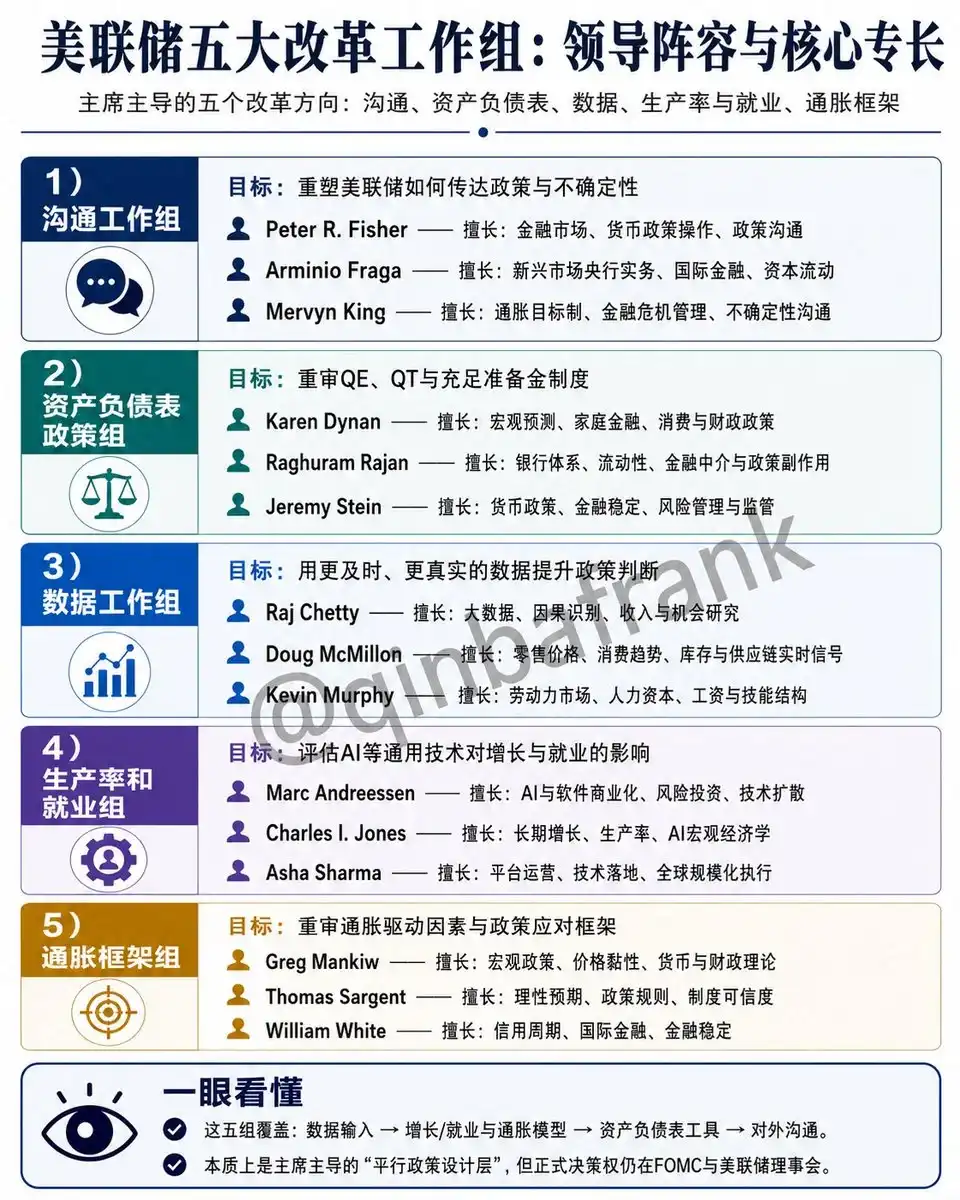
Пов'язані питання

QWhat are the five new working groups recently announced by the Federal Reserve, and what is their purpose?

AThe Federal Reserve announced five new 'Chair's Advancing Monetary Policy Working Groups'. Their purpose is to conduct independent research covering the entire monetary policy 'operating system' — from data input and economic models to balance sheet tools and external communication — and to submit their conclusions to the Federal Open Market Committee (FOMC).

QHow does the author perceive Kevin Warsh's role in establishing these Fed working groups?

AThe author believes Kevin Warsh is using these working groups to quietly reshape the Federal Reserve. The analysis suggests Warsh is creating a parallel layer of policy design, centralizing agenda-setting, knowledge production, data access, and public narrative power with the Fed Chair and selected external experts, while the formal decision-making authority remains with the FOMC and the Board of Governors.

QWhat are the key characteristics of these new Federal Reserve working groups, according to the article?

AAccording to the article, the key characteristics of the working groups are: 1) Initiated directly by the top leader; 2) Spanning existing departmental boundaries; 3) Establishing parallel information reporting channels; 4) Bypassing slow bureaucracy and departmental interests; 5) Quickly resetting the policy agenda through 'top-level design'; and 6) Centralizing coordination and knowledge authority through a special organization.

QWhat potential future implications of these working groups does the article raise?

AThe article raises several questions about future implications: Will the working groups become permanent? Could their conclusions become tantamount to the Chair's predetermined policy, with the FOMC merely providing formal ratification? It also suggests that until the groups' research is complete, the Fed Chair is likely to delay major policy moves.

QWhat comparison does the author draw regarding the structure and function of these Fed working groups?

AThe author draws a comparison to the 'central working groups' frequently used in the Chinese Communist Party's institutional reforms, noting a similar organizational approach for implementing major reforms and policy coordination from the top.

Пов'язані матеріали

WEEX TradFi Trading Competition Kicks Off, 50,000 USDT Prize Pool First-Come, First-Served, Open a Position and Get 5 U

WEEX Exchange Launches "TradFi Trading Competition" with a 50,000 USDT Prize Pool Amidst a crypto market downturn, WEEX Exchange highlights the growth of tokenized traditional finance (TradFi) assets as a key trend, allowing users to trade stocks, ETFs, and commodities using crypto. The platform has launched a "TradFi Trading Competition" from July 9th to 23rd, featuring a 50,000 USDT prize pool. The campaign offers three reward tiers: 1. **New User Bonus (25,000 USDT pool):** New users depositing ≥100 USDT, completing a specified spot trade, and one TradFi contract trade (margin ≥10 USDT) receive 200 USDT. 2. **Volume-Based Rewards (20,000 USDT pool):** All users can earn tiered bonuses for achieving TradFi contract trading volumes of 5,000 USDT (3 USDT), 20,000 USDT (10 USDT), and 100,000 USDT (50 USDT). Rewards are stackable. 3. **Participation Reward:** Any user opening a TradFi contract trade during the event receives 5 USDT instantly. The article promotes WEEX's TradFi features, which include trading tokenized shares of companies like NVIDIA and Tesla using USDT, 24/7 trading, fractional share investing starting from $5, and high leverage up to 100x for hedging. It positions these features as solutions to traditional investing barriers like high fees, strict trading hours, and high share prices. The summary concludes by encouraging users to join the competition and leverage WEEX's platform to access global TradFi markets.

marsbit1 год тому

WEEX TradFi Trading Competition Kicks Off, 50,000 USDT Prize Pool First-Come, First-Served, Open a Position and Get 5 U

marsbit1 год тому

Switching Chains for Another Shot at Success: Can It Really 'Change One's Destiny'?

Recent months have witnessed a wave of established blockchain projects migrating to new public chains, notably Base and Arbitrum, coupled with strategic pivots in their business models—essentially "re-starting" elsewhere. Examples include Sophon (moving from ZKsync to Base to cut $3M+ annual costs and focus on consumer apps), Moonbeam (shifting from Polkadot to Base to pursue decentralized AI), and Secret Network (planning a move from Cosmos to Arbitrum to explore privacy-AI integrations, though its token price plunged 30% post-announcement). A common thread is that these migrating projects are primarily layer-1 or layer-2 chains now seeking relevance in AI and real-world consumer applications. This trend highlights the relative stagnation of ecosystems like Polkadot and Cosmos, which are seeing significant outflows. However, the community remains skeptical about whether such chain-hopping truly enables a turnaround. Historical cases like y00ts NFTs (which moved from Solana to Polygon and back to Ethereum) and Synthetix (which retreated from a multi-chain strategy) show that migration often fails to deliver expected benefits and can add complexity. In today's more rational market, devoid of easy narrative or airdrop红利, simply changing chains is unlikely to be a silver bullet. For both migrating projects and destination chains, the real challenge lies not in attracting projects but in developing actual use cases that retain users.

marsbit1 год тому

Switching Chains for Another Shot at Success: Can It Really 'Change One's Destiny'?

marsbit1 год тому

Does Switching Chains to Re-entrepreneur Really "Change One's Destiny"?

Amid a recent wave of blockchain migrations, several established projects, including Sophon, Moonbeam, and Secret Network, are moving to new ecosystems like Base and Arbitrum. Unlike past migrations driven by hype or security, these moves are often accompanied by strategic pivots, such as shifting focus to consumer applications, AI, or privacy-AI integration, effectively representing a "re-startup" attempt. However, the crypto community has reacted cautiously. Following Secret Network's announcement of its planned migration to Arbitrum, its token price plummeted over 30% in 24 hours. While migrating to more cost-efficient, higher-traffic, or technologically suitable chains can be a pragmatic choice, history shows that such moves rarely guarantee success. Examples like the y00ts NFT project, which moved from Solana to Polygon and then to Ethereum, or Synthetix’s retreat from a multi-chain strategy, illustrate the challenges and often underwhelming results. The current market environment, characterized by greater user rationality and the partial validation of past narratives, makes a successful "pivot via migration" even more difficult. Simultaneously, destination chains themselves face challenges in demonstrating sustainable user adoption beyond merely attracting migrating projects. Ultimately, the competition is shifting from which chain can onboard the most projects to which can genuinely foster real-world application and retain users.

链捕手1 год тому

Does Switching Chains to Re-entrepreneur Really "Change One's Destiny"?

链捕手1 год тому

Торгівля

Спот
活动图片