Wall Street Shorts ETH: Vitalik Knows and Is Front-Running, Tom Lee Remains Deluded

marsbitОпубліковано о 2026-03-06Востаннє оновлено о 2026-03-06

Анотація

Wall Street short-selling firm Culper Research has disclosed a significant short position against ETH and related securities, including Bitmine (BMNR). The firm argues that Ethereum’s token economic model was broken following the Fusaka upgrade in December 2025. According to the report, Vitalik Buterin is aware of the issue and has been selling ETH, while prominent bull Tom Lee continues to invest despite what the report describes as clear signs of decline. Culper claims that the surge in on-chain activity post-Fusaka—cited by Lee as evidence of adoption—is largely driven by address poisoning and dust attacks, not genuine usage. Their analysis indicates that 95% of new wallet growth comes from dust addresses, poisoning attacks have tripled, and such transactions now account for 22.5% of all Ethereum activity. The upgrade increased the gas limit from 45M to 60M, aiming to expand capacity, but gas fees fell by ~90% instead of the projected 10–30%. Culper attributes this to a miscalculation in Layer-1 demand elasticity by Vitalik and developers, using outdated models. The report also notes declining validator earnings and a shift of developers and institutional activity to Solana, which it says is outperforming Ethereum in key metrics. The firm draws a parallel to past tech giants like Netscape and Nokia, suggesting Ethereum may face a similar decline absent structural changes.

This article is from:Culper Research

Compiled | Odaily Planet Daily (@OdailyChina); Translator | Azuma (@azuma_eth)

Editor's Note: On March 6, Wall Street short-selling firm Culper Research suddenly published an article announcing that it is shorting ETH and related securities such as BMNR. Culper Research's logic is that Vitalik and other developers miscalculated Ethereum's demand elasticity before the Fusaka upgrade, leading to the upgrade damaging ETH's token economic model. Culper Research also mentioned that Vitalik is well aware of this and is actively front-running with practical actions, while the deluded Tom Lee is heading toward a dead end.

In response to the firm's massive shorting, Vitalik himself and Tom Lee have not yet responded, but Vitalik's father, Dmitry Buterin (dima.eth), responded by saying: "When you see the phrase 'Vitalik knows this and is selling,' you don't need to read further. They are clowns craving attention, not researchers."

Below is the original content from Culper Research, compiled by Odaily Planet Daily. Compiling this article does not mean we agree with Culper Research's views, but rather to present the perspective of some Wall Street institutions on ETH and their market煽动.

Latest disclosure: We are shorting ETH and ETH-related stocks, including Bitmine (BMNR).

We believe that after the Fusaka upgrade in December 2025, ETH's token economic model has been broken. Vitalik knows this and is selling; while ETH's staunchest bull, Tom Lee, continues to add ineffective investments. ETH will continue to fall.

Tom Lee's Bitmine has been defending ETH, claiming that "ETH is not in a death spiral due to increasing utility." He cited the surge in active addresses and transaction numbers on Ethereum after the Fusaka upgrade as evidence of so-called "improved fundamentals" and institutional adoption, but he is completely wrong.
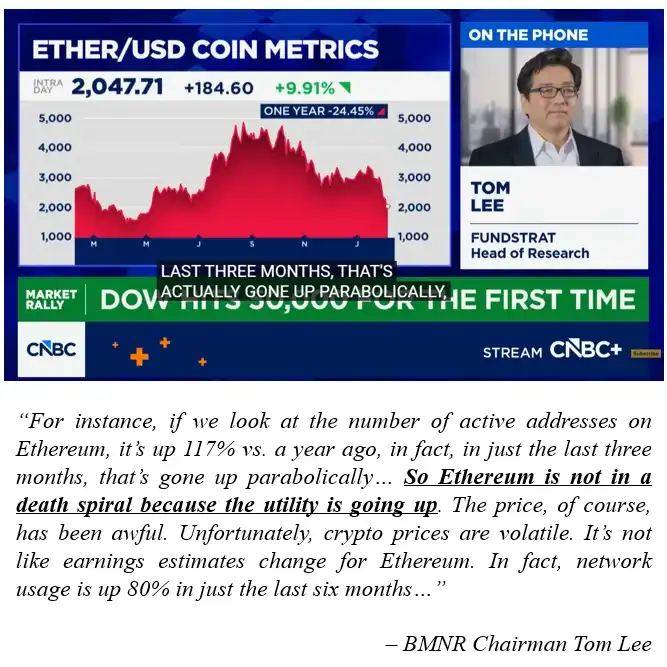
According to Tom Lee's own logic, if Ethereum's on-chain activity does not reflect real usage growth and fundamental improvement, then ETH is indeed in a death spiral.

And our research shows that this is exactly what is happening.

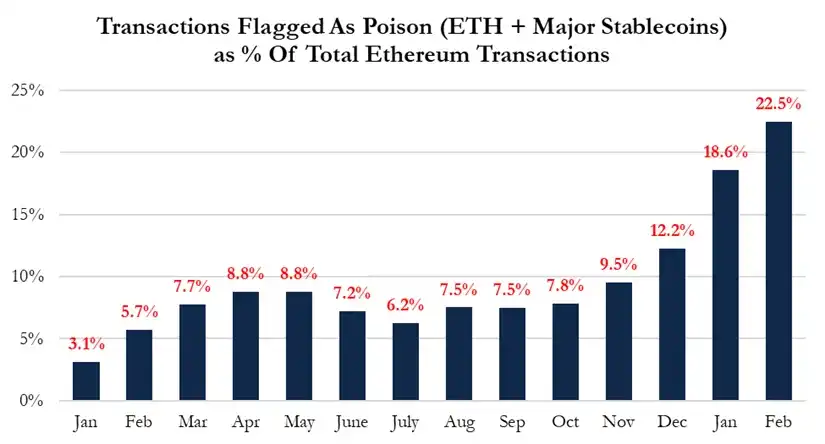
We conducted a comprehensive analysis of on-chain data from January 2025 to February 2026, and the results show that what Lee calls "institutional adoption driving Ethereum's activity growth" can actually be explained by a large number of low-value address poisoning and wallet dusting behaviors. These behaviors were triggered by the excess block space after the Fusaka upgrade.
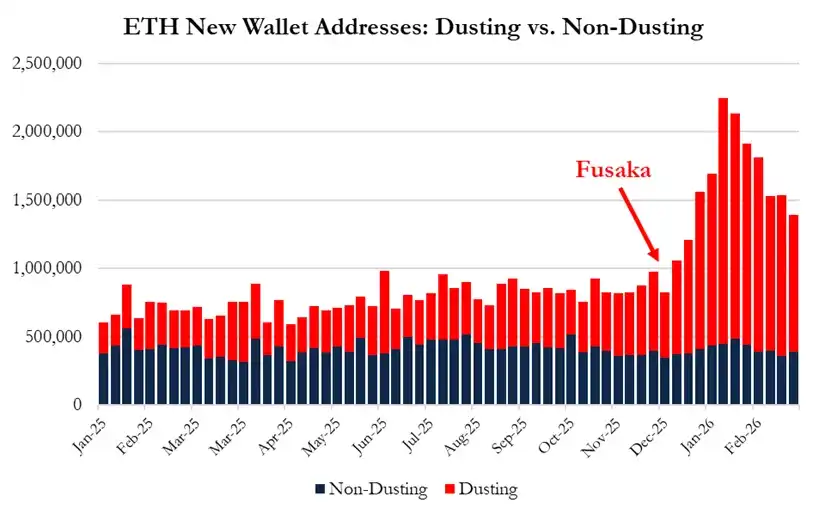
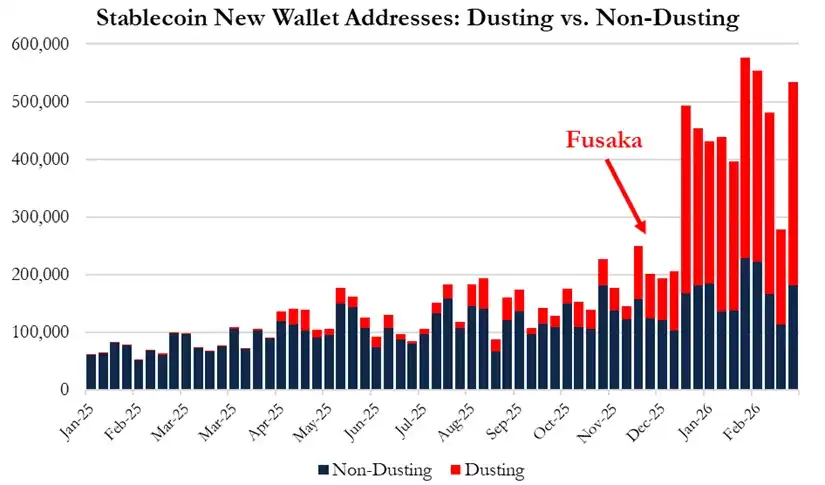
After the Fusaka upgrade:

  • 95% of new wallet growth comes from newly created dust addresses;
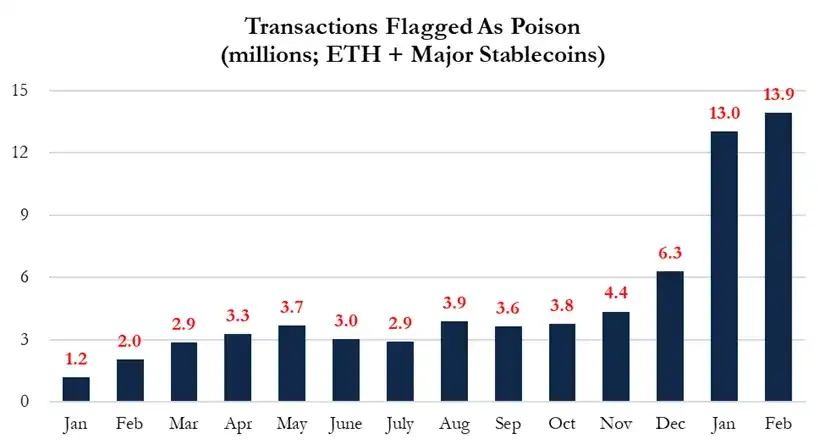
  • Address poisoning attacks increased by more than 3 times;
  • Poisoning behavior explains over 50% of Ethereum's transaction growth;
  • Poisoning transactions now account for 22.5% of all Ethereum transactions;
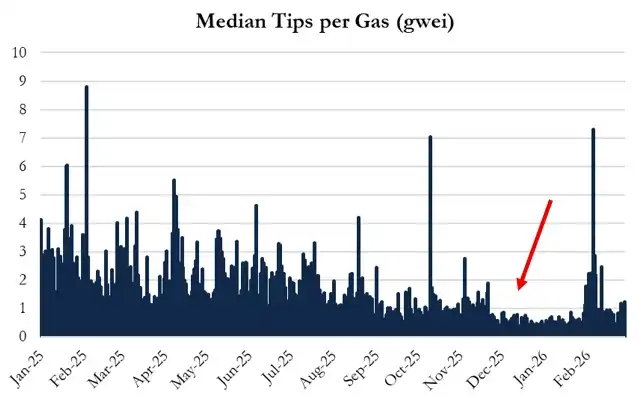
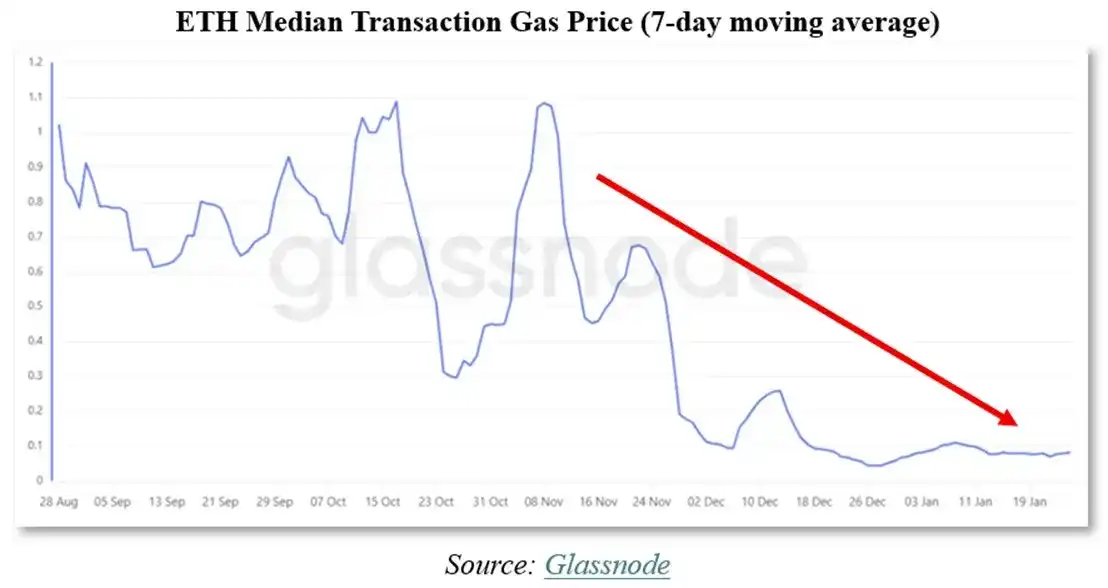
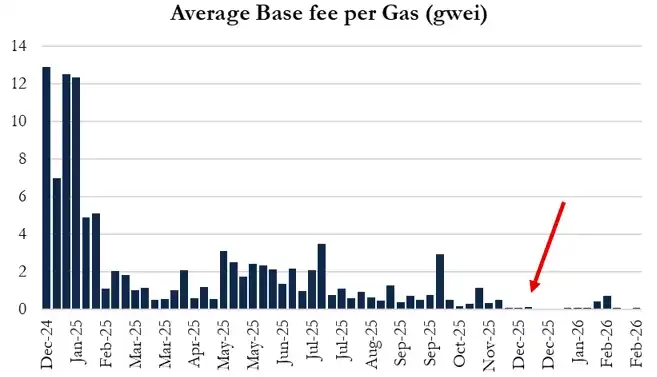
The Fusaka upgrade increased the gas limit from 45M to 60M, aiming to expand Ethereum Layer1's capacity. Vitalik and the protocol team previously predicted that gas fees would drop by 10%–30%, but the reality is that gas fees dropped by about 90%.

Vitalik and the validators made a serious miscalculation regarding Layer1 demand elasticity. They used outdated mathematical models (based on assumptions from before EIP-1559 and before Layer2 emerged), thereby overestimating Layer1 demand by 3 to 9 times. This is also why we believe Vitalik is selling large amounts of ETH. On January 30, Vitalik announced in advance that he would sell 16,384 ETH to fund the Ethereum Foundation's "austerity period," but since then, he has sold over 19,300 ETH and is still selling.

Vitalik understands what Tom Lee does not — ETH's token economic model has been broken.

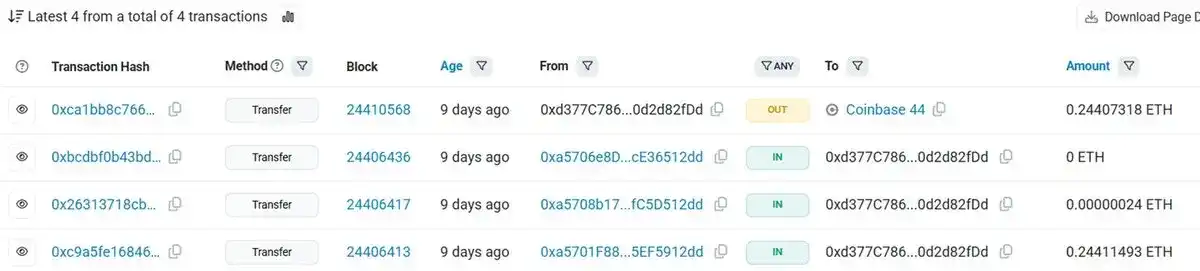
We personally documented Ethereum network address poisoning. We created two new addresses and transferred between them. Within 5 minutes, we were hit by an address poisoning attack. We encourage readers to verify this phenomenon themselves. Currently, the rate of losses due to poisoning attacks has increased by more than 8 times compared to before the Fusaka upgrade.
<极速赛车开奖结果查询官网div>

Additionally, the increase in the gas limit has hit Ethereum's validators群体, as validators now see a 40%–50% decline in tip income per unit of gas. Falling yields will weaken staking demand and high-value transaction activity, further undermining institutional adoption. This flywheel has now started to reverse.

Meanwhile, Ethereum continues to lose market share to Solana and its own Layer2 networks.

  • Solana developer count grew by 29% in 2025;
  • Ethereum developer growth was only 6%;
  • Talent is leaving the Ethereum ecosystem;
  • Institutions like Visa and Citigroup have chosen Solana for DeFi applications;
  • Solana DEX trading volume is already more than double that of Ethereum.

During the dot-com bubble era, Netscape and Nokia dominated the market for over 10 years, but the real winners were Google and Apple. We believe Ethereum is in a similar situation — we think Ethereum's token economic model has collapsed, Tom Lee is trapped in his own position, and ETH's price will continue to fall.

Пов'язані питання

QWhat is the main argument presented by Culper Research for shorting ETH?

ACulper Research argues that the Fusaka upgrade in December 2025 broke Ethereum's token economic model. They claim the upgrade created a massive oversupply of block space, leading to a 90% drop in gas fees and a surge in spam activities like address poisoning and dusting attacks, which artificially inflate on-chain metrics. They believe this has triggered a death spiral for ETH.

QAccording to the report, what evidence does Culper provide to dispute Tom Lee's claim of 'improving fundamentals'?

ACulper disputes Tom Lee's claims by presenting on-chain data analysis showing that 95% of new wallet growth comes from dust addresses, address poisoning attacks have tripled, and these spam activities account for over 50% of transaction growth and 22.5% of all Ethereum transactions post-upgrade, rather than genuine adoption.

QWhat role does the article claim Vitalik Buterin is playing in this situation?

AThe article claims Vitalik Buterin is aware that the token economic model is broken and is 'front-running' the market by selling his ETH. It cites that he has sold over 19,300 ETH since announcing a sale of 16,384 ETH on January 30th to fund the Ethereum Foundation's 'austerity period'.

QHow did the Fusaka upgrade allegedly impact Ethereum validators?

AThe Fusaka upgrade's increase in the gas limit led to a 40-50% decrease in tip revenue per unit of gas for validators. This decline in yield is predicted to weaken staking demand and high-value transaction activity, further damaging institutional adoption.

QWhat broader market trend does Culper Research compare Ethereum's situation to?

ACulper Research compares Ethereum's situation to the internet bubble era, drawing a parallel to how former market leaders like Netscape and Nokia dominated for over a decade but were ultimately surpassed by new technologies like Google and Apple. They suggest Ethereum is losing its dominance to competitors like Solana.

Пов'язані матеріали

Three Scenarios for BTC's Future Direction and a Duel Between Two Strong Forces | Special Invited Analysis

**Title: Three Scenarios for BTC's Future Trajectory and a Key Duel | Invited Analysis** The market remains at a critical juncture. Over the past week, Bitcoin (BTC) consolidated broadly between $79,500 and $80,600, validating previous technical analysis. The current focus is on whether this marks the start of a new uptrend or a pause within a larger correction. **BTC Multi-Cycle Analysis & Three Possible Scenarios** BTC's daily chart structure, following its peak at $126,200 in October 2025, presents three primary technical scenarios based on Elliott Wave theory: 1. **Bullish Scenario (End of Correction):** The corrective A-B-C wave from $126,200 ended at the $60,000 low in February 2026. The current price action is the start of a major Wave I uptrend. A subsequent Wave II pullback would not break below $60,000. 2. **Bearish Scenario 1 (Complex Correction):** The correction is unfolding as an A-B-C-D-E pattern. The current move from $60,000 is a D-wave rally. After its completion, a final E-wave decline could potentially breach the $60,000 level. 3. **Bearish Scenario 2 (Larger Correction):** The entire move down from $126,200 to $60,000 was a large A-wave. The current rally is a B-wave correction within a larger A-B-C structure, to be followed by a C-wave decline below $60,000. *Analysis suggests Scenario 2 is less probable due to time disproportions between waves. The battle is effectively between the Bullish Scenario (1) and Bearish Scenario (3).* **Key BTC Levels & Weekly Strategy** On the 4-hour chart, BTC trades above a crucial consolidation zone ("Central Pivot C"). * **Key Resistance:** $83,500-$84,500; $89,000-$90,500. * **Key Support:** $78,500-$79,500 (pivot upper bound); $73,500-$75,000; $69,500-$70,500. **Weekly Outlook:** The market direction hinges on BTC's ability to hold above or break below the $78,500-$79,500 support zone. * **Mid-term Strategy:** Neutral/Wait-and-see stance due to unclear direction. * **Short-term Tactics:** Two contingency plans using 30% max capital: * **Plan A (Bullish):** Look for long entries if price holds above $78,500-$79,500 with confirming signals. Initial stop-loss below $78,500. * **Plan B (Bearish):** Consider short positions if price breaks below $73,500-$75,000 with confirming signals. Initial stop-loss above $76,500. **HYPE Analysis & Strategy** HYPE's daily chart shows a seven-segment structure from its January low of $20.46, forming a "rising pivot" zone. * **Key Level to Watch:** $45.76 (previous high). A break above would confirm the bullish structure remains intact. * **Short-term Strategy:** Focus on pivot zone boundaries ($38.41 upper, $34.44 lower). * **Long:** Consider on support near $38.41 with bullish confirmation signals. * **Short:** Consider on a break below $34.44 with bearish confirmation signals. * Position size must be below 30% with strict stop-loss discipline. **Risk Management Reminder:** Always set an initial stop-loss upon entry. Move stop-loss to breakeven at +1% profit, then trail it upwards to lock in profits dynamically. All views are based on technical analysis for informational purposes only and do not constitute investment advice. The market is inherently risky.

Odaily星球日报5 хв тому

Three Scenarios for BTC's Future Direction and a Duel Between Two Strong Forces | Special Invited Analysis

Odaily星球日报5 хв тому

Sequoia Interview with Hassabis: Information is the Essence of the Universe, AI Will Open Up Entirely New Scientific Branches

Demis Hassabis, co-founder and CEO of Google DeepMind and Nobel laureate, discusses the path to AGI and its profound implications in a Sequoia Capital interview. He outlines his lifelong dedication to AI, tracing his journey from game development (e.g., *Theme Park*)—a perfect AI testing ground—to neuroscience and finally founding DeepMind in 2009. He emphasizes the critical lesson of being "5 years, not 50 years, ahead of time" for successful entrepreneurship. Hassabis reiterates DeepMind's two-step mission: first, solve intelligence by building AGI; second, use AGI to tackle other complex problems. He highlights the transformative potential of "AI for Science," particularly in biology where tools like AlphaFold have revolutionized protein folding. He envisions AI-powered simulations drastically shortening drug discovery from years to weeks and enabling personalized medicine. Furthermore, he predicts AI will spawn new scientific disciplines, such as an engineering science for understanding complex AI systems (mechanistic interpretability) and novel fields enabled by high-fidelity simulators for complex systems like economics. He posits a fundamental worldview where information, not just matter or energy, is the essence of the universe, making AI's information-processing core uniquely suited to understanding reality. He defends classical Turing machines as potentially sufficient for modeling complex phenomena, including quantum systems, as demonstrated by AlphaFold. On consciousness, Hassabis suggests first building AGI as a powerful tool, then using it to explore deep philosophical questions. He believes components like self-awareness and temporal continuity are necessary for consciousness but that defining it fully remains an open challenge. He predicts AGI could arrive around 2030 and, once achieved, would be used to probe the deepest questions of science and reality, much as envisioned in David Deutsch's *The Fabric of Reality*.

链捕手23 хв тому

Sequoia Interview with Hassabis: Information is the Essence of the Universe, AI Will Open Up Entirely New Scientific Branches

链捕手23 хв тому

Morgan Stanley 2026 Semiconductor Report: Buy Packaging, Buy Testing, Buy China Chips, Avoid Traditional Tracks

Morgan Stanley 2026 Semiconductor Report: Buy Packaging, Buy Testing, Buy Chinese Chips; Avoid Traditional Segments. The core theme is the shift in AI compute supply from NVIDIA dominance to a three-track system of GPU + ASIC + China-local chips. The key opportunity is capturing share in this expansion, while non-AI semiconductors face marginalization due to resource reallocation to AI. Key investment conclusions, in order of priority: 1. **Advanced Packaging (CoWoS/SoIC) - Highest Conviction**: TSMC is the primary beneficiary of explosive demand, driven by massive cloud capex. Its pricing power and AI revenue share are rising significantly. 2. **Test Equipment - Undervalued & High-Growth Certainty**: Chip complexity is causing test times to double generationally, structurally driving handler/socket/probe card demand. Companies like Hon Hai Precision (Foxconn), WinWay, and MPI offer compelling value. 3. **China AI Chips (GPU/ASIC) - Long-Term Irreversible Trend**: Export controls are accelerating domestic substitution. Companies like Cambricon, with firm customer orders and SMIC's 7nm capacity support, are positioned to benefit from lower TCO (30-60% vs NVIDIA) and growing local cloud demand. 4. **Avoid Non-AI Semiconductors (Consumer/Auto/Industrial)**: These segments face a weak, structurally hindered recovery due to AI's resource "crowding-out" effect on capacity and supply chains. 5. **Memory - Severe Internal Divergence**: Strongly favor HBM (Hynix primary beneficiary) and NOR Flash (Macronix). Be cautious on interpreting price rises in DDR4/NAND as true demand recovery. The report emphasizes a 2026-2027 time window, stating the AI capital expenditure cycle is far from over. Key macro variables include persistent export controls and AI's systemic "crowding-out" effect on traditional semiconductor supply chains.

marsbit1 год тому

Morgan Stanley 2026 Semiconductor Report: Buy Packaging, Buy Testing, Buy China Chips, Avoid Traditional Tracks

marsbit1 год тому

Circle:Sluggish Market? The Top Stablecoin Stock Continues to Expand

Circle, the issuer of the stablecoin USDC, reported its Q1 2026 earnings on May 11th, Eastern Time. Against a backdrop of weak crypto market sentiment, USDC's average circulation in Q1 was $752 billion, with a modest 2% sequential increase to $770 billion by quarter-end. New minting volumes declined due to the poor crypto market, but remained high, indicating demand expansion beyond crypto trading. USDC's market share remained stable at 28% of the total stablecoin market, while competition from Tether's USDT persists. A key highlight was "Other Revenue," which reached $42 million, more than doubling year-over-year, though sequential growth slowed to 13%. This revenue stream, including fees from services like Web3 software, the Cipher payment network (CPN), and the Arc blockchain, is critical for diversifying away from interest income. Circle's internally held USDC share increased to 18%, helping to improve gross margin by 130 basis points to 41.4% by reducing external sharing costs. However, profitability was pressured as total revenue growth slowed, primarily due to the significant weight of interest income, which is tied to USDC规模 and Treasury rates. Adjusted EBITDA was $133 million with a 19.2% margin. Management maintained its full-year 2026 guidance for adjusted operating expenses ($570-$585 million) and other revenue ($150-$170 million). The long-term target for USDC's CAGR remains 40%, though near-term volatility is expected. The article concludes that while Circle's current valuation of $28 billion appears reasonable after a recent recovery, further upside depends on the pace of stable币 adoption and potential positive sentiment from the advancement of regulatory clarity acts like CLARITY.

链捕手1 год тому

Circle:Sluggish Market? The Top Stablecoin Stock Continues to Expand

链捕手1 год тому

Tech Stocks' Narrative Is Increasingly Relying on Anthropic

The narrative of tech stocks is increasingly relying on Anthropic. Anthropic, the AI company behind Claude, has become central to the financial stories of major tech giants. Elon Musk dissolved xAI, merging it into SpaceX as SpaceXAI, and secured an exclusive deal to rent the massive "Colossus 1" supercomputing cluster to Anthropic. In return, Anthropic expressed interest in future space-based compute collaborations. Google and Amazon are also deeply invested. Google plans to invest up to $40 billion and provide significant compute power, while Amazon holds a 15-16% stake. Both companies reported massive quarterly profit surges largely due to valuation gains from their Anthropic holdings. Crucially, Anthropic has committed to multi-billion dollar cloud compute contracts with both Google Cloud and AWS. This creates a clear divide: the "A Camp" (Anthropic-Google-Musk) versus the "O Camp" (OpenAI-Microsoft). The A Camp's strategy intertwines equity, compute orders, and profits, making Anthropic a "systemic financial node." Its performance directly impacts its partners' financials and stock prices. In contrast, OpenAI, while leading in user traffic, faces commercialization challenges, lower per-user revenue, and a recently restructured relationship with Microsoft. The AI industry is shifting from a race for raw compute (symbolized by Nvidia) to a focus on monetizable applications, where Anthropic currently excels. However, this concentration of market hope on one company amplifies systemic risk. The rise of powerful open-source models like DeepSeek-V4 poses a significant threat, as they could undermine the value proposition of closed-source models like Claude. The article suggests ongoing geopolitical efforts to suppress such competitors will be a long-term strategic focus for Anthropic's allies.

marsbit1 год тому

Tech Stocks' Narrative Is Increasingly Relying on Anthropic

marsbit1 год тому

Торгівля

Спот
Ф'ючерси
活动图片