Wall Street Plunged into 'AI Phobia': An Indiscriminate Sell-off Is Spreading

marsbitОпубліковано о 2026-02-11Востаннє оновлено о 2026-02-11

Анотація

Wall Street is experiencing a widespread "AI panic," triggering indiscriminate sell-offs across sectors perceived as vulnerable to AI disruption. The fear intensified recently when a tax-strategy tool from startup Altruist Corp. caused sharp declines in shares of major wealth managers like Charles Schwab, Raymond James, and LPL Financial. This reflects a broader market shift from focusing on AI winners to hastily dumping stocks of companies—from small software firms to large financial services—deemed at risk of being replaced by AI-driven products. Similar sell-offs occurred earlier in software, insurance, and asset management after AI companies like Anthropic and Insurify launched new tools. While some investors see this as an overreaction, citing the slow pace of technological adoption historically, others warn that AI’s rapid advancement is fueling legitimate anxiety. High market valuations have made stocks particularly sensitive to any negative signals, amplifying the volatility. The key uncertainty remains how quickly and deeply AI will reshape industries, leaving the market in a state of cautious speculation.

Source: Jinshi Data

On Wall Street, growing fears about artificial intelligence are hammering the stocks of companies that could become its targets of disruption, from small software firms to large wealth management companies, none have been spared.

The latest round of selling erupted on Tuesday when a tax strategy tool launched by a little-known startup, Altruist Corp., caused shares of Charles Schwab Corp., Raymond James Financial Inc., and LPL Financial Holdings Inc. to fall by 7% or more.

This marked the steepest decline for some of these stocks since the market crash triggered by the trade war last April. But it is just the latest example of the "sell first, ask questions later" mentality—a mindset that is rapidly taking hold as the hundreds of billions of dollars poured into AI begin to translate into commercial products, sparking anxiety that AI could disrupt entire industries.

"Companies with any potential disruption risk are being sold off indiscriminately," said John Belton, a fund manager at Gabelli Funds.

Over the past few years, advancements in AI technology have been at the forefront of Wall Street, with tech stocks leading the gains. As this rally pushed stock prices to record highs, questions have persisted about whether this is a bubble about to burst or whether it will trigger a productivity boom that reshapes the American corporate landscape.

But since the beginning of last week, a series of AI product launches has triggered a noticeable market shift. Instead of focusing on picking winners, investors are quickly trying to avoid holding any company facing even the slightest risk of being replaced.

"I don't know what's going to happen next," said Will Rhind, CEO of Graniteshares Advisors.

"Last year's story was that we all believed in AI—but we were looking for applications, and as we keep discovering applications that seem increasingly powerful and persuasive, it is now leading to disruption."

For some time, the software industry has been troubled by concerns about AI. Last week, when a new tool from Anthropic PBC triggered sharp declines in stocks across industries such as software, financial services, asset management, and legal services, these worries began to shift more broadly to other sectors.

The same fears hit U.S. insurance broker stocks hard on Monday after the online insurance marketplace Insurify launched a new app using ChatGPT to compare auto insurance rates. On Tuesday, wealth management stocks became the next victim, as the product Hazel launched by Altruist—which helps financial advisors create personalized strategies for clients—dragged these stocks down.
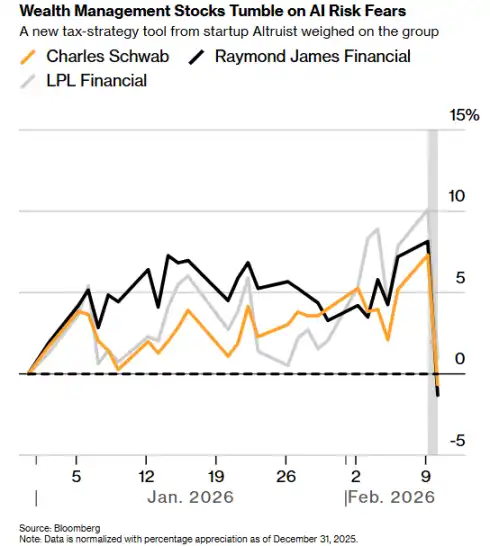
Wealth management stocks plunge on AI risk concerns

Altruist CEO Jason Wenk said he himself was surprised by the scale of the stock market reaction, which wiped tens of billions of dollars from the market value of several investment firms. But he said it sends a strong signal about the competitive threat his company poses.

"People are beginning to realize—the architecture we used to build Hazel, it can replace any job in wealth management," he said in an interview. "Usually these jobs are done by entire teams. And now, AI can effectively do these jobs for just $100 a month."

AI companies like OpenAI and Anthropic have already made solid progress in the field of software engineering with products that help developers simplify and debug code processes, and are now entering other industries.

However, many questions remain about how this technology will be adopted. Take banking, for example, which has periodically faced challenges from electronic services and other technologies, but these have ultimately failed to undermine its dominance.

Gabelli fund manager Belton is one of the skeptics about how Wall Street has shifted from worrying about an AI bubble to fearing its imminent disruption of large parts of the economy.

"There will be winners and losers in every industry," Belton said. But he added: "A rule of thumb is that technological disruption often takes longer to materialize than expected."

This pullback may also reflect widespread anxiety about the sharp rise in stock prices over the past few years, driven by the AI spending boom and an unusually resilient U.S. economy. This has already pushed valuations too high and made investors more sensitive to concerns about a reversal.

"As long as they emit a signal that the market perceives as somewhat negative, the stock will fall 10%, which would never happen in a market that hasn't reached current trading levels," said Graniteshares' Rhind.

For Ross Gerber, CEO of Gerber Kawasaki, the anxiety about AI losers that has been hitting parts of the market over the past week is premature. He said it is still too early to say exactly what the impact will be.

"We can try to extrapolate how AI will change the world in five years, but we just don't know," he said. "The market is trying to judge this while we are still at the beginning of this infancy."


Пов'язані питання

QWhat is the main reason behind the recent sell-off in Wall Street stocks, particularly affecting companies like Charles Schwab and Raymond James?

AThe sell-off is primarily driven by growing fears that new AI products, such as Altruist Corp's tax strategy tool Hazel, could disrupt traditional business models in industries like wealth management, leading investors to indiscriminately dump stocks perceived as vulnerable to AI-driven disruption.

QHow did the launch of Altruist Corp's Hazel tool impact the stock prices of major financial firms?

AThe launch of Hazel caused significant stock price declines, with companies like Charles Schwab Corp., Raymond James Financial Inc., and LPL Financial Holdings Inc. falling by 7% or more, marking some of their worst drops since the market crash triggered by the trade war in April of last year.

QWhat shift in investor behavior is observed as AI products become commercially available?

AInvestors have shifted from focusing on picking AI winners to rapidly avoiding any companies that face even the slightest risk of being disrupted by AI, adopting a 'sell first, ask questions later' mentality.

QAccording to Jason Wenk, CEO of Altruist, why is AI seen as a threat to the wealth management industry?

AJason Wenk stated that AI tools like Hazel, built with advanced architectures, can replace various jobs in wealth management that are typically done by entire teams, performing these tasks effectively for as low as $100 per month.

QWhat skepticism do some experts, like John Belton of Gabelli Funds, express about the current AI-driven market disruption fears?

AJohn Belton expresses skepticism, noting that technological disruption often takes longer to materialize than expected, and while there will be winners and losers in every industry, the current panic may be premature given the early stage of AI adoption.

Пов'язані матеріали

This Week's Key Events Preview | U.S. to Release April CPI Data; U.S. Senate Banking Committee to Review "Digital Asset Market Structure Act of 2025"

Weekly News Preview: Key events for May 12-16 include major economic and crypto industry developments. On Tuesday, May 12, the U.S. will release its April CPI data. Additionally, the gaming blockchain Ronin will begin a 10-hour migration to an Ethereum Layer 2, built on OP Stack with EigenDA for data availability. This aims to leverage Ethereum's security and settle RON's annual inflation below 1%. Base's first independent network upgrade, "Base Azul," is scheduled for mainnet activation on Wednesday, May 13, focusing on security, performance, and developer experience enhancements. Thursday, May 14, sees the U.S. Senate Banking Committee voting on the "Digital Asset Market Structure Act of 2025." In other news, Solana DeFi protocol Carrot will shut down, setting a final withdrawal deadline due to impacts from the Drift exploit. The Moscow Exchange will launch futures trading for Solana, Ripple, and Tron indices (RUB-settled) for qualified investors. Multiple service closures are scheduled for Friday, May 15. Dmail Network will begin winding down due to unsustainable infrastructure costs and failed commercialization. Users must export data before this date. Separately, the Cosmos-based lending blockchain UX Chain will fully shut down. Finally, on Saturday, May 16, gaming infrastructure provider Lattice will wind down operations, with its Redstone Layer 2 network ceasing. Users are urged to withdraw assets, especially from contracts like Uniswap pools, before the shutdown.

链捕手2 хв тому

This Week's Key Events Preview | U.S. to Release April CPI Data; U.S. Senate Banking Committee to Review "Digital Asset Market Structure Act of 2025"

链捕手2 хв тому

Morning Post | Trump Media Group Releases Q1 Financial Report; Top Three DeFi Applications Return Nearly $100 Million in Revenue to Token Holders in 30 Days; Michael Saylor Shares Bitcoin Tracker Info Again

**Title: Daily Briefing | Trump Media Group Releases Q1 Report; Top 3 DeFi Apps Return Nearly $100M to Token Holders; Michael Saylor Signals Potential Bitcoin Buy** **Summary:** Key developments in the past 24 hours include: * **Economic Outlook:** Goldman Sachs has pushed back its forecast for the next two Federal Reserve interest rate cuts to December 2026 and March 2027, citing persistent inflationary pressures from energy costs. This delayed timeline is expected to tighten liquidity flow into risk assets, including cryptocurrencies. * **DeFi & Revenue:** Data from DefiLlama shows that three leading DeFi applications—Hyperliquid, Pump.fun, and EdgeX—collectively distributed $96.3 million in revenue to their token holders over the last 30 days. This trend highlights a shift in the crypto community's focus towards real protocol earnings and sustainable economic models. * **Corporate Bitcoin Moves:** Michael Saylor, founder of MicroStrategy (note: referred to as 'Strategy' in the text, likely a typographical error), has signaled potential upcoming Bitcoin purchases by posting a "Bitcoin Tracker" update, following a pattern that typically precedes the company's official disclosure of new acquisitions. * **Market Integrity:** Prediction market platform Polymarket announced updates to address platform issues, including identifying and banning clusters of accounts involved in "ghost-fill" activities and implementing measures to prevent bulk account creation. * **Regulation:** The Bank of England Governor warned that stablecoin regulation could lead to tensions between US and international regulators. In South Korea, the National Tax Service has launched a pilot program to entrust seized virtual assets to private custody firms for management. * **Meme Token Trends:** GMGN data lists the top trending meme tokens on Ethereum (e.g., HEX, SHIB), Solana (e.g., FWOG, TROLL), and Base (e.g., SKITTEN, PEPE) over the past day. **Financial Note:** Trump Media & Technology Group reported a Q1 loss of approximately $4 billion, primarily attributed to unrealized losses on its Bitcoin and other digital asset holdings.

链捕手32 хв тому

Morning Post | Trump Media Group Releases Q1 Financial Report; Top Three DeFi Applications Return Nearly $100 Million in Revenue to Token Holders in 30 Days; Michael Saylor Shares Bitcoin Tracker Info Again

链捕手32 хв тому

Telegram Takes Direct Control of TON, Social Traffic Rewrites the Public Chain Narrative

Telegram founder Pavel Durov announced that Telegram will replace the TON Foundation as the core driver and largest validator of The Open Network (TON). Key initiatives include a sixfold reduction in transaction fees, performance upgrades, and improved developer tools within the next few weeks. This marks a strategic shift from Telegram merely providing user access to deeply integrating TON into its platform's core infrastructure. The goal is to transform Telegram's massive social traffic into sustainable on-chain activity. While viral mini-apps like Notcoin have demonstrated Telegram's ability to drive user adoption, TON aims to support frequent, low-value transactions inherent to social platforms—such as tipping, in-app payments, and game rewards. Ultra-low fees and sub-second finality (0.6 seconds) are crucial to making blockchain interactions seamless and nearly invisible within the Telegram user experience. However, Telegram's increased central role raises questions about network decentralization. Durov argues that Telegram's participation will attract more large validators, thereby enhancing decentralization. TON also offers high annual staking rewards (18.8%), aiming to retain capital within its ecosystem. The fundamental challenge for TON is no longer leveraging Telegram's user base, but becoming an indispensable, seamless infrastructure layer for Telegram's everyday applications—moving from an adjacent chain to an embedded utility.

marsbit34 хв тому

Telegram Takes Direct Control of TON, Social Traffic Rewrites the Public Chain Narrative

marsbit34 хв тому

Telegram Takes Direct Control of TON, Social Traffic Reshapes Public Chain Narrative

Telegram's founder, Pavel Durov, has announced a major shift in the development of The Open Network (TON). Telegram will now become the core driver of TON, replacing the TON Foundation and becoming its largest validator. The focus will be on technical upgrades over the next few weeks, including slashing network fees by six times to near-zero and improving finality time to 0.6 seconds. This move signifies a deeper integration between Telegram and TON, moving beyond just providing a user base. The goal is to transform Telegram's vast social traffic and built-in features—like Mini Apps, payments, and bots—into sustainable, on-chain usage scenarios. The reduced fees and faster speeds are crucial for enabling the small, frequent transactions typical of social interactions. While this promises stronger execution and product alignment, it raises questions about centralization. Durov argues Telegram's involvement will attract more validators, enhancing decentralization, but the outcome remains to be seen. Additionally, TON's high annual staking reward of 18.8% aims to retain capital within the ecosystem. The key challenge for TON is no longer just leveraging Telegram's entry point, but becoming an invisible, seamless infrastructure layer within Telegram's daily use. Its success hinges on converting viral attention into lasting, embedded utility.

Odaily星球日报44 хв тому

Telegram Takes Direct Control of TON, Social Traffic Reshapes Public Chain Narrative

Odaily星球日报44 хв тому

Торгівля

Спот
Ф'ючерси
活动图片